Russia orders 175,000 diplomatic passports, prompting speculation about their use
April 28, 2022 2 Comments
 THE RUSSIAN FEDERATION HAS reportedly ordered 175,000 new diplomatic passports to be printed, prompting speculation about their possible use at a time when Western sanctions are affecting Russia’s governing elite. Diplomatic passports are travel documents that are issued to accredited diplomats and government officials, such as foreign ministry envoys and others. Pursuant to the Vienna Convention of Diplomatic Relations, holders of diplomatic passports enjoy diplomatic immunity and are typically subjected to very limited inspections by security personnel when crossing international borders.
On Wednesday, SOTA Vision, a Russian alternative news website and social media network, claimed in a report that the Ministry of Foreign Affairs of the Russian Federation had ordered nearly 175,000 diplomatic passports to be printed, at the cost of over 300 million rubles ($4 million). The report, which was translated into English by the British newspaper The Daily Mail, questioned the need for so many diplomatic passports to be printed. It noted that the Ministry of Foreign Affairs employs no more than 15,000 people, of whom only about a third spend any time abroad, and thus require diplomatic passports.
So what is the reason for the use of so many diplomatic passports? According to SOTA Vision, these may be used by members of the Russian governing and economic elite, as well as their families, to evade Western sanctions on international travel and to avoid arrest when traveling abroad. Since Russia’s invasion of Ukraine in February of this year, Russia has been subjected to the harshest sanctions by Western countries since the end of the Cold War. Additionally, employees of Russian intelligence agencies may use several thousands of these diplomatic passports for their employees to operate abroad under what is known as “official cover”. Such agencies include the Foreign Intelligence Service (SVR), the Federal Security Service (FSB) and the Federal Protective Service (FSO), SOTA Vision noted.
► Author: Joseph Fitsanakis | Date: 28 April 2022 | Permalink
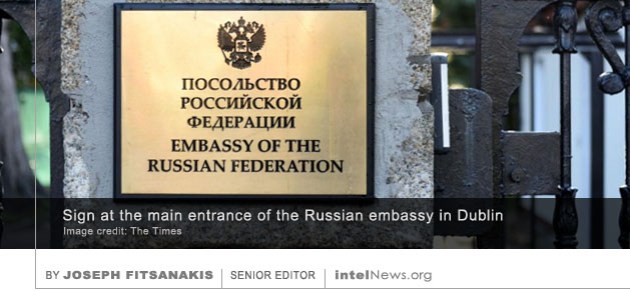 IRELAND’S COUNTERINTELLIGENCE SERVICE HAS launched an investigation into an expansion project at the embassy of Russia in Dublin. According to sources cited by The Times newspaper, the Irish government is concerned that the expansion project is part of a secret plan by Moscow to turn its embassy in Dublin into a major espionage hub in Europe.
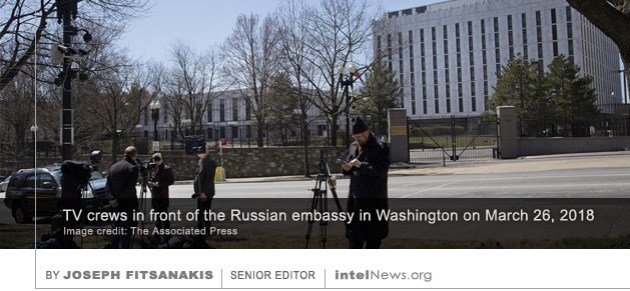 Relations between Russia and much of the West reached a new low on Monday, with the expulsion of over 100 Russian diplomats from two dozen countries around the world. The unprecedented expulsions were publicized on Monday with a series of coordinated announcements issued from nearly every European capital, as well as from Washington, Ottawa and Canberra. By the early hours of Tuesday, the number of Russian diplomatic expulsions had reached 118 —not counting the 23 Russian so-called “undeclared intelligence officers” that were expelled from Britain last week. Further expulsions of Russian diplomats are expected in the coming days.
 predecessor, Barack Obama, and his Secretary of State Hillary Clinton, who is known for her hardline anti-Russian stance. In Europe, the move to expel dozens of Russian envoys from 23 different countries —most of them European Union members— was a rare act of unity that surprised European observers as much as it did the Russians.
 The Central Intelligence Agency (CIA) pulled a number of officers from the United States embassy in Chinese capital Beijing, after a massive cyber hacking incident compromised an American federal database containing millions of personnel records. Up to 21 million individual files were






 intelNews.org
South Korea’s top HUMINT agency probes potentially catastrophic data breach
July 29, 2024 by intelNews 1 Comment
Formed under American tutelage in 1946, KDIC is today considered South Korea’s most secretive intelligence agency. It operates under the Defense Intelligence Agency (DIA), which makes it part of the Ministry of National Defense’s chain of command. Unlike DIA’s civilian counterpart, the National Intelligence Service, KDIC rarely surfaces in unclassified news reporting, and it almost never issues press releases. Its operations primarily involve HUMINT activities, thus making it South Korea’s most active HUMINT-focused agency.
Predictably, KDIC’s primary intelligence target is North Korea. The agency gathers much of its intelligence on the North through an extensive network of undercover officers operating with diplomatic credentials. KDIC also handles non-official cover (NOC) operatives, who are located mostly in Asia. There have been periodic claims in the unclassified literature that some KDIC NOCs have operated inside North Korea at times –though such claims remain speculative.
On Saturday, the Seoul-headquartered Yonhap News Agency alleged that classified information relating to KDIC had been “leaked”. According to Yonhap, the leak included personally identifiable information about KDIC official and non-official cover personnel stationed abroad. The report claimed that the leak was discovered by South Korean authorities a month ago, and that the discovery had resulted in the recall of several KDIC undercover operatives serving overseas “due to concerns over their identities being exposed”.
The Yonhap report claimed that, according to an ongoing probe, the leak may have originated from a personal laptop computer belonging to a civilian KDIC employee. The employee has since claimed that the laptop had been hacked, but some investigators believe the suspect may have “intentionally left the laptop vulnerable to hacking by North Koreans”.
According to an official statement released on Sunday by the Ministry of National Defense, the case is “currently under investigation by military authorities”.
► Author: Joseph Fitsanakis | Date: 29 July 2024 | Permalink
Filed under Expert news and commentary on intelligence, espionage, spies and spying Tagged with Defense Intelligence Agency (South Korea), HUMINT, KDIC (South Korea), Korea Defense Intelligence Command, News, non-official-cover, North Korea, official cover, South Korea