Key testimony from Rosenberg spy case released after 64 years
July 17, 2015 1 Comment
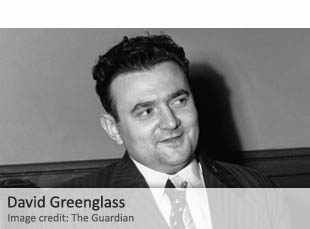
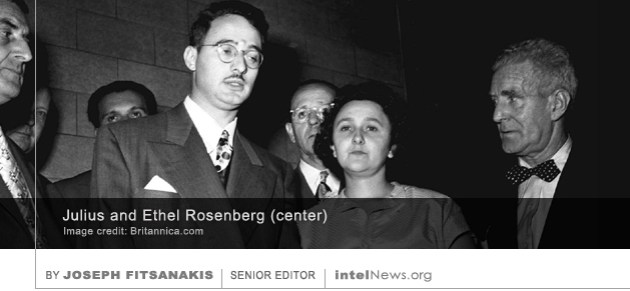 The final piece of sealed testimony in one of the most important espionage cases of the Cold War has been released, 64 years after it was given. The case led to the execution in 1953 of Julius and Ethel Rosenberg, an American couple who were convicted of spying for the Soviet Union. The Rosenbergs were arrested in 1950 for being members of a larger Soviet-handled spy ring, which included Ethel’s brother, David Greenglass. Greenglass agreed to testify for the US government in order to save his life, as well as the life of his wife, Ruth, who was also involved in the spy ring. He subsequently fingered Julius Rosenberg as a courier and recruiter for the Soviets, and Ethel as the person who retyped the content of classified documents before they were surrendered to their handlers. That piece of testimony from Greenglass the primary evidence used to convict and execute the Rosenbergs.
However, although historians are confident that Julius Rosenberg was indeed an active member of the Soviet spy ring, there are doubts about Ethel. Many suggest that her involvement with her husband’s espionage activities was fragmentary at best, and that she refused to cooperate with the Federal Bureau of Investigation in an ill-judged attempt to protect her husband. The argument goes that Ethel was put to death as a warning to Moscow, as well as to intimidate other American spies, rather than on the basis of actual evidence of her involvement in espionage. Many years after the Rosenbergs’ execution, Greenglass claimed he had lied about Ethel’s role in the spy affair in order to protect his wife, who was the actual typist of the espionage ring.
The debate over Ethel Rosenberg’s fate was rekindled by US District Judge Alvin Hellerstein’s decision in May of this year to unseal Greenglass’ testimony. The documents could not be made public while Greenglass was alive, because he objected to their release. But he died last year in a nursing home in New York, so Judge Hellerstein said his testimony could now legally be made available to the public as a “critical piece of an important moment in our nation’s history”.
Greenglass’ grand jury testimony, made under oath in 1950, six months before he implicated his sister in nuclear espionage for the Soviets, was posted online on Wednesday by George Washington University’s National Security Archive. Speaking at a press conference about the release, several experts said the new information directly contradicts Greenglass’ later testimony in which he accused his sister of being a spy. In the press conference of his grand jury testimony, Greenglass emphatically denies that Ethel had a role in the atom spy ring. When asked whether she was involved in espionage, Greenglass responds: “my sister has never spoken to me about this subject”. Later on he recounts how Julius tried to convince him to prolong his US Army service in order to continue to have access to classified information. When asked whether Ethel also tried to convince him to continue to spy for the Soviets, he responds: “I said before, and say it again, honestly, this is a fact: I never spoke to my sister about this at all”.
National Security Archive Director Tom Blanton said at the press conference that the evidence made it clear that Julius Rosenberg led an active spy ring; but Ethel was not an active spy, he said, even though witting.
► Author: Joseph Fitsanakis | Date: 17 July 2015 | Permalink: https://intelnews.org/2015/07/17/01-1737/







 intelNews.org
Morton Sobell, convicted of conspiracy in the Rosenberg espionage case, dies at 101
January 31, 2019 by Joseph Fitsanakis 1 Comment
Sobell was born in New York’s Manhattan Island in 1917 and worked on radar tracking systems for defense contractors. During college, he and several of his friends, including fellow-engineer Julius Rosenberg, joined the United States Communist Party, partly in reaction to the Great Depression. When the Federal Bureau of Investigation began to arrest members of what the United States government claimed was a Soviet atomic spy ring led by Rosenberg, Sobell escaped with his family to Mexico, where he used a fake identity to evade the authorities. But he was dramatically abducted by a paramilitary force and surrendered to the FBI.
He was then tried alongside Rosenberg and his wife Ethel for conspiracy to commit acts of espionage. The Rosenbergs refused to cooperate with the FBI and were sentenced to death. Both were executed in 1953 and remain to this day the only American citizens to have been executed for espionage after the Civil War. Sobel was found guilty of the lesser charge of conspiracy and no evidence was presented in court that connected him to atomic espionage. He was therefore sentenced to 30 years in prison and served 18 of those, following a successful public-relations campaign organized by his wife, Hellen. He was released from prison in 1969 and continued to insist that he had never been a spy and had been wrongly convicted of conspiracy.
But in 2008, at the age of 91, Sobell spoke to The New York Times and publicly admitted for the first time that he had been a spy for the Soviet Union. He said that he had worked systematically to provide Moscow with information on weapons systems and other classified technologies. However, he had “never thought of it” as spying, he said. He also told The Times that he had developed a favorable impression of Soviet communism during the Great Depression, when he and many others saw the Soviet economic system as an antidote to crisis-ridden capitalism. “Now I know it was an illusion”, he told the paper.
► Author: Joseph Fitsanakis | Date: 31 January 2019 | Permalink
Filed under Expert news and commentary on intelligence, espionage, spies and spying Tagged with Cold War, espionage, history, Morton Sobell, News, obituaries, Rosenberg nuclear spy ring, United States, USSR