January 25, 2019
by Joseph Fitsanakis
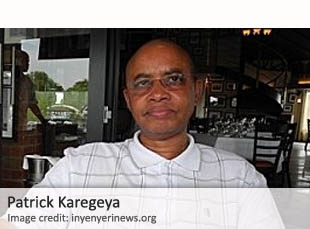
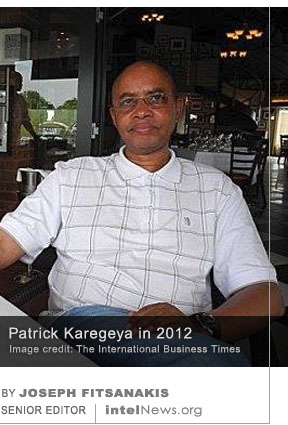 A public inquest into the 2014 killing of a Rwandan dissident and former spy chief, who had been given political asylum in South Africa, has unearthed evidence showing that South African authorities believed the killers had close links to the government of Rwanda. It also appears that the South Africans chose not to prosecute the killers in order to protect their diplomatic ties with the Rwandan government. Patrick Karegeya was a leading member of the Rwandan Patriotic Army (RPA), the armed wing of the Rwandan Patriotic Front (RPF), which was founded in 1987 in Uganda by Rwandan Tutsi refugees. In 1994, the RPA, led by Paul Kagame, took control of Rwanda, thus putting an end to the genocide of up to a million Tutsis and moderate Hutus. Soon afterwards Karegeya was named Director General of External Intelligence in the RPA, which was renamed to Rwandan Defense Forces.
In 2004 however, after falling out with Kagame, who had become President of Rwanda in 2000, Karegeya was arrested, stripped of his rank of colonel, and served 18 months in prison for “insubordination and desertion”. He fled the country in 2007 and received political asylum in South Africa. In 2011, the Rwandan government issued an international arrest warrant for Karegeya, but South Africa refused to extradite him. His body was discovered on December 31, 2014, in a room at the Michelangelo Towers Hotel in Sandton, an affluent suburb of Johannesburg. He was 53.
Earlier this month, in response to pressures from Karegeya’s family and human rights groups, the government of South Africa began a formal inquest into the murder, in anticipation of launching a possible court case. Earlier this week, the magistrate in charge of the inquest, Mashiane Mathopa, made public a previously secret letter from the South African prosecutor’s office about Karegeya’s murder. In the letter, dated June 5, 2018, explains the prosecutor’s decision to “decline at this stage” to prosecute the murder. The decision rests on two arguments. The first argument is that the four men who were believed to have killed Karegeya had already “left South Africa and returned to Rwanda”. The second argument is that there were “close links […] between the suspects and the current Rwandan government”.
On Monday, Mathopa suggested that the South African authorities may have decided not to investigate Karegeya’s murder in order to “help repair” South Africa’s bilateral relations with Rwanda. He then halted the inquest and gave police officials two weeks to “explain their failure to prosecute” Karegeya’s alleged murderers. He also requested detailed information about the “steps, if any, [that] have been taken to arrest the four suspects […], since their whereabouts and their identity are known” to the authorities. Supporters of the inquest said earlier this week that Mathopa could potentially order a trial of the case, which might lead to a formal request made by South Africa for Rwanda to extradite the four men implicated in the case.
► Author: Joseph Fitsanakis | Date: 25 January 2019 | Permalink
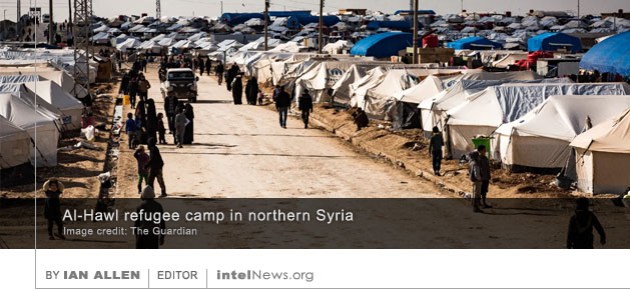 • South African intelligence concerned about spread of insurgency in Mozambique. This is the first public expression of concern from the South African government that the violence in neighboring Mozambique could spread. Previously, the South African Parliament was informed the matter was only to be discussed behind closed doors. Earlier in June, the South African military reportedly participated in Operation COPPER, in support of the Mozambican Defense Force.
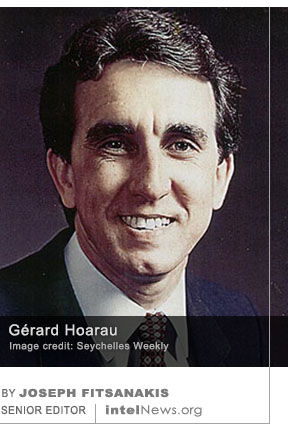 A man has been arrested by British counter-terrorism police in Northern Ireland, reportedly in connection with the assassination of a Seychelles exiled political leader in London in 1985. No-one has ever been charged with the murder of Gérard Hoarau, who was gunned down with a Sterling submachine gun in Edgware, London, on November 29, 1985. At the time of his killing, the 35-year-old Hoarau led the Mouvement Pour La Resistance (MPR), which was outlawed by the Seychelles government but was supported by Western governments and their allies in Africa. The reason was that the MPR challenged the president of the Seychelles, France-Albert René, leader of the leftwing Seychelles People’s United Party —known today as the Seychelles People’s United Party. The British-educated René assumed the presidency via a coup d’etat in 1977, which was supported by neighboring Tanzania, and remained in power in the island-country until 2004.
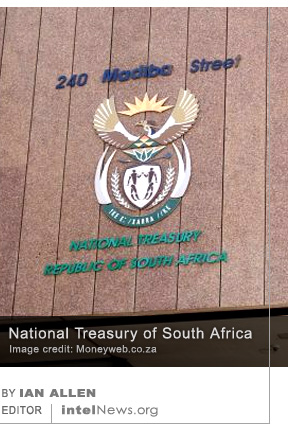 South Africa’s National Treasury threatened to terminate all funding for covert operations last year, after the country’s spy agency refused to account for tens of millions of dollars in expenses, saying the money had been put to “secret use”. An investigation by two leading South African news outlets, the Afrikaans-language weekly newspaper Rapport and the English-language online news portal News24, has revealed the existence of a major bureaucratic spat between the National Treasury and the State Security Agency (SSA), the country’s primary civilian intelligence organization.
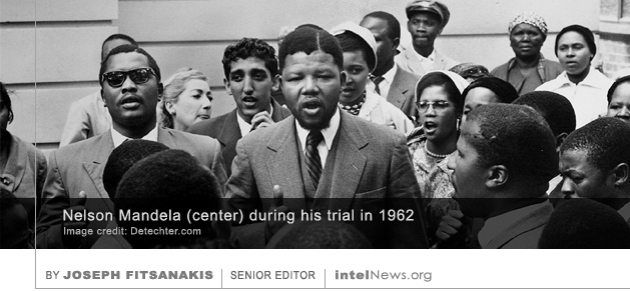 The arrest of Nelson Mandela in 1962, which led to his 28-year incarceration, came after a tip from the United States Central Intelligence Agency, according to an American diplomat who was in South Africa at the time. At the time of his arrest, Mandela was the head of uMkhonto we Sizwe (MK), an organization he founded in 1961 to operate as the armed wing of the anti-apartheid African National Congress (ANC). But the white minority government of South Africa accused Mandela of being a terrorist and an agent of the Soviet Union. The US-Soviet rivalry of that era meant that the ANC and its leader had few supporters in America during the early stages of the Cold War.
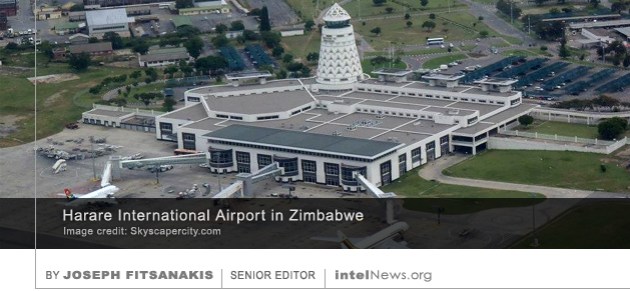 An American-registered airplane carrying large quantities of cash on behalf of a South African bank was impounded by authorities in Zimbabwe after a dead body was found on board. Zimbabwean media said police was notified after human blood was seen dripping from the plane’s cargo area during an emergency refueling stop. Authorities








 intelNews.org
South African president abolishes security ministry, assumes control of spy agencies
August 9, 2021 by Joseph Fitsanakis Leave a comment
IN A SURPRISE ANNOUNCEMENT last week, South African President Cyril Ramaphosa abolished the country’s Department of State Security and assumed direct control over its spy agencies. The unexpected move was part of an extensive government reshuffle, meant to address the security shortcomings exposed by last month’s riots, which marked the worst political unrest in the country’s post-apartheid history.
Nearly 330 people died, thousands were injured, and thousands of businesses were looted in July, when extensive violent protests erupted in the provinces of KwaZulu-Natal and Gauteng. The riots lasted several days following the jailing of Ramaphosa’s predecessor, Jacob Zuma, for contempt of court. Zuma was facing a high-profile trial for 16 counts of corruption, racketeering, fraud, and money laundering.
In a televised announcement aired live on Thursday, Ramaphosa said he would terminate the post of security minister and abolish the Department of State Security. Instead, the country’s domestic and external intelligence agencies will from now on operate under the office of the presidency and at times report directly to the president. In this way, Ramaphosa aims to assume “political responsibility” for, as well as oversight of, intelligence programs and activities.
In explaining his decision, Ramaphosa said that the South African intelligence agencies had been “found wanting in several respects” during last month’s riots. From now on, instead of a security minister, the work of South African spy agencies will be supervised by the new Minister in the Presidency, Mondli Gungubele. His two deputies, Zizi Kodwa and Pinky Kekana, who were also appointed on Thursday, will share the task of supervising the agencies. According to Ramaphosa, the reform will “ensure that the country’s domestic and foreign intelligence services [will] more effectively enable the president to exercise his responsibility to safeguard the security and integrity of the nation”.
Speaking on South African television on Saturday, Ronnie Kasrils, South Africa’s former Minister of Intelligence Services under President Thabo Mbeki, said he supported the move. He added that the country’s leadership had received “poor service” from the intelligence community, especially from the State Security Agency (SSA), during last month’s riots. Kasrils noted that “the centralization of SSA was a good move” because it reflects “best general practice internationally”.
► Author: Joseph Fitsanakis | Date: 09 August 2021 | Permalink
Filed under Expert news and commentary on intelligence, espionage, spies and spying Tagged with Cyril Ramaphosa, Mondli Gungubele, News, Pinky Kekana, Ronnie Kasrils, South Africa, South African Ministry of Intelligence, South African State Security Agency, Zizi Kodwa