Syria sought out and assassinated American journalist, former spy says

Marie ColvinThe Syrian government tracked down and killed American journalist Marie Colvin in order to stop her from reporting about the Syrian Civil War, according to a Syrian intelligence officer who has defected to Europe. Colvin was an experienced war correspondent who worked for The Sunday Times. The British newspaper sent her to Syria soon after the outbreak of the war. From there, she gave live interviews to media outlets such as CNN and the BBC. But on the morning of February 22, 2012, Colvin was killed along with French war photographer Remi Ochlik. Their death came when Syrian government forces repeatedly shelled a media center in the city of Homs, which housed the two reporters.

In 2016, the San Francisco-based Center for Justice and Accountability filed a lawsuit against the government of Syrian President Bashar al-Assad, claiming that Colvin’s death was deliberate and wrongful. The lawsuit is supported by Colvin’s family in the United States. Court records unsealed on Monday include a sworn testament by a Syrian former intelligence officer who has defected and now lives under a new identity in an undisclosed European country. The defector, codenamed ULYSSES, said that Colvin was assassinated by the Assad government as part of a concerted effort to hunt down Western journalists and local media correspondents. The ultimate purpose of the plan was to hinder international reporting about the war. The plan was allegedly carried out by the Syrian military under the guidance of the country’s Military Intelligence Directorate. Many of the reporters targeted for assassination were reporting from the city of Homs, where Colvin was killed.

According to ULYSSES, Syrian government forces began targeting the Homs media center after they found out that foreign journalists had managed to enter the city’s western sector from nearby Lebanon. They then employed a mobile satellite interception system to capture the journalists’ communications, which in turn revealed their precise location. At that point, Syrian troops were ordered to fire several missiles at the building housing the journalists, in full knowledge that Colvin and Ochlik were inside. In his testimony, ULYSSES claimed that Syrian intelligence officials “celebrated” when they were told that Colvin had been killed. He identified eight senior Syrian officials who he said were involved in planning the American journalist’s alleged assassination. One of them, said ULYSSES, was Maher al-Assad, President Assad’s brother, who leads the 4th Armored Division of the Syrian Army, considered as one of the staunchest pro-government parts of the Syrian military. Testimonies in the case continue this week.

Author: Ian Allen | Date: 10 April 2018 | Permalink

Syrian rebels visit Washington to request resumption of CIA assistance

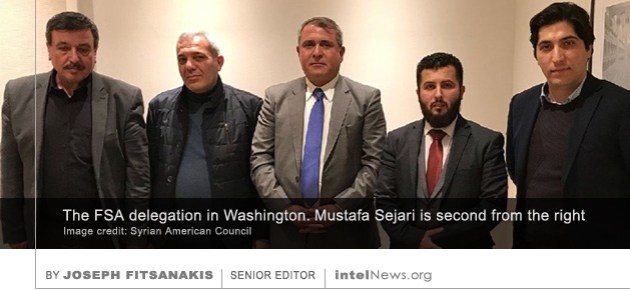
Free Syrian Army delegationA delegation of Syrian rebels is currently in Washington to ask that that United States President Donald Trump authorizes the Central Intelligence Agency to resume giving them military assistance. In 2013, the then-US President Barack Obama instructed the CIA to provide covert support to fighters in Syria. The CIA promptly began to assist fighters affiliated with the Free Syrian Army (FSA), whose goal was to topple the regime of Syrian President Bashar al-Assad. Under the project, which was codenamed TIMBER SYCAMORE, CIA personnel trained FSA fighters and gave them light weaponry. But in July of last year, President Trump abruptly terminated the CIA program, which he called “dangerous and wasteful”.

Now the FSA has sent a delegation to Washington to argue that, if the CIA does not help them, Iranian-backed militias will dominate much of Syria. On Monday, the Reuters news agency quoted Mustafa Sejari, a senior representative of the FSA, who said that the Syrian delegation had met with US Congress members and White House officials. This week they were hoping to speak with representatives from the Departments of State and Defense, said Sejari. Members of the delegation, Sejari told Reuters, “asked for the resumption of aid and explained the dangers of leaving moderate FSA forces without support”. He added that, if the US “is serious about challenging growing Iranian influence in Syria” by Hezbollah and other Shiite militias, it should resume its support of the FSA. Sejari also described Mr. Trump’s decision to end TIMBER SYCAMORE as “damaging”. The FSA, he said “endorse[s] President Trump’s statements about the need to confront Iranian hegemony in the region. It is time to turn words into action”. We went on to claim that “until now on the ground it’s the Iranian militias that are expanding without serious resistance”.

Shortly after President Trump announced his decision to terminate CIA support for the FSA, some experts warned that the move could backfire by causing the suddenly unemployed fighters to join jihadist organizations, if only to secure sources of income. In late August, it was reported that US troops deployed in Syria had exchanged fire with former FSA rebels that were now led by Turkish-trained commanders. In a related development, the government of Turkey dismissed on Monday plans by the US military to train members of the Kurdish Syrian Democratic Forces (SDF) as “terror army” tactics. The US-led coalition in Syria said that it planned to train a 30,000-strong SDF force as a professional army that could maintain control of the territories captured last year from the Islamic State.

Author: Joseph Fitsanakis | Date: 16 January 2018 | Permalink
French-Swiss firm allegedly bribed Islamic State to keep its factory working in Syria

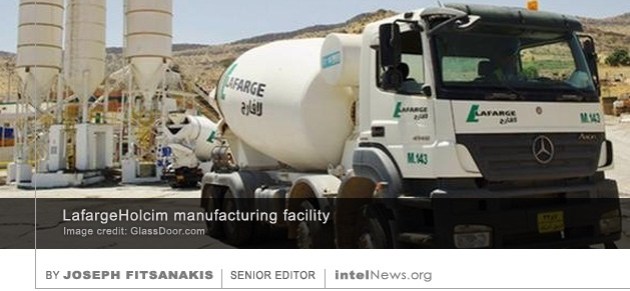
LafargeHolcimThe world’s largest building materials manufacturer, LafargeHolcim, which is headquartered in France and Switzerland, allegedly bribed the Islamic State to keep its factory working in Syria, according to court witnesses. The company specializes in the manufacture of building materials such as cement, concrete and various byproducts. It was formed in 2015 by a merger of France-based Lafarge and Swiss-based Holcim, and currently employs an estimated 120,000 employees in nearly 100 countries around the world.
In 2011, soon after the Syrian Civil War broke out, various militant groups began operating in the area around one of LafargeHolcim’s plants, located in in north-central Syria, 10 miles south of the Syrian-Turkish border. In June of 2016, French newspaper Le Monde published allegations that LafargeHolcim’s subsidiary, Lafarge Cement Syria (LCS), which owns the plant, bribed various militias to stay away from its factory. According to the paper, at least €20,000 (approximately $24,000) went to the Islamic State, which eventually conquered the area around the LafargeHolcim plant. The article further claimed that LCS managers in Syria sent detailed emails to LafargeHolcim executives in Europe about their dealings with various militias, including the Islamic State. LafargeHolcim approved the use of funds to bribe the militias, said Le Monde, in order to allow the factory to remain operational and to avoid having their employees taken hostage.

The newspaper’s allegations prompted the Office of the Public Prosecutor in Paris to launch a preliminary investigation in October of the same year. Eventually, an official complaint was filed by the French Ministry of Finance, which argued that the activities of LCS may have constituted illicit financial relations between a French-owned company and a terrorist group. An official investigation was opened in June of 2017 into whether LafargeHolcim illegally financed terrorist groups through its subsidiaries, Lafarge and LCS. Investigators are also examining claims that the company presented the French government with forged accounting documents in order to hide the bribes it gave to various Syrian armed groups.

Last week, investigators heard from the first time from witnesses, three of whom were LCS employees in 2014, when the company first made contact with Islamic State militants. They allegedly told prosecutors that the French-Swiss company paid approximately $20,000 a month to various armed groups, including al-Qaeda, al-Nusra Front, and the Islamic State. Prosecutors did not discuss details about the witnesses’ testimonies, but Le Monde said it spoke to individuals with direct knowledge of the investigation, who said that the witnesses’ testimonies were particularly damning for LafargeHolcim. The probe continues.

Author: Joseph Fitsanakis | Date: 25 September 2017 | Permalink

US troops in Syria battle anti-Assad rebels once funded by the CIA

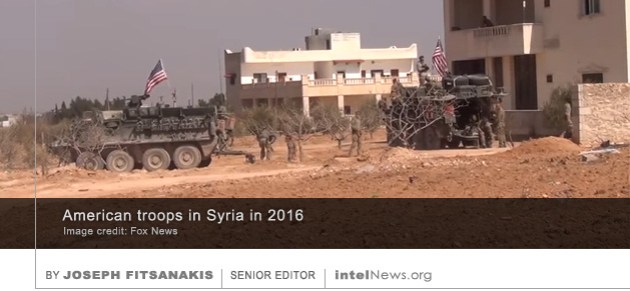
US troops in SyriaAmerican troops deployed in Syria have exchanged fire with rebels that were until recently supported by the United States Central Intelligence Agency. In 2013, soon after the outbreak of the Syrian Civil War, the then-US President Barack Obama instructed the Central Intelligence Agency to provide covert support to fighters in Syria. Acting on the president’s directive, the CIA promptly joined forces with spy agencies from Britain, France, Saudi Arabia and the United Arab Emirates, to assist fighters affiliated with the Free Syrian Army. At that time, Washington saw the Free Syrian Army and forces affiliated with it as ideologically moderate. It also agreed with the group’s main aim, which was to topple the regime of Syrian President Bashar al-Assad.

Under the project, which was codenamed TIMBER SYCAMORE, CIA personnel trained Free Syrian Army fighters in irregular warfare, while also providing them with light weaponry including machine guns, sniper rifles and off-road vehicles. But on July 19 of this year, US President Donald Trump abruptly ended the CIA program, which he called “dangerous and wasteful”. It soon became apparent that many Free Syrian Army soldiers approached Turkey, seeking financial income and protection. By early August, there were reports from Syria that large groups of former Free Syrian Army troops were conducting raids in northern Syria in coordination with the Turkish military.

Early on Wednesday, a spokesman for the Combined Task Force Operation Inherent Resolve told reporters that US troops in Syria had come under fire by Turkish-commanded former Free Syrian Army units. The spokesman told reporters in Kuwait City that the rebels shot at US troops in the outskirts of Manbij, a northern Syrian city of about 70,000, located a few miles from the Turkish border. The American soldiers reportedly returned fire before seeking shelter from the assault. According to the US Pentagon, the Turkish government was promptly contacted by Inherent Resolve commanders, who described the incident as “not acceptable”. Washington alleges that its troops have come under fire “multiple times” in the past month. Some of the culprits are believed to be Turkish-controlled Syrian insurgents, including former members of the Free Syrian Army.

Turkey and the US are member states of the North Atlantic Treaty Organization. But the two countries do not follow a common policy on Syria. The US Pentagon supports Kurdish insurgents in Syria, which Turkey claims are connected with Kurdish separatists inside Turkey. Washington’s official position on Kurdish separatists is that they engage in terrorism against the Turkish state.

Author: Joseph Fitsanakis | Date: 30 August 2017 | Permalink

CIA’s withdrawal from Syria could cause pro-US rebels to join Islamists, experts warn

Free Syrian ArmyThe decision by the White House to terminate American support for rebels in war-torn Syria could backfire by causing the suddenly unemployed fighters to join jihadist organizations, according to experts. The United States’ support for the rebels began in secret in early 2013, after the then US President, Barack Obama, instructed the Central Intelligence Agency to provide covert support to fighters in Syria. The CIA then joined forces with spy agencies from Britain, France, Saudi Arabia and the United Arab Emirates, to assist fighters affiliated with the Free Syrian Army. At that time, Washington saw the Free Syrian Army and forces affiliated with it as ideologically moderate. It also agreed with the group’s main aim, which was to topple the regime of Syrian President Bashar al-Assad.
Codenamed TIMBER SYCAMORE, the CIA program was designed to mirror a similar project run by the US military in support of local troops fighting the Islamic State. On the one hand, the White House wanted to use the CIA’s support for the FSA to weaken militarily the regime in Damascus. On the other hand, Washington hoped that the CIA’s involvement in the region would be able to control the influx of weapons, money and fighters that were streaming in from neighboring countries. Under TIMBER SYCAMORE, for over three years, CIA personnel trained Free Syrian Army fighters in irregular warfare, while also providing them with light weaponry including machine guns, sniper rifles and off-road vehicles.

But on July 19 of this year, US President Donald Trump abruptly ended the CIA program, which he called “dangerous and wasteful”. Some observers argued that the termination of TIMBER SYCAMORE was an attempt by the Trump administration to come to an agreement with Russia on Syria. It is believed that America’s local allies, such as Saudi Arabia and the United Arab Emirates, are also terminating their clandestine support for the Free Syrian Army, not wishing to go against the White House. This development, therefore, may signal the effective termination of substantial foreign support for the most important anti-Assad rebel group in Syria.

What does that mean for the fate of the Free Syrian Army and its thousands of fighters? Some experts say that their fate is uncertain, and warn that some of them may turn against their former benefactors. Writing in The Christian Science Monitor, Taylor Luck, said earlier this week that the Free Syrian Army reported 50 defections of its fighters in July. Some of these fighters, says Luck, are joining the Pentagon’s program in support of forces fighting the Islamic State, and are currently heading to the eastern and northern battlefronts. But many others are being tempted to join al-Qaeda affiliated groups, who are still fighting President Assad’s forces. Many do so for financial reasons, after seeing their CIA income suddenly disappear. Others, says Luck, are feeling very emotional and bitter against what they see as a betrayal by Washington. “We lost our brothers, our sisters, our children”, says one of these fighters, before vowing to fight Assad until the end. According to Luck’s report, Saudi Arabia and the United Arab Emirates are trying to come up with ways to continue to pay the Free Syrian Army rebels, in an attempt to stop them from joining rival jihadist groups.

Author: Ian Allen | Date: 04 August 2017 | Permalink

Dozens of Western ‘freelance fighters’ embedded with anti-ISIS forces in Syria

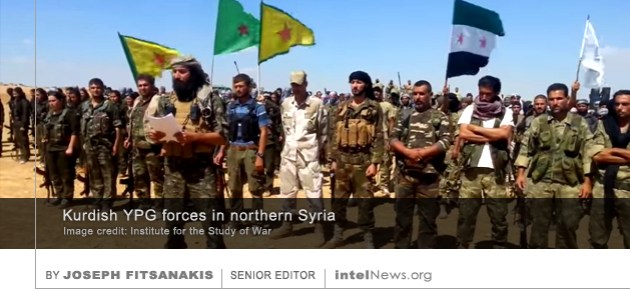
Kurdish YPG SyriaDozens of Western European and American citizens are participating in the ongoing takeover of Raqqa, the de facto capital of the Islamic State in Syria, despite being prohibited from doing so by their own governments, according to recent news reports. Much has been written about foreign fighters who enter Iraq and Syria in order to join the ranks of the Islamic State, the Sunni militant group that previously went by the name Islamic State of Iraq and Syria (ISIS). But relatively little attention has been paid to the thousands of foreign fighters who have traveled to the region to join the war against ISIS.
In late 2015, independent researcher Nathan Patin published “The Other Foreign Fighters”, a rare examination of Americans who had joined the various armed groups fighting ISIS in the region. Patin found that at least 200 Americans had attempted to travel to the region in order to join the fight against ISIS as ‘freelance fighters’. Roughly half of those had managed to embed themselves with armed —primarily Kurdish— groups, and saw action on the ground. In 2016, three British and Irish anti-ISIS volunteers were jailed by Iraqi authorities while attempting to return to Europe after having fought for the Kurdish People’s Protection Unit (YPG), a group that serves as the armed wing of the Kurdistan Workers’ Party (PKK) in northern Syria. The three were initially suspected of being foreign ISIS volunteers, but were released from prison in April of 2016, after the YPG verified their bona fides.

A recent report by The Los Angeles Times claims that there are still “several dozen” Western volunteers embedded with anti-ISIS militias in Syria. They are doing so in the face of warnings by European and American government agencies that freelance participation in the Syrian civil war is a potentially punishable offense. The Times cited “local estimates” and spoke to Daman Frat, a YPG commander stationed in the eastern outskirts of Raqqa, who said that “several foreign volunteers” were embedded in YPG units. Most, though certainly not all of them, said Frat, had prior military experience. According to the paper, at least three Western volunteers, one British and two American citizens, have died in recent days, as YPG forces are closing in on the de facto ISIS capital. The US Departments of State and Defense, which are tacitly in support of the YPG and other Kurdish groups operating in Syria, did not comment on The Los Angeles Times report.

Author: Joseph Fitsanakis | Date: 20 July 2017 | Permalink

French spy agencies conclude Assad government was behind Syria gas attack

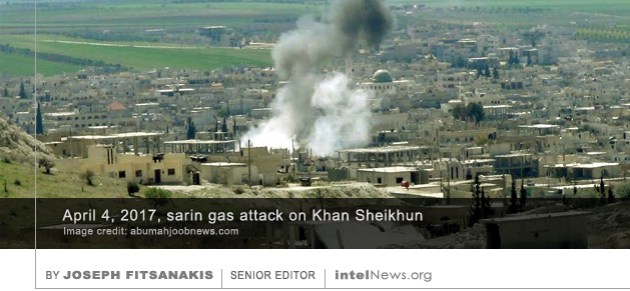
Khan SheikhunA comprehensive report released yesterday by the French Intelligence Community concludes with certainty that the government of Syrian President Bashar al-Assad was behind the April 4 sarin gas attack in northwestern Syria. The report, a “national evaluation” based on France’s own intelligence sources and scientific analysis of samples collected from the site of the attack, indicates that the poison gas used in the attack came from stockpiles that belong to the Syrian government.
The sarin gas attack targeted Khan Sheikhun, a town of approximately 50,000 people in the southern region of Syria’s Idlib Governorate. The city is located on the main highway that connects the Syrian capital Damascus with the city of Aleppo in the north of the country. The surprise attack killed nearly 100 people and drew near-universal condemnation from the international community. It also sparked a military attack by the United States, which launched a missile attack at a Syrian military base from where the sarin gas attack allegedly originated.

On Wednesday, France’s Minister of Foreign Affairs, Jean-Marc Ayrault, announced the publication of a report, which, he said, proves conclusively that the Syrian government perpetrated the attack. The six-page declassified version of the report concludes that “the Syrian armed forces and security services perpetrated a chemical attack using sarin against civilians”. It alleges that the conclusion rests on “intelligence collected by our services”, which includes “samples from the scene of the attack”. The latter are reportedly identical with samples collected from sites of previous chemical attacks perpetrated by the Syrian government. Additionally, the French report concludes that the attack was conducted with the use of airplanes, which the Syrian rebel forces do not have.

The French intelligence report comes after a similar report from the United States concluded that Assad’s government was behind the attack on Khan Sheikhun. A few days after the attack, medical tests conducted on victims of the attack by Turkish experts showed that sarin gas had been used, but did not implicate a specific culprit. The Syrian and Russian governments deny all involvement in the attack and claim that it was carried out by al-Qaeda-linked rebels.

Author: Joseph Fitsanakis | Date: 27 April 2017 | Permalink

Analysis: US launches strikes against Syrian regime in major policy shift

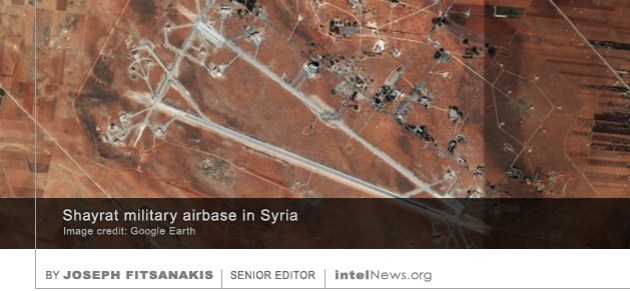
Shayrat SyriaThe nearly 60 Tomahawk missiles that the United States fired at Syria in the early hours of Friday local time were not the first. Nor were they the first that struck a Syrian government installation. In September of 2016, for example, a United States airstrike hit a military base in the eastern Syrian city of Deir el-Zour, killing 62 and wounding over 100 government soldiers. However, the Pentagon claimed that the strike was in error and had been intended to hit Islamic State militants. In fact, the entirety of America’s previous military strikes on Syrian soil has been aimed at the Islamic State. The missiles that last night on the Syrian military airbase of Shayrat marked Washington’s first intentional attack on the government of Syrian President Bashar al-Assad. Consequently, the US is now an official belligerent in one of our time’s most complex and intractable armed conflicts.
Since the missile attacks were confirmed, all eyes have concentrated on Russia, President Al-Assad’s primary supporter, without whom Damascus would now probably be run by a consortium of Sunni militias. There is no question that Shayrat hosts a significant contingent of Russian military personnel and large quantities of Russian-supplied military equipment, ranging from airplanes to radar facilities. Moscow’s response to the American attack will largely depend on whether any of its personnel are among the casualties in Shayrat. There is also concern about China’s response, given that Washington’s attack took place during the official visit to the United States by Xi Jinping, premier of China, another strong Syrian ally. Finally, it is worth considering possible Iranian responses to the US attack, especially if Iranian citizens end up on the casualty list.
The attention paid by observers to Russia, China and Iran is understandable given the clout of these countries on the world stage. But the most important response may come from Syria itself. According to the US Pentagon, the strike on the Shayrat airbase was intended “to deter the [Syrian] regime from using chemical weapons again”. But what if it does not? Last time Washington responded to rumors of a chemical attack in Syria, President Obama warned his counterpart in Damascus not to cross the red line of chemical warfare. Which, of course, was precisely what Mr. Assad did, successfully calling Washington’s bluff. He may do so again. Last night’s American attack may therefore result in an intensification of chemical warfare by the Syrian regime. At that point, US President Donald Trump will have no choice but to deepen America’s involvement in an increasingly chaotic and unpredictable war, where he will find Russia on the opposite side.

Few supporters of President Trump, who campaigned promising to disengage America from foreign wars and focus on domestic concerns, could have imagined even a month ago that the White House would be entering the Syrian Civil War. And yet this is precisely what is happening. The US now has over 500 troops stationed on Syrian soil, and has just attacked the country’s government with dozens of missiles. The reaction to that attack by the government in Damascus may draw Washington even deeper into the Syrian war. Many observers in America have suggested that the only way to truly evaluate the Trump administration will be by observing its performance during a major international crisis. It appears that they may soon get their wish.

Author: Joseph Fitsanakis | Date: 07 March 2017 | Permalink

Israel’s chief of staff says Hezbollah killed its own commander in Syria

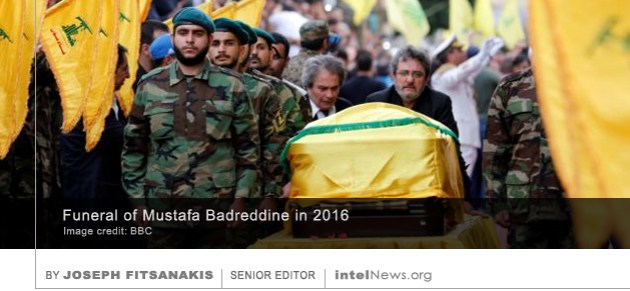
Mustafa Amine BadreddineAn Israeli military official has repeated claims in the Arab media that the Lebanese Shiite group Hezbollah killed its own military commander in Syria, following a dispute with Iran. Mustafa Amine Badreddine, 55, an expert in explosives and former bomb-maker, was a senior military commander in the military wing of Hezbollah. He rose through the ranks of the organization to become a trusted adviser to Hezbollah’s Secretary General, Hassan Nasrallah. In 2011, the Special Tribunal for Lebanon, set up by the United Nations, charged Badreddine with organizing the assassination of Lebanese Prime Minister Rafik Hariri. Hariri was killed with over 20 other people in a massive bomb blast in Beirut, in February of 2005.
Soon after the outbreak of the Syrian Civil War, the leadership of Hezbollah dispatched Badreddine to the Syrian capital Damascus. His stated mission was to command thousands of Hezbollah troops, who fought under Iranian guidance in support of the Syrian President Bashar al-Assad. But on May 13, 2016, Badreddine was reportedly killed in Damascus, causing observers to describe his death as the biggest setback for the Shiite militant group since the 2008 assassination of its leading commander, Imad Mughniyeh. Initial reports in Hezbollah-controlled Lebanese media suggested that Badreddine might have been killed in an Israeli air attack. But a press statement issued later by Hezbollah said the commander had been killed as a result of an armed attack by Sunni rebels. However, on March 8 of this year, the Saudi-owned pan-Arab television network al-Arabiya said it had conducted its own investigation into Badreddine’s death, and had concluded that he was killed by Hezbollah itself. The network claimed that Hezbollah’s Secretary General Nasrallah had ordered Badreddine’s killing, after the Iranians demanded it. Apparently the Iranians wanted him killed because he disputed the authority of Major General Qasem Soleimani, commander of Iran’s Revolutionary Guard Corps, who is often credited with having saved the Syrian government from demise during the Civil War.

The claim that Badreddine was killed by Hezbollah was echoed on Tuesday by Lieutenant General Gadi Eisenkot, Chief of the General Staff of the Israel Defense Forces. Speaking to the Associated Press, Lt Gen Eisenkot said that reports from Arab media that Badreddine was killed by his own forces agreed “with intelligence we have”, referring to the Israeli military. It is worth noting that Israeli officials rarely comment on intelligence operations, including assassination operations, choosing instead to adhere to a “refuse to confirm or deny” policy.

Author: Joseph Fitsanakis | Date: 22 March 2017 | Permalink

Trump administration instructs CIA to halt support for anti-Assad rebels in Syria

Free Syrian ArmyThe White House has instructed the Central Intelligence Agency to halt military support to armed groups that are associated with the Free Syrian Army (FSA), a group opposed to Syrian President Bashar al-Assad. Some believe that the move indicates a change in American policy under United States President Donald Trump. But Syrian rebel commanders say they believe the move is temporary, and that military aid will be restored. For several years, the CIA has provided training and other forms of assistance to rebel groups in Syria, such as the New Syrian Force, which operate under the umbrella of the FSA. Aside from training, the assistance has included light and heavy ammunition, including antitank missiles, mines and grenades.

However, it appears that the CIA was instructed nearly a month ago by the White House to freeze all assistance to these rebel groups. Correspondents from the Reuters news agency said they confirmed the change in policy by speaking to senior rebel commanders from five armed groups operating under the FSA. These commanders told Reuters that they had not been given any official reason for the sudden termination of all CIA assistance. The change coincided with the change of guard at the White House, from Barack Obama to Donald Trump. Some in Washington, as well as some members of rebel factions in Syria, are concerned that the change in the CIA’s stance might denote a broader policy shift in the White House. During his election campaign, Mr. Trump said repeatedly that he would end America’s overt and covert support for the FSA and would focus instead on defeating the Islamic State.

But the rebel commanders themselves told Reuters that the freeze in CIA support was due to a wave of renewed attacks against them by Jabhat Fateh al-Sham, a Sunni militant group that was previously affiliated with al-Qaeda. The rebels said that the CIA was concerned that weaponry provided to the FSA would end up in the hands of jihadist militants, so it temporarily halted its support until Jabhat Fateh al-Sham could be pushed back by FSA forces. Reuters published comments by two anonymous officials who were familiar with the CIA’s operations in Syria. They told the newspaper that the freeze of the CIA’s program had “nothing to do with US President Donald Trump replacing Barack Obama in January”. Additionally, said Reuters, Mr. Trump’s policy in Syria remains unknown. Several newspapers and news agencies contacted the CIA asking for comments, but the agency declined all requests on Wednesday.

Author: Ian Allen | Date: 23 February 2017 | Permalink

Analysis: Turkey’s entry in Syrian war further-complicates a chaotic conflict

Syrian troopsEver since 2011, when the Syrian Civil War erupted, Turkey has refrained from directly intervening in the conflict, other than to provide material support to opponents of Syrian President Bashar al-Assad. The hope in Ankara was that Islamist and pro-Assad forces would exhaust each other. There is no evidence that Turkey was at any point seriously alarmed about the rise of Sunni militancy in Syria. Instead, the Turkish government of President Recep Tayyip Erdoğan made no secret of its primary concern, which was the rise of Kurdish nationalism in northern Syria.

However, a possible demise of the Islamic State may strengthen Kurdish forces in Syria and Iraq and could leave the al-Assad regime in place in Damascus. That would be the worst possible outcome for Turkey, which has always viewed the Syrian president a direct threat to its national security, surpassed only by Kurdish separatism. In a desperate effort to avoid such an outcome, Turkey is now increasingly intervening in the war. Its current goal is to have a strong say in how the region will look like once the Islamic State has been defeated.

With the exception of some pro-Turkish rebels, such as the Syrian Turkmen Brigades, who openly welcome Ankara’s intervention, no rebel factions in Syria are especially elated by Turkey’s entry in the war. Most recognize that the sole reason for Turkey’s intervention is the protection of its own national interest, which centers on preventing a rise of an independent Kurdish state —either official or de facto— in northern Syria.

Turkey’s involvement in the Syrian war will further complicate the conflict and is likely to prolong it. The more international actors are involved in the war, the more convoluted it gets and the longer it will take for it to end. Currently we have the Syrian government, various Sunni rebel forces, the Islamic State, Russia, the United States, Iran, Saudi Arabia, the Kurds, and several European powers involved in the war. The last thing this conflict needs is yet another foreign intervention, no matter where it comes from.

Moreover, Ankara’s overall role in the Syrian conflict has been inconsistent, as the country has at times sharply distanced itself from both Russian-led and American-led efforts in the region. President Erdogan’s policy on Syria —as on most other matters— has been spasmodic and haphazard, and has been primarily shaped by domestic concerns, as Turkey’s political strongman tries to solidify its rule inside the country. Consequently neither Moscow nor Washington have much faith in the reliance of the Turkish military contribution to the conflict.

The election of Donald Trump in the United States could further-complicate the regional balance of power in the Middle East and Turkey’s role in it. If a rapid rapprochement takes place between Washington and Moscow in 2017, Turkey will feel increasingly uneasy about its regional role. The Kurds, who have been working closely with Russia in Syria and with America in Iraq, will expect to be rewarded and compensated once the dust settles in the region. There have been voices in Moscow and Washington calling for the establishment of a de facto independent Kurdish state in northern Syria. If that happens, it will signal a massive setback for Turkey’s foreign policy and negatively affect its relations with Russia and possibly the United States.

Over a million people have now died in the Syrian civil war. Millions more have been displaced internally and abroad. Things could get immeasurably worse if Russian-led and American-led forces launch all-out attacks in Aleppo and Mosul respectively. There is no reason to believe at this point that the Islamic State and other rebel groups will abandon these cities, where over a million people remain trapped between the warring sides. We could be seeing the largest slaughter of civilians since World War II. At that point, there will be little that Ankara or anyone else can do to restore stability in that desperately troubled region.

Author: Joseph Fitsanakis | Date: 30 November 2016 | Permalink

FBI seeking former Syrian intelligence officer reportedly hiding in Florida

Moustafa Abed AyoubA Syrian former intelligence officer, who was given American citizenship several years ago, is being sought by authorities in the United States. The man was named by the Federal Bureau of Investigation last week as Moustafa Abed Ayoub, a 75-year-old resident of Fort Lauderdale, Florida. A statement by the FBI said the wanted man is believed to be hiding in southern Florida, possibly in the Miami area. A reward is now offered for information leading directly to Ayoub, according to the FBI press release. The release did not specify whether the former intelligence officer is wanted in connection with the ongoing civil war in Syria.
The FBI press release described Ayoub as a former brigadier general in Syria’s powerful Mukhabarat, the Military Intelligence Directorate, which operates under the auspices of the country’s Ministry of Defense. He is reported to have served in the Mukhabarat for nearly 20 years, from the early 1980s to the late 1990s. According to the FBI release, Ayoub served initially in Hama and Homs before he was transferred to Damascus. It appears that Ayoub is accused by the FBI of procuring American citizenship unlawfully, after giving deliberately false testimony during his naturalization proceedings. To be eligible for American citizenship, an applicant must have lived in the US for at least 30 months during the period leading to his or her naturalization application. Ayoub is accused of not telling immigration authorities that he had spent over 1,000 days outside the US in the months leading to his application for citizenship.

The FBI said it issued a warrant for Ayoub’s arrest in Florida, where he is believed to be hiding. However, the FBI release noted that Ayoub may have returned to Syria, or may be currently residing in the Lebanese capital Beirut.

Author: Ian Allen| Date: 30 September 2016 | Permalink

Cease-fire near collapse after US airstrike kills 62 and injures 100 Syrian troops

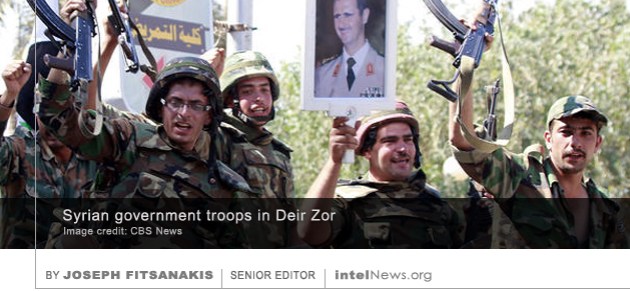
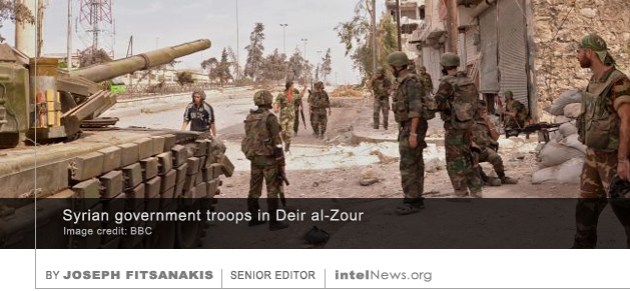
Deir al-Zour SyriaA cease-fire that was launched with much fanfare by the United States and Russia last week appeared in tatters on Sunday night, after Washington acknowledged it mistakenly killed over 60 Syrian troops on Saturday. American officials expressed regret for the alleged error, but Syrian and Russian officials accused Washington of deliberately sabotaging the cease-fire agreement. Russian sources said the US air strike killed 62 and injured over 100 Syrian government troops who were engaged in a battle against Islamic State forces in Syria’s eastern province of Deir al-Zour. American military officials insisted that the pilots, who flew into Syria from bases in Iraq, believed they were targeting Islamic State forces. The operation was allegedly aborted as soon as US forces were notified by the Russian military that Syrian government troops were being targeted.
According to media reports, the US government has apologized to Damascus though Russian intermediaries for the “unintentional loss of life of Syrian forces”. But the incident has incensed Moscow, as it marks the first known engagement between US and Syrian forces since American military forces began fighting the Islamic State in 2014. The incident was described by The Washington Post late on Saturday as having sparked “one of the most hostile diplomatic exchanges between Washington and Moscow in recent years”. Soon after the US airstrike, Russia called an emergency meeting of the United Nations Security Council, during which the Russian delegation accused the United States of deliberately trying to derail the cease-fire. According to reports, the American delegation stormed out of the closed-door meeting and denounced it as a “stunt” after the Russians openly accused Washington of aiding the Islamic State and al-Qaeda in Syria.

American officials have launched an investigation into Saturday’s incident and are so far refusing to speculate whether it was caused by human error or an intelligence failure. In Washington, a State Department spokesman insisted that “coalition forces would not intentionally strike a known a Syrian military unit”. But in a statement issued on Saturday, Russian Major General Igor Konashenkov said that, if the US air strike was in error, it was a “direct outcome of the US side’s stubborn unwillingness to coordinate its activities  in Syria with Russia”.

Author: Joseph Fitsanakis | Date: 19 September 2016 | Permalink

Flow of foreign fighters to ISIS drops to near zero, intel assessments show

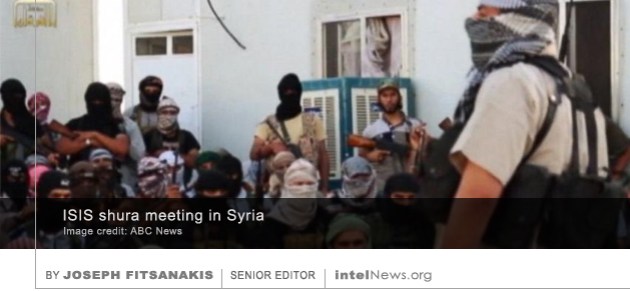
ISIS meetingThe transfer of foreign fighters into Iraq and Syria to join the Islamic State and other Sunni militant groups has been all but eliminated in countries across the world, according to intelligence assessments. In previous years, it has been estimated that nearly as many as 2,000 foreign recruits, both men and women, crossed into Syria each month, mainly from Turkey, with the intention of joining armed Sunni groups. By the end of 2015, it was believed that over 30,000 foreign nationals from close to 90 countries had entered Syria and Iraq to fight for one of the Sunni-inspired opposition groups taking part in the Syrian civil war. Most of these foreign recruits joined the Islamic State, which is also known as the Islamic State of Iraq and Syria (ISIS).
But current intelligence assessments produced by analysts in the US Intelligence Community suggest that the total inflow of foreign recruits has trickled down to a total of just 50 since the beginning of 2016. Many European countries, notably Belgium and Britain, have not seen any of their nationals leaving for Syria or Iraq this year, while fewer than 10 Americans have done so since January. According to The Washington Post, which last week published a report on the subject, this unprecedented trend is largely attributable to the shrinking territory —and presumably operational strength— of the Islamic State. Some experts note that, like al-Qaeda before it, the Islamic State is now seen as “failing entity” by Sunnis, prompting many aspiring jihadists to not wish to be associated with the group. It has also becoming more difficult for individuals to enter Syria, as Western governments and Turkey have grown progressively vigilant of young men and women seeking to travel to regional warzones. The Islamic State has also lost its control over regions that are adjacent to Turkey’s borders, which discourages Turkish and Syrian smugglers from attempting to transfer people across the notoriously porous border.

But even though the decline is sustainable, and marks “an important milestone” in multinational endeavors to combat the growth of the Islamic State, The Washington Post notes that it also raises critical questions about the future of Western security. Specifically, the paper wonders whether the terrorism threat from the Islamic State is easing, or if it is “morphing into a more dangerous new phase”, in which potential recruits are instructed to attack Western targets and former recruits disperse into conflict-prone areas across the world to spread the jihad there.

Author: Joseph Fitsanakis | Date: 12 September 2016 | Permalink

Fake Syrian passports given to ISIS members found in Greek refugee camps

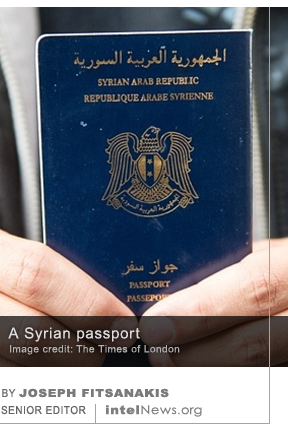
Syrian passportFake Syrian passports designed for use by members of the Islamic State trying to enter Europe have been found in refugee camps in Greece during an investigation by the law enforcement agency of the European Union (EU). Officials from Europol, the EU agency that coordinates intelligence operations against organized crime across EU-member-states, said that the fake travel documents were found during a fact-finding mission in Greek refugee camps. The mission was part of a larger investigation into the production and use of forged passports by the Islamic State, the Sunni militant group that is also known as the Islamic State of Iraq and Syria (ISIS).


According to the Italian newspaper La Stampa, which published the claim, Europol is investigating the production and distribution of fake passports by ISIS in its strongholds of Syria and Iraq, and among refugee networks in European countries like Belgium, Austria, Italy and Greece. Greece is the most widely used route into Europe by hundreds of thousands of refugees from Syria and the rest of the Middle East, who leave their countries in hopes of migrating to the prosperous countries of Western Europe. Nearly 60,000 of them have been trapped in Greece since April, when Macedonia shut down its borders, thus preventing migrants from heading north. These people have been living in refugee camps since that time, hoping for a chance to continue the journey northwards.

But in a leading article published last weekend, La Stampa claimed that ISIS is using the refugee crisis form Syria to infiltrate Europe with militants intent on launching attacks on soft targets. The militants are supplied with false identity papers, said La Stampa, primarily fake Syrian and Iraqi passports. They then use these passports to enter Greece. Their goal is to eventually travel north to countries such as Belgium, Germany, Austria or France, and claim asylum there. La Stampa quoted one unnamed Europol official as saying that fake passports “that were destined to supposed members of ISIS” had been identified in refugee camps in Greece. It has been confirmed that at least two of the perpetrators of last November’s attacks in Paris, France, which killed over 130 people, entered the EU using forged Syrian passports. The Italian daily also noted that the reliability of Turkey, from where the vast majority of Syrian refugees entered Europe in recent years, remains fragile after the failed July 15 coup, which has altered the balance of power in that country. As a result, the EU-Turkey migrant deal may collapse “at any moment”, said the paper.

Author: Joseph Fitsanakis | Date: 24 August 2016 | Permalink