Swiss intelligence employee stole ‘millions’ of classified pages
December 5, 2012 2 Comments
By JOSEPH FITSANAKIS | intelNews.org |
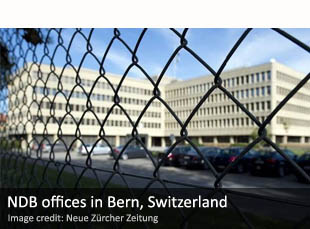
Swiss authorities have warned Western intelligence agencies that their secrets may have been compromised by a disgruntled intelligence employee who stole “thousands or even millions of pages of classified material”. Citing “European national security sources”, Reuters said the employee at the center of the case worked for the NDB, Switzerland’s Federal Intelligence Service. He had been employed by NDB for eight years as a network technician with “full administrator rights” and had unrestricted access to the NDB’s computers, as well as to those of Switzerland’s Federal Department of Defense, under which the NDB operates. About a year ago, however, the unnamed technician apparently became disgruntled after his views on how to structure the NDB’s databases were allegedly sidelined or ignored. He eventually decided to use several portable hard drives to download countless classified documents from Swiss government servers and managed to carry them out of the office building where he worked, using a backpack. According to Swiss authorities, he intended to sell the classified information to foreign governments or black-market operatives. He was apprehended, however, after he tried to set up a numbered bank account with Swiss-based UBS bank, using what bank security officials described as “suspicious identification documentation”. Read more of this post

















Illegal spy agency operated in West Germany, new book claims
December 6, 2012 Leave a comment
Conservative politicians in Cold-War West Germany set up an illegal domestic intelligence agency in order to spy on their political rivals, a forthcoming book claims. In Destroy After Reading: The Secret Intelligence Service of the CDU and CSU, German journalist Stefanie Waske exposes what she says was an elaborate plot to undermine West Germany’s rapprochement with Soviet-dominated Eastern Europe. The book, which is scheduled for publication in February of 2013, claims that the illegal intelligence agency, known as ‘the Little Service’, was set up by politicians from Germany’s conservative Christian Democratic Union (CDU) and its sister organization, the Christian Social Union of Bavaria (CSU). The two parties allegedly founded ‘the Little Service’ in 1969, in response to the election of Willy Brandt as German Chancellor in 1969. Brandt, who was leader of the center-left Social Democratic Party of Germany (SDP), was elected based on a program of normalizing West Germany’s relations with Eastern Europe. Under this policy, which became known as ‘Neue Ostpolitik’ (‘new eastern policy’), Brandt radically transformed West German foreign policy on Eastern Europe. In 1970, just months after his election, he signed an extensive peace agreement with the Soviet Union, known as the Treaty of Moscow, which was followed later that year by the so-called Treaty of Warsaw. Under the latter agreement, West Germany officially recognized the existence and borders of the People’s Republic of Poland. Brandt’s Neue Ostpolitik, which continued until the end of his tenure in the Chancellery in 1974, earned him the Nobel Peace Prize for his efforts to achieve reconciliation between West Germany and the countries of the Soviet bloc, primarily East Germany. But Brandt’s policy of rapprochement alarmed the CDU/CSU coalition, says Waske, which quickly set up ‘the Little Service’ by enlisting former members of Germany’s intelligence community. Read more of this post
Filed under Expert news and commentary on intelligence, espionage, spies and spying Tagged with Christian Democratic Union (Germany), Christian Social Union of Bavaria (Germany), Cold War, domestic intelligence, Federal Republic of Germany, Helmut Kohl, Henry Kissinger, history, Neue Ostpolitik, News, political policing, Social Democratic Party (Germany), Stefanie Waske, United States, Willy Brandt