News you may have missed #810 (Petraeus resignation edition)

David PetraeusBy JOSEPH FITSANAKIS | intelNews.org |
►►How did Petraeus’ affair come to light? CIA Director David Petraeus resigned after a probe into whether someone else was using his email. The probe eventually led to the discovery that he was having an extramarital affair, according to The Wall Street Journal, which cites “several people briefed on the matter”. An FBI inquiry into the use of Petraeus’s Gmail account led agents to believe the woman or someone close to her had sought access to his email. An extramarital affair has significant implications for an official in a highly sensitive post, such as that held by Petraeus, because it can open an official to blackmail.
►►Who did Petraeus have an affair with? The woman with whom General David Petraeus was having an affair is Paula Broadwell, a West Point graduate and the author of a recent hagiographic book about him, entitled All In: The Education of General David Petraeus, co-written with Vernon Loeb. Slate‘s Fred Kaplan reports that “it had long been rumored that something was going on between Petraeus and Broadwell. When she was embedded with him in Afghanistan, they went on frequent 5-mile runs together. But Petraeus went on 5-mile runs with many reporters, and few people who knew him took the rumors seriously”.
►►Who is leading the CIA now? With General David Petraeus stepping down as director of the CIA, following reports of an extra-marital affair, the agency’s current deputy director will take over as director on an interim basis. His name is Michael Morell, and he was a senior CIA aide in the White House to President George W. Bush. Morell had served as deputy director since May 2010, after holding a number of senior roles, including director for the agency’s analytical arm, which helps feed intelligence into the President’s Daily Brief. He also worked as an aide to former CIA Director George Tenet.

Murdered British businessman ‘was MI6 operative’ (we told you so)

Neil HeywoodBy JOSEPH FITSANAKIS | intelNews.org |
An investigation by The Wall Street Journal has concluded that Neil Heywood, the British businessman who was murdered in China last November, was an active informant for British intelligence at the time of his death. The news appears to confirm intelNews’ assessment of April 2012 that Heywood was in fact connected with British intelligence. A highly successful financial consultant and fluent Chinese speaker who had lived in China for over a decade, Heywood was found dead on November 14, 2011, in his room at the Nanshan Lijing Holiday Hotel in Chongqing. His death led to the dramatic downfall of Bo Xilai and Gu Kailai, a husband-and-wife team of political celebrities who were found guilty in a Chinese court of killing the British businessman. Immediately after Heywood’s death, there was widespread speculation that he may have been a spy for MI6, Britain’s external intelligence service. On April 27, 2012, I argued that I was not aware of anyone “with serious knowledge of intelligence issues who was not completely certain, or did not deeply suspect, that Heywood had indeed collaborated with British intelligence at some stage during the past decade”. I wrote this in the face of an official denial by British Foreign Secretary William Hague, who had said earlier in the week that “Heywood was not an employee of the British government in any capacity”. Now an extensive investigation by The Wall Street Journal has concluded that the dead British businessman had been an MI6 operative “for more than a year” prior to his death. Read more of this post
Mossad, IDF ‘resisted order’ to prepare for Iran war in 2010

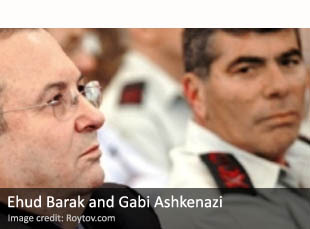
Ehud Barak and Gabi AshkenaziBy JOSEPH FITSANAKIS | intelNews.org |
The heads of Israel’s army and main spy agency resisted an order issued by the Israeli Prime Minister to prepare for an all-out military attack on Iranian nuclear installations in 2010, according to a report aired today. According to Monday’s edition of Uvda (Fact), a popular investigative program on Israel’s Channel 2 television, the command to prepare for an attack was given by Israeli Prime Minister Benjamin Netanyahu and Minister of Defense Ehud Barak. The two men delivered the order to a meeting of senior cabinet ministers, telling them that the Israeli military’s preparedness level would be elevated to ‘P plus’, effective immediately. According to Uvda, ‘P plus’ meant that the Israeli armed forces should prepare to take military action at a moment’s notice. However, the then-Director of Israeli spy agency Mossad, Meir Dagan, who was present at the meeting, asked to speak and, according to Israeli newspaper Ha’aretz, which said it has seen the Uvda program, “came out sharply” against both Netanyahu and Barak. He told those present that elevating the military preparedness to ‘P plus’ was something that technically could only be decided at a meeting of Israel’s Political-Security Cabinet. Also known as “the inner cabinet”, the group, which consists of over a dozen Ministers and is led by the Prime Minister, is tasked with outlining and implementing Israel’s foreign and defense policy. Dagan told the two men that “only the [inner] cabinet is authorized to decide this” and warned them that they were “likely to make an illegal decision to go to war”. Dagan’s objection was later reinforced when General Gabi Ashkenazi, then-leader of the Israel Defense Forces, told the Prime Minister that the Israeli army was not ready to elevate its preparedness level to a ‘P plus’. Read more of this post

Israel admits assassinating Palestinian commander in Tunisia

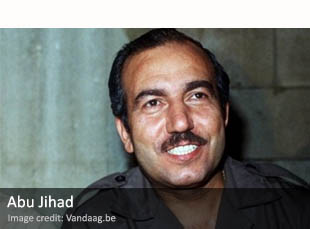
Abu JihadBy JOSEPH FITSANAKIS | intelNews.org |
Authorities in Israel have authorized the publication of an interview acknowledging Israel’s role in the assassination of a senior Palestinian military commander in Tunisia in 1988. The target of the assassination was Khalil al-Wazir, better known as Abu Jihad, one of the co-founders of Fatah, the secular wing of the Palestinian Liberation Organization chaired by Yasser Arafat. In the 1960s and 1970s, Abu Jihad rose within the ranks of Fatah and eventually became commander of its armed wing, known as al-Assifa. However, he was killed on April 16, 1988, when a group of unidentified gunmen stormed his villa in Tunisian capital Tunis, before managing to slip away. In the past 23 years, the Israeli intelligence services have been repeatedly singled out as prime suspects in Abu Jihad’s assassination. Nearly 15 years ago, Israeli newspaper Yedioth Ahronot announced that it had secured an interview with an Israeli commando who had a leading role in the operation and had been the one who fired the shots that killed the Fatah commander. But the interview was blocked from publication by the Israeli military censors, who, under Israeli law, have the power to prevent the airing of information that might harm national security. In 2000, however, the commando, Nahum Lev, died in a motorcycle accident, which prompted the Israeli newspaper to renew its application for the ban on the interview to be lifted. This week, Israeli authorities officially lifted the ban, which allowed Yedioth Ahronot to run the interview with Lev. The airing of the interview was coupled by a more substantial account of the operation, which appeared in the specialist Israel Defense magazine. According to the article, the operation was planned over several months by the Israeli covert action agency Mossad and the Sayaret Matkal, a special forces unit of the Israel Defense Forces. It involved 26 commandos who allegedly reached the Tunisian shore on rubber boats. Several of them walked the streets of Tunis disguised as women tourists. Read more of this post

Analysis: Iranian-Israeli proxy war flares up in Sudan

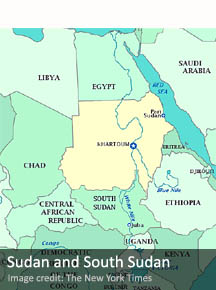
Sudan and South SudanBy JOSEPH FITSANAKIS | intelNews.org |
While much of the world focuses on the effects of hurricane Sandy in the eastern United States, the proxy war between Israel and Iran continues to flare up, this time in Africa. Last week, the government of Sudan accused Israeli of being behind a surprise bombing of a weapons factory in the Sudanese capital Khartoum. According to Sudan’s Minister of Information, Ahmed Belal Osman, four Israeli Air Force jets invaded Sudanese airspace and struck the Yarmouk military complex in Khartoum, inflicting heavy damages. There are unconfirmed claims that the factory was operated by the Iranian government and produced weapons that were smuggled through the Sinai Peninsula into the Gaza Strip, which is controlled by Palestinian group Hamas. On Tuesday, almost exactly a week after the alleged Israeli bombing took place, two Iranian warships arrived in Port Sudan, the country’s most important harbor, located on the Red Sea. The arrival of the vessels was confirmed by Iranian news agency IRNA, which said a helicopter carrier and a destroyer had docked at Port Sudan. The news agency, which is owned by the Iranian government, said the arrival of the ships was meant to contribute to anti-piracy efforts in the Red Sea. But non-Iranian news media, including British newspaper The Independent, quote observers who view the ships’ arrival in Sudan as an Iranian “show of support” for the Sudanese government. According to this explanation, Tehran’s decision to send the ships to the East African country is part of an ongoing proxy war between Iran and Israel taking place throughout the region. Read more of this post

MI5 official’s diaries reveal tensions between UK, US spy agencies

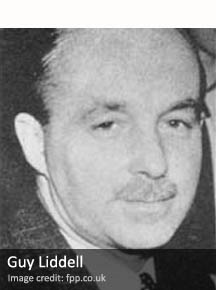
Guy LiddellBy JOSEPH FITSANAKIS | intelNews.org |
Newly declassified personal diaries belonging to a senior British intelligence official reveal tensions between British and American spy agencies in the years immediately following World War II. The National Archives, an executive agency operating under the United Kingdom’s Secretary of State for Justice, released the diaries on Friday. They belong to Guy Maynard Liddell, a longtime British intelligence operative who rose to the post of Deputy Director General of MI5, Britain’s domestic intelligence agency. Liddell meticulously kept a diary during most of the 1940s and 1950s, in which he detailed both personal information and details of his work at MI5. Two volumes of his diaries (from 1939 to 1945, edited by Nigel West) have already been published. Now a third installment has been declassified by the National Archives, containing Liddell’s diary entries from the late 1940s and 1950s. The diaries project what some intelligence historians describe as “a certain friction” between postwar British and American intelligence services. Even though the two countries were largely viewed as allies in the immediate postwar period, their respective intelligence agencies did not always see eye to eye. In one instance, Liddell describes his American colleagues as “utterly incapable […] of seeing anybody’s point of view except their own” and accuses them of being “quite ready to cut off their noses to spite their faces”. He also comes across as skeptical of the then-newly established Central Intelligence Agency, which, he writes, “someday” may be able to produce information that would be “worth disseminating, evaluating, or coordinating”. In 1947, shortly after the CIA’s founding, Liddell wrote with a degree of uncertainty that “in the course of time, [the Agency] may produce something of value”. Further on he relayed the opinion of CIA Deputy Director Edwin Kennedy Wright, who apparently told British intelligence officials that in American intelligence organizations “500 people were employed to do what 50 people would do” in the UK. Read more of this post

France pressing for Western military intervention in Mali, claim sources

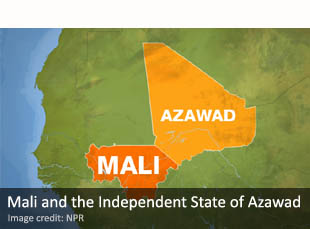
Mali and the Independent State of AzawadBy JOSEPH FITSANAKIS | intelNews.org |
The government of France is holding secret talks with American and other Western officials to explore options for a concerted military intervention in Mali, according to diplomatic sources. A Tuareg rebellion in the northern part of Mali, which began earlier this year, culminated in the unilateral declaration of the Independent State of Azawad. The new state, which borders Algeria, Mauritania, Niger and Burkina Faso, is controlled by the National Movement for the Liberation of Azawad (NMLA). The NMLA is partially staffed by former members of the Libyan Army during the rule of Colonel Muammar al-Gaddafi. But it is also said to incorporate armed members of Ansar Dine, the Movement for Unity and Jihad in West Africa (MUJAO) and Al-Qaeda in the Islamic Maghreb (AQIM), all of which claim to have links with al-Qaeda. Many French observers view the Independent State of Azawad as the African version of mid-1990s Afghanistan, which eventually served as the base for Osama bin Laden’s al-Qaeda. But even though the French government has come out in favor of armed intervention in northern Mali, it has denied persistent rumors that it is contemplating sending French troops in the West African country. Instead, Paris officially favors intervention by the Malian Army backed by African Union troops and using logistical support provided by the Economic Community of West African States (ECOWAS). However, in an article published yesterday, The Associated Press claimed that, behind the scenes, the French government is trying to convince the US and other Western countries to participate in a military intervention in Mali. Read more of this post

Comment: The Significance of the Killing of Lebanon’s Security Chief

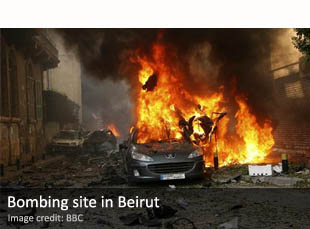
The bombing that killed Wissam al-HassanBy JOSEPH FITSANAKIS*| intelNews.org |
Perhaps the only concrete reality reflected in last week’s assassination of Lebanon’s security chief is the confusion that continues to dominate Western reporting about Lebanese politics. On Friday, Lebanese capital Beirut experienced its most powerful bombing in nearly four years, when a car laden with explosives detonated killing at least eight and injured nearly 100 people. Among the dead was Brigadier General Wissam al-Hassan, head of the intelligence section of Lebanon’s national police force, known as the Internal Security Forces (ISF).  Hassan, a career intelligence officer, was a Sunni Muslim strongly associated with Lebanon’s former Prime Minister Rafik Hariri. Hariri, who was assassinated in Beirut in 2005, was openly anti-Syrian, as was Hassan. This political identification is extremely telling in a country like Lebanon, which has existed under near-complete Syrian political and military domination for the past three-and-a-half decades. Throughout this period, the position of different actors on the Syrian question has been the core defining parameter in Lebanese politics. The same applies to Lebanese institutions. As one such institution, the ISF is widely perceived as strongly anti-Syrian, and is often considered the main rival of the Security Organ of Hezbollah, the Shiite paramilitary group that controls most of southern Lebanon. Read more of this post

White House review ‘found no evidence’ of Huawei spying for China

Huawei TechnologiesBy JOSEPH FITSANAKIS | intelNews.org |
A review commissioned by the government of the United States has reportedly found no evidence that Chinese telecommunications hardware manufacturer Huawei Technologies spied for the Chinese government. The 18-month-long review, which was ordered directly by the White House, examined the question of security vulnerabilities posed by telecommunications hardware suppliers, which could theoretically harm US service providers and pose a danger to US national security. The report, which was allegedly aided by several US intelligence agencies and other federal government departments, was based on detailed interviews with nearly 1,000 telecommunications equipment consumers across the United States. It was concluded at the start of 2012, but remains largely classified. However, Reuters news agency cites “two people familiar with the probe”, who claim that the probe contains “no clear evidence” that Huawei spied for the government of China. At the same time, however, the probe concluded that Huawei telecommunications hardware contains numerous structural vulnerabilities which could help hackers exploit telecommunications networks supported by the Chinese company. According to one source quoted by Reuters, the White House report found that the telecommunications hardware sold by Huawei was “riddled with holes”. Read more of this post

Controversial ex-Mossad chief ‘fighting for his life’ following operation

Meir DaganBy JOSEPH FITSANAKIS | intelNews.org |
An Israeli former intelligence chief, who has been voicing strong public criticism of Israeli calls for an all-out war with Iran, is allegedly “fighting for his life” following a transplant operation in Belarus. An announcement aired late on Tuesday by Belarusian President Alexander Lukashenko said Meir Dagan, who led Israeli covert-action agency Mossad from 2002 to 2010, had undergone a kidney transplant at a hospital in Belarusian capital Minsk. Lukashenko claimed that the former Mossad strongman, who was born in Russia, had decided to undergo the operation in the former Soviet republic after consulting with him personally. The Belarusian president claimed that, prior to traveling to Minsk for the operation, Dagan had asked American, German and Swedish doctors to perform it, but that they refused, allegedly because “no one wanted to carry out a liver transplant operation on a former head of the Mossad”. According to the announcement, the former Mossad Director was operated on over a week ago and initially seemed to be doing well. However, complications soon set in and he is currently “recovering in isolation”, while it appears that his body is not receiving the transplant well. Reputable Israeli newspaper Ha’aretz said that Belarusian media had directed several queries to hospital staff in Minsk, who apparently confirmed that an organ transplant had been performed on a patient who was a citizen of Israel. But they refused to give the person’s name due to patient confidentiality rules. It is not clear why Dagan had to leave Israel in order to undergo the operation, or why he failed to notify the Israeli embassy in Belarus. Israeli diplomats in Minks told Israeli media that they had no idea about Dagan’s medical procedure or even presence in the eastern European country. Read more of this post

Canadian diplomats spied for the CIA in Cuba, claims new book

Embassy of Canada in Havana, CubaBy JOSEPH FITSANAKIS | intelNews.org |
Several accredited Canadian diplomats were recruited by the United States Central Intelligence Agency to spy on Cuba in the aftermath of the 1962 missile crisis, according to a new book. Authored by Canadian retired diplomat John Graham, the book, entitled Whose Man in Havana? Adventures from the Far Side of Diplomacy, is to be published this week by Penumbra Press. In it, Graham claims that he was among a number of Canadian diplomats stationed in Cuba, who were secretly recruited by the CIA. The US agency had been essentially forced out of the island after Washington and Havana terminated diplomatic relations in 1961, soon after the government of Fidel Castro declared itself a proponent of Marxism. The closure of the US embassy meant that the CIA had no base from which to operate in the Caribbean island. Two years later, in May 1963, US President John F. Kennedy personally asked Canadian Prime Minister Lester Pearson for assistance in intelligence-gathering efforts in Cuba. The Canadian leader consented and, according to Graham, Canadian diplomatic officials actively assisted the CIA until at least 1970. The author states in his book that he himself operated in Cuba for two years, from 1962 until 1964, under the official cover of Political Officer at the Canadian embassy in Havana. Prior to that, he says, he was provided with rudimentary training by the CIA, which consisted of spending “just a few days” at the Agency’s headquarters in Langley, VA. He was then tasked with conducting physical surveillance of Soviet military bases on Cuba and, if possible, identifying weapons and electronic security measures, and noting troop movements. Read more of this post

News you may have missed #802 (Jeffrey Paul Delisle edition)

Jeffrey Paul DelisleBy IAN ALLEN | intelNews.org |
►►New information released on Canadian spy case. Newly released information from Canadian naval officer Jeffrey Paul Delisle‘s bail hearing in January reveals that, facing chronic financial difficulties, Delisle began a four-year espionage career by walking into the Russian Embassy in Ottawa in 2007. Wearing civilian clothes, Delisle displayed his Canadian military identification badge and asked to meet someone from GRU, the Russian military intelligence service. Canadian prosecutors said Delisle regularly downloaded a ”vast amount” of classified information to share with his Russian handlers.
►►Canada spy had escape plan. Canadian naval officer Jeffrey Paul Delisle told a Canadian court that he had an escape plan in place —one he never got a chance to use. If he needed to seek refuge or re-establish contact with the Russians, for whom he spied for over four years, he was told he could walk into a Russian embassy —preferably not the one in Ottawa— and inform them he was “Alex Campbell”. The Russians would then ask him “did I meet you at a junk show in Austria?”, and he was supposed to reply “no, it was in Ottawa”.
►►Canada spy accessed Australia intelligence. This is not exactly news for intelNews readers, since we have covered it before, but it appears that Jeffrey Paul Delisle has openly admitted selling highly classified intelligence gathered by the United States, Britain, Canada, New Zealand and Australia to Russian agents. He said he had access to signals intelligence produced by the US National Security Agency, Britain’s Government Communications Headquarters, Canada’s Communications Security Establishment, Australia’s Defence Signals and New Zealand’s Government Communications Security Bureau.

Danish Muslim convert claims he was CIA’s mole inside al-Qaeda

Morten StormBy JOSEPH FITSANAKIS | intelNews.org |
A Danish citizen who converted to Islam in the early 2000s claims he was a spy for the United States Central Intelligence Agency and helped track down an American-born Islamist cleric who was killed by a drone strike in 2010. The man, who goes by the name Morten Storm, told Danish newspaper Jyllands-Posten that he converted to Islam while living in the United Kingdom. But he quickly grew disillusioned, he said, and in 2006 he was recruited by the Danish Police Intelligence Service (PET). In subsequent years, he traveled several times to Yemen on PET missions, and gradually managed to gain the trust of members of the al-Qaeda in the Arabian Peninsula (AQAP). Eventually, he said, he grew close to one of AQAP’s central figures, the American-born Yemeni cleric Anwar al-Awlaki. At that point, claims Storm, the PET turned him over to the CIA, who allegedly used him to gather information on al-Awlaki. The Danish Muslim convert claims that his role as a CIA informant was so important that US President Barack Obama knows his name. He also told the paper that it was his information that eventually helped the CIA track and assassinate the charismatic cleric. According to Storm, the CIA supplied him with a memory stick that contained a stealth Global Positioning System tracking device. He sent the memory stick to al-Awlaki, who used it on his computer, thus allowing the CIA to track him down. In April 2010, President Obama ordered that al-Awlaki’s name be included on a list of individuals that the CIA was officially authorized to kill. Little less than a year later, on September 30, 2011, the cleric and three other suspected members of AQAP were killed when their car was hit by two Hellfire missiles in Yemen’s northern al-Jawf province. Read more of this post

Norway, Sudan, expel diplomats over spying allegations

PST headquarters in OsloBy JOSEPH FITSANAKIS | intelNews.org |
Norway and Sudan have announced tit-for-tat diplomatic expulsions over allegations of espionage. On Tuesday, the Norwegian Ministry of Foreign Affairs announced that a Sudanese diplomat stationed in the Norwegian capital Oslo would be expelled. The diplomat, whose name and position at the Sudanese embassy were not disclosed, allegedly engaged in “activities incompatible with his status under the protection of the Vienna Convention” —standard diplomatic lingo for espionage. The Reuters news agency reported that the diplomat was expelled after Norway’s main counterintelligence intelligence agency, the Police Security Service (PST), arrested and charged a 38-year-old Sudanese immigrant with espionage. The unnamed man, who was arrested in Trondheim, said he had been instructed by Sudanese embassy personnel to spy on the activities of the Sudanese expatriate community in Norway. He had previously been observed by the PST having a meeting with the same Sudanese diplomat who was subsequently expelled from Norway. Both men were arrested on Tuesday. While the unnamed diplomat has been expelled, the 38-year-old immigrant remains imprisoned in Oslo on espionage charges. According to a statement from the Norwegian Ministry of Foreign Affairs, Tuesday’s arrests marked the first case of ‘immigration intelligence’-related charges in the Scandinavian country since the 1970s. Early on Wednesday, the Sudanese Ministry of Foreign Affairs announced that it was expelling a Norwegian diplomat in response to Oslo’s move on the previous day. Read more of this post

Former CIA senior analyst argues in favor of US deal with Iran

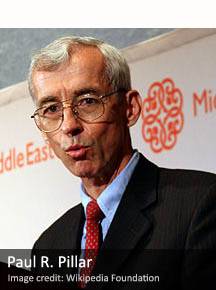
Paul R. PillarBy JOSEPH FITSANAKIS | intelNews.org |
A former senior analyst in the United States Central Intelligence Agency has come out in support of a bilateral compromise between Iran and the West on Tehran’s nuclear program. In an article published last week, Georgetown University professor Paul R. Pillar, who spent nearly three decades with the CIA, dismissed the widespread view that the differences between Iran, Israel, and the West are insurmountable. Commenting on news of a nine-step negotiation plan offered by Tehran in early October, but dismissed by Washington as “unworkable”, Pillar said the offer provided the initial steps of an “eminently achievable agreement” between the interested parties. The CIA veteran, who rose to be one of the Agency’s top analysts prior to his retirement in 2005, argued that a possible outcome of bilateral negotiations would be for Iran to curtail its enrichment of uranium to the 20 percent level in exchange for the lifting of most economic sanctions imposed on Iran by Western countries. “An agreement along these lines makes sense”, he added, “because it would meet the major concerns of each side” in the dispute. He cautioned, however, that, under such an agreement, Tehran would not only be prohibited from continuing its uranium enrichment process, but would also be required to surrender all quantities of uranium previously enriched to a level above 20 percent. Such an agreement, claimed Pillar, would mean that neither Iran nor Israel and the West would receive everything they wanted at once. Instead, the process would depend on a gradual implementation of several bilateral agreements in stages, “each side giving something and getting something at each stage”. Read more of this post