Files released by WikiLeaks show advanced CIA technical collection methods

Julian AssangeThousands of documents belonging to the United States Central Intelligence Agency, which were released on Tuesday by the international anti-secrecy website WikiLeaks, are almost certainly genuine. They reveal an entire universe of technical intelligence collection methods used by the CIA to extract information from digital applications and electronic devices, ranging from flash drives to smart screen televisions. WikiLeaks named the collection Vault 7, and said that it consists of nearly 8,000 web pages and 1,000 attachments. It also said that its editors redacted hundreds of pages of computer code, in order to prevent the public release of advanced cyberweapons that are allegedly used by the CIA to sabotage electronic devices and systems.

The information contained in the leaked documents is almost certainly genuine, and most likely belongs to the CIA —though many of the programs listed may be jointly run by the CIA and the National Security Agency (NSA). These programs, with names such as McNUGGET, CRUNCHYLIMESKIES, ELDERPIGGY, ANGERQUAKE and WRECKINGCREW, appear to be designed to compromise computer systems using a series of sophisticated methods that force entry or exploit built-in vulnerabilities or systems. Targets include popular communications systems like Skype and WhatsApp, smartphones produced by Google and Apple, commercial software like PDF and Microsoft Windows, and even so-called smart televisions that connect to the Internet.

The WikiLeaks revelations are most likely related to operations conducted under the auspices of the Special Collection Service (SCS), a joint CIA/NSA program that dates to the earliest days of the Cold War. The program was started by the United States Armed Forces but was eventually transferred to civilian hands and monitored by the CIA. It used advanced communications-interception facilities around the world to collect information. Over the years, the CIA collaborated with the NSA and developed many SCS projects targeting several foreign countries using technical and human means. In recent years the SCS has been primarily operated by the NSA, which oversees the program’s technical platforms.

WikiLeaks did not reveal the source of the documents. But it said that they had been “circulated [by the CIA] among former US government hackers and contractors” and that it was one of the latter that leaked them to the anti-secrecy website. A statement by WikiLeaks said that Tuesday’s release, which it codenamed “Year Zero”, was part one of several installments of documents that will be released under its Vault 7 program. The site also claimed that the information in “Year Zero” has “eclipsed the total number of pages published over the first three years of the Edward Snowden NSA leaks”. The CIA, the NSA and the White House have not commented on this development.

Author: Joseph Fitsanakis | Date: 08 March 2017 | Permalink

Malaysia assassination highlights North Korea’s network of front companies

North KoreaThe sensational assassination of Kim Jong-nam, half-brother of North Korea’s Supreme Leader Kim Jong-un, on February 13, revealed much about the current operational mindset of Pyongyang. But it also brought to light the shady network of front companies set up by the North Korean regime to facilitate the country’s illicit financial activities around the world. This extensive network permits Pyongyang to evade international sanctions against it, and to coordinate the activities of hundreds of clandestine operatives around the world. Through these activities, the reclusive country has been able to develop its weapons of mass destruction program unabated, despite concerted efforts by the United Nations to prevent it from doing so.

Writing for Forbes, Scott Snyder, senior fellow for Korea Studies and director of the program on US-Korea Policy at the Council on Foreign Relations, notes that the UN has for many years employed sanctions to “block international financial and material support for North Korean nuclear and missile development efforts”. But now the UN’s own experts have concluded that Pyongyang has been able to evade these sanctions so skillfully that it has “largely eviscerated the intent and impact of UN sanctions resolutions”. How has it done so? Mostly through a network of countries that routinely turn a blind eye to North Korea’s illicit activities. These include several countries in the Middle East, as well as Singapore, China, Indonesia, and Malaysia. Pyongyang maintains an extensive network of front companies in these countries, says Snyder, with the main purpose of enabling it to evade international sanctions against it.

Malaysia has been a primary hub of North Korean illicit activity. In that, Pyongyang has been crucially assisted by the fact that —until last week— North Korean citizens could travel to Malaysia without entry visas. Malaysia thus provides a useful base for dozens of North Korean front companies, such as Glocom, which ostensibly markets radio communications equipment, or Pan Systems Pyongyang, which just happens to trade in exactly the kind of commercial items that could be described as “dual-use goods” in UN sanctions resolutions. Pan Systems is connected to several Malaysian-based subsidiaries, including International Global Systems and International Golden Services, which, according to investigators, are operated by North Korean intelligence.

Many of these companies also serve as exporting and importing hubs for Pyongyang. In the last five years, several ships have been intercepted while carrying illicit cargo dispatched from North Korea or destined for the reclusive state. In one such instance in 2013, the Jie Shun, a Cambodian-registered ship with a North Korean crew, was found to be carrying over 30,000 rocket propelled grenades hidden under thousands of tons of iron ore. The shipment was intended for an “undisclosed Middle Eastern destination”, says Snyder and was traced to a firm called “Dalian Haoda Petroleum Chemical Company Ltd.”. Many of these mysterious firms are headquartered in China, registered in Hong Kong, but actually work on behalf of North Korea, often using banking facilities in Europe and the United States to conduct financial transactions.

Author: Joseph Fitsanakis | Date: 07 March 2017 | Permalink
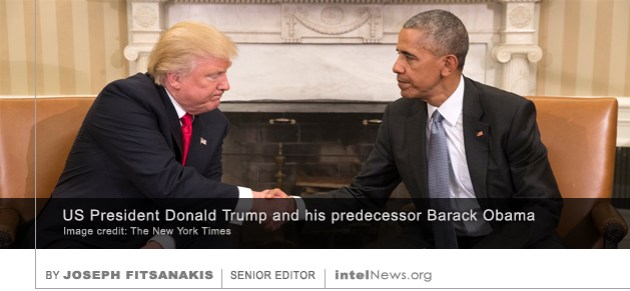
Opinion: Trump’s astonishing wiretapping claims deepen volatility of US politics

Trump and ObamaThe absurdity of American politics reached new heights over the weekend, as President Donald Trump dramatically alleged on Twitter that his predecessor, Barack Obama, wiretapped his telephones last year. Even for a highly impulsive public figure known for his sensational and often-unsubstantiated allegations, Mr. Trump’s latest claims prompted a new sense of abnormality and astonishment in Washington. If the president is unable to prove his dramatic claims, his reliability will be further-eroded, and what little is left of his relationship with the American intelligence and national-security communities will disintegrate. If his allegations are proven, they will cause a scandal of unprecedented proportions from which American political institutions —including the presidency— will find it difficult to recover.
Mr. Trump appears to claim that Mr. Obama personally instructed the machinery of government to intercept the telecommunications of his campaign in the run-up to the 2016 US presidential election. But experts —including the present author, whose PhD focuses on government-sponsored wiretapping— correctly note that, barring a complete and systematic breakdown of law and q-quoteorder at the highest levels of the American government, Mr. Trump’s claims cannot possibly be true. American presidents have not been legally allowed to order wiretaps since 1978, when the Foreign Intelligence Surveillance Act (FISA) was established. Prompted by the abuse of executive power revealed through the Watergate scandal, FISA forces government agencies to seek the approval of specially mandated judges before installing wiretaps. If an agency like the Federal Bureau of Investigation (FBI) wants to wiretap an individual or group suspected of acting as agents of a foreign power, it must convince one of 11 federal district judges who rotate on the FISA court that the case warrants a wiretap order. Thus, before authorizing the wiretap, a FISA judge must be convinced by examining the available evidence presented before him or her.
Usually FISA counterintelligence cases involve foreign subjects who are suspected of operating in the US as unregistered agents of a foreign power —that is, spies or handlers of spies. However, if the case proposed by the FBI involves the targeting of American citizens’ communications, then the application for a wiretap must be personally reviewed by the US attorney general. Only if the attorney general approves the application does it get sent to a FISA judge. That is precisely why President Trump’s allegation is so explosive: if Mr. Obama personally directed a law enforcement or intelligence agency to wiretap the Trump campaign’s telecommunications, it would mean that a US president deliberately violated FISA regulations and kept the Department of Justice in the dark while wiretapping the telecommunications of American citizens. Read more of this post

MI6 to revert to old-fashioned ways of recruitment, says director

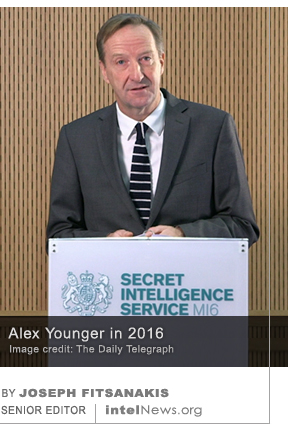
Alex YoungerBritain’s primary external-intelligence agency will revert to old-fashioned ways of recruiting employees, including the co-called “tap on the shoulder” method, according to its director. Known informally as MI6, the Secret Intelligence Service (SIS) was founded in 1908 to protect Britain’s national security by collecting intelligence from foreign sources. However, the agency has had difficulty recruiting a diverse group of people, and many still view it as a professional destination for a small wealthy elite, drawn primarily from Britain’s most prestigious universities such as Oxford and Cambridge.
MI6 is now trying to diversify the makeup of its employees, according to its director, Alex Younger. Younger, who is known at MI6 as ‘C’, gave an interview to British newspaper The Guardian on Thursday. He did so as the agency he leads prepares to increase its personnel numbers by 40 percent in the next four years. Last year, the British government announced that MI6’s personnel strength would grow from its current size of 2,500 employees to approximately 3,500 by 2020. The reason for the increase, said Younger, is that Britain is facing “more threats than ever before […] from terrorist groups and hostile states”. As a result, “the demands on our services [and] capabilities are on the up”, Younger told The Guardian in his first-ever interview with a national newspaper.

But MI6 would function more efficiently and achieve better results it if had a “more diverse workforce”, said Younger. Therefore, he said, the agency must go out of its way to “draw in a new cadre of black and Asian officers”. In doing so, the spy service would need to reach out to minority communities who are “selecting themselves out” of working for the British intelligence community. Useful in this process are what Younger called “old recruitment techniques”, such as the so-called “tap on the shoulder”. The term refers to the deliberate recruitment of individuals who will be approached by MI6 without having applied for employment with the agency. “We have to go to people that would not have thought of being recruited to MI6”, said Younger, adding that the “tap on the shoulder” method can be redeployed in order to increase diversity among MI6’s workforce and “reflect the society we live in”.

The spy agency is preparing to launch an aggressive recruitment campaign next week, aiming at bringing its overall size to 3,500 —a historic high, according to intelligence observers.

Author: Joseph Fitsanakis | Date: 03 March 2017 | Permalink

Islamic State faces imminent financial collapse, claims new study

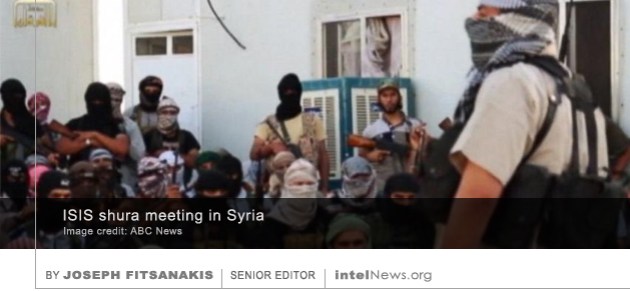
ISIS meetingThe Islamic State is facing imminent financial collapse, according to a new study conducted by a London-based research group in association with one of the world’s leading international accounting firms. The recently launched report is entitled Caliphate in Decline: An Estimate of Islamic State’s Financial Fortunes. The analysis that forms the basis of the report was conducted by scholars at the International Center for the Study of Radicalization, a research center that operates out of the Department of War Studies at King’s College in London. The report’s authors were joined by financial analysts at Ernst & Young, a British-based company that is often referred to as one of the world’s ‘big four’ accounting firms.
The report challenges the widely accepted claim that the Islamic State is the wealthiest terrorist organization in history. Its authors argue that the organization’s wealth is connected to its function as “a quasi-state”, with a geographical territory under its control and a subject population that lives in it. Territorial control, say the report’s authors, allows the Islamic State to amass significant revenue from sources like direct and indirect taxation, extraction of natural resources, and confiscation of property from citizens, among others. Even though much of the Islamic State’s financial activity is hidden, the study uses open sources to make the claim that the group’s income in 2014 was close to $2 billion. Last year, however, the overall income amassed from all sources dropped to less than $900 million, an estimated reduction of 45 percent, say the researchers.

The reason for the drop is that the financial revenue model of the Islamic State is directly linked to its territorial control. In comparison to the peak of its power in the spring of 2014, the Islamic State has today lost control of over 60 percent of its territory in Iraq and nearly a third of its territory in neighboring Syria. As coalition forces are beginning to retake Mosul, the Islamic State is facing the potential loss of the caliphate’s commercial capital. These developments will continue to seriously erode the group’s tax base and severely limit its revenue streams. There are no signs, say the researchers, that the Islamic State has been able to devise new forms of revenue streams that are not connected to direct territorial control. However, the authors of the study warn that a potential financial collapse of the Islamic State will not prevent the organization from carrying out terrorist activities in the Middle East and beyond.

Author: Joseph Fitsanakis | Date: 01 March 2017 | Permalink

CCTV footage shows assassination of North Korean leader’s half-brother

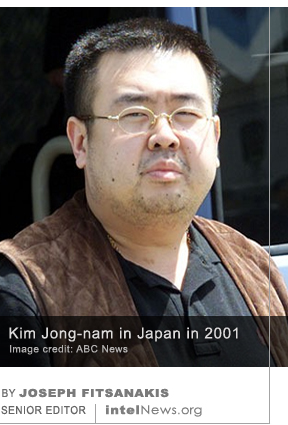
Kim Jong-nam murderA Japanese television channel has aired footage showing the alleged assassination of the half-brother of North Korean leader Kim Jong-un, who died in Malaysia on Monday. Investigators believe that Kim Jong-nam, half-brother of North Korea’s supreme leader, and grandson of North Korea’s founder Kim Il-Sung, died after being deliberately poisoned by two women at the Kuala Lumpur International Airport. Shortly prior to his death, he reported that two women approached him at the Kuala Lumpur International Airport and splashed his face with liquid poison —though some reports suggest that he was injected with a poisoned needle. According to Malaysian media, Kim was about to board a flight to Macau, where he had been living in exile since 2007. American and South Korean officials believe that he was killed on orders of the North Korean government in Pyongyang.
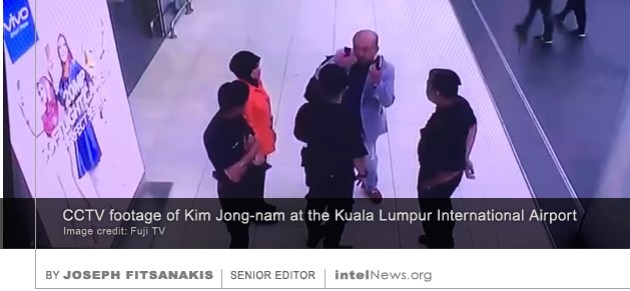
The footage —seen here in its entirety— is low quality and appears to have been taken from closed-circuit television (CCTV) cameras at the airport. It was aired by Fuji TV, a Japanese television station based in Tokyo, Japan. The filmed sequence shows a man dressed in blue jeans, dark blue shirt and gray jacket, who closely resembles Kim, heading toward the low-budget departures hall of the Kuala Lumpur International Airport. In subsequent footage he is shown being grabbed from behind by a woman wearing a white long-sleeved shirt, while another woman rapidly approaches him and assaults him from the front. The woman standing behind him appears to quickly put her hands over his face and pull rapidly backwards. The entire attack sequence lasts no more than two seconds, after which both women rapidly walk away. A stunned Kim then hurriedly stumbles away from the scene of the attack, and is seen approaching airport personnel. They direct him to a group of police officers. Another camera shows him trying to describe to the officers the attack that just took place, pointing to his face with his hands. The officers are then seen escorting him to a secure area of the airport.

Fuji TV did not reveal how it acquired the footage, and the connection between it and the death of Kim has not been independently verified or commented on by Malaysian authorities. However, regional observers have confirmed that the airport shown in the footage is indeed the low-budget departures hall of the Kuala Lumpur International Airport. Malaysian authorities have arrested four people, two men and two women, in connection with the attack. One of the men carries a North Korean passport; the other man carries a Malaysian passport, while the two women are in possession of Vietnamese and Indonesian travel documents. Authorities in Kuala Lumpur say they are still looking for four North Korean men who appear to have left the country shortly after the attack on Kim.

Author: Joseph Fitsanakis | Date: 22 February 2017 | Permalink

Indonesia to investigate North Korean restaurant reportedly used as spy base

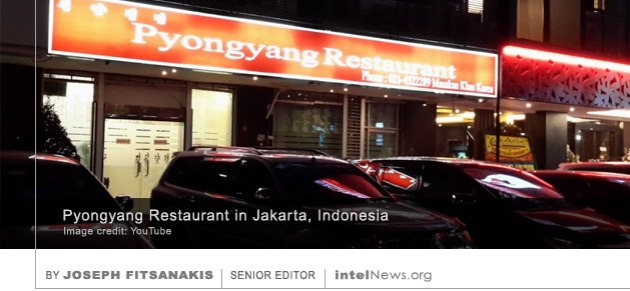
Pyongyang Restaurant in Jakarta, IndonesiaIndonesian authorities said on Sunday that they will investigate a North Korean restaurant in the country, after a Singaporean news agency claimed it was being used as a center for espionage. The announcement comes amidst heightened tensions between North Korean and its neighbors, following the murder last week in Malaysia of Kim Jong-nam, half-brother of North Korea’s Supreme Leader Kim Jong-il. Kim, the grandson of North Korea’s founder Kim Il-Sung, died after two women approached him at the Kuala Lumpur International Airport and splashed his face with liquid poison. Sources in South Korea and the United States have pointed at Pyongyang as the culprit of the assassination.
On Friday of last week, the Singapore-based news agency Asia One published a lengthy report into alleged North Korean espionage operations in Southeast Asia. The report claimed that North Korean intelligence agencies have operated extensive networks of operatives in Indonesia, Malaysia and Singapore, and that these networks have operated unimpeded for over two decades. The news agency cited an unnamed “intelligence source” as saying that the spy networks are operated by North Korea’s Reconnaissance General Bureau (RGB). The RGB is in charge of special activities abroad, which include covert operations and intelligence collection involving espionage. It operates under the Ministry of State Security and answers directly to North Korea’s supreme leader.

According to Asia One, the RGB maintains some of its largest spy networks abroad in Indonesia, Singapore and Malaysia, where Kim Jong-nam met a gruesome death last week. RGB personnel operating in these countries are North Korean citizens who are employed in the construction sector, as well as the tourism industry. Some operate North Korean restaurants, which are popular tourist attractions across Southeast Asia. The unnamed intelligence source told Asia One that North Korean restaurants serve “as a main front to conduct intelligence gathering and surveillance [against] Japanese and South Korean politicians, diplomats, top corporate figures and businessmen”. The RGB’s network in Indonesia is based in textile factories located in several Indonesian cities, said Asia One. There is also “an apartment located above a North Korean restaurant in [the Indonesian capital] Jakarta that is part of the RGB Indonesia office”, according to the report.

Following the news agency’s allegations, Argo Yuwono, senior commander for the Indonesian National Police, said that an investigation would take place into Asia One’s allegations. He said that his detectives would coordinate their activities with the Indonesian Foreign Ministry before moving ahead with the probe.

Author: Joseph Fitsanakis | Date: 21 February 2017 | Permalink

Turkish diplomats stepping up espionage in Europe, claims German report

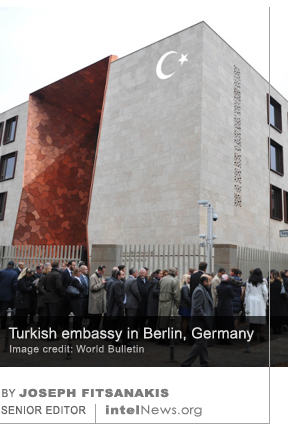
Turkish embassy in GermanyTurkish state agencies have asked the country’s diplomats stationed all over Europe to spy on Turkish expatriate communities there, in an effort to identify those opposed to the government, according to a German report. The government of Turkish President Recep Tayyip Erdoğan accuses members of the so-called Gülen movement of orchestrating a military coup in July of last year, which resulted in an armed attack on the country’s parliament and the murder of over 200 people across Turkey. The Gülen movement consists of supporters of Muslim cleric Fethullah Gülen, who runs a global network of schools, charities and businesses from his home in the United States. The government of Turkey has designated Gülen’s group a terrorist organization and claims that its members have stealthily infiltrated state institutions since the 1980s.
According to German newsmagazine Der Spiegel, the Erdoğan government has now tasked its diplomats stationed abroad to engage in intelligence collection targeting alleged Gülen sympathizers. The report cited “a confidential analysis by the Federal Office for the Protection of the Constitution” (BfV), Germany’s counterintelligence agency. The analysis allegedly states that Turkish diplomats are now conducting systematic espionage activities in Germany, Austria, Switzerland, Holland, Belgium, and other Western European countries. The BfV report allegedly claims that much of the espionage conducted by Turkish diplomats is directed by the country’s Religious Affairs Directorate, known as Diyanet. The agency is seen as the institutional guardian of Turkey’s Sunni Muslim orthodoxy. It provides schools with religious education that is carefully tailored to be compatible with the country’s secular constitution, and trains the country’s imams, who are employed by the state. Der Spiegel claimed on Monday that Diyanet has asked its religious representatives stationed in Europe to look for Gülen sympathizers. According to the German newsmagazine, information is now pouring in from Turkey’s embassies and consulates. It includes names of individuals, as well as student groups, cultural organizations, schools and day-care centers that are seen as not sufficiently critical of the Gülen movement. Der Spiegel said it had seen a report sent to Diyanet by the Turkish embassy in Berne, Switzerland, which warned that many Gülenists had left Turkey and were now operating in Switzerland.

Late last summer, Der Spiegel claimed that Turkey’s National Intelligence Organization (known by its Turkish initials, MİT) secretly contacted its German counterpart, the Federal Intelligence Service (BND) and asked for assistance to investigate and arrest supporters of the Gülen movement living in Germany, some of whom are German citizens. The BND reportedly refused to cooperate with the request. Another German news outlet, Die Welt, cited an unnamed German security official who said that the MİT employed more operatives in Germany than the East German spy agency did at the height of the Cold War.

Author: Joseph Fitsanakis | Date: 20 February 2017 | Permalink

Wall Street Journal alleges US spies hide sensitive intelligence from Trump

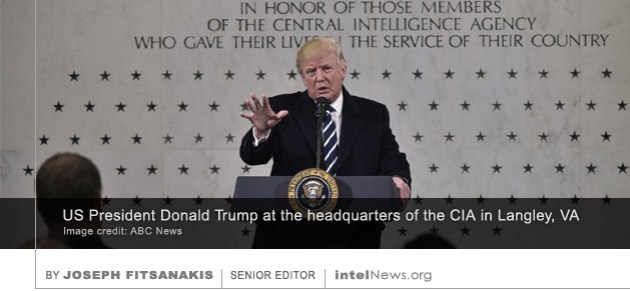
Donald Trump CIAIn a leading article published on Wednesday, The Wall Street Journal alleged that American intelligence officials are choosing to withhold sensitive intelligence from President Donald Trump, fearing that it might be compromised. The WSJ, America’s leading newspaper by circulation, which is highly influential in conservative circles, cited “current and former officials familiar with the matter”. The paper said it was unclear how much information had been withheld from President Trump. It added that at no point did intelligence officials keep the president in the dark about critical security threats by foreign states or potential terrorist attacks by non-state groups. However, intelligence officials are consciously and systematically withholding information from the White House that concerns “sources and methods”, said the article. The term refers to the precise methods used by the United States Intelligence Community to collect information, as well as the identification of sources —human or otherwise— of the information.
In recent weeks, several media outlets have alleged that American intelligence officials are skeptical about providing the White House with sensitive information. Late last month, Steve Hall, a former member of the Central Intelligence Agency’s Senior Intelligence Service, told National Public Radio that the matter of President Trump’s trustworthiness was “a live question” at the CIA. But this week’s article in The WSJ marks the first time that a conservative media outlet alleges that senior American intelligence officials mistrust the president. According to the New York-based newspaper, the Intelligence Community is uncomfortable with Mr. Trump’s “repeated expressions of admiration” for his Russian counterpart Vladimir Putin. Many intelligence officials are also disturbed by the US president’s public support for the alleged hacking of Democratic Party computer servers by the Kremlin.

Relations between the White House and the Intelligence Community are said to be extremely tense at the moment. On Wednesday, President Trump repeated his previously stated allegation that the US Intelligence Community is systematically leaking information to the media in order to subvert his administration’s work. The WSJ said it spoke to a representative from the Office of the Director of National Intelligence, which heads and oversees the US Intelligence Community. The representative questioned the accuracy of the newspaper’s allegations, saying that “any suggestion that the US intelligence community is withholding information and not providing the best possible intelligence to the president and his national security team is not true”. The report was also denied by an official at the White House, who said that Mr. Trump and his aides had no evidence “that leads us to believe that [The WSJ article] is an accurate account of what is actually happening”.

Author: Joseph Fitsanakis | Date: 17 February 2017 | Permalink

Two women arrested for assassinating North Korean leader’s half-brother

Kim Jong-namTwo women have been arrested in the past 48 hours in connection with the assassination of Kim Jong-nam, half-brother of North Korea’s supreme leader, who died in Malaysia on Monday. Kim, the grandson of North Korea’s founder Kim Il-Sung, died after two women approached him at the Kuala Lumpur International Airport and splashed his face with liquid poison. Some reports suggest that he was injected with a poisoned needle. According to Malaysian media, Kim was about to board a flight to Macau, where he had been living in self-exile since 2007. His relations with his brother, North Korean Supreme Leader Kim Jong-un, and the regime in Pyongyang, were adversarial, and some suggest that he had survived at least one assassination attempt in the past.

On Wednesday, Malaysian authorities announced the arrest of a woman carrying a Vietnamese travel document, which identified her as Doan Thi Huong (also reported as Doan Thin Hoang). No elaboration was offered on whether the travel document is genuine or forged. The 28-year-old woman is believed to have been arrested at the same airport where Kim’s assassination took place. Apparently she returned there by herself on Wednesday to catch an outbound flight to Vietnam, but was recognized by security personnel through the airport’s closed-circuit television monitoring system. Another woman, carrying an Indonesian passport, was arrested on Thursday in connection with the assassination, but no information was released about her. Some reports in the Malaysian media suggested that the second woman had been observed wandering around the Kuala Lumpur International Airport immediately following Kim’s assassination. It is believed that her co-conspirators inadvertently left her behind as they escaped the scene of the crime. Malaysian police said they also arrested a taxi driver who transported the women to the airport on the morning of the assassination. Four males, who are also believed to have helped organize the attack, remain at large.

Meanwhile South Korean and American government sources told news agencies that the assassins are thought to be agents of the North Korean government. Malaysian media said that senior North Korean diplomats were dispatched to Kuala Lumpur on Wednesday and held lengthy meetings with Malaysian government officials. Reports suggest that Pyongyang exercised pressure on Malaysian officials to cancel a planned post mortem examination of Kim’s body. But the request was allegedly denied. Malaysian officials did not respond to queries about whether Kim’s body will be handed to North Korea or flown to China for burial.

Author: Joseph Fitsanakis | Date: 16 February 2017 | Permalink

North Korean leader’s half-brother killed by female assassins in Malaysia

DPRK assassinThe half-brother of North Korean Supreme Leader Kim Jong-un has been killed in an audacious attack in Malaysia, reportedly by two female assassins who used a poisonous substance to murder him. Kim Jong-nam, was the eldest son of Kim Jong-il, and grandson of Kim Il-Sung, who founded the Democratic People’s Republic of Korea in 1948. However, he left the country in 2007, reportedly after it became clear that his younger half-brother, Kim Jong-un, was the regime’s preferred successor to his father, Kim Jong-il.

Since that time, it is believed that the self-exiled Kim split his time between Singapore and China, and that he had a residence in the former Portuguese colony of Macau. It is also believed that he employed a variety of passports, including South Korean, Portuguese and Swiss, some of which were reputed to be forgeries. Even though Kim kept a relatively low profile in the past decade, relations between him and the North Korean regime were adversarial. He made occasional comments to the press that were critical of the government in Pyongyang, and at times criticized his half-brother’s character and actions. Intelligence sources in South Korea claimed that the DPRK tried to kill him at least once in the past.

It appears that Pyongyang may have finally managed to kill Kim on Monday morning, at the Kuala Lumpur International Airport, Malaysia’s main international flight hub and one of Southeast Asia’s largest. The attack is believed to have taken place at 9:00 a.m. at the airport’s economy class terminal, where Kim was waiting to board a 10:00 a.m. flight to Macau. According to Malaysian news media, Kim was approached by two women, one of whom attacked him from behind. The female suspect reportedly covered Kim’s face with a “cloth laced with a poisonous liquid” that burned his eyes. A frantic Kim managed to run away and alert an airport employee, who called an ambulance. According to police, the victim told paramedics that someone had grabbed him from behind and “splashed a burning liquid on his face”. Some reports claimed that Kim was attacked with a poisonous needle or acid spray. According to Malaysian police spokesman Fadzil Ahmat, the grandson of North Korea’s founder expired on the way to a nearby hospital.

It was later confirmed that, at the time of his death, Kim was using a North Korean passport issued under the name “Kim Chol” and giving his date of birth as June 10, 1970. However, the travel document is believed to have been forged. Malaysian authorities said on Tuesday they had been unable to identify the suspects, but that an investigation was ongoing. Early on Wednesday, Malaysian authorities released CCTV footage of one of the suspects (pictured). Meanwhile, Kim’s body has been subjected to an autopsy, but the results remain unavailable. South Korean authorities told the Reuters news agency that Kim had been killed by assassins working for the North Korean government.

Author: Joseph Fitsanakis | Date: 15 February 2017 | Permalink

Opinion: America in deep and profound security crisis as Michael Flynn resigns

Michael Flynn and Donald TrumpThe ongoing security crisis in the United States reached new heights last night as Michael Flynn, President Donald Trump’s national security advisor, resigned. In his letter announcing his decision, the former general admitted that he “inadvertently” gave members of the Trump administration “incomplete information” about his conversations with the Russian ambassador to the US in December of last year. This development is only the latest in a series of unprecedented incidents in Washington. The city, and by extension the country, are now in a deep and profound security crisis with unpredictable consequences for the US and its allies.
The sense of normality in America’s capital, the seat of government of the world’s most powerful nation, is becoming increasingly scarce, as the country faces one astonishing situation after another. Today, three weeks after Donald Trump assumed the reins of power in DC, the relationship between the Executive and the Intelligence Community is almost nonexistent. A growing q-quotenumber of former insiders warn that senior intelligence officials are —in the words of former National Security Agency officer John Schindler— “beginning to withhold intelligence from a White House which our spies do not trust”. Last month, Steve Hall, a former senior member of the Central Intelligence Agency’s National Clandestine Service, cautioned that officers at Langley are suspicious of the White House’s links with Russia. Currently, Michael Flynn, who served as director of the Defense Intelligence Agency, and the man chosen by the president to serve as his national security advisor, is being investigated as part of a counterintelligence probe by the Federal Bureau of Investigation and is facing a separate set of questions from the military. On Tuesday, Senior Republican lawmakers called for a Congressional investigation into Moscow’s alleged proximity with the Trump White House.
Meanwhile, the (now former) acting attorney general and several judges have sought to stop the president from violating Constitutional norms with the imposition of an ill-fated travel ban. In response, q-quoteMr. Trump summarily fired the head of the Department of Justice and openly challenged the legitimacy of a judge who ruled against his executive order. The president did not even address the concerns of the Intelligence Community, which largely views the travel ban as nonsensical, unworkable and counterproductive. Mr. Trump also dismissed the significance of a “Dissent Channel” memorandum, signed by over 1,000 State Department employees —an unprecedented number with no parallel in American diplomatic history— who openly objected to the violation of “core American and constitutional values that we, as federal employees, took an oath to uphold”.

Discord and disharmony are not novel concepts in American political life. But the current situation is anything but conventional. It is not normal for the president to summarily fire the chief legal counsel to the US government —acting or not. Nor is it normal for his national security advisor, a man who is privy to the most sensitive secrets of the US government, to be the subject of a counterintelligence investigation, and for one of his senior aides to be denied a security clearance by the CIA. It is unprecedented for a US president to question the usefulness of the North Atlantic Treaty Organization while seemingly consenting to Russia’s annexation of an important American ally —namely Ukraine. It is equally remarkable to watch conservative governments in Western Europe warn against US policies and even refuse to have Mr. Trump address their parliaments. We are witnessing unparalleled developments ofq-quote inconceivable magnitude, with implications that may well shape the future of America and its place in the world.
These are not partisan considerations, which this website shies away from as a matter of policy. Rather, they are political observations that go to the very heart of America’s ability to govern itself, provide security to its citizens and lead the Western world in our century. Anyone who rejects the notion that the US is currently at the onset of one of the most serious crises in its modern political history is simply disconnected from empirical reality. Anyone —Republican or Democrat— who tries to exploit the current crisis for narrow political gain is not simply foolish, but dangerous to the wellbeing of this country. Mr. Trump’s many friends and adversaries within and without his political party must reach out to him and attempt to mend the damage he has inflicted on America’s government, while preventing further injury to the machinery of national administration. It is every sane person’s hope that the president will take heed at this crucial time, and introduce the much-needed qualities of caution and prudence to his inexperienced administration. History will be particularly unkind to him and his colleagues if they fail to act responsibly. The world is watching.

Author: Joseph Fitsanakis | Date: 14 February 2017 | Permalink

French intelligence warn of Russian meddling in upcoming election

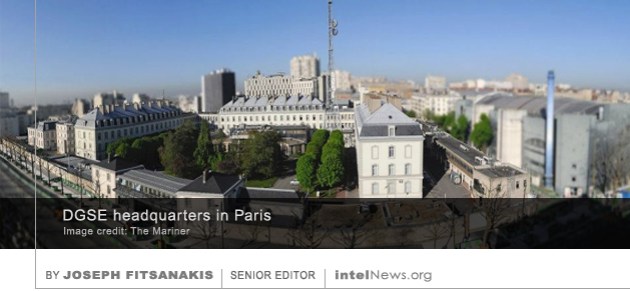
dgse franceFrance’s primary intelligence agency warned the country’s government this week that Russia has launched a secret operation to try to influence the outcome of the upcoming French presidential election in favor of the far right. According to the Paris-based weekly newspaper Le Canard Enchaîné, France’s Directorate-General for External Security (DGSE) has notified the country’s leadership that a covert operation by the Kremlin is already underway, and is expected to intensify in the run-up to April’s election. The spy agency allegedly believes that Russian efforts aim to promote Marine Le Pen, leader of the ultra-right National Front. Le Pen wants to curb immigration to France and remove the country from the European Union.
In an article published on Wednesday, Le Canard Enchaîné said the DGSE’s warning has alarmed the Élysée Palace. The paper also said that French President François Hollande, who chairs the country’s defense council, has decided to devote the entire agenda of the council’s next meeting to the subject of Russia’s alleged interference in the election. Anonymous sources told the paper that, according to a classified DGSE report, Russian spy agencies are using automated systems designed to “fill the Internet with tens of millions” of articles, images and memes that support the National Front candidate. Additionally, several news media that are controlled by Moscow will try to discredit Le Pen’s rivals for the presidency. At the same time, websites such as WikiLeaks —which some American commentators accuse of working with Moscow— will publish leaked information designed to damage Le Pen’s competitors.

The Le Canard Enchaîné allegations sound very similar to accusations leveled against the Kremlin by American intelligence agencies and by members of the United States Democratic Party. However, these allegations have not been supported by concrete evidence, and Russia denies that it had any involvement in last November’s presidential election in the US, which was won by Donald Trump.

Author: Joseph Fitsanakis | Date: 10 February | Permalink

Prominent Putin critic poisoned with unknown substance, say doctors

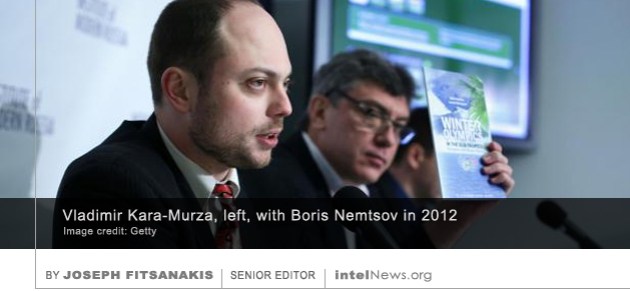
Vladimir Kara-MurzaA prominent member of the Russian opposition and vocal critic of the Kremlin, is fighting for his life in a Moscow hospital as a result of “acute poisoning from an undefined substance”, according to his doctors. Vladimir Kara-Murza, 35, is a senior figure in the Open Russia Foundation, a political pressure group founded by Mikhail Khodorkovsky. Khodorkovsky, an ultra-wealthy Russian businessman who was once estimated to be worth over $15 billion, has been living in Switzerland since 2013. Immediately prior to that, he served a 10-year prison sentence in Russia for tax evasion. In 2013, Kara-Murza was a member of a network of Putin critics who helped organize opposition protests in Moscow and Saint Petersburg. He also co-authored a number of reports accusing the administration of Russian President Vladimir Putin of corruption.
For several years now, Kara-Murza, his wife and three young children have been living in the United States. But he frequently travels back to Russia to meet with opposition activists and other organizers. For the past few weeks, Kara-Murza had been traveling in his homeland to help launch a new documentary film about the life and death of scientist and opposition figure Boris Nemtsov. Nemtsov served as Russia’s deputy prime minister for a few months in 1998, under Russian President Boris Yeltsin. After 2000, he became a vocal critic of the Putin administration. In late February 2015, Nemtsov was shot four times in the back and killed while walking with his girlfriend near Moscow’s Red Square. Opposition groups, including members of the Open Russia Foundation, claim that his murder was organized by the Kremlin.

Kara-Murza’s wife, Yevgeniya, said yesterday that her husband woke up suddenly in the early hours of last Thursday, finding it difficult to breathe. He was rushed to a Moscow hospital where he has been under a medically induced coma since Tuesday. His family said that, while visiting Russia in 2015, Kara-Murza was hospitalized with similar symptoms, and was diagnosed with “kidney failure in connection with poisoning”. He later claimed that he survived an attempt on his life by people in power who wanted to silence him. This time, said Kara-Murza’s wife, the family has sent blood samples to specialists in Israel and France, hoping that the poison that is allegedly inside his body can be identified.

Author: Joseph Fitsanakis | Date: 08 February 2017 | Permalink

Observers speak of uncertainty as North Korean leader fires spy chief

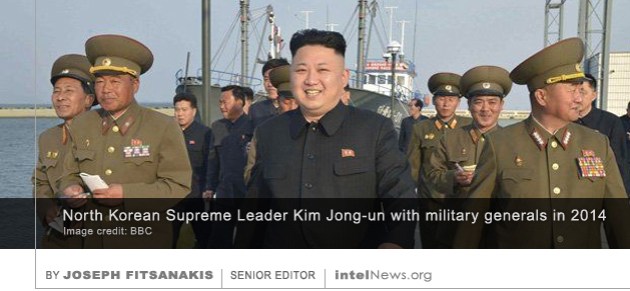
kim jong unObservers of North Korean politics raised alarm bells over the weekend, as it emerged that Supreme Leader Kim Jong-un fired his spy chief, interfering for the first time with a state institution that had not until now experienced major purges. The news circulated on Friday, following a report by South Korea’s Ministry of Unification —Seoul’s government department responsible for promoting the reunification of Korea. The ministry said that, according to its sources in the North, General Kim Won-hong had been dismissed from his post as Minister for State Security.


Kim is believed to have joined the Korean People’s Army (KPA) in 1962, at age 17. He rose through the ranks of the military to become a commander and a commissar (political officer) with the KPA’s General Political Bureau. In 1998, Kim was elected to North Korea’s Supreme People’s Assembly, which functions as the country’s parliament. In 2003, the North Korean leadership appointed Kim to director of the Military Security Command —the North Korean Army’s intelligence directorate. By 2009, Kim had been made a General and had entered the personal circle of Kim Jong-un. In 2011, when Kim Jong-un became supreme leader of North Korea, General Kim was widely viewed as one of his most trusted advisors. Few were surprised, therefore, when Kim was made State Security Minister, in April 2012. From that position, General Kim oversaw the activities of the regime’s secret state police, North Korea’s most powerful security institution, which is answerable only to the country’s supreme leader.

But it now appears that General Kim was dismissed from his powerful post two weeks into 2017, allegedly on charges of corruption and abuse of state power. Some reports suggest that his dismissal may be related to the defection of Thae Yong-ho, a senior North Korean diplomat who defected with his family while serving in the country’s embassy in London last year. It is also believed that Kim was demoted from a four-star to a one-star general.

Since he assumed power in the country in late 2011, Kim Jong-un has purged several layers of elite government apparatchiks. But he has not interfered in the country’s intelligence and security agencies. Thus, if General Kim was indeed dismissed, it would mark the first major demotion of a senior official in the Ministry of State Security in over six years. Some observers suggest that Kim’s demotion may mark the beginning of a major round of purges in the country’s security and intelligence services. But others think that that Kim was demoted by the country’s supreme leader in a pre-emptive action aimed at preventing a possible military coup against him.

Author: Joseph Fitsanakis | Date: 06 February 2017 | Permalink