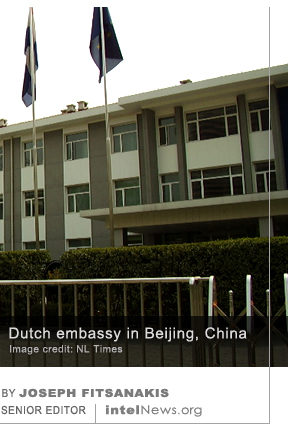
Holland suspends its ambassador to China due to suspected honey trap

Holland Embassy in ChinaThe Dutch government has suspended its ambassador to China and has launched an official investigation into an alleged secret relationship between the ambassador and a female Chinese employee at the Dutch embassy. The ambassador, Ron Keller, is a career diplomat and senior member of the Dutch foreign service corps, who has served in Russia and Turkey among other international posts. He assumed duties as Holland’s ambassador to China in late 2015. In December of that year, he arrived in Beijing and took command of one of the largest Dutch embassies in the world.

Last weekend, however, Dutch newspaper De Telegraaf reported that Keller had been suspended from his post after it was alleged that he had a secret affair with an employee at the embassy. The employee, whose name has not been released, is reportedly a female Chinese national. Her position at the embassy is not known, but is thought to be of a clerical nature. Foreign diplomats stationed in China —whether married or single— are routinely warned to avoid having intimate relationships with Chinese nationals due to concerns that the latter may be in the service of Chinese intelligence. Some refer to this practice as a ‘honey trap’.  In 2011, Taiwan suffered its most serious espionage case in over half a century when it was revealed that the director of the Taiwanese military’s Office of Communications and Information fell for a “tall, beautiful and chic” Chinese female operative, who held an Australian passport, but later turned out to be a Chinese intelligence officer. In 2014, a leaked British military report warned United Kingdom government officials of attempts by Chinese intelligence services to compromise them using sexual entrapment.

De Telegraaf said it contacted the Dutch Ministry of Foreign Affairs about Keller’s suspension. In a statement, the ministry confirmed the diplomat’s suspension but said that it could not comment on the case. The newspaper reported that Keller is currently back in Holland and that his return to Beijing in an official capacity is not likely.

Author: Joseph Fitsanakis | Date: 19 October 2016 | Permalink

Mossad had prior knowledge of Six-Day War plans, says Israeli ex-spy chief

first-post-hIsrael’s intelligence services had access to recordings of secret talks between Arab heads of state in 1965, which helped the Jewish state win the Six-Day War, according to the former director of the country’s Military Intelligence Directorate. The brief but important conflict, which is also known as the Third Arab-Israeli War, broke out on June 5, 1967, when the Egyptian, Syrian and Jordanian armies attacked Israel. But within hours the Jewish state had managed to decimate the assailants’ air forces, and went on to deliver fatal blows to its adversaries. By the end of the war, Israel’s territory had increased threefold and Israeli troops were in control of the West Bank, the Gaza Strip and the Sinai Peninsula, among other areas.
But according to Major General Shlomo Gazit, who directed Israel’s Military Intelligence Directorate in the 1970s, Israel’s victory was sealed in September 1965. At that time, a conference of Arab heads of state was held in Casablanca, Morocco, with the participation of senior Arab military commanders and intelligence chiefs. The centerpiece of the conference was a secret meeting where preparations were made for a war with the Jewish state. Participants discussed plans for setting up a joint Arab military command to coordinate the war and shared insights on the strength and state of readiness of their respective militaries.

Major General Gazit told the Israeli newspaper Yedioth Ahronoth that Morocco’s King Hassan II, who was mistrustful of his fellow Arab heads of state, invited the Israeli intelligence services to monitor the conference. Speaking to Yedioth Ahronoth’s military correspondent Ronen Bergman, Gazit said that a team of spies from the Mossad, Israel’s external intelligence service, and the Shin Bet, its domestic equivalent, arrived in Casablanca prior to the start of the conference. Acting on the King’s orders, Moroccan authorities designated an entire floor in the luxury hotel where the conference was held for the use of the Israelis. After the conference ended, King Hassan gave the Mossad copies of secret recordings of all closed-door meetings. These were promptly transcribed and translated into Hebrew by the Research Unit of Israel’s Military Intelligence Directorate, said Gazit.

According to the former spy chief, these transcripts produced “massive amounts of intelligence”. They were combined with other sources of information and crucially helped Israel anticipate the Six-Day War. Thanks to these recordings, said Gazit, Israel “was in full knowledge of how unprepared [the Arab forces] were for war”, especially the Egyptian forces, which were “in a terrible shape”. Israeli military commanders were thus certain that the Jewish state would prevail in an armed conflict with its Arab neighbors.

The public disclosure of the fact that the Mossad had access to the content of the secret negotiations between Arab leaders in 1965 is not new. Bergman and his fellow author Shlomo Nakdimon revealed it in a 2015 article about the broader intelligence relationship between Israel and Morocco in the 1960s and 1970s. But the latest revelation highlights the significance of the secret recordings for Israel’s military posture during the Six-Day War. Indeed, Bergman reports that, after the end of the war, Meir Amit, who was the then director of the Mossad, drafted a letter to Israel’s Prime Minster Levi Eshkol, in which he described the Casablanca operation as “one of the greatest moments of Israeli intelligence”.

Author: Joseph Fitsanakis | Date: 17 October 2016 | Permalink

NSA contractor charged with spying removed both electronic and printed files

NSAA United States federal contractor, who was charged with espionage after he was found to have stolen classified documents, was able to remove both electronic and printed files from his office at the National Security Agency, according to a report. The man was identified by The New York Times last week as Harold Thomas Martin III, a 51-year-old employee of Booz Allen Hamilton, one of the largest federal contractors in the US. Last August, agents of the Federal Bureau of Investigation raided Martin’s house in Maryland and arrested him on charges of stealing government property and illegally removing classified material.

In reporting on the disclosure earlier this week, we noted that the FBI found classified information “on a variety of electronic devices that Martin had stored —though apparently not hidden— in his house and car”. It turns out, however, that at least some of the classified files in Martin’s possession were in printed format. According to The Washington Post, which revealed this information on Wednesday, this means that Martin extracted the information from his office at the NSA “the old-fashioned way, by walking out of the workplace with printed-out papers he had hidden”. The paper cites unnamed US government officials who claim that Martin was repeatedly able to walk out the front door of the NSA with what one anonymous congressional aide described as “a whole bunch of stuff”. The paper alleged that printed classified material found in Martin’s possession amounts to “thousands of pages”.

It appears that Martin extracted most of the documents before the fall of 2013, when the NSA and other US intelligence agencies imposed strict security controls on data access following the defection of Edward Snowden, another federal contractor who worked for the NSA and is today living in Russia. But the revelation will undoubtedly raise further questions about the ability of US intelligence agencies to scrutinize the activities of hundreds of thousands of employees who have access to classified information. The Post notes that the NSA and other US intelligence agencies do not employ universal searches of personnel that enter or exit government facilities. Instead they prefer random checks for reasons of convenience and to foster a sense of trust among employees. That, however, may change if more cases like those of Snowden and Martin become known.

Author: Joseph Fitsanakis | Date: 14 October 2016 | Permalink

US files espionage charges against military contractors with Turkish ties

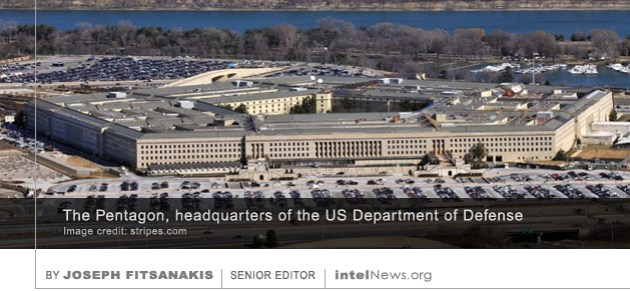
PentagonIn a development that is expected to contribute to the downward spiral in Turkish-American relations, the United States government has reportedly filed espionage charges against three Department of Defense contractors with Turkish background. The three are believed to have been charged with transferring US military secrets abroad and are currently in prison.


A statement published by the US Pentagon said that the group consists of two men and a woman, all of whom are of Turkish background. Two of them are naturalized American citizens. They are listed as owners of a company that conducts research in military technology and has contracted for many years with the US Pentagon. All contracts were allegedly won following competitive bids and can only be awarded to bidders who are in possession of US citizenship and top security clearances. According to Turkey’s pro-government English-language newspaper, Daily Sabah, the three contractors have helped develop and manufacture parts for missile-launching systems used on American warplanes. They have also worked on several generations of grenade launchers used by the US military.

But on Sunday, the three contractors were arrested in simultaneous raids and charged with “funneling military secrets out of the country”, according to Sabah. The paper said the US government decided to arrest the three once it became known that some hardware parts related to the Pentagon bids handled by their company were being illegally manufactured in Turkey. There is no information in the Pentagon’s press release on whether the top-secret military components were also shared with the Turkish government. Relations between Washington and Ankara, two North Atlantic Treaty Organization member-states, have suffered since the failed July 15 military coup in Turkey. Many in the administration of Turkish President Recep Tayyip Erdoğan blame Washington for the coup and for allegedly shielding the man behind it, the Islamic cleric Muhammed Fethullah Gülen, who lives in the US state of Pennsylvania.

Author: Joseph Fitsanakis | Date: 12 October 2016 | Permalink

Danish court halts sales of book written by former spy boss (updated)

Jakob Scharf's "Ten Years With the PET"

Jakob Scharf’s “Ten Years With the PET”

A court in Denmark has issued an injunction that prevents retail outlets from selling a book written by the former director of the country’s domestic intelligence agency. Titled Seven Years with the PET, the book is based on a series of interviews with Jakob Scharf, who directed Denmark’s Police Intelligence Service (PET) from 2007 to 2013. The book was scheduled for general release in bookstores across the country on October 17 by its publisher, People’s Press. By the end of the first week of October, the Copenhagen-based publisher had already supplied 5,000 copies of the book to 40 bookstores across Denmark, and several copies had already found their way into the hands of readers.

But last Friday night, the PET filed a request for an injunction to be placed on retail sales of the book, arguing that its pages might contain information pertaining to state secrets. The injunction was granted by a court in Copenhagen overnight, and communicated in the early hours of Saturday morning to the publisher, two online retailers and over 40 bookstores. The PET is listed as the requester of the injunction, and a rarely used ‘state secrets’ clause is given as justification for the urgent measure. On Saturday, the current director of the PET, Finn Borch Andersen, spoke to Denmark’s TV2 channel about the injunction. He told the television station that his agency filed the injunction after commercials appeared on television, advertising the book as “an exposure of PET operations”. He added that PET personnel “are currently reading” the book and that the agency will ask for the injunction to be lifted if no sensitive information is found.

But on Monday, Danish newspaper Politiken said it would defy the court injunction and publish excerpts of Scharf’s book. Speaking on the same day, the paper’s editor-in-chief, Christian Jensen, dismissed the ban, which he said “directly attacks the fundamental liberties on which our open society and free press depends”. Politiken had been scheduled to serialize Scharf’s book and was among the recipients of the court injunction.

The PET made headlines in 2012, after it was revealed that one of its double agents, Morten Storm, successfully infiltrated al-Qaeda in the Arabian Peninsula (AQAP). The revelation caused controversy in Denmark because of Storm’s admission that he broke domestic and international law in the course of his activities, and led to a pledge by the country’s justice minister to impose more governmental control over the PET. Scharf, who led the agency from 2007 to 2013, was head of the organization after Denmark became targeted by Islamist extremists, following the publication in 2005 of cartoons depicting the Prophet Muhammad. The latter is considered sacrilegious by literalist Muslims, including organizations that espouse militant versions of Islam.

Update Oct. 11, 2016, 12:35 GMT: It appears that Politiken proceeded to publish nearly the entire book on Sunday and Monday. The PET has just announced that it will withdraw its injunction request against the publication of the book, because it cannot be practically enforced at this point.

Author: Joseph Fitsanakis | Date: 11 October 2016 | Permalink

Arrested contractor may have worked for NSA’s elite cyber spy unit

NSAA United States federal contractor, who remains in detention following his arrest last summer for stealing classified documents, may have worked for an elite cyber espionage unit of the National Security Agency. The man was identified by The New York Times last week as Harold Thomas Martin III, a 51-year-old employee of Booz Allen Hamilton, one of the largest federal contractors in the US. The paper said that, prior to joining Booz Allen Hamilton, Martin served as a US Navy officer for over a decade, where he specialized in cyber security and acquired a top secret clearance. But last August, agents of the Federal Bureau of Investigation raided Martin’s house in Maryland and arrested him on charges of stealing government property and illegally removing classified material.

Media reports suggest that the FBI discovered significant quantities of classified information, some of it dating back to 2006, on a variety of electronic devices that Martin had stored —though apparently not hidden— in his house and car. Another interesting aspect of the case is that there is no proof at this point that Martin actually shared the classified information with a third party. There is some speculation that he may be behind a disclosure of a collection of NSA hacking tools, which were leaked in August of this year by a previously unknown group calling itself “the Shadow Brokers”. But some speculate that Martin may have taken the classified material home so he could write his dissertation for the PhD he is currently undertaking at the University of Maryland’s Information Systems program.

A few days ago, The Daily Beast quoted an unnamed former colleague of Martin who said that the NSA contractor was a member of one of the agency’s elite cyber spy units. The existence of the secretive unit, which is known as the NSA’s Office of Tailored Access Operations, was revealed in June 2013 by veteran NSA watcher Matthew M. Aid. Writing in Foreign Policy, Aid cited “a number of highly confidential sources” in alleging that the NSA maintained a substantial “hacker army” tasked with conducting offensive cyber espionage against foreign targets. More information on NSA’s TAO was provided in January 2014 by German newsmagazine Der Spiegel. If The Daily Beast’s allegations about Martin are accurate, they would explain why anonymous government sources told The Washington Post last week that some of the documents Martin took home “could be expected to cause exceptionally grave damage to the national security of the United States”. The case also highlights the constant tension between security and the privatization of intelligence, which was also a major parameter in the case of Edward Snowden, another Booz Allen Hamilton contractor who defected to Russia in 2013.

Meanwhile, Martin remains in detention. If he is convicted, he will face up to 11 years behind bars.

Author: Joseph Fitsanakis | Date: 10 October 2016 | Permalink

Comment: Far-right militancy just as dangerous as Islamist extremism

Dylann RoofMany in the United States associate terrorism with contemporary versions of militant Islam. The data, however, tells a different story: since 2002, domestic extremists who hold far-right ideologies have struck more often and have killed more people than Islamic-inspired radicals. This blog has argued in the past that American counterterrorism policy creates a security vacuum by over-concentrating on Islamic-inspired radicals and largely ignoring domestic terrorist groups. In an insightful article published earlier this year in Newsweek magazine, Kurt Eichenwald, a 20-year veteran of investigative reporting and author of The Informant, argues that far-right radicalism is a bigger threat to American security than Islamic militancy, including the Islamic State.

Eichenwald cites a report by Duke University’s Triangle Center on Terrorism and Homeland Security, which was based on surveys from 382 law enforcement groups across the US. The report, published in June of last year, argues that American “law enforcement agencies […] consider anti-government violent extremists, not radicalized Muslims, to be the most severe threat of political violence” they face. He also points to increasing incidents of surveillance of Muslim schools, religious and community centers in nearly a dozen states by members of far-right militia groups for what informants describe as “operational purposes”.

American counterterrorism specialists understand that the term “far-right militancy” encompasses thousands of groups of various sizes and capabilities, which are both wildly diverse and constantly evolving, says Eichenwald. Most experts separate the members of these groups into three distinct categories, namely violent racists, anti-federalist (or anti-government) radicals, and religious fundamentalists. These factions, which include dozens of sub-factions, do not usually work together and even have adversarial relations with each other. Violent racists operate as members of groups such as the Ku Klux Klan in mostly rural and semi-urban settings. In urban environments, neo-Nazi and skinhead groups are more prevalent than the KKK. Anti-government radicals join armed militias that espouse various ideologies representing the so-called “sovereign citizens” worldview —namely the belief that federal, state or local laws are tyrannical and do not apply to them. The final category, religious fundamentalists, are members of various Christian identity groups that prioritize the Bible over the US Constitution and support the violent imposition of Christian religious codes on social life.

The list of these groups is growing, says Eichenwald, largely in reaction to economic pressures caused by the deep recession of 2007. The ascendency of Barack Obama to the US presidency has also radicalized the racist-oriented far right, he says, which overlaps to some extent with the militia movement. In 2008 there were 42 organized militia groups operating in the US. Today there are 276, he says, referring to information provided by the Alabama-based Southern Poverty Law Center. There is no doubt that Islamic fundamentalism poses clear dangers to US security. But, as Eichenwald argues, this country has been extremely lucky to have avoided a repeat of the 1995 attack on the Oklahoma Federal Building, which was carried out by a white supremacist guided by militant anti-government ideas. A repeat of such a massacre in recent years has not been due to lack of trying, says Eichenwald, and ignoring the problem will not make it go away.

Author: Joseph Fitsanakis | Date: 06 October 2016 | Permalink

Public event held in Cuba for the first time to demand release of US spy

Ana Belen MontesA public event has been held for the first time in Havana to demand the release Ana Belen Montes, an American former intelligence analyst who is serving a 25-year prison term for spying on the United States for Cuba. The event appeared to be sanctioned by the Cuban government and is bound to reignite rumors that a deal between Washington and Havana to release Montes may be in the works.

Montes grew up in Kansas. In 1985 she joined the US Defense Intelligence Agency, which collects and analyzes military-related information from abroad. Montes quickly distinguished herself in the DIA, and by the mid-1990s she was seen as one of the US government’s most knowledgeable and capable Cuba experts. She was the main author of nearly every major assessment on Cuba that was produced by the US Intelligence Community in the 1990s. But on September 21, 2001, Montes was arrested by the Federal Bureau of Investigation and charged with having committed espionage for Cuba. During her trial, US government prosecutors argued that Montes had been recruited by Cuban intelligence before she joined the DIA, and that she eventually compromised every US intelligence collection program targeting the Caribbean island. The former DIA analyst was also accused of having given Havana the identities of US intelligence officers who had secretly operated in Cuba. In 2002, Montes was sentenced to 25 years in prison, after pleading guilty to having committed espionage throughout her 16-year career in the DIA.

In recent months, there has been speculation that Montes could be released and allowed to relocate to Cuba. In return, Havana would reportedly extradite to the US Assata Shakur, a former member of militant black nationalist groups in the United States, who is accused of the 1973 murder of a state trooper in New Jersey. These rumors were denied by the US Department of State in August. Last week, however, the first public event took place in Havana to demand Montes’ release. The event featured performances by artists, as well as a keynote speech by Manuel David Orrio, a retired officer in the Cuban General Intelligence Directorate (DGI). Orio told those present at the event in downtown Havana that committees to demand Montes’ release had been formed in several Cuban provinces, as well as in Sweden, France, Puerto Rico and the Dominican Republic. He added that formally requesting Montes’ release would be an “extremely complex” and delicate affair for the Cuban government, but that social pressure groups were free to press US officials.

In the past, the Cuban government has been silent about Montes’ case, and very few Cubans are aware of her existence. The fact that the government is now mobilizing popular committees and other pressure groups may point to a change of policy in Havana.

Author: Joseph Fitsanakis | Date: 28 September 2016 | Permalink

Is Chinese salvage ship searching for flight MH370 spying on Australia?

DONG HAI JIU 101The Chinese embassy in Canberra has strongly denied accusations that a Chinese government ship involved in the international effort to find the missing Malaysia Airlines Flight MH370 is spying on the Royal Australian Navy. The ship, the Dong Hai Jiu 101, is a salvage and rescue vessel built in Shanghai in 2012 and currently sailing under the Chinese flag. In April, the Chinese government contracted the Dong Hai Jiu 101 to join the international search effort for the wreckage of Flight MH370. The Boeing 777 aircraft disappeared over the South China Sea on March 8, 2014, while flying from Kuala Lumpur International Airport in Malaysia, to the Beijing Capital International Airport in China.

Only a few pieces of debris, purportedly belonging to the plane, have been found, despite the most extensive and costly search in aviation history. The coordinated international search began off the coast of Thailand last year and is currently focused on the seabed off the city of Perth in Western Australia. The Dong Hai Jiu 101 has been sailing in the area since April of this year, along with three other search and rescue vessels. Last week, however, The Australian newspaper published interviews with several security experts who expressed the opinion that the Dong Hai Jiu 101 may be collecting intelligence on Australia for the Chinese government. The alleged intelligence collection is probably of maritime nature and probably involves hydrophonic instrumentation to track submarine movements, said the experts.

But the Chinese government responded quickly, issuing a strong denial through its embassy in Canberra. An embassy spokesman reminded The Australian that 154 of 239 passengers and crew on Flight MH370 were Chinese, and therefore Beijing has a “strong obligation” to participate in the international search effort. Additionally, said the statement, the Chinese vessel is sailing off the Australian coast with the consent of the Australian government, and in coordination with the Australian Transport Safety Bureau, using underwater search equipment supplied by an American-based company. The Australian government has not made a statement on the matter.

Author: Ian Allen | Date: 27 September 2016 | Permalink

Britain’s MI6 to increase its size by 40% in four years

MI6Britain’s primary external intelligence agency, MI6, will see a 40 percent increase in personnel numbers in the next four years, according to a new report. The agency, which is formally known as the Secret Intelligence Service, currently employs about 2,500 people. But the BBC said on Wednesday that the number of MI6 employees will rise to approximately 3,500 by 2020. The broadcaster said that no public announcement had been made about the planned increase, but that it had verified the information “via Whitehall sources”, referring to the official seat of the British government.

If the BBC’s report is accurate, the planned increase will be the biggest personnel boost for MI6 since the Cold War. It reflects a renewed emphasis in foreign intelligence collection using human sources, which is the primary task of the spy agency. The broadcaster said that the increase in personnel has been “made necessary by the development of the Internet and technology” in recent years. Earlier this week, the director of MI6, Alex Younger, said during a panel presentation in Washington, DC, that the operating environment of MI6 had fundamentally changed due to “the information revolution”. The latter, he said, presented the agency with “an existential threat” and a “golden opportunity” at the same time.

The reported increase is consistent with an announcement made by the then British Prime Minister David Cameron in November 2015, that London would boost significantly the size of its intelligence services. Cameron made the announcement shortly after the terrorist attacks in Paris, which killed over 130 people and injured 700. In a subsequent report, called the 2015 Strategic Defence and Security Review, the British government said it would incorporate 1,900 additional staff to its intelligence and security services. It now appears that over half of these new recruits will join MI6, while the Security Service (MI5), the Government Communications Headquarters (GCHQ) and the Metropolitan Police’s Counter Terrorist Command will hire the remaining 900 people.

A similar rise in personnel numbers occurred after the July 7 London bus bombings in 2005. Following those attacks, the MI5, which focuses on domestic security and counterterrorism, saw its personnel size increase by approximately 35 percent.

Author: Joseph Fitsanakis | Date: 23 September 2016 | Permalink

Informer accuses Sinn Féin leader of ordering British spy’s murder

Denis DonaldsonA former member of the Provisional Irish Republican Army, who was an agent for the British security services, has alleged that Gerry Adams, leader of the second-largest political party in Northern Ireland, ordered the killing of a British spy in 2006. The former agent was referring to the killing of Denis Donaldson, a senior member of the Provisional IRA, who was found dead months after it was revealed that he had been secretly spying on the republican organization on behalf of British intelligence.

In December 2005, Adams announced at a press conference in Dublin, Ireland, that Donaldson had been a spy for the British government inside the Provisional IRA and its political wing, Sinn Féin. Soon after Adams’ revelation, Donaldson read a prepared statement on Ireland’s RTÉ television station, admitting that he had been recruited as a spy by the British Security Service (MI5) and the Special Branch of the Royal Ulster Constabulary (known today as the Police Service of Northern Ireland). Following his public admission, Donaldson was nowhere to be found. However, in March 2006, a reporter for a British tabloid newspaper found Donaldson living in a remote farmhouse in Northern Ireland’s County Donegal. Weeks later, Donaldson was shot dead in his cottage by persons unknown. In 2009, the Real IRA, a Provisional IRA splinter group that disagreed with the Good Friday Agreement and subsequent cessation of hostilities, took responsibility for Donaldson’s killing.

On Tuesday, a man who claims he was an informant for British intelligence inside Sinn Féin and the Provisional IRA alleged that Donaldson’s killing was ordered by Adams himself. The man, who spoke on the BBC’s Spotlight program, could not be identified due to concerns about his personal safety. He said during a televised interview that he knew from his “experience in the IRA that murders have to be approved by […] the leadership of the IRA and the military leadership of the IRA”. When asked by the report who he was “specifically referring to”, the former informant answered: “Gerry Adams. He gives the final say”. On Wednesday, Adams denied any involvement in the killing, saying he wished to “specifically and categorically refute these unsubstantiated allegations”. The leader of Sinn Féin went on to claim that the accusations against him were “part of the British security agencies’ ongoing attempts to smear republicans and cover-up their own actions”. Adams’ lawyer said late on Wednesday that his client was considering launching a lawsuit against the BBC for defamation.

Author: Joseph Fitsanakis | Date: 22 September 2016 | Permalink

British judge denies request to name alleged new member of Cambridge spy ring

Corpus Christi College CambridgeA document that allegedly contains the name of a man who could be connected to one of the most sensational spy rings of the Cold War is to remain secret after a judge rejected a request to have it released. The man is believed by some to have been associated with the so-called ‘Cambridge spy ring’, a group of upper-class British graduates of Cambridge University, who spied for the USSR from the 1930s until the 1960s. Among them was Guy Burgess, Donald Maclean and H.A.R. “Kim” Philby, all of whom eventually defected to the Soviet Union. In 1979, it was revealed that Anthony Blunt, an art history professor who in 1945 became Surveyor of the King’s Pictures and was knighted in 1954, was also a member of the group. A fifth member, career civil servant and former intelligence officer John Cairncross, was publicly outed as a Soviet in 1990, shortly before his death.

Over the years, more individuals have been suggested by historians as potential members of the group, including intelligence officers Leo Long and Guy Liddell, academics Ludwig Wittgenstein and Andrew Gow, and physicist Wilfrid Mann. But according to British newspaper The Daily Mail, another individual may be identified in a classified document as a possible member of the Cambridge spy ring. The document was allegedly traced by Andrew Lownie, who authored the recently published Stalin’s Englishman: The Lives of Guy Burgess. Lownie filed a Freedom of Information request to have the document, which is held at the National Archives in London, released. But the request was denied, and a judge has now upheld the decision.

In denying the request, the judge argued that the man named in the document is still alive and that a possible release of the document could “jeopardize […] personal relationships”. He also contended that the case is too old to warrant immediate public interest, and thus there was “no pressing need” to declassify the file. The Mail speculates that the individual named in the document could have cooperated with the British government in the past in return for protection, or that the file in question may contain details that could embarrass the British government.

Author: Joseph Fitsanakis | Date: 20 September 2016 | Permalink

Cease-fire near collapse after US airstrike kills 62 and injures 100 Syrian troops

Deir al-Zour SyriaA cease-fire that was launched with much fanfare by the United States and Russia last week appeared in tatters on Sunday night, after Washington acknowledged it mistakenly killed over 60 Syrian troops on Saturday. American officials expressed regret for the alleged error, but Syrian and Russian officials accused Washington of deliberately sabotaging the cease-fire agreement. Russian sources said the US air strike killed 62 and injured over 100 Syrian government troops who were engaged in a battle against Islamic State forces in Syria’s eastern province of Deir al-Zour. American military officials insisted that the pilots, who flew into Syria from bases in Iraq, believed they were targeting Islamic State forces. The operation was allegedly aborted as soon as US forces were notified by the Russian military that Syrian government troops were being targeted.

According to media reports, the US government has apologized to Damascus though Russian intermediaries for the “unintentional loss of life of Syrian forces”. But the incident has incensed Moscow, as it marks the first known engagement between US and Syrian forces since American military forces began fighting the Islamic State in 2014. The incident was described by The Washington Post late on Saturday as having sparked “one of the most hostile diplomatic exchanges between Washington and Moscow in recent years”. Soon after the US airstrike, Russia called an emergency meeting of the United Nations Security Council, during which the Russian delegation accused the United States of deliberately trying to derail the cease-fire. According to reports, the American delegation stormed out of the closed-door meeting and denounced it as a “stunt” after the Russians openly accused Washington of aiding the Islamic State and al-Qaeda in Syria.

American officials have launched an investigation into Saturday’s incident and are so far refusing to speculate whether it was caused by human error or an intelligence failure. In Washington, a State Department spokesman insisted that “coalition forces would not intentionally strike a known a Syrian military unit”. But in a statement issued on Saturday, Russian Major General Igor Konashenkov said that, if the US air strike was in error, it was a “direct outcome of the US side’s stubborn unwillingness to coordinate its activities  in Syria with Russia”.

Author: Joseph Fitsanakis | Date: 19 September 2016 | Permalink

France’s ex-cyber spy chief speaks candidly about hacking operations

Bernard BarbierThe former director of France’s cyber spy agency has spoken candidly about the recent activities and current state of French cyber espionage, admitting for the first time that France engages in offensive cyber operations. Between 2006 and 2013, Bernard Barbier was director of the technical division of the General Directorate for External Security, France’s external intelligence agency, which is commonly known as DGSE. During his tenure at DGSE, the organization’s technical division witnessed unprecedented financial and administrative growth. Today it is said to employ over 2500 people, nearly half of DGSE’s total personnel.

Earlier this month, Barbier was interviewed on stage during a symposium held by the CentraleSupélec, a top French engineering university based in Paris. He spoke with surprising candor about France’s cyber espionage operations. In the first part of his interview, which can be watched on YouTube, he recounted the history of what he described as “France’s cyber army”. He said that France began to build “teams of hackers” in 1992. Around that time, the DGSE purchased an American-built Cray supercomputer, said Barbier, and soon discovered that it could use the machine’s immense computing power to break passwords. More recently, said the former cyber spy chief, the DGSE has been trying to “catch up” with its American and British counterparts, the National Security Agency and the Government Communications Headquarters, by increasing its annual budget to over half a billion and hiring hundreds of young hackers. Many of these new employees have little to no university education, said Barbier, and are instead self-taught, having started hacking in their teenage years.

Like most governments, France will not officially admit to conducting offensive cyber operations using computer hacking and other techniques. But Barbier said during his interview that France was behind an offensive cyber operation that targeted Iran in 2009. He added that the DGSE has also directed cyber operations against Canada, Ivory Coast, Algeria, Norway, as well as its European Union partners Spain and Greece. He also complained that French government executives do not understand the importance of cyber operations and are not aiming high enough when it comes to planning, direction and hiring. The DGSE’s technical division still needs between 200 and 300 more staff members, Barbier argued in his interview.

Author: Joseph Fitsanakis | Date: 16 September 2016 | Permalink

US spy agencies are significantly expanding operations against Russia

CIAAmerican intelligence agencies are diverting counterterrorist resources to Russian accounts, prompting some commentators to describe the move as the greatest expansion of spy operations against Russia since the Cold War. In a leading article published on Wednesday, The Washington Post’s Greg Miller cites unnamed United States officials in describing “a shift in resources across spy services”. The shift allegedly reflects an increasing emphasis on Russia, with many of the resources coming from accounts focusing on terrorism threats and war zones in the Middle East and Central Asia, which were created in the aftermath of 9/11.

In contrast to the Cold War, when US intelligence agencies devoted most of their resources to the Soviet Union and its allies around the world, today the US Intelligence Community designates “at most 10 percent” of its budget on espionage targeting Russia, according to Miller. But this is now beginning to change, he says, as the Office of the Director of National Intelligence has now “moved Russia up the list of intelligence priorities for the first time since the Soviet Union’s collapse” in 1991. This move, which reflects current national-security priorities in the White House, will have a spiraling effect on the resources devoted to Russia by every American intelligence agency. There will be more human intelligence collection conducted by the CIA against Russian targets, more attention paid by the National Security Agency to Russian communications, and more reconnaissance activity over Russia by satellites operated by the National Reconnaissance Office, among other changes.

This change in direction comes after a prolonged period of tension between Washington and Moscow, which has been marked by America’s intervention in North Africa during the Arab Spring, which Moscow strongly objected to, Russia’s annexation of Crimea, the Syrian Civil War, and numerous instances of cyber espionage. As a result, says Miller, “surging tensions now cut across nearly every aspect of the US-Russia relationship”. He adds that some voices in Washington have raised concerns about the slow response by the US Intelligence Community to Russia’s resurgence as a world actor, especially in Eastern Europe and the Middle East. He quotes one unnamed senior US intelligence official as saying that American spy agencies are now “playing catch-up big time with Russia”. However, some US officials stress that, given the level of reduction in US intelligence capabilities targeting Russia since 1991, it will take years to rebuild them. Regardless, they say, there is no desire in Washington to return to Cold War levels of intelligence activity any time soon.

Author: Joseph Fitsanakis | Date: 15 September 2016 | Permalink