US spied on 143-member Iran delegation to 2007 UN summit

Manouchehr Mottaki and Mahmoud AhmadinejadThe United States National Security Agency spied on the Iranian president, foreign minister, and over 140 Iranian dignitaries who visited New York in 2007 to participate in the United Nations General Assembly. The allegation was aired on Wednesday by American television station NBC, which cited former intelligence officials and a top-secret report on the espionage operation. The original report was included in an October 2007 issue of SID Daily, an internal NSA newsletter published by the spy agency’s Signal Intelligence Division. The report, which is entitled “Tips for a Successful Quick Reaction Capability”, commends the espionage operation against the Iranian UN delegation as an exemplary illustration of a collaborative effort between managers, technical experts, and analysts.

The operation appears to have been directly initiated in early 2007 by the George W. Bush White House, which asked the NSA to spy on Iran’s UN delegation. The blanket permission included espionage conducted against the then Iranian President Mahmoud Ahmadinejad and Minister of Foreign Affairs Manouchehr Mottaki, who were scheduled to be in New York in September of that year to attend the 62nd session of the UN General Assembly. In response to the White House authorization, the NSA deployed a small army of technical experts and analysts to spy on the entire 143-member Iranian delegation for 19 hours a day during the summit.

The NSA teams were allegedly able to record, transcribe and analyze 2,000 conversations of various lengths per day. According to NBC, the NSA was able to intercept the personal conversations of President Ahmadinejad, a number of video conferences involving members of the Iranian delegation, as well as calls made using Skype. The latter were intercepted using a secret technology codenamed BLARNEY by NSA, while the agency also relied on bugs installed in hotel and conference rooms used by the Iranians, said NBC. The intercepted communications were subsequently examined by the NSA’s Social Network Analysis Office in an effort to map the “social networks” of the Iranian government’s senior echelons.

The Iranian government did not respond to NBC’s requests for comment. Iranian President Hassan Rouhani is scheduled to arrive in New York today to attend the 70th UN General Assembly debate.

Author: Joseph Fitsanakis | Date: 24 September 2015 | Permalink

New study documents views of defectors from Islamic State

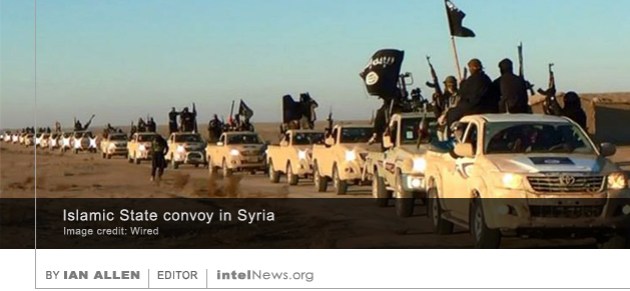
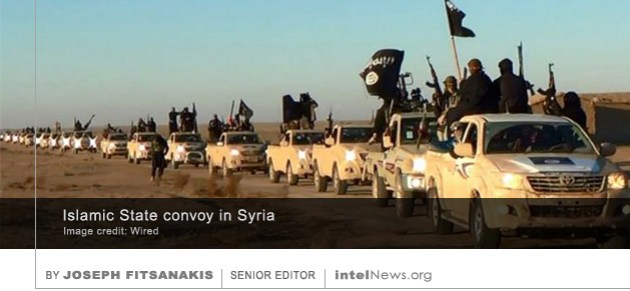
Islamic State convoy in SyriaA new study by a British-based organization details for the first time the views of dozens of former Islamic State fighters who have defected from the group in the past year. The study shows that most defectors were disillusioned after witnessing high levels of corruption among Islamic State members, or in response to the extreme violence perpetrated by the group against other Sunni Muslims. The research was carried out by the London-based International Center for the Study of Radicalization and Political Violence (ICSR), which said it gathered the publicly expressed views of nearly 60 Islamic State members who left the organization between August 2014 and August 2015.

According to ICSR Director Peter Neumann, who authored the report (.pdf), just over 30 percent of the defectors from the Islamic State are Syrian citizens, while one in four were born in other Middle Eastern countries. Neumann told a press conference held in London on Monday that many of the defectors saw life under the rule of the Islamic State as too austere. They also believed that the group was too unforgiving against fellow Sunni Muslims who did not agree with its stern doctrine. Some of the defectors complained that Islamic State commanders were more interested in launching attacks against other Sunni rebel groups than against the government of Syria, which is ostensibly the Islamic State’s foremost rival. Additionally, some defectors said that Islamic State commanders were obsessed and paranoid about alleged traitors and spies within the group’s ranks, and that they often ordered the execution of Islamic State fighters based on little or no evidence.

A smaller number of defectors said they had experienced racism from other Islamic State members, while others said that combat duties under Islamic State command was neither action-filled nor heroic. Moreover, luxury goods looted from civilians were rarely handed down to regular Islamic State troops by their commanders. Some defectors also stated that non-Arab fighters were used “as cannon fodder” by the Islamic State in battles that took place in Syria and Iraq. Neumann told reporters on Monday that the ICSR study challenged the portrayal of harmony and dedication that the Islamic State had carefully cultivated on social media.

Author: Joseph Fitsanakis | Date: 23 September 2015 | Permalink

‘End of an era’ as feared Algerian spy chief is removed from office

Mohamed MedièneIn an unprecedented development described by local media as the “end of an era”, the longtime director of Algeria’s main intelligence agency, and one of the country’s most powerful figures, has been removed from office. Until last Sunday, General Mohamed Mediène was described as the world’s longest-serving intelligence chief, having led Algeria’s Department of Intelligence and Security since 1990. Known by its initials, DRS, the organization grew rapidly in size and power during the Algerian Civil War of the 1990s. After an electoral victory by the Islamic Salvation Front (FIS) was quashed in a military-led coup, General Mediène took advantage of the country’s fragile security situation to strengthen the DRS and his own political influence. He became a staunch ally of Algerian President Abdelaziz Bouteflika and created what some have called “a state within a state”.
The general cultivated an aura of mystique, going to great pains to avoid publicity. His name did not appear in print until 2014, while a photograph of him was published for the first time in an Algerian paper on Sunday. According to The New York Times, Mediène’s many critics claim that he was able to hang on to power for so long by systematically “blackmailing politicians and other public figures” throughout his tenure. But the General’s removal from DRS was announced unexpectedly on Sunday, ostensibly in fulfilment of President Bouteflika’s stated goal of imposing more civilian control of the Algerian military. Mediène’s sudden removal follows the arrest in August of a number of other senior intelligence figures, including General Abdelkader Ait-Ouarabi, who served as DRS’s senior counterterrorism official for two decades under Mediène.

Many believe that the removal of DRS’ senior leadership was sparked by a widening rift between Bouteflika and Mediène. Last year, when Bouteflika announced that he would run for a fourth term, Mediène let it be known that he did not approve of the president’s decision. The ailing leader, who is 78, suffered a severe stroke in 2013, and has avoided public appearances since that time, giving rise to constant rumors about possible successors, or even machinations for coups by members of the armed forces. The Reuters news agency reported on Sunday that General Mediène has been replaced by General Athmane Tartag, who has served as President Bouteflika’s security advisor for several years.

Author: Joseph Fitsanakis | Date: 16 September 2015 | Permalink

Obama delegation switches hotels allegedly due to espionage fears

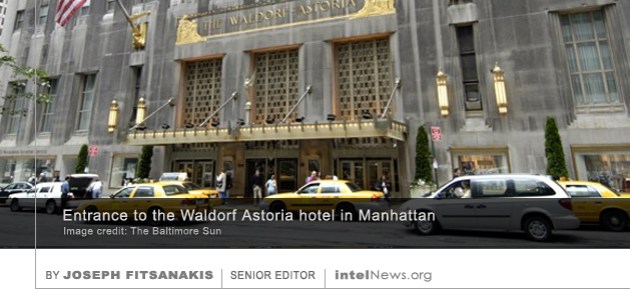
Waldorf AstoriaThe president of the United States and his delegation will be housed at a different hotel during a United Nations General Assembly meeting later this month, allegedly due to concerns over Chinese espionage activity. Since the late 1940s, the American president and his diplomatic entourage have resided at the Waldorf Astoria for several days in September, while attending the annual UN General Assembly in New York. The luxury hotel, which is located on Park Avenue on the island of Manhattan, has also served since 1947 as the residence of the US ambassador to the UN. That is also why the American delegation is usually hosted there, courtesy of the ambassador. This year, however, President Barack Obama and his sizeable delegation will be staying at the New York Palace Hotel, located at the corner of Manhattan’s 50th Street and Madison Avenue. The announcement was made last week by the White House and the US Department of State.
According to The Associated Press and The New York Times, the decision to relocate the American high-level delegation is primarily due to security concerns. The reports cited well-placed sources in the US government as stating that the relocation was prompted by the sale last year of the Waldorf Astoria to the Chinese firm Anbang Insurance Group. The McLean, VA-headquartered Hilton Worldwide Holdings, Inc., which sold the hotel to the Chinese firm, pocketed nearly $2 billion from the transaction. Based on the terms of the agreement, the American company will continue to operate the Waldorf Astoria until 2114. But Anbang announced last spring that the hotel would be undergoing a massive renovation program, which, according to media reports, has alarmed American counterintelligence officials. The latter are concerned that Chinese intelligence technicians may use the renovation to install eavesdropping equipment in Waldorf Astoria’s rooms and compromise the hotel’s Internet network.

The US diplomatic exit from the Waldorf Astoria was first reported back in mid-June, but was not confirmed by the White House or the Department of State. Since that time, no American cabinet official, including Secretary of State John Kerry and Vice President Joe Biden, has stayed at the Waldorf. But President Obama’s upcoming trip renewed the media’s interest in the change of hotels, and US government officials finally confirmed that the Chinese-owned hotel had been dropped based “on several considerations, including space, costs and security”. A State Department official told reporters last week that the change took “into account changing circumstances”. The Times also reported that the US government is examining whether its ambassador to the UN will continue to be headquartered at the Waldorf.

Author: Joseph Fitsanakis | Date: 14 September 2015 | Permalink

Pentagon continues to probe ISIS reports after US intel analysts “revolt”

ISIS - JFThe United States Department of Defense is still probing claims that some of its officials doctored intelligence reports to give a falsely optimistic account of the campaign against the Islamic State. IntelNews has followed this story since late August, after initial reports surfaced in The New York Times. The reports suggested that at least one analyst in the Defense Intelligence Agency (DIA), the Pentagon’s primary human-intelligence agency, had complained that reports about ISIS were being deliberately tweaked by officials at the US Central Command (CENTCOM), the Pentagon body that directs and coordinates American military operations in Egypt, the Middle East and Central Asia. Some of the reports related to al-Qaeda activity in Iraq and Syria, but most were about the Islamic State of Iraq and Syria (ISIS), the militant Sunni organization that controls large swathes of territory in Iraq and Syria.
According to The Daily Beast, more than 50 intelligence analysts from the DIA have now come forward to complain to the Pentagon’s Office of the Inspector General that their reports on the Islamic State were altered by CENTCOM officials, in order to give a falsely positive projection of US policy in relation to the organization. The website said that some of the analysts have been complaining for months about what they describe as the deliberate politicization of their reports by CENTCOM. But their complaints are now part of an official investigation into the matter by the Inspector General. The latter is required to produce a report with the intelligence oversight committees of the US Congress.

The Daily Beast said that its reporting was based on nearly a dozen individuals who were “knowledgeable about the details of the report”. But it said that it would not name its sources due to the sensitivity of the case. It did, however, quote one source, who described case as “a revolt” by intelligence analysts. Another source described the altering of the analysts’ intelligence reports as a “cancer […] within the senior level of the intelligence command”. A source identified only as “a defense official”, told the website that the analysts’ “revolt” was prompted by the experience of the US invasion of Iraq in 2003. At that time, “poorly written intelligence reports suggesting Iraq had weapons of mass destruction, when it did not, formed the basis of the George W. Bush administration’s case for war”, said the official. And continued: the analysts “were frustrated because they didn’t do the right thing then and speak up about their doubts on Iraq’s weapons program”.

Author: Joseph Fitsanakis | Date: 11 September 2015 | Permalink

Dual US-Russian citizen pleads guilty to spying for Russia

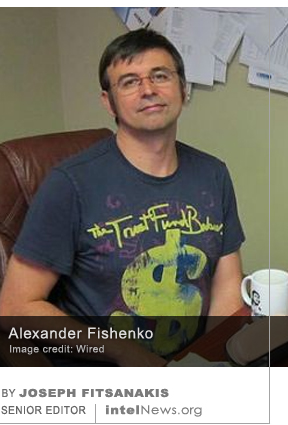
Alexander FishenkoA resident of Texas, who is accused by United States authorities of setting up a front company in order to illegally acquire American technology on behalf of Russia’s intelligence services, has pleaded guilty to espionage charges. Alexander Fishenko, 49, was one of 11 people arrested in October 2012 by the Federal Bureau of Investigation. The arrests came during several raids in locations around Houston, Texas, which included the headquarters of Arc Electronics, Inc. The FBI accused the export firm of having shipped over $50 million-worth of military-grade micro-electronics since 2008. The supplies were received in Moscow, Russia, by a mysterious procurement company called Apex System LLC. Counter-intelligence investigators in the US claim that both firms are part of an elaborate scheme set up by Russian military intelligence, aimed at stealing dual-use electronics hardware created by American firms.
According to the indictment, Arc Electronics told its US suppliers that the microelectronics technologies were intended for use in various types of streetlights. But in reality, said the FBI, the company gave the hi-tech supplies to the Russian Ministry of Defense for use in airborne surveillance systems, as well as in remote weapons guidance systems, among other military applications. Federal prosecutors said that, for over four years, Arc Electronics engaged in a prolonged “surreptitious and systematic” scheme to circumvent US government export controls, thus seriously damaging US national security. Following the early-morning raids, the FBI unsealed indictments against 11 Arc Electronics employees, most of whom were charged with “acting as unregistered agents of the Russian Federation in the United States” —legal jargon for espionage.

Fishenko, who is originally from Kazakhstan, was scheduled to face trial on September 21 in New York. But on Wednesday he chose to plead guilty to the charges leveled against him. He is the fifth member of the 11 Apex System employees arrested back in 2012 to plead guilty to espionage. A government spokesman said the Fishenko’s plea did not result from an agreement to cooperate with the FBI. He now faces up to 15 years in prison. His lawyer, Richard Levitt, declined comment when he was contacted on Wednesday. The Russian government has denied that it had any involvement with Fishenko’s operations.

Author: Joseph Fitsanakis | Date: 08 September 2015 | Permalink

Islamic State forces are engaging in chemical warfare, says German intelligence

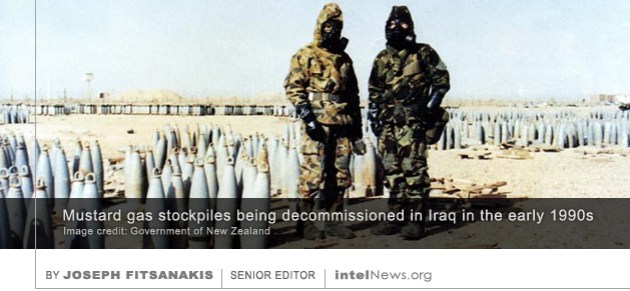
Mustard gas chemical warfareGermany’s foreign intelligence agency says it has evidence that the Islamic State is making use of chemical weapons in northern Iraq, according to media reports. The German Federal Intelligence Service, known as BND, says its operatives in the Middle East were able to collect biological samples from Kurdish fighters engaged in battles against the Islamic State forces. The samples pointed to chemical poisoning that most likely came from sulfur mustards, more commonly known as mustard gas. The chemical, which is banned from use in warfare by the 1993 Chemical Weapons Convention, causes skin irritation that gets progressively worse until sufferers develop debilitating blisters filled with yellow fluid.
Earlier this month there were unconfirmed reports that the Islamic State had used a type of poisonous gas against fighters in the Syrian town of Marea, a stronghold of the Free Syrian Army that is located just north of Aleppo. But no evidence was provided at that time to show that the poisonous substances were indeed chemical weapons. On Monday, however, the Director of the BND, Gerhard Schindler, was quoted in the German press as saying that his officers had gathered credible “information that the Islamic State used mustard gas in northern Iraq”. Schindler said that the information was derived from blood samples that were voluntarily provided by Kurdish fighters that suffered blisters during battles against Islamic State forces.

The BND has not yet answered the question of where the Islamic State managed to acquire its mustard gas supplies. Some allegedly believe that they came from old stockpiles produced during the regime of Saddam Hussein in the 1980s, for use by the Iraqi armed forces. Others claim that Islamic State scientists produced the mustard gas from scratch using laboratories in the University of Mosul, a largely Kurdish city that has been occupied by Islamic State forces since the summer of 2014. Asked to comment on the BND report, a spokeswoman for the United States Department of Defense refused to “comment on intelligence or operational matters”, but added that, if confirmed, the use of chemical weapons “by any party […] is an abhorrent [and] reprehensible act”.

Author: Joseph Fitsanakis | Date: 08 September 2015 | Permalink

Secret program gave CIA ‘unfiltered access’ to German communications

CIAThe United States Central Intelligence Agency had direct and unfiltered access to telecommunications data exchanged between German citizens, according to a new document that has surfaced in the German press. The program, codenamed GLOTAIC, was a collaboration between the CIA and Germany’s Federal Intelligence Service, known as BND. According to German newsmagazine Der Spiegel, which revealed the existence of the program last week, it lasted from 2004 to 2006. During those years, the CIA was given access to telephone and fax data carried by US telecommunications provider MCI Communications, which is owned by Verizon. The US-headquartered company owns a network switching facility in the German city of Hilden, located 10 miles east of Düsseldorf near the country’s border with Holland.

The existence of joint collection programs between the BND and American intelligence agencies has been established in the past, and has prompted the creation of a special investigative committee in the German parliament. The Committee of Inquiry into Intelligence Operations was set up in 2014, after files leaked by American defector Edward Snowden revealed that the US had been spying on the telephone communications of German Chancellor Angela Merkel. But it has also been investigating whether the BND’s collaboration with American intelligence agencies violated the rights of German citizens.

The committee had previously been told that all telecommunications data given to the US by German agencies had previously been vetted by BND officers. But the GLOTAIC documents published by Der Spiegel states that audio recordings of intercepted telephone calls were “directly routed to the US” in the interests of technical efficiency. The parliamentary committee had also been told that the data shared with the CIA concerned non-German citizens using German telecommunications networks. But the documents published last week state that a “technical glitch” in the GLOTAIC system allowed “massive German traffic” to be directly accessed by the CIA without having been first filtered by the BND.

Another document published by Spiegel reveals that the BND warned project CLOTAIC supervisors that the agency faced “serious risks” should the secret operation become public, because it had allegedly violated German federal privacy regulations.

Author: Joseph Fitsanakis | Date: 08 September 2015 | Permalink

Pakistani ex-troops speak about secret infiltration of Indian Kashmir

1965 Indo-Pakistani WarFifty years after the 1965 Indo-Pakistani War, Pakistani former soldiers have spoken for the first time about their role in a secret effort by Pakistan to infiltrate India and incite a Muslim uprising. The conflict between India and Pakistan over Jammu and Kashmir is largely rooted in Britain’s decision to partition its former colonial possession into mainly Hindu India and Pakistan, a mostly Muslim state. As soon as the British withdrew in 1947, the two states fought a bloody war that culminated in a violent exchange of populations and led to the partition of Kashmir. Today India controls much of the region, which, unlike the rest of the country, is overwhelmingly Muslim. Indian rule survived an uprising by some of the local population in August 1965, which led to yet another war between the two countries, known as the 1965 Indo-Pakistani War.
Although Pakistan refuses to confirm that it was behind the opening shots of the war, much historical research has focused on Operation GIBRALTAR, a secret project by the Pakistani military to infiltrate Indian-controlled Kashmir and prompt the local population to start a rebellion against Indian rule. It is believed that the plan was devised and supervised by Major General Akhtar Hussain Malik, a hawkish military leader who was close to Ayub Khan, Pakistan’s military dictator who served as the country’s second president, from 1958 to 1969. Operation GIBRALTAR involved the use of between 7,000 and 20,000 men who were trained by the Pakistani Army before being sent to infiltrate Indian Kashmir in the summer of 1965. Moving mostly at night in units of no more than 200 men, the armed infiltrators sabotaged Indian transportation and communication systems in order to prevent Indian Armed Forces units from reaching the region.

Several of these men, who are today in their 60s and 70s, have been speaking to the BBC and to Pakistani newspaper The Dawn about their role in Operation GIBRALTAR. Among them is Qurban Ali, 71, who told the BBC that most of the men in his unit of 180 infiltrators were civilian recruits. Another GIBRALTAR veteran, Mohammad Nazeer, 64, who was only 14 when he was recruited, said that he and his fellow soldiers thought they were practicing maneuvers when they were moved toward the Indian border. Interestingly, the infiltrators were unaware that hundreds of other Pakistani military units were also operating in secret in Indian Kashmir.

Eventually, India was able to deploy over 100,000 soldiers in the contested region, while few among the local Muslim population joined the infiltrators of Operation GIBRALTAR. After several weeks of fighting, the two sides entered negotiations held in Soviet Uzbekistan. The outcome was the Tashkent Agreement, under which both sides agreed to withdraw to the pre-August borders. However, the fate of Operation GIBRALTAR weakened the position of Pakistan’s President Khan. He was deposed in a popular uprising in 1969 and died in 1974, aged 66, allegedly a broken man.

Author: Joseph Fitsanakis | Date: 07 September 2015 | Permalink

Cambridge spy’s last years in Russia are detailed in new biography

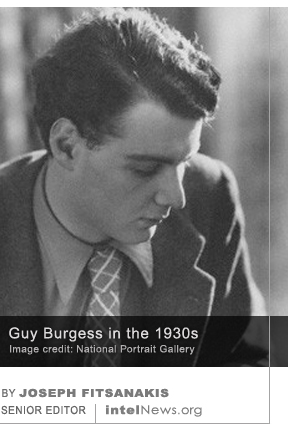
Guy BurgessThe life of Guy Burgess, one of the so-called ‘Cambridge Five’ double agents, who spied on Britain for the Soviet Union before defecting to Moscow in 1951, is detailed in a new biography of the spy, written by Andrew Lownie. Like his fellow spies Kim Philby, Donald Maclean, Anthony Blunt and John Cairncross, Burgess was recruited by the Soviets when he was a student at Cambridge University. He shook the British intelligence establishment to its very core when he defected to the USSR along with Maclean, after the two felt that they were being suspected of spying for the Soviets.
A few years after his defection, Burgess wrote to a close friend back in the UK: “I am really […] very well and things are going much better for me here than I ever expected. I’m very glad I came”. However, in his book, entitled Stalin’s Englishman: The Lives of Guy Burgess, Lownie suggests that Burgess’ life in the USSR was far from ideal. After being welcomed by the Soviets as a hero, the Cambridge University graduate was transported to the isolated Siberian city of Kuybyshev. He lived for several months in a ‘grinder’, a safe house belonging to Soviet intelligence, where he was debriefed and frequently interrogated until his Soviet handlers were convinced that has indeed a genuine defector.

It was many years later that Burgess was able to leave Kuybyshev for Moscow, under a new name, Jim Andreyevitch Eliot, which had been given to him by the KGB. Initially he lived in a dacha outside Moscow, but was moved to the city in 1955, after he and Maclean spoke publicly about their defection from Britain. He was often visited in his one-bedroom apartment by Yuri Modin, his Soviet intelligence handler back in the UK. According to Lownie, Burgess often complained to Modin about the way he was being treated by the Soviet authorities. His apartment had apparently been bugged by the KGB, and he was constantly followed each time he stepped outside.

The British defector worked for a Soviet publishing house and produced foreign-policy analyses for the Soviet Ministry of Foreign Affairs. He also produced a training manual for KGB officers about British culture and the British way of life. But he did not like living in the USSR and argued that he should be allowed to return to the UK, insisting that he could successfully defend himself if interrogated by British counterintelligence. Eventually, Burgess came to the realization that he would never return to his home country. He became depressed, telling friends that he “did not want to die in Russia”. But in the summer of 1963 he was taken to hospital, where he eventually died from acute liver failure caused by his excessive drinking.

Andrew Lownie’s Stalin’s Englishman: The Lives of Guy Burgess, is published by Hodder & Stoughton in the UK and by St Martins’ Press in the US. It is scheduled to come out in both countries on September 10.

Author: Joseph Fitsanakis | Date: 04 September 2015 | Permalink

Israeli nuclear whistleblower recalls his 1986 capture by the Mossad

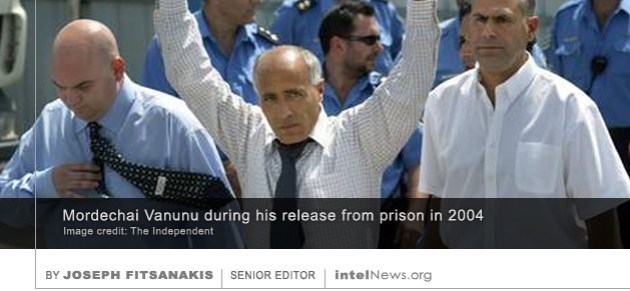
Mordechai VanunuIsraeli nuclear whistleblower Mordechai Vanunu, who spent 18 years in prison for revealing the existence of Israel’s nuclear program, has spoken for the first time about his 1986abduction by the Mossad in Rome. Vanunu was an employee at Israel’s top-secret Negev Nuclear Research Center, located in the desert city of Dimona, which was used to develop the country’s nuclear arsenal. But he became a fervent opponent of nuclear proliferation and in 1986 fled to the United Kingdom, where he revealed the existence of the Israeli nuclear weapons program to the The Times of London. His action was in direct violation of the non-disclosure agreement he had signed with the government of Israel; moreover, it went against Israel’s official policy of ‘nuclear ambiguity’, which means that the country refuses to confirm or deny that it maintains a nuclear weapons program.
Soon after Vanunu settled in London, the Israeli intelligence agency Mossad began making plans to capture him. The spy agency sent one of its American-born female officers, Cheryl Bentov, to befriend Vanunu. The decision was taken after Mossad psychologists determined that Vanunu was lonely and longed for female companionship. Masquerading as an American tourist by the name of ‘Cindy’, Bentov convinced Vanunu to go with her on Vacation to Rome, Italy. Soon after the couple arrived in the Italian capital, Vanunu was abducted by a Mossad team who injected him with a paralyzing drug before taking him away in a van. Vanunu was then transferred onboard the INS Noga, an Israeli signals-intelligence ship masquerading as a merchant vessel, which transported him to Israel. He was convicted to 18 years in prison and was released in 2004, after having spent 11 years in solitary confinement.

On Wednesday, Israel’s Channel 2 television showed excerpts of Vanunu’s first-ever interview to an Israeli media outlet. The interview, which is to be aired in full on Friday, includes Vanunu’s personal account of his capture by the Mossad. He told the interviewer that ‘Cindy’ first spoke to him as she walked alongside him while the two of them were crossing a London street. But he said that it was he who “initiated the relationship” with the woman posing as an American tourist. That was a critical moment in the whole process, said Vanunu, because “if she initiates you’ll suspect her”. The nuclear whistleblower insisted, however, that he did not “fall in love with her”, as some accounts of the Mossad operation have suggested, though he was “definitely attracted” to her, he said.

Vanunu added that the thought of ‘Cindy’ being a Mossad officer had initially crossed his mind; but he disregarded it and did not realize he was being tricked “until the very last moment”. He told Channel 2 that even after several days after his capture, he still believed that ‘Cindy’ had also been abducted. It was only later that he “reached the conclusion that she was part of the plan”, he said. At another point in the interview, Vanunu said that ‘Cindy’ was not the only Mossad officer who had tried to befriend him while he was in London, but that he was able to detect every other attempt by Israeli intelligence operatives.

Author: Joseph Fitsanakis | Date: 03 September 2015 | Permalink

‘Day of the Jackal’ author reveals he was MI6 agent for 20 years

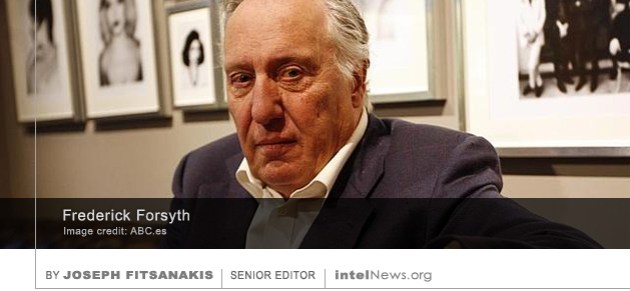
Frederick ForsythFrederick Forsyth, the esteemed British author of novels such as The Day of the Jackal, has confirmed publicly for the first time that he was an agent of British intelligence for two decades. Forsyth, who is 77, worked for many decades as an international correspondent for the BBC and Reuters news agency, covering some of the world’s most sensitive areas, including postcolonial Nigeria, apartheid South Africa and East Germany during the Cold War. But he became famous for authoring novels that have sold over 70 million copies worldwide, including The Odessa File, Dogs of War and The Day of the Jackal, many of which were adapted into film. Several of his intelligence-related novels are based on his experiences as a news correspondent, which have prompted his loyal fans to suspect that he might have some intelligence background.
But Forsyth had never commented on these rumors until last weekend, when was interviewed on the BBC’s main evening news program. He spoke to the station on the occasion of the upcoming publication of his autobiography, The Outsider: My Life, which will be in stores in October. He told the BBC that he was first recruited by the Secret Intelligence Service (MI6) in the late 1960s while covering the Nigerian Civil War. The bloody conflict, which is also known as the Biafran War, pitted the separatist Igbo people against the Nigerian federal government. Like other military conflicts in postcolonial Africa, it attracted the attention of the world’s powers, including France, the Soviet Union, the United States, and Britain. London was firmly on the side of the government in Lagos, but MI6 had reservations, believing that the Nigerian military forces were committing mass atrocities in Biafra. Forsyth said he was recruited by an MI6 officer who wanted to know if children were dying in Biafra as a result of the Nigerian government’s military policies against the Igbo separatists. The intelligence service were apparently hoping that they could use this information to change London’s stance on the brutal civil war. The author told the BBC that he spent the rest of the war “sending both journalistic reports to the media and other reports to my new friend”, referring to his MI6 handler.

When asked if he was paid for his services, he said his assistance to MI6 was provided on a strictly voluntary basis. “The attitude, the spirit of the age, was different back then”, he said, adding that “the Cold War was very much on” and when the British government asked a reporter for a favor it was “very hard to say no”. He did say, however, that MI6 promised to approve passages of some of his novels by way of payment. The author of The Day of the Jackal said he was given a number to call and told to send MI6 his manuscripts for vetting. “If they are too sensitive, we will ask you not to continue”, Forsyth told the BBC.

Author: Joseph Fitsanakis | Date: 31 August 2015 | Permalink

IRA is still ‘broadly in place’, says Northern Ireland police chief

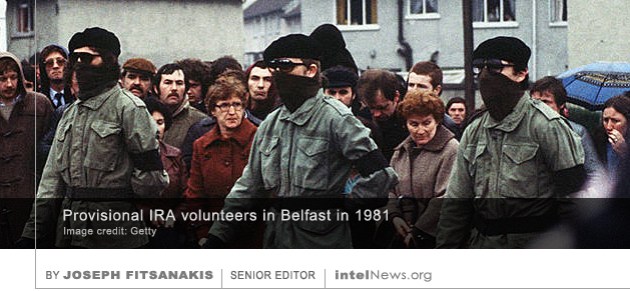
Provisional IRAThe Provisional Irish Republican Army, which fought British rule in Northern Ireland for decades, but officially disbanded in 2005, is still “broadly in place”, according to the head of the Police Service of Northern Ireland. On July 28, 2005, the Provisional IRA announced that was ceasing all paramilitary operations and disbanding as of 4:00 p.m. that day. The man who made the announcement on British television was Séanna Walsh, a former cellmate of Bobby Sands, the Provisional IRA volunteer who was the first prisoner to die in the 1981 Irish hunger strike. He read a statement authorized by the Provisional IRA leadership, which said that all PIRA units had been “ordered to dump arms” and that PIRA volunteers should “not engage in any other activities whatsoever”. Three years later, the Independent Monitoring Commission declared that the PIRA’s Army Council, which steered the activities of the militant organization, was “no longer operational or functional”.
In the ensuing years, which have seen the implementation of the Good Friday Agreement that restored peace in Northern Ireland, it has been generally assumed that the PIRA had ceased to exist. Last week, however, George Hamilton, the head of the Police Service of Northern Ireland, told reporters that “some of the PIRA structure from the 1990s remains broadly in place” in the area. Hamilton was speaking in reference to the murder earlier this month of Kevin McGuigan in east Belfast. McGuigan, a 53-year-old father of nine, was a former member of the Provisional IRA, who had fallen out with the organization. He was gunned down at his home, allegedly in retaliation for the murder last May of Gerard Jock Davison, a former commander of the Provisional IRA, who was also shot dead in the Markets area of Belfast.

Some allege that McGuigan had participated in Davison’s murder, and that the Provisional IRA’s Army Council authorized McGuigan’s killing in response. Chief Hamilton said last week that the PIRA had probably not authorized McGuigan’s killing, but added that the militant separatist organization was still in existence. In response to his statement, the Irish government said on Tuesday that it would reassess its intelligence on the activities of the PIRA during the last decade. Meanwhile, Gerry Adams, the leader of Sinn Fein, which is believed to be the political wing of the PIRA, has denied that the armed separatist group is still active and insisted that the PIRA “left the stage in 2005”.

Author: Joseph Fitsanakis | Date: 28 August 2015 | Permalink

US Pentagon probing claims of falsely optimistic intel reports on ISIS

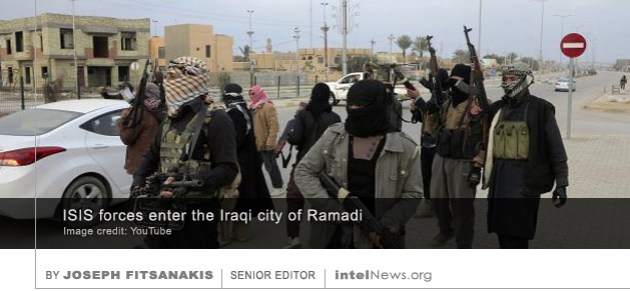
ISIS forces in RamadiThe United States Department of Defense is investigating claims that some of its officials doctored intelligence reports to give a falsely optimistic account of the campaign against the Islamic State. Citing “several officials familiar with the inquiry”, The New York Times said in a leading article on Tuesday that the Pentagon launched a probe into the allegations in recent weeks. According to the paper, the probe was launched following a complaint filed by at least one analyst in the Defense Intelligence Agency (DIA), the Pentagon’s primary human-intelligence agency. According to the analyst, intelligence reports were deliberately tweaked by officials at the US Central Command (CENTCOM), the Pentagon body that directs and coordinates American military operations in Egypt, the Middle East and Central Asia. The reports related to the Islamic State, known also as the Islamic State of Iraq and al-Sham (ISIS), a militant Sunni organization that currently controls large swathes of territory in Iraq and Syria.
Many Middle East observers, including this website, have made notably dire projections about the continuing reinforcement and territorial expansion of ISIS. Earlier this month, the Associated Press published an unconfirmed assessment of a “strategic stalemate” in Syria, which allegedly represented the views of the Central Intelligence Agency (CIA), the DIA and other members of the US Intelligence Community. According to the news agency, the report said that ISIS is “fundamentally no weaker” today than it was a year ago, when the United States began a bombing campaign targeting ISIS strongholds.

But earlier assessments by DIA, which were communicated to senior US policymakers, including President Barack Obama, were far more optimistic about America’s ability to defeat the militant group, said The Times. According to the paper, the DIA analyst had evidence showing that CENTCOM officials had systematically doctored the conclusions of intelligence reports about ISIS before passing them on to American leaders. It appears that the evidence pointing to deliberate manipulation of intelligence assessments was convincing enough to prompt the Pentagon’s Office of the Inspector General to launch an official probe into the matter.

When asked to respond to The Times’ allegations, CENTCOM spokesman Colonel Patrick Ryder said he was unable to comment on an ongoing investigation by the Inspector General. If the allegations are substantiated by the probe, the Inspector General is legally required to share them with the intelligence oversight committees of the US Congress.

Author: Joseph Fitsanakis | Date: 27 August 2015 | Permalink

British government releases MI5 file on little-known Cold War spy

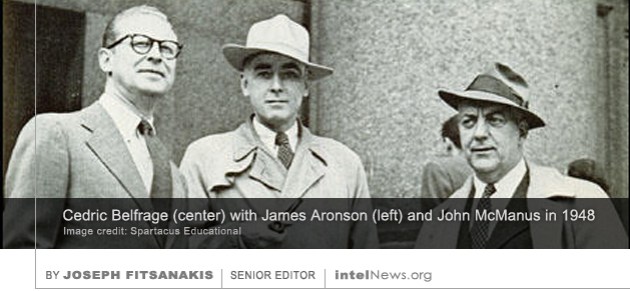
Cedric BelfrageThe British government has released a nine-volume file on an influential film critic who some believe was “one of the most important spies the Soviet Union ever had”. Cedric Belfrage was born in 1904 in London and read English Literature at Cambridge University in the 1920s. While a student at Cambridge he made a name for himself as a reviewer of motion pictures, and by the early 1930s he was known as Britain’s highest-paid film critic. Soon afterwards he moved to the American city of Los Angeles, where he became a film and theater correspondent for British tabloid newspaper The Daily Express. But a multivolume file on him compiled by the British Security Service (MI5) and released last week by the National Archives in London, confirms that Belfrage spied for Soviet intelligence under the codename BENJAMIN.

According to the file, Belfrage turned to communism after witnessing the effects of the Great Depression in the United States. After a 1936 trip to the USSR, he reached out to the Communist Party of the US, which eventually put him in touch with a number of Soviet intelligence operatives in America. In 1940, the Secret Intelligence Service (MI6) set up the British Security Coordination (BSC) in New York. It was a clandestine propaganda project aimed at turning local public opinion in favor of America’s entry into World War II. Belfrage was one of many writers and intellectuals that were recruited by the BSC to help counter the prevalent isolationist sentiment in the country. The film critic worked for MI6 until 1943, and then returned to Britain to join another wartime propaganda outfit, the Political Warfare Executive.

At war’s end, Belfrage returned to the US, only to find that he had attracted the attention of the Federal Bureau of Investigation. The FBI had discovered that the British film critic had dealings with the Communist Party in the 1930s and suspected that he may have worked for Soviet intelligence. Further investigations revealed that Belfrage had indeed conducted espionage under the guidance of Jacob Golos, a Ukrainian-born American who managed a large network of pro-Soviet spies in America in the interwar period. But when he was questioned by the FBI, Belfrage said that he had given Golos a number of British —not American— government documents under direct orders by MI6. The latter allegedly hoped that the Soviets would reciprocate the move within the context of the anti-Nazi alliance between the UK and the USSR.

Eventually, Belfrage was brought up before the House Un-American Activities Committee (HUAC) of the US Congress in 1953. The Committee was conducting public hearings aimed at unmasking suspected communist sympathizers in the American entertainment industry. But the British-born film critic refused to answer questions put to him, prompting HUAC to recommend that he should be deported from the country. The government adopted the Committee’s recommendation and deported Belfrage in 1955 for having been a member of the Communist Party under a fake name. Belfrage traveled throughout the Caribbean and Latin America before settling in Mexico, where he died in 1990, aged 86.

Interestingly, the British files reveal that MI5 decided not to prosecute Belfrage, most likely in order to avoid the embarrassment of admitting that British intelligence had employed a Soviet spy. The decision was probably not unrelated to the public scandal that followed the escape of the so-called Cambridge spies to the Soviet Union. Interestingly, Belfrage studied at Cambridge at the same time that Kim Philby (Soviet cryptonym STANLEY), Donald Duart Maclean (HOMER) and Guy Burgess (HICKS) were students there. But there is no evidence he ever collaborated with them, as he was not interested in politics at that time.

Author: Joseph Fitsanakis | Date: 24 August 2015 | Permalink