Israeli, Italian intelligence officers drown as boat capsizes in Lake Maggiore
May 31, 2023 1 Comment
 ONE ISRAELI AND TWO Italian intelligence officers are among the victims of a boating accident in northern Italy. Local reports indicate that the incident occurred last Sunday evening, when a passenger boat named the Gooduria capsized and sank rapidly in Italian territorial waters. The boat was on a sightseeing trip near the Italian shoreline of Lake Maggiore, a popular destination situated on the southern side of the Alps between Italy and Switzerland.
It has been reported that nearly all of the approximately two dozen passengers aboard the Gooduria were current or former members of the Italian and Israeli intelligence services. These individuals were believed to have collaborated professionally as intelligence officers and had gathered for “a convivial meeting to celebrate the birthday of one of the group”, according to a statement issued by the Italian government.
It is worth noting that some Italian news outlets have expressed skepticism about the precise nature of the gathering. An article in the Italian daily Corriere della Sera suggested that “the gathering was a working meeting of intelligence agents”. Another Italian daily, La Stampa, said that the gathering was “an opportunity to exchange information between agents of the two countries”. These claims have not been confirmed by the Italian and Israeli governments.
Italian authorities have stated that no foul play is suspected in the accident. Instead, it is believed that inclement weather, possibly coupled with overcrowding onboard the Gooduria, contributed to the incident. The Ministry of Foreign Affairs of Israel released a brief statement on Sunday acknowledging the death of a retired member of the Israeli intelligence services, without identifying the victim by name or professional title. However, local media reports have identified the deceased as Shimoni Erez, 50, a recent retiree from the Mossad, Israel’s external intelligence agency.
The two Italian victims of the accident have been identified as Claudio Alonzi, 62, and Tiziana Barnobi, 53, both of whom were intelligence officers. Additionally, among the casualties was a Russian national named Anna Bozhkova, 50, who was reportedly the wife of the captain of the Gooduria. Following the capsizing of the boat, Israeli diplomats promptly arranged for the immediate evacuation of ten active Israeli intelligence officers from Italy. They were swiftly removed from regional hospitals and transported back to Israel via a military flight.
► Author: Ian Allen | Date: 31 May 2023 | Permalink
 A COURT IN ALBANIA
  ON MONDYA, TURKEY’S NATIONAL intelligence organization (MİT) announced the arrest of several members of an alleged spy network, who were reportedly recruited, trained and handled by Israel’s intelligence agency, the Mossad. Two members of the alleged spy ring were arrested two months ago, according to the Office of the Istanbul Chief Public Prosecutor and Turkey’s National Intelligence Organization (MİT).
 The United States Department of Justice has
  RIVAL ONLINE CAMPAIGNS BY American and Russian intelligence agencies are encouraging each other’s citizens to contact them, share information and possibly even defect. At least three ads have been on social media, with the Federal Bureau of Investigation (FBI) issuing the earliest one in February of this year. The Central Intelligence Agency (CIA) and its Russian counterpart, the Foreign Intelligence Service (SVR), are now believed to have published similar ads.
 A CHINESE COURT HAS sentenced a United States passport holder to life in prison on espionage charges, following a brief closed-door trial. However, no information has been made available about the precise charges against him. Closed-door trials are frequent occurrences in Chinese courts, especially in cases relating to national security, which include charges of espionage against the state. However, life sentences are exceedingly rare for espionage cases.
 SOUTH KOREAN PROSECUTORS have charged four senior members of one of the country’s largest trade unions with espionage on behalf of North Korea. The move, which is seen as highly controversial by South Korea’s liberal opposition, has come a few months after the conservative administration of President Yoon Suk Yeol
  AN ESPIONAGE TOOL DESCRIBED by Western officials as the most advanced in the Russian cyber-arsenal has been neutralized after a 20-year operation by intelligence agencies in the United States, Australia, Canada, the United Kingdom and New Zealand. The operation targeted
  A UKRAINIAN PARAMILITARY GROUP has claimed to be behind a targeted attack against an influential figure in Russian literature and social media on Saturday, which killed his fellow passenger and prompted strong denouncements by the Kremlin. The attack appeared to target Yevgeny Nikolayevich Prilepin, 47, known in Russia as Zakhar Prilepin. One of the best-known novelists in Russia, Prilepin spent much of his late teens and early twenties serving in the Russian National Guard. He saw action during two tours in Chechnya.
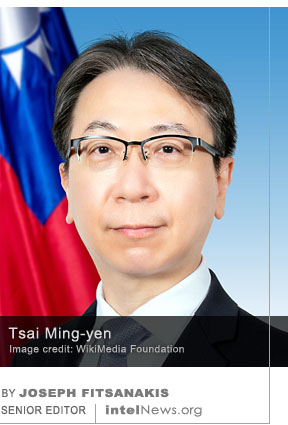 IN A SERIES OF rare public comments, the director of Taiwan’s primary intelligence agency has singled out 2027 as a year of paramount significance for China’s military plans for Taiwan. On Thursday, Tsai Ming-yen (pictured), director-general of Taiwan’s National Security Bureau (NSB) since February, spoke to an audience of graduating students at Taiwan’s National Chung Hsing University in Taichung City. According to
  OFFICIALS IN UKRAINE HAVE
  Russia’s border with Belarus, two trains were
 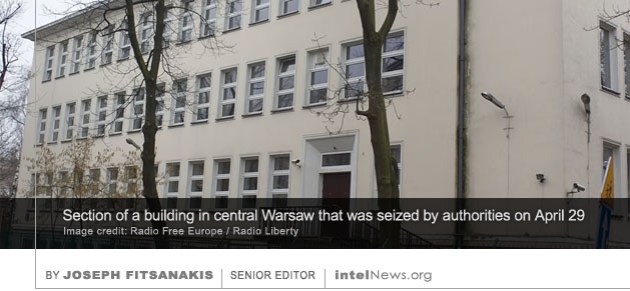 AUTHORITIES IN POLAND HAVE seized an abandoned school building in the Polish capital Warsaw, allegedly because it was being used as a base for espionage activities by the Russian government. Following the seizure of the building complex, Russian officials issued stern but vague warnings, saying that action will be taken in response to what they termed as an “act of provocation” by the Polish government.
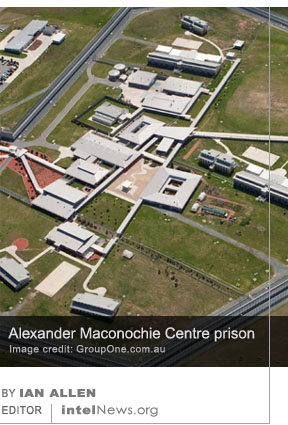 AN AUSTRALIAN HIGH COURT has released the sentencing remarks in an unprecedented closed-door trial of an intelligence officer, identified only as “Witness J”, who was convicted in 2019 of a crime that cannot be revealed. The man, who is also known as “Prisoner 123458,” was given a jail sentence in November of 2019. His sentencing came following a closed-door hearing, which was described by a judge as “generally undesirable” and “unusual”. The very existence of the court case
  THE UNITED STATES HAS arrested two residents of New York City for allegedly conspiring to create and operate a clandestine police station run by the Chinese government in the borough of Manhattan. The arrests come a month after authorities in Canada launched an






 intelNews.org
Russia says it uncovered U.S. operation to compromise Apple phones
June 2, 2023 by Joseph Fitsanakis 1 Comment
The source of the allegation is the Federal Security Service (FSB), Russia’s primary counterterrorism and counterintelligence agency. On Thursday, the FSB said that “an intelligence action of the American special services” had been uncovered by FSB officers with the assistance of the Federal Protective Service. Known in Russia by its initials, FSO, the Federal Protective Service operates federal emergency communications systems and provides personal security for high-ranking government officials.
According to the FSB, “several thousand Apple telephones” were targeted in the alleged NSA operation, including devices belonging to “domestic Russian subscribers”, as well as devices belonging to foreign diplomats stationed in Russia. The latter allegedly include diplomats from Israel, Syria and China, according to the FSB. The Russian agency also claimed that Russia-based foreign diplomats from North Atlantic Treaty Organization member-states had their phones targeted, as well as diplomats from former Soviet states.
In the same press release, the FSB accused the NSA and Apple of working in “close cooperation” with each other —an allegation that the Russian government has been making for several years. In a follow-up media statement, the Russian Ministry of Foreign Affairs accused the United States of engaging in “hidden data collection” and dismissed Apple iPhones as “absolutely transparent”.
Kremlin spokesman Dmitry Peskov urged Russians to avoid using Apple products and lamented reports that one in three Russian government workers continue to utilize Apple products for their personal use. When asked by reporters if the Russian government had plans to outlaw the use of Apple products by government employees, Peskov responded that the Kremlin did “not have the power to even recommend that”, except for those government employees with access to classified information.
► Author: Joseph Fitsanakis | Date: 02 June 2023 | Permalink
Filed under Expert news and commentary on intelligence, espionage, spies and spying Tagged with Apple, FSB, FSO (Russia), iPhone, News, NSA, Russia, Russian Federal Protective Service, telephone hacking