Iraqi Kurds claim they have captured senior Turkish intelligence officers

Cemîl BayikThe Turkish government has refused to comment on reports from Iraq, which suggest that Kurdish forces have captured at least two senior Turkish intelligence officers. News of the arrests first emerged in mid-August, when pro-Kurdish media in Turkey’s Anatolia region claimed that an armed Kurdish group in Iraq had captured two members of the National Intelligence Organization (MİT), Turkey’s principal intelligence agency.

According to the reports, the Turkish intelligence officers had used forged identity papers to travel from eastern Turkey to the northern Iraqi city of Erbil. From there, they went to Sulaimaniyah, a metropolitan center in Iraq’s Kurdish north. Allegedly, the Turkish officers traveled to Iraq in order to assassinate Cemîl Bayik, a co-founder and senior leader of the Kurdistan Worker’s Party (PKK). Founded in 1978, the PKK is a leftwing secessionist paramilitary organization that seeks an independent homeland for Turkey’s Kurdish minority. Iraq’s Sulaimaniyah region is controlled by another Kurdish armed group, the Patriotic Union of Kurdistan (PUK), which has close relations with Iran. But a rival Kurdish group, the Kurdistan Democrat Party (KDP), which is supported by Turkey and opposes the PKK’s secessionist aims, also has a strong presence in the area. It is not known whether KDP forces were aware of —or even assisted— the Turkish intelligence officers in Sulaimaniyah.

Kurdish sources claim that the two Turkish intelligence officers were arrested by PUK forces. Notably, media reports suggest that one of arrestees serves as the MİT’s deputy undersecretary for foreign operations, while the other heads the MİT’s PKK desk. The PUK is now threatening to publish photographs of the two men, which would blow their cover. But there has been no comment on this story from Ankara, where Turkish government officials refuse to confirm or deny that the arrests happened or that the two men are indeed MİT employees. Some observers, however, note that the Turkish government shut down the PUK’s office in the Turkish capital on August 23, and expelled the organization’s representatives. The group has maintained an office in Ankara since 1991, so the Turkish government’s surprising move may signify that the media reports about the arrests of the two MİT officers are indeed accurate.

Author: Joseph Fitsanakis | Date: 08 September 2017 | Permalink

French police officer charged in complex spy case involving Morocco, Algeria

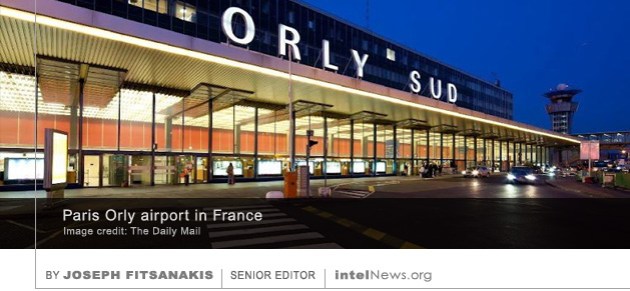
Paris Orly AirportA French police officer has been charged with illegally sharing secret government documents in an espionage case involving France’s border police and diplomats from Morocco and Algeria. According to information published by the French daily Libération, the police officer supplied Moroccan intelligence with classified information about France’s border-control policies and procedures. He also gave the Moroccans information about the movements in France of Moroccan nationals and senior Algerian government officials.

According to the report by Libération, the police officer, identified only as “Charles D.”, was charged on May 31 of this year with corruption and violating secrecy rules. Court documents state that Charles D. gave away classified documents belonging to the Direction centrale de la police aux frontières (DCPAF), a directorate of the French National Police that is in charge of immigration control and border protection across France. He reportedly gave the documents to another man, identified in court documents as “Driss A.”, who worked at Paris’ Orly Airport. It is believed that Driss A. worked as director of the Orly branch of ICTS International, a Dutch-based company that provides security services in several European airports. It is also believed that Driss A. —a Moroccan-born French citizen— was secretly employed by the Deuxième Bureau, Morocco’s military intelligence service. It appears that the Moroccans compensated Charles D with free holidays in Morocco in exchange for his services.

Interestingly, when French counterintelligence officers raided Driss A.’s home in Paris, they found documents detailing the activities of senior Algerian government ministers during their official trips to France. The officials are identified in the documents as Algeria’s former Deputy Prime Minister Noureddine Yazid Zerhouni, Higher Education Minister Tahar Hadjar, and Telecommunications Minister Hamid Grine. The documents appear to have been produced by Algerian intelligence and given initially to the embassy of Algeria in France. No explanation has been given about how these documents fell in Driss A.’s possession. Some observers assume that Driss A., acting as a Moroccan intelligence operative, must have acquired them from a source inside the Algerian embassy in Paris.

Author: Joseph Fitsanakis | Date: 07 September 2017 | Permalink
Probe uncovers massive $3 billion secret bribe fund in Azerbaijan

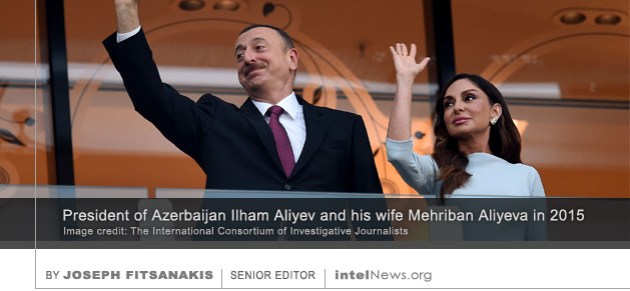
Ilham AliyevAn investigation by a consortium of European newspapers has uncovered details of a massive slush fund worth nearly $3 billion, which was allegedly used by Azerbaijan’s governing elite to bribe officials, business leaders and journalists at home and abroad. The fund was operated out of Baku, the capital of the former Soviet state, which is routinely accused of human-rights abuses. Western countries, including the United States, censure the government of the oil-rich state for its role in systematic abuses. These involve high levels of public- and private-sector corruption, vote-rigging, politically motivated disappearances, and wide curtailment of basic civil liberties. This new information is bound to add to Azerbaijan’s image as a secretive oil-rich state ruled by corrupt elite connected to the country’s President, Ilham Aliyev, and his family.

The existence of the slush fund was revealed by the Organized Crime and Corruption Reporting Project (OCCRP), an international investigative consortium. The OCCRP’s report was published in Tuesday, following a lengthy investigation by members of 17 European news media, including publications in the United States, Britain, Germany, France, Denmark and Belgium. The report states that the fund, which it nicknames “the Azerbaijani Laundromat”, was operational for over two years, from 2012 to 2014. During that time, it participated in “over 13,000 transactions”, many of which were carried out through companies based in the United Kingdom but registered in the British Virgin Islands, Belize and the Seychelles. Payments were processed by the Estonian branch of Danske Bank, a major European banking institution.

According to the OCCRP report, most of the fund’s recipients were politicians, business executives, reporters and other influential people in Western Europe, as well as Turkey and Central Asia. Other recipients included wealthy families in Azerbaijan, who used the funds to finance a luxurious lifestyle, according to the report. Some foreign recipients of the funds were politicians, journalists or lobbyists who have been vocal in supporting Azerbaijan’s government and its policies. Most of the funds are believed to have originated from Azerbaijani-based companies, primarily Baktelecom MMC. But Russian-based companies, including Rosoboronexport, Russia’s state-operated exporter and importer of defense-related technologies, also contributed over $30 million to the slush fund.

Perhaps most controversially, the OCCRP report alleges that some of the secret slash funds originated from senior cabinet members in Azerbaijan, as well as some intelligence officials. It also states that investigators uncovered “ample evidence of [the fund’s] connection to the family of [Azerbaijan’s longtime] President Ilham Aliyev”. Late on Tuesday, a statement issued by President Aliyev’s office rejected the report as “baseless, malicious and […] provocative in nature”. More reactions to the OCCRP report are expected in the coming days.

Author: Joseph Fitsanakis | Date: 06 September 2017 | Permalink

Australian parliament reviews use of Chinese-made cell phones

ZTE CorporationThe Parliament of Australia is reportedly reviewing the use of cell phones built by a Chinese manufacturer, after an Australian news agency expressed concerns about the manufacturer’s links with the Chinese military. The cell phone in question is the popular Telstra Tough T55 handset. It is made available to Australian parliamentarians though the Information, Communications and Technology (ICT) unit of the Department of Parliamentary Services (DST). Any parliamentarian or worker in Australia’s Parliament House can order the device through the Parliament’s ICT website. According to data provided by the DST, 90 Telstra Tough T55 cell phones have been ordered through the ICT in the current financial year.

The handset is manufactured by ZTE Corporation, a leading Chinese telecommunications equipment and systems company that is headquartered in the city of Shenzhen in China’s Guangdong province. On Monday, the News Corp Australia Network, a major Australian news agency, said it had contacted the parliament with information that ZTE Corporation’s links to the Chinese military may be of concern. News Corp said it informed the DST that members of the United States Congress and the House of Representatives’ intelligence committee, have expressed serious concerns about the Chinese telecommunications manufacturer in recent years.

As intelNews reported in 2010, three American senators told the US Federal Communications Commission that the ZTE was “effectively controlled by China’s civilian and military intelligence establishment”. The senators were trying to prevent a proposed collaboration between American wireless telecommunications manufacturers and two Chinese companies, including ZTE Corporation. In 2012, the intelligence committee of the US House of Representatives investigated similar concerns. It concluded that telephone handsets manufactured by ZTE should not be used by US government employees due to the company’s strong links with the Chinese state. And in 2016, US-based security firm Kryptowire warned that some ZTE cell phone handsets contained a suspicious backdoor feature that could potentially allow their users’ private data to be shared with remote servers at regular intervals.

A DST spokesman told the News Corp Australia Network that the ZTE-manufactured cell phones had been selected for use by Australian parliamentarians based on “technical and support requirements, [DST] customers’ feedback and cost”. The spokesman added that the DST “is currently reviewing the ongoing suitability” of the T55 handsets, following reports about ZTE’s links with China’s security establishment.

Author: Ian Allen | Date: 05 September 2017 | Permalink

More facts revealed about mystery sonic attacks on US embassy in Cuba

US embassy in CubaAmerican officials have revealed more information about a mysterious sonic device that is believed to have caused numerous diplomats to suffer hearing loss and other serious ailments. Last month, the Associated Press reported that the first hearing-loss symptoms were reported by personnel at the US embassy in Havana in the fall of 2016. The news agency said that at least five embassy personnel reported suffering from sudden and unexplained loss of hearing. The symptoms were so serious that caused some American diplomats “to cancel their tours early and return to the United States”, according to the Associated Press.
Now new information has been disclosed by the United States Department of State. It suggests that, although diplomats began reporting hearing-loss symptoms in as early as fall 2016, the incidents continued until mid-August of this year. In a report published on Saturday, the BBC said that the bizarre incidents had not ended “several months ago” as was initially believed. Instead, they continued even after the last week of May, when the US deported two Cuban diplomats from Washington, DC. The move was in response to what Washington believes was a deliberate attempt to sabotage its diplomatic mission in Havana. The American embassy in the Cuban capital reopened in 2015, 54 years after it was closed down following a series of diplomatic rifts between Cuba and the US during the height of the Cold War.

Additionally, the Department of State said on Friday that the number of American diplomats and other US embassy personnel who have reported sonic-related symptoms has increased to 19. State Department spokeswoman Heather Nauert told reporters in Washington that doctors were still evaluating the health of those serving at the US embassy in Havana. She added that new cases of people suffering from sonic-related medical symptoms could not be ruled out. A report from the American Foreign Service Association, which represents members of the United States Foreign Service, said on Friday that its representatives had spoken to 10 people who had received various treatments for ailments related to the alleged sonic attacks in Cuba. It said that many had suffered “permanent hearing loss”, while others were diagnosed with mild brain injuries.

According to media reports, Washington has concluded that the American diplomats were exposed to “an advanced device that was deployed either inside or outside their residences”. But the Cuban government denied that it had anything to do with the American diplomats’ symptoms, and some believe that the alleged “covert sonic device” may have been deployed by an intelligence service of a third country —possibly Russia— without the knowledge of Cuban authorities.

Author: Joseph Fitsanakis | Date: 04 September 2017 | Permalink

South Korean former spy chief sent to prison for meddling in elections

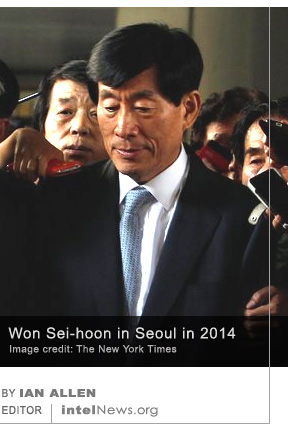
Won Sei-hoonThe former director of South Korea’s main intelligence agency has been sent to prison for organizing a large-scale illegal campaign to influence the result of the country’s 2012 presidential election. Won Sei-hoon headed the NIS from 2008 to 2013, during the administration of conservative President Lee Myung-bak. During the 2012 presidential election, Won ordered a group of NIS officers to “flood the Internet” with messages accusing liberal political candidates of being “North Korean sympathizers”. One of those candidates, Moon Jae-in, of the left-of-center Democratic Party of Korea, is now the country’s president. Mr. Moon succeeded his main right-wing rival, Park Geun-hye, who resigned in March of this year following a series of financial scandals. She is now facing charges of bribery, abuse of power, leaking government secrets, and corruption.
In February 2015, the Seoul High Court upheld an earlier sentence of 2.5 years in prison, which had been imposed on Won by a lower court. But his conviction was overturned on appeal. Earlier this August, an internal inquiry conducted by the NIS found that many its officers were tasked by Won to manipulate the outcome of the 2012 presidential election with 30 dedicated teams of officers —some of whom were hired specifically for that purpose. A number of teams were in charge of creating fake social media accounts and using them to post negative views of Mr. Moon and positive views of his conservative rival, Mrs. Park. Other teams were tasked with creating the false impression that South Korea’s rival, North Korea, was supportive of Mr. Moon’s candidacy. The probe also found that the NIS launched similar —though on smaller scale— efforts to influence the outcome of parliamentary elections in 2011 and 2012.

On Wednesday, based on new evidence provided by the government, including the results of the NIS’ internal investigation, the Seoul High Court sentenced Won to four years in prison for political meddling. Two other former senior officials in the NIS were sentenced to 30 months in prison each. In delivering his sentence, the judge said Won assembled a team of NIS operatives “with the specific intention to sway public opinion”. Throughout the operation, said the judge, Won was “regularly briefed” and exercised precise control over it. Won was transferred directly from the court to prison, where he will serve his sentence.

Author: Ian Allen | Date: 30 August 2017 | Permalink

US troops in Syria battle anti-Assad rebels once funded by the CIA

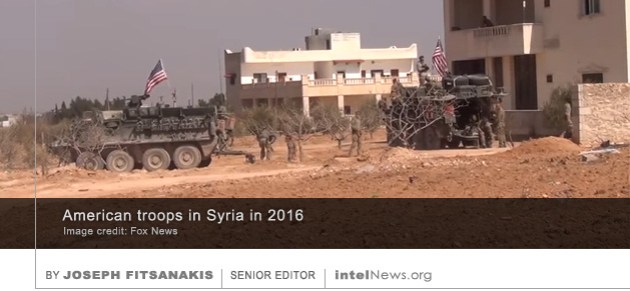
US troops in SyriaAmerican troops deployed in Syria have exchanged fire with rebels that were until recently supported by the United States Central Intelligence Agency. In 2013, soon after the outbreak of the Syrian Civil War, the then-US President Barack Obama instructed the Central Intelligence Agency to provide covert support to fighters in Syria. Acting on the president’s directive, the CIA promptly joined forces with spy agencies from Britain, France, Saudi Arabia and the United Arab Emirates, to assist fighters affiliated with the Free Syrian Army. At that time, Washington saw the Free Syrian Army and forces affiliated with it as ideologically moderate. It also agreed with the group’s main aim, which was to topple the regime of Syrian President Bashar al-Assad.
Under the project, which was codenamed TIMBER SYCAMORE, CIA personnel trained Free Syrian Army fighters in irregular warfare, while also providing them with light weaponry including machine guns, sniper rifles and off-road vehicles. But on July 19 of this year, US President Donald Trump abruptly ended the CIA program, which he called “dangerous and wasteful”. It soon became apparent that many Free Syrian Army soldiers approached Turkey, seeking financial income and protection. By early August, there were reports from Syria that large groups of former Free Syrian Army troops were conducting raids in northern Syria in coordination with the Turkish military.

Early on Wednesday, a spokesman for the Combined Task Force Operation Inherent Resolve told reporters that US troops in Syria had come under fire by Turkish-commanded former Free Syrian Army units. The spokesman told reporters in Kuwait City that the rebels shot at US troops in the outskirts of Manbij, a northern Syrian city of about 70,000, located a few miles from the Turkish border. The American soldiers reportedly returned fire before seeking shelter from the assault. According to the US Pentagon, the Turkish government was promptly contacted by Inherent Resolve commanders, who described the incident as “not acceptable”. Washington alleges that its troops have come under fire “multiple times” in the past month. Some of the culprits are believed to be Turkish-controlled Syrian insurgents, including former members of the Free Syrian Army.

Turkey and the US are member states of the North Atlantic Treaty Organization. But the two countries do not follow a common policy on Syria. The US Pentagon supports Kurdish insurgents in Syria, which Turkey claims are connected with Kurdish separatists inside Turkey. Washington’s official position on Kurdish separatists is that they engage in terrorism against the Turkish state.

Author: Joseph Fitsanakis | Date: 30 August 2017 | Permalink

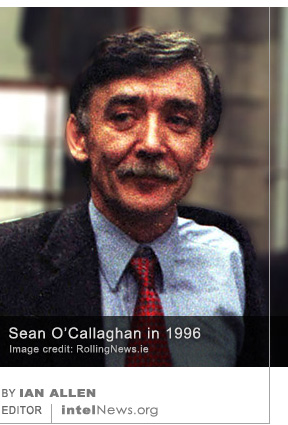
Sean O’Callaghan, Provisional IRA defector-in-place, dies at 63

Sean O’CallaghanSean O’Callaghan, one of the most contentious figures in the history of the Provisional Irish Republican Army, has died in Jamaica. He was born in County Kerry, Republic of Ireland, in a strongly republican family, which sided with opponents of the Ango-Irish treaty and fought against the official Irish government in the Irish Civil War of 1922-1923. In 1971, aged just 17, O’Callaghan joined the Provisional Irish Republican Army, which fought to unite British-controlled Northern Ireland with the independent Republic of Ireland. Not long after, O’Callaghan was arrested by the Garda Síochána (Irish police) in his home county of Kerry, when a small quantity of explosives he was hiding in his parents’ house accidentally detonated.
After serving his prison sentence in Ireland, O’Callaghan returned to active duty as a Provisional IRA volunteer, and even pulled the trigger in the killing of Detective Inspector Peter Flanagan, a Catholic officer in the Royal Ulster Constabulary, the police body of Northern Ireland, who was assassinated by the Provisional IRA in 1974. Gradually, however, O’Callaghan became disillusioned with armed militancy and distanced himself from the Provisional IRA, eventually moving to London. By 1979, when the Provisional IRA contacted him and asked him to return to active service, O’Callaghan had become an ideological opponent of militant Irish republicanism. He contacted the Irish government and offered to become an agent-in-place for the Special Branch of Garda Síochána.

O’Callaghan operated as a spy for the Irish government within the Provisional IRA from 1979 until 1988. During that time, he continued to participate in Provisional IRA operations, including an attempt (which he claimed to have foiled) to murder the Prince of Wales and his then wife, Princess Diana. He also remained a member of Sinn Féin, a republican political party that was widely viewed as the political wing of the Provisional IRA. In 1985, he was elected county councilor representing Sinn Féin. Three years later, fearing for his life, O’Callaghan turned himself in to British authorities. He was prosecuted, convicted, and served a prison sentence, during which he wrote his best-selling memoir, published under the title The Informer: The True Life Story of One Man’s War on Terrorism. In it, he details his ideological change from a socialist republican to a pro-unionist, who occasionally advised the Ulster Unionist Party, a pro-British conservative political party in Northern Ireland.

After he revealed his pro-unionist sympathies, O’Callaghan was disowned by most of his family and did not even attend his father’s funeral in 1997. He lived openly in England, refusing police protection and rejecting pleas from his supporters to change his name and hide his whereabouts. He died last week from a suspected heart attack while visiting his daughter in Jamaica. He was 63.

Author: Ian Allen | Date: 29 August 2017 | Permalink

Ukraine releases rare footage showing arrests of North Korean nuclear spies

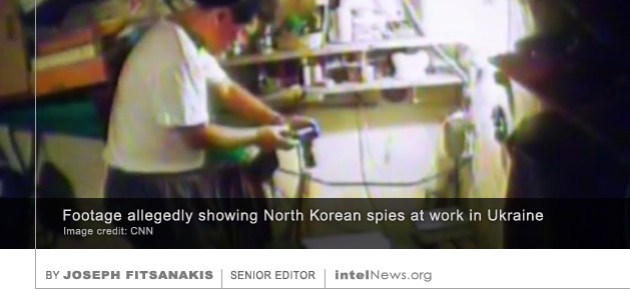
North Korean SpiesUkrainian authorities have released rare surveillance footage filmed during a sting operation that ended with the capture of three North Korean spies. The North Koreans, two of whom are now serving prison sentences in Ukraine, had traveled there in 2011 believing they would be given missile technology secrets. Last July, North Korea surprised missile technology experts by successfully testing two intercontinental ballistic missiles (ICBMs). Government-controlled media in Pyongyang claimed that North Korean ICBMs were capable of reaching the United States’ mainland.
On August 14, a report by the London-based International Institute of Strategic Studies (IISS) suggested that North Korea’s technological leap had been achieved with assistance from abroad. The report claimed that one possible source of North Korea’s technical advancement was the Yuzhnoye Design Office, a corporation that specializes in the design of rockets and satellites. Based in the central Ukrainian city of Dnipro, Yuzhnoye has its roots in the Soviet space and weapons program of the early 1950s. Following the publication of the IISS report, some experts claimed that North Korean spies may have illicitly purchased or stolen missile designs from Yuzhnoye. Ukrainian authorities strongly denied these allegations, and argued that Russia was a far more likely source of North Korea’s technical knowledge —something that Moscow refutes. In an effort to strengthen their claims, Ukrainian officials were authorized to release details of counterespionage operations against North Korean spies in recent years. They told the US-based news network CNN that several North Korean spies had been caught spying in Ukraine in recent years, and that Ukraine responded in 2016 by barring all North Koreans from entering the country.

The Ukrainians also released to CNN surveillance footage filed during a sting operation in 2011, in which three North Korean diplomats were caught photographing classified documents in Ukraine. The documents, which contained technical blueprints of missiles, were fake, and the operation had been planned by the Ukrainians several years prior. The three North Koreans had traveled to Ukraine from the Democratic People’s Republic of Korea’s embassy in Moscow. One of the men, who had been tasked with transporting stolen hardware missile parts out of Ukraine, was deported following his arrest. His two accomplices are currently serving eight-year prison sentences in a Ukrainian prison located nearly 90 miles west of Kiev. Reporters from CNN were also granted access to the two North Korean prisoners, known only as “X5” and “X32”. The younger prisoner, who goes by X32, declined to be interviewed. But X5, who is in his mid-50s, told CNN that he was born in Pyongyang and that at the time of his arrest he was serving as a trade representative in the DPRK’s embassy in Belarus.

Ukrainian officials told CNN that the two men were visited in jail once by officials in the DPRK’s embassy in Moscow, but that was their only contact —face-to-face or otherwise— with North Korean citizens since their arrest. The officials argued that this information about Ukraine’s counterespionage operations against North Korean spies should help dispel all allegations that Pyongyang may have acquired its missile knowhow from Ukrainian sources.

Author: Joseph Fitsanakis | Date: 28 August 2017 | Permalink

Russia jailed senior intelligence officers for helping CIA nab notorious hackers

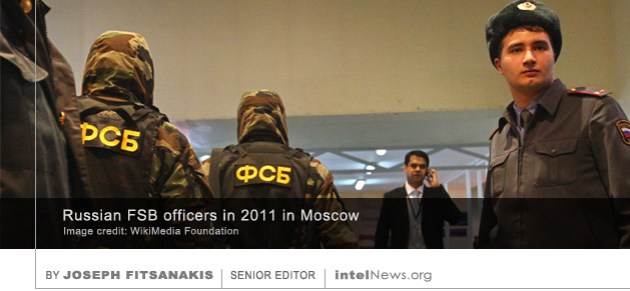
FSB - JFTwo senior officers in the Russian intelligence services were charged with treason after they were found to have helped the United States catch two notorious Russian hackers, according to reports in the Russian media. Sergey Mikhailov was a career officer in the Federal Security Service —a descendant of the domestic section of the Soviet-era KGB— which is often referred to as Russia’s equivalent of the United States Federal Bureau of Investigation. Mikhailov had risen through the ranks of the FSB to eventually head the agency’s Center for Information Security. Known in Russia as CIB, the Center is tasked with investigating electronic crime in the Russian Federation.
But in December 2016, Mikhailov and one of his trusted deputies in the CIB, Dmitry Dokuchaev, were suddenly removed from their posts and arrested. The arrests marked some of the highest-profile detentions of intelligence officers in Russia since the demise of the Soviet Union. Russian authorities refused to reveal the reasons for the arrests, but confirmed that the two men had been charged with treason. Reports soon surfaced in the Russian media, claiming that Mikhailov and Dokuchaev were arrested for their involvement in a Russian criminal hacker gang. Some Western media, including The New York Times, speculated that the two men may have been arrested for helping US intelligence investigate Russian interference in the 2016 US presidential election.

But now a new report alleges that Mikhailov and Dokuchaev were charged with treason after helping the US Central Intelligence Agency catch two prolific Russian hackers. The report was aired on Russian television station TV Dozhd, also known as TV Rain, a privately owned channel based in Moscow, which broadcasts in Russia and several other former Soviet Republics. One of the hackers, Roman Seleznev, known in hacker circles as Track2, reached worldwide notoriety for defrauding major credit card companies of tens of millions of dollars. He was arrested in 2014 in the South Asian island country of Maldives and eventually extradited to the US to stand trial. He was sentenced to 27 years in prison, which he is currently serving. The other hacker, Yevgeniy Nikulin, was arrested in the Czech Republic in 2016, pursuant to a US-issued international arrest warrant. He is now awaiting extradition to the US, where he is expected to be tried for hacking several high-profile companies, including DropBox and LinkedIn.

TV Dozhd said that Russian authorities are also suspecting the men of being members of hacker gangs, but that their main charges relate to their close cooperation with American intelligence agencies, reportedly in exchange for cash.

Author: Joseph Fitsanakis | Date: 25 August 2017 | Permalink

Canadian intelligence monitoring far-right activities after Charlottesville

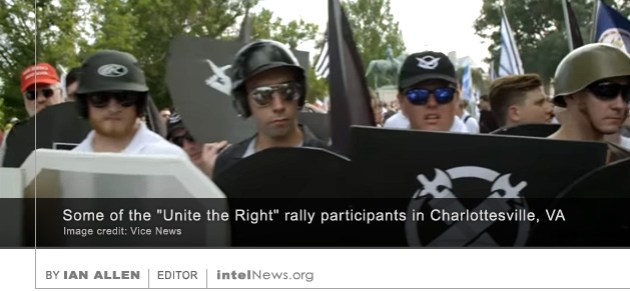
Unite the Right rallyCanadian spy organizations are working with domestic and international agencies in response to reports that several Canadian far-right activists attended the “Unite the Right” rally in Charlottesville, Virginia, earlier this month. The rally drew the attention of the world’s media after violent clashes between protesters and counter-protesters left a woman dead. Two Virginia State Police officers were also killed when a helicopter used in crowd control in Charlottesville crashed near the site of the demonstrations. The rally, which took place on August 11 and 12, drew members of various white supremacist, white nationalist, neo-Nazi and neo-Confederate groups. There were also heavily armed members of a self-styled militia at Emancipation Park, where a soon-to-be-removed statue of the late Confederate General Robert E. Lee became the focal point of the far-right demonstrators.
Canadian news watchers were surprised to find out that several Canadian citizens traveled to the United States to participate in the “Unite the Right” rally. At least two were identified on social media after appearing in a Vice News documentary about the rally. One Canadian participant is believed to be an activist with Le Meute (The Wolf Pack), a far-right group that appeared in Quebec in 2015 and today boasts 43,000 registered members. The stated position of the Canadian Security Intelligence Service (CSIS), Canada’s primary national intelligence agency, is that far-right extremism is not a major problem in Canada. In 2014, the agency said that rightwing extremism was not “as significant a problem in Canada in recent years”. The statement added that Canadians who held far-right extremist views “have tended to be isolated and ineffective figures”.

Speaking to the Canadian online newspaper The National Observer, the CSIS declined to comment specifically about the events in Charlottesville. It also did not respond to a question about whether it monitors the international travels of Canadian far-right activists. A CSIS spokeswoman, Tahera Mufti, told the newspaper that the agency was unable to discuss details about its ongoing investigations into Charlottesville “due to national security reasons”. But she added that CSIS was working “with its Canadian and international partners” to combat the activities of “those who support right-wing extremism”.

Author: Ian Allen | Date: 23 August 2017 | Permalink

Serbia recalls all staff from embassy in Macedonia, alleges espionage

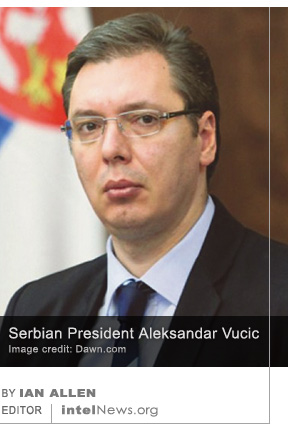
Serbian President Aleksandar VucicSerbia recalled its entire diplomatic staff from its embassy in the Former Yugoslav Republic of Macedonia on Monday, claiming that it wanted to protect its diplomats from “offensive intelligence activities” directed against them. The move came without warning and surprised journalists in the two former Yugoslav republics. No official reason was given for the recall on Monday morning. Later, however, Serbian President Aleksandar Vučić said that he had decided to recall the diplomats back to Belgrade due to “sufficient evidence of highly offensive intelligence activities against certain bodies and institutions in Serbia”. He did not specify what he meant, but added that the duty of the government of Serbia was to ensure that “our people be prepared and ready”.

Some reports in Macedonia media suggested that Serbia’s move was related to rumors in Skopje that the Macedonian government plans to support an expected attempt by the Republic of Kosovo to join the United Nations Educational, Scientific and Cultural Organization (UNESCO). Kosovo was a province of Serbia until 2008, when it proclaimed its independence, a move that was backed by many Western powers, including the United States. However, Serbia has not recognized Kosovo’s independence and has actively opposed Kosovo’s attempts to become a full member of international bodies. Belgrade successfully blocked Kosovo’s entry into UNESCO in 2015. At that time, the former Serbian province country did not receive enough votes to join the organization. But there are concerns in Serbia that, Kosovo might apply again this year and that this time it may be successful.

Serbia has kept a cautionary stance on the current political crisis in Macedonia, which began in 2015 when thousands of people took to the streets in Macedonian capital Skopje to protest against the conservative government of Prime Minister Nikola Gruevski. The crisis deepened in late 2016, when many intelligence officers, including a former director of the national spy service, were accused of illegally wiretapping thousands of people on orders of the government. Under growing pressure, Gruevski stepped down and was eventually replaced by the leader of the center-left opposition, Zoran Zaev, who is now prime minister. During his election campaign last spring, Zaev was critical of Serbia, which he accused of behaving nationalistically against other former Yugoslav republics.

Speaking to reporters in Belgrade on Monday, Serbia’s Minister of Foreign Affairs, Ivica Dačić, said he believed Serbian diplomatic staff would be back in Skopje by the end of August. Mr. Vucic simply commented that there was a “different, new atmosphere” in the Macedonian capital and said he hoped that the situation would become clearer in the coming days.

Author: Ian Allen | Date: 22 August 2017 | Permalink

Australia concerned about Chinese firm’s involvement in undersea cable project

Sogavare and TurnbullAustralia has expressed concern about a plan by a Chinese telecommunications company to provide high-speed Internet to the Solomon Islands, a small Pacific island nation with which Australia shares Internet resources. The company, Huawei Technologies, a private Chinese venture, is one of the world’s leading telecommunications hardware manufacturers. In recent years, however, it has come under scrutiny by Western intelligence agencies, who view it as being too close to the Communist Party of China.

One of Huawei’s most recent large-scale projects involves the Solomon Islands, a former British overseas territory that became independent in 1978 and is today a sovereign nation. The Pacific country consist of a complex of nearly 1,000 islands of different sizes, scattered over a distance of 11,000 square miles. It lies northeast of Australia and directly east of Papua New Guinea. In 2014, the government of the Solomon Islands began an ambitious project to connect its Internet servers to those of Australia via a 2,700-mile undersea fiber optic cable. The ultimate goal of the project is to provide Solomon Islands inhabitants with reliable high-speed Internet. The project was approved by Canberra (Australian government) and Sydney (Australian private sector) and given the green light by the Asian Development Bank, which promised to fund it. But in 2016 the Solomon Islands government suddenly named Huawei Marine as the project’s main contractor. Huawei Marine, a subsidiary of Huawei Technologies, is a joint venture between the Chinese firm and Global Marine Systems, a British-headquartered company that installs undersea telecommunications cables.

The news was greeted with concern in Canberra. The Australian intelligence community has previously warned that Huawei operates as an arm of the Chinese spy services. Intelligence agencies in the United Kingdom and the United States have issued similar warnings. In 2011, a report by a research unit of the US Office of the Director of National Intelligence concluded that Huawei Technologies relied on a series of formal and informal contacts with the Chinese People’s Liberation Army and the Ministry of State Security. But a subsequent 18-month review commissioned by the White House found no evidence that Huawei spied for the Chinese government.

Canberra is concerned that, by constructing the Solomon Islands undersea cable, Huawei would be “plugging into Australia’s telecommunications infrastructure backbone”, something that, according to some intelligence officials, “presents a fundamental security issue”. To further-complicate things, opposition officials in the Solomon Islands allege that the country’s government contracted the services of Huawei after the Chinese company promised to make a multi-million dollar donation to the ruling political party. Last June, the director of the Australian Secret Intelligence Service (ASIS), Nick Warner, visited the Solomon Islands and tried to convince the country’s Prime Minister, Manasseh Sogavare, to drop Huawei from the project. The topic was also discussed in a meeting between Mr. Sogavare and his Australian counterpart, Malcolm Turnbull, in Canberra last week. Following the meeting, the Solomon Islands leader said that his government would “continue to have discussions with the Australian government to see how we can solve that […] security issue”.

Author: Ian Allen | Date: 21 August 2017 | Permalink

CIA warned Barcelona police two months ago about possible Islamist attack

BarcelonaThe United States Central Intelligence Agency recently warned Spanish authorities that the Islamic State planned to attack Barcelona, according to Spanish media. The disclosure follows Thursday’s dramatic events in the Catalan capital, where a white van deliberately drove into a crowd in the pedestrian mall of La Rambla, killing at least 16 people and injuring more than 100. The attack was followed by reports early on Friday that Catalan police had shot dead four suspects who were planning a second strike.
In the hours following the attack, several observers noted that Barcelona was always an obvious target for the Islamic State, given that the group had already perpetrated terrorist attacks in Berlin, London, Paris and Brussels. They also raised questions about the low level of police presence and the absence of anti-vehicle barrier systems in Barcelona —one of Europe’s busiest tourist destinations. Late on Thursday, the Catalan newspaper El Periódico reported that, two months ago, the CIA alerted the Mossos d’Esquadra, the autonomous police and security service of Catalonia, of a possible terrorist attack by the Islamic State. According to the Barcelona-based daily, the CIA even mentioned La Rambla as the main target of Islamist militants.

Even before the CIA issued its warning, the Islamic State had directed several threats against Spain since 2014, when the group first appeared in Syria. As El Periódico said, the group’s followers “consider themselves obligated to re-establish Islam” in areas that were ruled by Muslim leaders in the past. For much of the medieval period, Spain and Portugal were known as Al-Andalus, and were ruled by a succession of Muslim caliphs. The Spanish daily also reported that a Twitter account associated with the Islamic State issued several warnings against Spain two weeks ago. Specifically, on July 30, the account twitted a series of messages that read: “We will implement the caliphate in Spain and will recover our land. Impending attack on Al-Andalus, God willing”. Similar threats had been issued a year ago on social media, but were later disregarded after they failed to materialize, said El Periódico.

Author: Joseph Fitsanakis | Date: 18 August 2017 | Permalink

Saudi government secretly abducting its critics from abroad, say dissidents

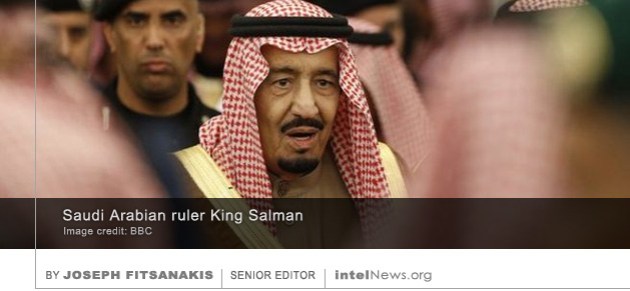
Salman of Saudi ArabiaAt least three prominent Saudi dissidents living in Europe, who openly criticized Saudi Arabia’s system of government, have been illegally abducted by the country’s monarchy in the past two years, according to a report by the BBC. All three, who are members of the Saudi royal family, are missing, believed to be dead or held against their will in Saudi Arabia. But the country’s government will not comment on their fate.


According to the BBC World Service, one of the missing dissidents is Prince Turki bin Bandar, a former major in the Saudi police force. In 2010, the prince began falling out with the Saudi royal family over a disputed inheritance. He was reportedly arrested and imprisoned. Once released from prison, in 2012, he moved to France, from where he began criticizing the Saudi government by posting videos and messages on social media. But his messages calling for political reform and an end to corruption in Saudi Arabia stopped in the summer of 2015 when, according to his friends, he disappeared. One of them, the blogger Wael al-Khalaf, told the BBC that Prince Bandar was visiting Morocco where he was detained following a request by the Saudi government. It is believed that he was then deported to Saudi Arabia, where he remains today, almost certainly against his will.

Another Europe-based Saudi royal, Prince Saud bin Saif al-Nasr, has been missing since 2015. His disappearance came after a year-long social-media campaign in which he called for the prosecution of senior Saudi officials for backing the overthrow of the now deposed Egyptian President Mohammed Morsi. In September 2015, shortly before his disappearance, Prince Nasr had publicly endorsed two anonymous open letters —allegedly written by a Saudi prince— calling for the violent overthrow of the Saudi monarchy. According to the BBC, Prince Nasr was the only Saudi royal to publicly and openly endorse the letters. He then disappeared and is presumed to be in Saudi Arabia.

The third case, that of Prince Khaled bin Farhan, is more complicated. The prince was living in Switzerland and was a prominent figure among Saudi exiles calling for political reforms in their homeland. In 2003, he took a flight from Milan to Rome on a private jet, which, according to the BBC, had been provided to him by a Russian-Italian company seeking to strike a business deal with him. But Prince Farhan alleges that the trip was a ruse, and that the jet took him instead to Saudi Arabia, where he was imprisoned. Seven years later, the Saudi government allowed him to seek medical treatment in the United States. But when he arrived in Boston, Massachusetts, the prince immediately filed a criminal complaint against his abductors in the Swiss courts. Amazingly, in 2016 he was convinced by the Saudi government in Paris, where he was living at the time, to use a Saudi government plane to visit his ailing father in Cairo, Egypt. But, predictably, the airplane took him and his 18-member entourage —which included non-Saudi citizens— to Riyadh. When the jet landed, Prince Farhan was “dragged […] from the plane” by heavily armed guards while “screaming at his team to call the US embassy”, according to two members of his entourage who spoke anonymously to the BBC.

The two anonymous sources told the British broadcaster that they had their passports taken away and were kept in a hotel for three days without being allowed to use a telephone to contact their family abroad or their country’s embassy in Saudi Arabia. They were then allowed to “fly to a destination of their choice” with their expenses paid by the Saudi government. The BBC said it contacted the Saudi government seeking information about the three missing royals, but Saudi officials declined to respond to questions.

Author: Joseph Fitsanakis | Date: 17 August 2017 | Permalink