Russia allegedly planning to expel 30 American diplomats in a few weeks
July 12, 2017 2 Comments
 Russia is planning to expel approximately 30 American diplomats from its territory, and seize buildings and property belonging to the United States Department of State, according to Russian media reports. The expulsions will be in response to the expulsion last December of 35 Russian diplomats stationed in the US by the administration of President Barack Obama. In addition to expelling the diplomats, Washington also reclaimed two “recreational facilities” (in reality intelligence outposts) that were used by the Russians in New York and Maryland. The White House said that the expulsions were ordered in response to alleged efforts by Russia to interfere in the 2016 US presidential election.
Observers, including the present author, were confident at the time that the Kremlin would respond in kind. In a surprising move, however, the Russian President Vladimir Putin said he would not respond to Mr. Obama’s move, in the hope that US-Russian relations would improve with the arrival of the new president in the White House. He added that Russia reserved the right to retaliate at a later time. Moscow’s response was met with praise by the then-president-elect Donald Trump and his transition team.
But Russia’s hopes for warmer relations with the US under Mr. Trump’s leadership do not seem to be materializing. A recent article in the daily Russian newspaper Izvestia reported that the Kremlin thought it was “outrageous” that the Trump White House had not yet returned the two seized compounds to the Russian Ministry of Foreign Affairs and not rescinded the expulsions of the 35 diplomats and their families. It also claimed that President Putin raised the issue with his US counterpart during their July 7 meeting in the German city of Hamburg. The Moscow-based newspaper quoted unnamed senior Russian officials, who said that Russia was preparing to expel dozens of American diplomats and seize US diplomatic facilities soon.
It appears that Russia will wait until the upcoming meeting between the US Undersecretary of State Thomas Shannon and the Russian Deputy Foreign Minister Sergei Ryabkov, which has been scheduled for later this month in St. Petersburg. If no US assurances for the return of the compounds and diplomats are made at that time, Moscow will proceed with its tit-for-tat plan. When asked about Izvestia’s article, the Russian Minster of Foreign Affairs, Sergei Lavrov, replied that the Kremlin was “weighing specific measures” in response to last December’s expulsions of Russian diplomats from the US. However, Mr. Lavrov said he did not want to elaborate at the present time, while also refusing to deny the newspaper’s allegations.
► Author: Joseph Fitsanakis | Date: 12 July 2017 | Permalink
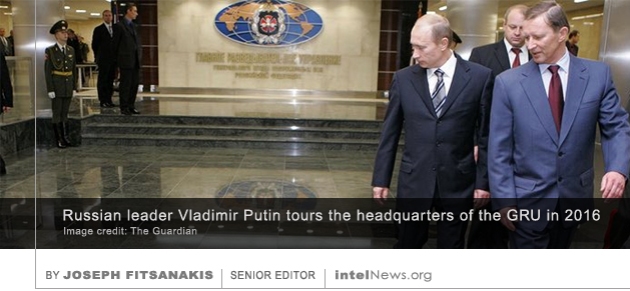 New information about carefully targeted attempts by Russian operatives to compromise the November 2016 presidential elections in the United States have emerged in a newly published intelligence document. The document, which dates from May of this year, was produced by the US National Security Agency and
 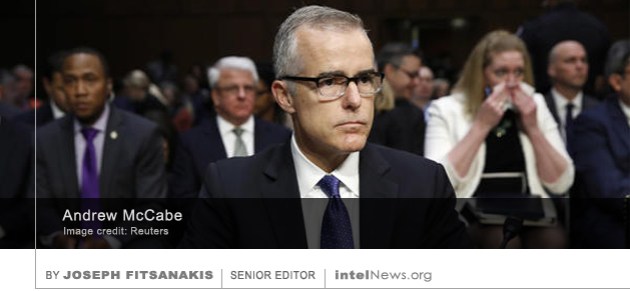 The interim director of the Federal Bureau of Investigation has told an intelligence panel in the United States Senate that he will not hesitate to report any attempts by the White House to interfere with an official investigation into Russia’s role in the 2016 presidential election. Andrew McCabe assumed the leadership of the FBI on Tuesday, after US President Donald Trump abruptly fired the Bureau’s director, James Comey. A trained lawyer who joined the FBI in 1996, McCabe amassed significant experience in countering organized crime and terrorism before being appointed Deputy Director of the Bureau in 2016.
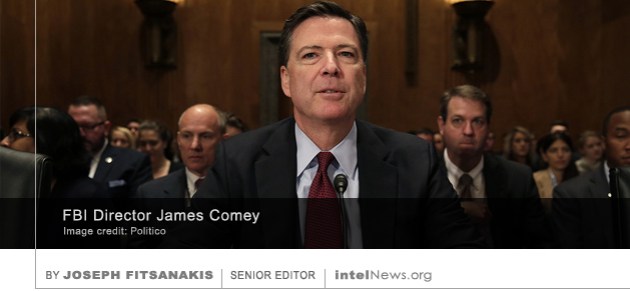 Monday’s official announcement that an investigation is underway into alleged Russian involvement in the 2016 United States presidential election was an important moment in American political history. It exposed the chaotic state of American politics and added yet another layer of complexity in an already intricate affair, from which the country’s institutions will find it difficult to recover for years to come. This is regardless of the outcome of the investigation, which is being conducted by the Federal Bureau of Investigation. Even if it fails to produce a ‘smoking gun’, the very fact that the country’s chief counterintelligence agency is examining the possibility that a US president was elected with help from Russia, is an astonishing development without parallel in modern American history.
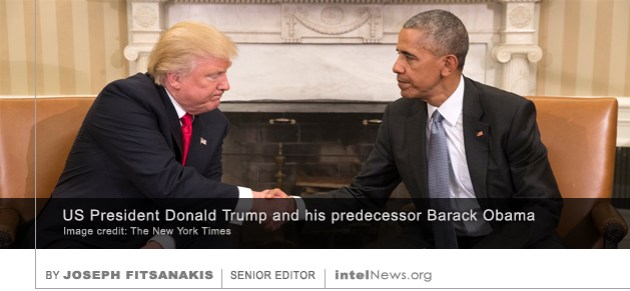 The absurdity of American politics reached new heights over the weekend, as President Donald Trump dramatically alleged on Twitter that his predecessor, Barack Obama, wiretapped his telephones last year. Even for a highly impulsive public figure known for his sensational and often-unsubstantiated allegations, Mr. Trump’s latest claims prompted a new sense of abnormality and astonishment in Washington. If the president is unable to prove his dramatic claims, his reliability will be further-eroded, and what little is left of his relationship with the American intelligence and national-security communities will disintegrate. If his allegations are proven, they will cause a scandal of unprecedented proportions from which American political institutions —including the presidency— will find it difficult to recover.
 order at the highest levels of the American government, Mr. Trump’s claims cannot possibly be true. American presidents have not been legally allowed to order wiretaps since 1978, when the Foreign Intelligence Surveillance Act (FISA) was established. Prompted by the abuse of executive power revealed through the Watergate scandal, FISA forces government agencies to seek the approval of specially mandated judges before installing wiretaps. If an agency like the Federal Bureau of Investigation (FBI) wants to wiretap an individual or group suspected of acting as agents of a foreign power, it must convince one of 11 federal district judges who rotate on the FISA court that the case warrants a wiretap order. Thus, before authorizing the wiretap, a FISA judge must be convinced by examining the available evidence presented before him or her.
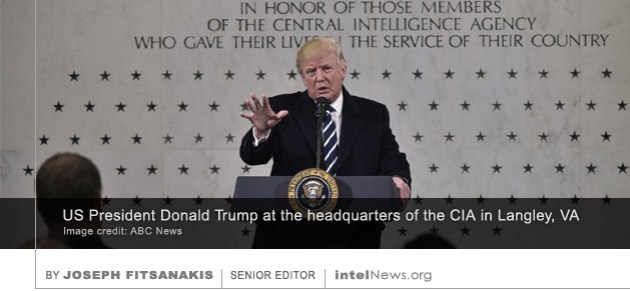 Officials at the United States Central Intelligence Agency have questioned whether it is safe for them to reveal the sources of their information about Russia to America’s new President, Donald Trump, according to a report. The implication is that some at the CIA are concerned that Trump’s allegedly close ties with Russian officials may put CIA operations officers in danger. The information was shared on Monday by Mary Louise Kelly, national security correspondent for National Public Radio (NPR). She
  There is no doubt whatsoever that Russia has compiled ‘information’ on United States President Donald Trump. Russian intelligence considers it a rightful duty to compile information on persons of relevance, especially when they are conducting significant business or maintain political relations with Russia. Trump qualified under that definition long before he even thought about running for president. Even I have been followed, during my numerous times in Russia, both openly and tacitly. I have had my computer hacked and hotel phone bugged. And my affairs in Russia have come nowhere near to the financial or political relevance of Donald Trump.
 intelligence on Trump has nothing to do with American celebrity culture. If it truly exists, this would have been done under the edict of ‘national security’ for Russian geopolitical interests. As such, the proper Russian intelligence behavior would be to deny its existence and hold on to anything it has until a time deemed strategically best. The least efficient usage of that compromising material would be to just embarrass him publicly before he is inaugurated, TMZ ‘gotcha’ style. Russians simply don’t work that way. Rather, keeping it secret and using it in a non-public but strategically effective manner for their national interests is the Russian way.
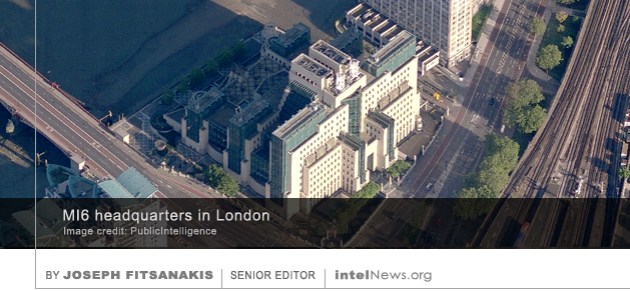 British intelligence agencies gave their United States counterparts an early warning about Russian attempts to influence the outcome of the American presidential election, according to The New York Times. The American newspaper
  There had been rumors for some time about a possible expulsion of Russian diplomats from the United States, in response to alleged Russian interference in the 2016 US Presidential election. The White House confirmed the rumors on Thursday morning, by
 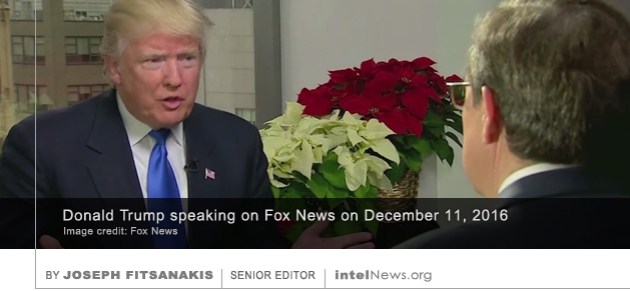 No person familiar with the theory and practice of intelligence will be shocked by allegations that Russia interfered in the recent American presidential election. On the contrary, the claim will strike experienced observers as a textbook case of covert operation —an intelligence activity designed to influence foreign political, military or economic developments. Far from being physically violent, most covert operations involve actions like secretly funding political parties, planting misinformation or propaganda in foreign media outlets and —in more extreme cases— bribing or extorting key political actors. During the Cold War, hardly a national election took place without attracting the
 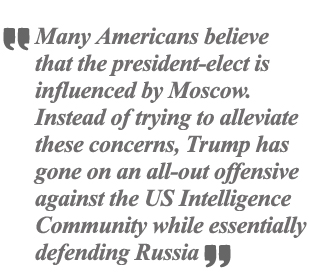 in last month’s US election. Indeed, the opposite would be strange.
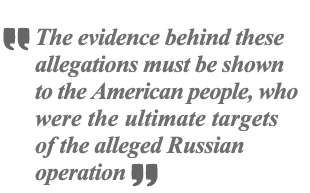 candidates. This was about the reputation of the American electoral process. In fact, the primary goal of Russia’s involvement in the US election —which, again, must be presumed— was not to empower a particular candidate, but to weaken the reputation of American political institutions as a whole. Those who claim that the Kremlin tried to promote Trump because the Republican candidate appears to be more favorably disposed toward Russia are wrong. They misunderstand the complex nature of Russian-American relations and underestimate Russian strategy. Moscow understands that its bilateral relationship with Washington rests on a set of longstanding geopolitical variables and does not depend on ephemeral personal relations between individual leaders. Furthermore, the Kremlin views Trump as an inherently unpredictable actor that is not to be trusted. The Russian plan, therefore, was not to help elect Trump. Rather, it was to sow mistrust between American –and by extension Western– civil society and its political institutions. Given the challenges currently being faced by European and American democracy, that is not a far-fetched goal.
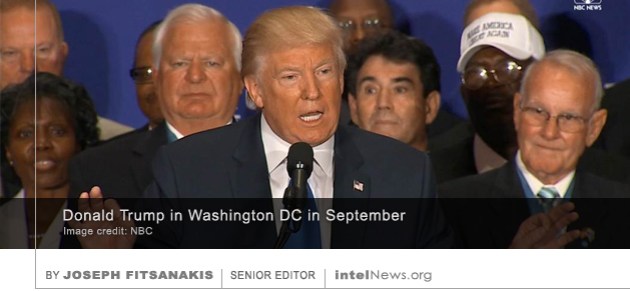 Members of the United States Intelligence Community will soon begin sharing top-secret information with the White House transition team of president-elect Donald Trump. According to a






 intelNews.org
Dutch spies identified Russian hackers who meddled in 2016 US election
January 29, 2018 by Joseph Fitsanakis 1 Comment
Last Thursday, the Dutch current affairs program Nieuwsuur, which airs daily on Holland’s NPO 2 television, said that the initial tipoff originated from the AIVD, Holland’s General Intelligence and Security Service. On the same day, the Dutch newspaper De Volkskrant published a detailed account of what it described as AIVD’s successful penetration of Cozy Bear. According to these reports, AIVD was able to penetrate Cozy Bear in mid-2014, before the hacker group intensified its campaign against political targets in the US. Citing “six American and Dutch sources who are familiar with the material, but wish to remain anonymous”, De Volkskrant said that the AIVD was able to detect the physical base of the Cozy Bear hackers. The latter appeared to be working out of an academic facility that was adjacent to Moscow’s Red Square. The AIVD team was then able to remotely take control of security camera networks located around the facility. Eventually, the Dutch team hacked into another security camera network located inside the buildings in which the hackers worked. They soon began to collect pictures and footage of Cozy Bear members, which they then compared with photos of “known Russian spies”, according to De Volkskrant.
The paper said that the AIVD team continued to monitor Cozy Bear’s activities until at least 2017, while sharing intelligence with the Central Intelligence Agency and the National Security Agency in the US. The intelligence was allegedly instrumental in alerting US spy agencies about Russian government-sponsored efforts to meddle in the 2016 presidential election. Several newspapers, including The Washington Post in the US and The Independent in Britain, contacted the AIVD and the MIVD —Holland’s military intelligence agency— over the weekend. But the two agencies said they would not comment on reports concerning Cozy Bear.
► Author: Joseph Fitsanakis | Date: 29 January 2018 | Research credit: E.J. & E.K. | Permalink
Filed under Expert news and commentary on intelligence, espionage, spies and spying Tagged with 2016 US presidential election, AIVD (Netherlands), APT29, computer hacking, Cozy Bear, cybersecurity, Netherlands, News, Russia, United States