Chinese diplomat who defected to Australia breaks silence to warn of spies
November 24, 2016 Leave a comment
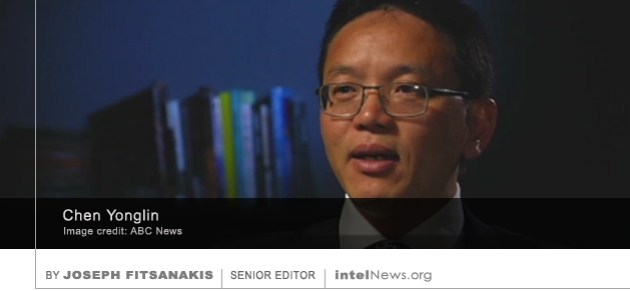 A Chinese diplomat, who made international news headlines in 2005 when he defected to Australia, has ended a decade of silence to warn about an alleged increase in Chinese espionage operations against his adopted country. Chen Yonglin was a seasoned member of the Chinese diplomatic corps in 2001, when he was posted as a political affairs consul at the Chinese consulate in Sydney, Australia. His job was to keep tabs on the Chinese expatriate community in Australia, with an emphasis on individuals and organizations deemed subversive by Beijing. He later revealed that his main preoccupation was targeting members of the Falun Gong spiritual movement, which is illegal in China. He also targeted supporters of Taiwanese independence, as well as Tibetan and East Turkestan nationalists who were active on Australian soil.
But in 2005, Chen contacted the Australian government and said that he wanted to defect, along with his spouse and six-year-old daughter. He was eventually granted political asylum by Canberra, making his the highest-profile defection of a Chinese government employee to Australia in over half a century. During a subsequent testimony given to the Parliament of Australia, Chen said that he was in contact with Australian intelligence and was giving them information about alleged Chinese espionage activities. He said at the time that China operated a network of over 1,000 “secret agents and informants” in Australia. Chen distinguished agents and informants from Chinese intelligence officers, most of whom were stationed in Chinese diplomatic facilities.
Chen, who now works as a businessman, disappeared from the public limelight after his defection. But last weekend, he reappeared after a decade of obscurity and gave an interview to ABC, Australia’s national broadcaster. The ABC journalist reminded Chen that in 2005 he had estimated the number of Chinese agents and informants operating in Australia at 1,000, and asked him how many he thought were active today. Chen responded that an increase in the number is certain, given that “China is now the wealthiest government in the world”. That meant, said Chen, that Beijing has the funds that are necessary to maintain “a huge number of spies” in Australia. However, the former diplomat said that most Chinese agents are “casual informants”, not trained spies, and that they are dormant for long periods of time in between operations.
► Author: Joseph Fitsanakis | Date: 24 November 2016 | Permalink
 A senior Chinese official with a leading role in the country’s ongoing anti-corruption crusade has been appointed head of the nation’s spy agency, which has undergone extensive purges in recent years. Chen Wenqing, 56, will be
 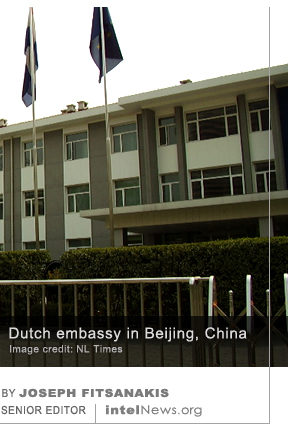 The Dutch government has suspended its ambassador to China and has launched an official investigation into an alleged secret relationship between the ambassador and a female Chinese employee at the Dutch embassy. The ambassador, Ron Keller, is a career diplomat and senior member of the Dutch foreign service corps, who has served in Russia and Turkey among other international posts. He assumed duties as Holland’s ambassador to China in late 2015. In December of that year, he arrived in Beijing and took command of one of the largest Dutch embassies in the world.
 The Chinese embassy in Canberra has strongly denied accusations that a Chinese government ship involved in the international effort to find the missing Malaysia Airlines Flight MH370 is spying on the Royal Australian Navy. The ship, the Dong Hai Jiu 101, is a salvage and rescue vessel built in Shanghai in 2012 and currently sailing under the Chinese flag. In April, the Chinese government contracted the Dong Hai Jiu 101 to join the international search effort for the wreckage of Flight MH370. The Boeing 777 aircraft disappeared over the South China Sea on March 8, 2014, while flying from Kuala Lumpur International Airport in Malaysia, to the Beijing Capital International Airport in China.
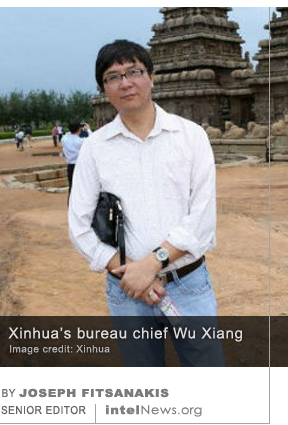 For the first time in history, India has refused to extend temporary residency visas for three senior Chinese media correspondents, effectively expelling them from the country, allegedly for espionage activities. All three reporters are employees of China’s state-run Xinhua news agency. They include Xinhua’s bureau chief in the Indian capital, New Delhi, Wu Xiang, and the agency’s Mumbai bureau chief, Lu Tang. A third journalist, She Yonggang, also based in Mumbai, has been asked to leave India by no later than July 31.
 A former computer technician who worked on cryptology has been sentenced to death in China after being found guilty in what some describe as one of the country’s most damaging espionage cases in recent years. The man, Huang Yu, is reportedly a 41-year-old computer expert who worked for a government-funded research institute specializing in cryptology —the science of making and breaking secret codes. He was arrested in 2011 in Chengdu, the capital of Sichuan province in southwestern China.
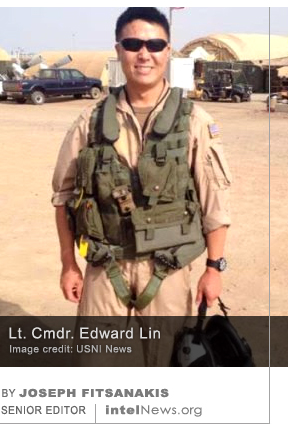 An American official has told Newsweek magazine that the possibility of further arrests in the espionage case of United States Navy flight officer Edward Lin should not be ruled out. Last Sunday, the US Navy reported the arrest Lt. Cmdr. Lin, who faces two counts of espionage and three counts of attempted espionage, among other charges. Aside from a three-page, heavily redacted charge sheet released by the Navy, almost nothing is known about this case. However, as intelNews
 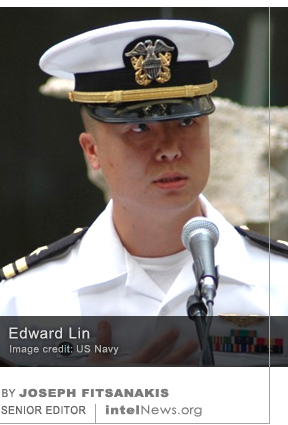 For the first time since 1985, when the Federal Bureau of Investigation broke the John Walker spy ring, an active United States Navy officer has been charged with espionage. On Sunday, the US Navy reported the arrest Lt. Cmdr. Edward C. Lin, who faces two counts of espionage and three counts of attempted espionage, among other charges. Aside from a three-page, heavily redacted
 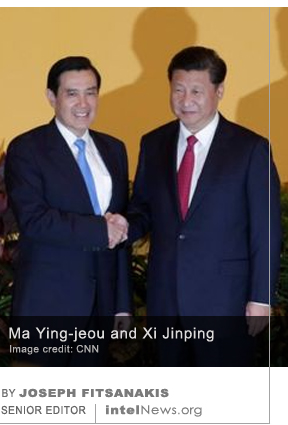 China and Taiwan reportedly swapped each other’s imprisoned spies, just days before a historic meeting between their heads of government. It was the first time in the two nations’ history that they have swapped jailed spies with each other. The exchange appears to have taken place in secret in late October, less than two weeks ahead of a historic November 7 meeting between Chinese President Xi Jinping and Taiwanese President Ma Ying-jeou. The meeting, which took place in Singapore, was hailed for its historic significance, as it was the first of its kind since 1949, when the two countries emerged following a bitter civil war between communist and nationalist forces.
 Authorities in Washington are preparing to launch an investigation into a dozen radio stations operating in major cities in the United States, which are allegedly owned by a subsidiary of the Chinese government. The investigation appears to have been sparked by a
  Authorities in China announced last week the arrests of two Japanese citizens accused of spying for the national intelligence agency of Japan. According to a spokesman from the Chinese Ministry of Foreign Affairs, the two men were been
 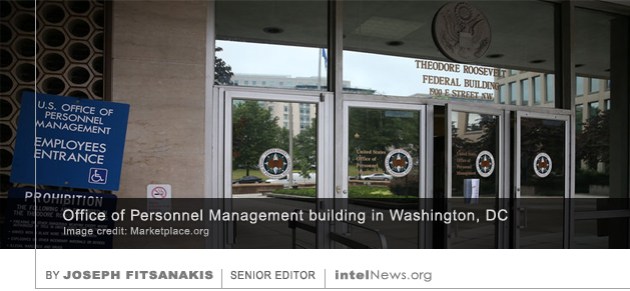 The Central Intelligence Agency (CIA) pulled a number of officers from the United States embassy in Chinese capital Beijing, after a massive cyber hacking incident compromised an American federal database containing millions of personnel records. Up to 21 million individual files were
 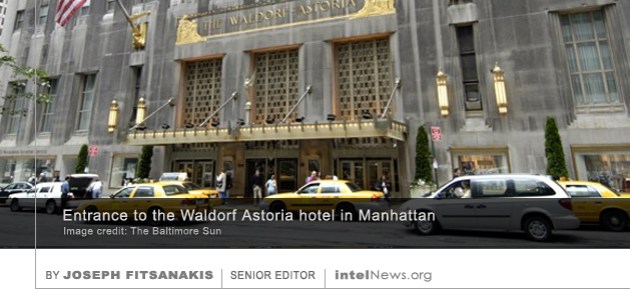 The president of the United States and his delegation will be housed at a different hotel during a United Nations General Assembly meeting later this month, allegedly due to concerns over Chinese espionage activity. Since the late 1940s, the American president and his diplomatic entourage have resided at the Waldorf Astoria for several days in September, while attending the annual UN General Assembly in New York. The luxury hotel, which is located on Park Avenue on the island of Manhattan, has also served since 1947 as the residence of the US ambassador to the UN. That is also why the American delegation is usually hosted there, courtesy of the ambassador. This year, however, President Barack Obama and his sizeable delegation will be staying at the New York Palace Hotel, located at the corner of Manhattan’s 50th Street and Madison Avenue. The announcement was made last week by the White House and the US Department of State.
 The White House has warned the Chinese government to stop deploying on American soil intelligence operatives masquerading as tourists, business executives or other false covers. Nowadays the standard practice for intelligence personnel deployed abroad is to be posted as diplomatic staff in a foreign embassy or consulate. But there are some intelligence officers who do not follow that practice. These are known as non-official-cover operatives, or NOCs in American intelligence parlance. NOCs are typically high-level principal agents or officers of an intelligence agency, who operate without official connection to the diplomatic authorities of the country that is employing them. They typically pose as business executives, students, academics, journalists, or non-profit agency workers. Unlike official-cover officers, who are protected by diplomatic immunity, NOCs have no such protection. If






 intelNews.org
Accused Chinese nuclear spy ‘to plead guilty’ in US court this week
January 4, 2017 by Ian Allen 4 Comments
The investigation began when the Tennessee Valley Authority (TVA) contacted the FBI with concerns about Ching Huey, a TVA senior manager. When the FBI questioned the TVA executive, he admitted that Allen Ho had paid him in exchange for information about nuclear power production. He also said that he had traveled to China for that purpose, and that the Chinese government had covered his travel expenses. A few months later, the FBI arrested Ho in Atlanta, Georgia, and charged him with espionage. The FBI also claims that Ho’s US business firm, Energy Technology International, gave secrets to China General Nuclear Power, a Chinese company that supplies nuclear energy technology to the Chinese government. According to Ho’s indictment, he used his technical expertise and business acumen to give Beijing US government information that could help China’s civilian and military nuclear program.
Government prosecutors argued successfully that Ho, who has close family in China, including a son from a former marriage, could flee there if freed. Prosecutors also claim that Ho has access to several million US dollars abroad. For the past months, Ho’s defense denied the espionage accusations against him. But on Tuesday, a newspaper in Knoxville, Tennessee, where Ho has been charged, said that the jailed engineer is preparing to plead guilty in court on Friday. Observers believe that this move by Ho’s legal team means that he has decided to cooperate with the FBI. He could therefore provide US authorities with information about Chinese nuclear espionage in the US, and secrets on “the inner workings of China’s nuclear program”, said the newspaper.
► Author: Ian Allen | Date: 4 January 2017 | Permalink
Filed under Expert news and commentary on intelligence, espionage, spies and spying Tagged with Allen Ho, China, China General Nuclear Power, Chinese nuclear program, Ching Huey, Energy Technology International, espionage, News, nuclear espionage, Szuhsiung Ho, Tennessee Valley Authority