Book alleges 1980s British Labour Party leader was Soviet agent

Michael FootThe leadership of the Labour Party in Britain has reacted with disdain after a new book by a leading author and columnist claimed that Michael Foot, who led the Party in the early 1980s was paid agent of the Soviet KGB. Foot, a staunch and vocal representative of the postwar British left, was a member of parliament for over 40 years, eventually serving as leader of the House of Commons. He rose to the post of deputy leader of the Labour Party and in 1980 succeeded Jim Callahan as head of the Party. But he stepped down in 1983 in the aftermath of Labour’s largest electoral defeat in over half a century.

Two years later, in 1985, Oleg Gordievsky, a colonel in the Soviet KGB, defected to Britain and disclosed that he had been a double spy for the British from 1974 until his defection. In 1995, Gordievsky chronicled his years as a KGB officer and his espionage for Britain in a memoir, entitled Next Stop Execution. The book was abridged and serialized in the London-based Times newspaper. In it, Gordievsky claimed that Foot had been a Soviet “agent of influence” and was codenamed “Agent BOOT” by the KGB. Foot proceeded to sue The Times for libel, after the paper published a leading article headlined “KGB: Michael Foot was our agent”. The Labour Party politician won the lawsuit and was awarded financial restitution from the paper.

This past week, however, the allegations about Foot’s connections with Soviet intelligence resurfaced with the publication of The Spy and the Traitor, a new book chronicling the life and exploits of Gordievsky. In the book, Times columnist and author Ben Macintyre alleges that Gordievsky’s 1995 allegations about Foot were accurate and that Gordievsky passed them on to British intelligence before openly defecting to Britain. According to Macintyre, Gordievsky briefed Baron Armstrong of Ilminster, a senior civil servant and cabinet secretary to British Prime Minister Margaret Thatcher. Lord Armstrong, a well-connected veteran of British politics, in turn communicated the information to the Secret Intelligence Service (MI6) in the summer of 1982, says Macintyre. The Times columnist alleges that MI6 received specific information from Lord Armstrong, according to which Foot had been in contact with the KGB for years and that he had been paid the equivalent of £37,000 ($49,000) in today’s money for his services. The spy agency eventually determined that Foot may not himself have been conscious that the Soviets were using him as an agent of influence. But MI6 officials viewed Gordievsky’s allegations significant enough to justify a warning given to Queen Elizabeth II, in case the Labour Party won the 1983 general election and Foot became Britain’s prime minister.

The latest allegations prompted a barrage of strong condemnations from current and former officials of the Labour Party. Its current leader, Jeremy Corbyn, who like Foot also comes from the left of the Party, denounced Macintyre for “smearing a dead man, who successfully defended himself [against the same allegations] when he was alive”. Labour’s deputy leader, John McDonnell, criticized The Times for “debasing [the] standards of journalism in this country. They used to be called the gutter press. Now they inhabit the sewers”, he said. Neil Kinnock, who succeeded Foot in the leadership of the Labour Party in 1983, said Macintyre’s allegations were “filthy” and described Foot as a “passionate and continual critic of the Soviet Union”.

Author: Joseph Fitsanakis | Date: 21 September 2018 | Permalink

Pro-Soviet radicals planned to kill Gorbachev in East Germany, book claims

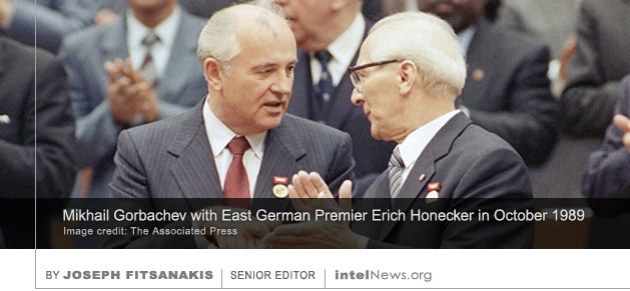
Mikhail GorbachevA group of German radicals planned to assassinate Soviet Premier Mikhail Gorbachev in East Germany in 1989, thus triggering a Soviet military invasion of the country, according to a new book written by a former British spy. The book is entitled Pilgrim Spy: My Secret War Against Putin, the KGB and the Stasi (Hodder & Stoughton publishers) and is written by “Tom Shore”, the nom de guerre of a former officer in the British Secret Intelligence Service (MI6). The book chronicles the work of its author, who claims that in 1989 he was sent by MI6 to operate inside communist East Germany without an official cover. That means that he was not a member of the British diplomatic community in East Germany and thus had no diplomatic immunity while engaging in espionage. His mission was to uncover details of what MI6 thought was a Soviet military operation against the West that would be launched from East Germany.

In his book, Shore says that he did not collect any actionable intelligence on the suspected Soviet military operation. He did, however, manage to develop sources from within the growing reform movement in East Germany. The leaders of that movement later spearheaded the widespread popular uprising that led to the collapse of the German Democratic Republic and its eventual unification with West Germany. While finding his way around the pro-democracy movement, Shore says that he discovered a number of self-described activists who had been planted there by the East German government or the Soviet secret services. Among them, he says, were members of the so-called Red Army Faction (RAF). Known also as the Baader Meinhoff Gang or the Baader-Meinhof Group, the RAF was a pro-Soviet guerrilla group that operated in several Western European countries, including Germany, Belgium and Holland. Its members participated in dozens of violent actions from 1971 to 1993, in which over 30 people were killed. Among other attacks, the group tried to kill the supreme allied commander of the North Atlantic Treaty Organization and launched a sniper attack on the US embassy in Bonn. The group is known to have received material, logistical and operational support from a host of Eastern Bloc countries, including East Germany, Poland and Yugoslavia.

According to Shore, the RAF members who had infiltrated the East German reform movement were planning to assassinate Soviet Premier Mikhail Gorbachev during his official visit to East Germany on October 7, 1989. The visit was planned to coincide with the 40th anniversary celebrations of the formation of the German Democratic Republic in 1949, following the collapse of the Third Reich. Shore says he discovered that the assassination plot had been sponsored by hardline members of the Soviet Politburo, the communist country’s highest policy-making body, and by senior officials of the KGB. The plan involved an all-out military takeover of East Germany by Warsaw Pact troops, similar to that of Czechoslovakia in 1968. But Shore claims that he was able to prevent the RAF’s plan with the assistance of members of the East German reform movement. He says, however, that at least two of the RAF members who planned to kill Gorbachev remain on the run to this day. The RAF was officially dissolved in 1998, when its leaders sent an official communiqué to the Reuters news agency announcing the immediate cessation of all RAF activities. However, three former RAF members remain at large. They are Ernst-Volker Staub, Burkhard Garweg and Daniela Klette, all of them German citizens, who are believed to be behind a series of bank robberies in Italy, Spain and France in recent years.

Author: Joseph Fitsanakis | Date: 11 September 2018 | Permalink
British police arrest man over mystery killing of Seychelles leader in 1985

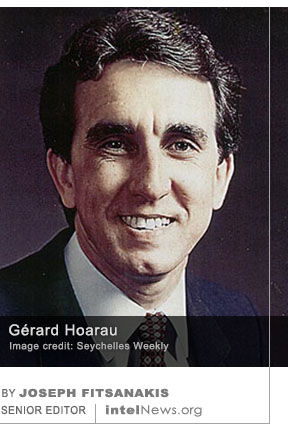
Gérard HoarauA man has been arrested by British counter-terrorism police in Northern Ireland, reportedly in connection with the assassination of a Seychelles exiled political leader in London in 1985. No-one has ever been charged with the murder of Gérard Hoarau, who was gunned down with a Sterling submachine gun in Edgware, London, on November 29, 1985. At the time of his killing, the 35-year-old Hoarau led the Mouvement Pour La Resistance (MPR), which was outlawed by the Seychelles government but was supported by Western governments and their allies in Africa. The reason was that the MPR challenged the president of the Seychelles, France-Albert René, leader of the leftwing Seychelles People’s United Party —known today as the Seychelles People’s United Party. The British-educated René assumed the presidency via a coup d’etat in 1977, which was supported by neighboring Tanzania, and remained in power in the island-country until 2004.

Despite proclaiming that he espoused a “moderate socialist ideology”, his critics —including Hoarau— accused him of being a secret admirer of Cuban-style communism and called for his removal from office. In 1979, Hoarau was one of several critics of René who were ordered to leave the Seychelles under threat of imprisonment. He initially found refuge in South Africa. But in 1981, the Seychelles security forces foiled an armed invasion by South African-supported mercenaries, which aimed to depose René. The mercenaries —most of them South African Special Forces veterans, former Rhodesian soldiers, Belgian veterans of the Congo Crisis, and American Vietnam War veterans— were led by British-Irish mercenary Thomas Michael “Mad Mike” Hoare. The group of over 50 armed men was intercepted at the Seychelles International Airport in Mahé and managed to escape only after taking hostages and hijacking an Air India passenger airplane that happened to be at the airport. However, they left behind five mercenaries, including at least one officer of South Africa’s National Intelligence Service.

In 1982, South Africa struck a deal with the Seychelles for the release of the captured mercenaries. In return, it promised to stop sheltering René’s opponents, including Hoarau. The latter was thus forced out of South Africa and sought refuge in London, England, where he was assassinated three years later. At the time of Hoarau’s killing, there was strong suspicion that the government of the Seychelles was directly involved in his assassination. There were also reports in the British press that a British hitman may have been hired to assassinate Hoarau. But despite several arrests in connection with the case, no-one was ever charged with the Seychellois exiled leader’s assassination. This, however, may soon change. In 2016, the British Metropolitan police re-opened the case and, according to a police press statement “established fresh lines of inquiry”. On Thursday, a 77-year-old man was reportedly arrested in Antrim town, Northern Ireland, by officers of the Metropolitan Police and the Police Service of Northern Ireland. The man, who has not been named, was transported to London for questioning “on suspicion of conspiracy to murder”. A police spokesman said on Thursday that the man had not previously been arrested as part of the Hoarau murder investigation.

Author: Joseph Fitsanakis | Date: 02 August 2018 | Permalink

Revealed: British prime minister was not told about fourth Cambridge spy ring member

Anthony BluntThe Prime Minister of Britain, Sir Alec Douglas-Home, was kept in the dark by his own home secretary about the discovery of a fourth member of the infamous Cambridge Spy Ring in 1964, according to newly released files. The Cambridge Spies were a group of British diplomats and intelligence officials who worked secretly for the Soviet Union from their student days in the 1930s until the 1960s. They included Guy Burgess, Donald Maclean and H.A.R. “Kim” Philby, all of whom eventually defected to the Soviet Union. In 1964, Sir Anthony Blunt, an art history professor who in 1945 became Surveyor of the King’s Pictures and was knighted in 1954, admitted under interrogation by the British Security Service (MI5) that he had operated as the fourth member of the spy ring.
Despite his allegedly full confession, Blunt was never seriously disciplined for his espionage activities against Britain. In return for revealing his spy activities and naming others who had assisted him, he was granted immunity from prosecution. He was also allowed to remain in his academic post and retained his title of Surveyor of the Queen’s Pictures –effectively the curator of Queen Elizabeth II’s art collection. It wasn’t until 1979 when British Prime Minister Margaret Thatcher revealed in a statement to the British House of Commons that Blunt had been the fourth member of the Cambridge Spy Ring. Minutes after the prime minister’s statement entered the public record, Buckingham Palace (which had been made aware of Blunt’s espionage role back in 1964, but had been asked by Britain’s Interior Ministry to not draw attention to the scandal) stripped him of his 1954 knighthood.

It has now been revealed known that, in the days following her House of Commons statement about Blunt, Prime Minister Thatcher received several letters by Henry Brooke, who was serving as home secretary in 1964, when Blunt’s treachery was discovered. In his letters, Brooke (by then Lord Brooke of Cumnoor) expressed his support for the prime minister’s revelation. But the letters, which were previously classified but were published on Tuesday by Britain’s National Archives, also reveal that Brooke kept Blunt’s 1964 confession hidden from the then Prime Minister Sir Alec Douglas-Home. In his 1979 letter to Thatcher, Brooke states that he did not inform the prime minister in 1964 in his “well-meant effort not to add to [Douglas-Home’s] burdens”. But he adds that “I may, with hindsight, have expressed my discretion wrongly”. By that time, Blunt had voluntarily withdrawn from public life and was rarely heard of. Upon his death in 1984, his unfinished memoir was given to the British Library by the executor of his will, under the stipulation that it be kept sealed for 25 years. It was released to the public in 2009.

Author: Joseph Fitsanakis | Date: 24 July 2018 | Permalink

Report reveals deeper CIA role in 1963 Vietnam coup and Diem’s assassination

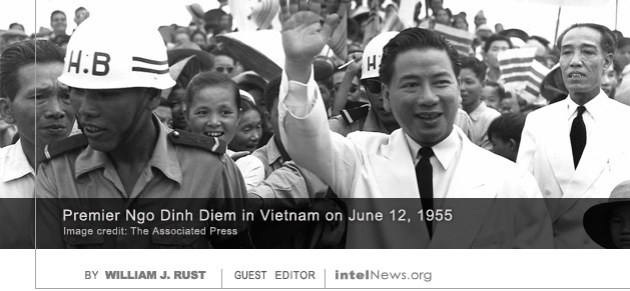
Ngo Dinh DiemA newly declassified report by the Inspector General of the United States Central Intelligence Agency reveals that the South Vietnamese generals who overthrew President Ngo Dinh Diem in 1963 used CIA money “to reward opposition military who joined the coup”. Acknowledging that “the passing of these funds is obviously a very sensitive matter”, the CIA Inspector General’s report contradicts the sworn testimony of Lucien E. Conein, the CIA liaison with the South Vietnamese generals. In 1975, Conein told a United States Senate committee that the agency funds, approximately $70,000 or 3 million piasters, were used for food, medical supplies, and “death benefits” for the families of South Vietnamese soldiers killed in the coup.

The report (.pdf), one of the 19,000 JFK assassination documents released by the US National Archives on Thursday, also contains new details about the South Vietnamese generals’ decision to assassinate Diem that contradict a conclusion of the coup’s history written by the CIA station in Saigon. The majority of the generals, said the CIA at the time, “desired President Diem to have honorable retirement from the political scene in South Vietnam and exile”. According to a newly declassified portion of the 49-page document written by the CIA’s Inspector General, an unidentified field-grade South Vietnamese officer who provided the CIA station with pictures of the bloodied bodies of Diem and his brother and advisor, Ngo Dinh Nhu, said that “most of the generals” favored their immediate execution: “The ultimate decision was to kill them. A Captain Nhung was designated as executioner”.

A redacted version of the Inspector General’s report, dated May 31, 1967, was released by the National Archives in November 2017. In that version of the report, the paragraphs related to the use of CIA funds and the generals’ decision to murder Diem were excised.

* William J. Rust is the author of four books about US relations with Southeast Asia countries during the cold war, including Kennedy in Vietnam. He is currently completing a book about US relations with Indonesia.


MI5 releases new information about Soviet ‘Portland Spy Ring’

DocumentFiles released on Monday by the British government reveal new evidence about one of the most prolific Soviet spy rings that operated in the West after World War II, which became known as the Portland Spy Ring. Some of the members of the Portland Spy Ring were Soviet operatives who, at the time of their arrest, posed as citizens of third countries. All were non-official-cover intelligence officers, or NOCs, as they are known in Western intelligence parlance. Their Soviet —and nowadays Russian— equivalents are known as illegals. NOCs are high-level principal agents or officers of an intelligence agency, who operate without official connection to the authorities of the country that employs them. During much of the Cold War, NOCs posed as business executives, students, academics, journalists, or non-profit agency workers. Unlike official-cover officers, who are protected by diplomatic immunity, NOCs have no such protection. If arrested by authorities of their host country, they can be tried and convicted for engaging in espionage.
The existence of the Portland Spy Ring has been known since 1961, when British authorities arrested five people throughout England. Two of them were British citizens, Harry Houghton, a clerk at the Royal Navy’s Underwater Detection Establishment facility in Dorset, England, and his mistress, Ethel Gee. Their Soviet handler was Konon Molody, a Soviet intelligence officer who was posing as a Canadian, under the name Gordon Lonsdale. Also arrested was a married couple from New Zealand, Peter and Helen Kroger. But in reality they were Americans, whose real names were Morris and Lona Cohen, and had worked for Soviet intelligence since the late 1930s. Collectively, the five were referred in media reports as members of the Portland Spy Ring.

The newly declassified files about the spy ring were released by the Security Service, known commonly as MI5, Britain’s primary counterterrorism and counterintelligence agency. They reveal how British authorities managed to bust the Portland Spy Ring. According to the files, the initial tip-off came from the Central Intelligence Agency (CIA). The American agency had managed to recruit Michael Goleniewski, codename SNIPER, a Polish military counterintelligence officer, who led the technical office of Poland’s military intelligence. In the spring of 1960, Goleniewski told the CIA that Polish intelligence were running a British agent who was recruited while serving in the office of the naval attaché at the British embassy in Warsaw. The CIA shared the information with British intelligence, who soon identified the agent as Harry Houghton in Dorset. MI5 agents followed Houghton and his girlfriend, Ethel Gee, as they met with a successful Canadian businessman in London, Gordon Lonsdale (real name Konon Molody). Molody had grown up with a family member in California in the 1930s, and spoke fluent English. He had joined Soviet intelligence during World War II and sent to Britain posing as a Canadian. When he arrived there, in 1954, he established the KGB’s first known illegal residency in the British Isles.

In turn, Molody led MI5 to Peter and Helen Kroger from New Zealand (real names Morris and Lona Cohen), who were posing as antique book dealers. The couple acted as couriers, radio operators and technical support officers for Molody. They were born in the United States and had been recruited by Soviet intelligence in the 1930s. It is now known that they had contacts with several other Soviet illegals in America, including Rudolf Abel (real name William Fisher) who was captured by the Federal Bureau of Investigation in 1957. The couple had left the United States on orders of the KGB in 1952 and reappeared in the United Kingdom using New Zealand passports and new names.

The newly declassified documents show that MI5 decided to move against the five members of the Portland Spy Ring after Goleniewski became an open defector and was exfiltrated to the United States by officers in the CIA’s Berlin station. British authorities feared that Goleniewski’s open defection would prompt the Soviets to pull out Houghton, whose identity was known to Goleniewski. Houghton and Gee were sentenced to 15 years in prison. They were released in 1970, married the following year, and died in the 1980s. Molody was sentenced to 25 years in prison but was released in 1964 and exchanged for Greville Wynne, a British spy captured in the USSR. The Cohens received 20 year sentences, but were released in 1969 and exchanged with Gerald Brooke, a British teacher who was arrested in the USSR for smuggling anti-communist literature and trying to organize dissidents inside the country.

Author: Joseph Fitsanakis | Date: 28 November 2017 | Permalink

CIA believed Yugoslavia was on the brink of going nuclear in 1975

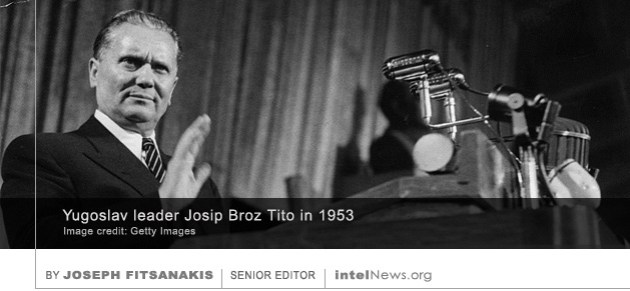
Josip Broz TitoThe United States Central Intelligence Agency believed that Yugoslavia was on the brink of becoming a nuclear-armed state in 1975, due partly to assistance from Washington, according to newly declassified documents. The documents, which date from 1957 to 1986, were unearthed by Dr Filip Kovacevic, a Montenegrin expert on American foreign policy who teaches at the University of San Francisco in California. He accessed the documents in October of this year, after filing a Freedom of Information Act request with the CIA in 2016. In response, the spy agency sent Dr Kovacevic eight different files consisting of 84 pages of formerly classified scientific studies, analytical estimates and other reports.
The documents show that the CIA placed the beginning of the Yugoslav nuclear program at the end of World War II. At that time, the multi-ethnic Balkan country became the focus of an intense campaign for influence by the two emerging superpowers, the United States and the Soviet Union. But Yugoslavia’s communist leader, Josip Broz Tito, opted for a policy of nonalignment, refusing to side with Washington or Moscow. It was at that time that Tito began to explore the creation of a nuclear arsenal, which he hoped would enable Yugoslavia to remain independent amidst the pressures of the Cold War. Interestingly, his plans were quietly supported by the US, which invited Yugoslav physicists and engineers to study and conduct research at American universities. Washington also sent teams of geologists to conduct surveys across Yugoslavia in 1952. These and subsequent surveys detected substantial uranium deposits in northern and southern Yugoslavia, which were deemed sufficient to fuel several nuclear bombs. Two decades later, an American manufacturing company, Westinghouse Nuclear, was contracted by Belgrade to build Yugoslavia’s first nuclear power plant in Slovenia.

The papers unearthed by Dr Kovacevic suggest that in 1975 the CIA was convinced that Yugoslavia was technically and financially capable of building an atomic weapon within four years. In a study entitled “Prospects for Further Proliferation of Nuclear Weapons”, the spy agency said that Belgrade had made remarkable technical strides in the area of nuclear research and production in 15 years, partly with America’s support. The only question was whether the Yugoslav leadership would decide to go nuclear, something that the CIA’s analysts warned that it would be difficult to ascertain, as President Tito was unpredictable in his decision-making. Eventually, the Yugoslav leader opted to beef up his country’s conventional forces instead of going nuclear. As Tito’s health worsened in the latter half of the 1970s, ethnic rivalries between competing officials took center stage, and the nuclear weapons question lost its immediacy. Tito died in 1980, and almost immediately the country began to sink under the weight of deepening ethnic tensions.

According to Dr Kovacevic, the CIA documents show that the agency kept close tabs on Yugoslavia’s nuclear ambitions throughout the Cold War. Moreover, CIA analysts appeared to have detailed, accurate and up-to-date information about the Yugoslav nuclear program, on which they based their —broadly accurate— estimates. Crucial pieces of information came from the CIA’s “well-organized network of informants” who were placed “across the country’s institutions” and provided the US with highly dependable intelligence on Tito’s nuclear plans, said Dr Kovacevic.

Author: Joseph Fitsanakis | Date: 23 November 2017 | Permalink

Cold-War-era Soviet spy George Blake issues rare statement from Moscow

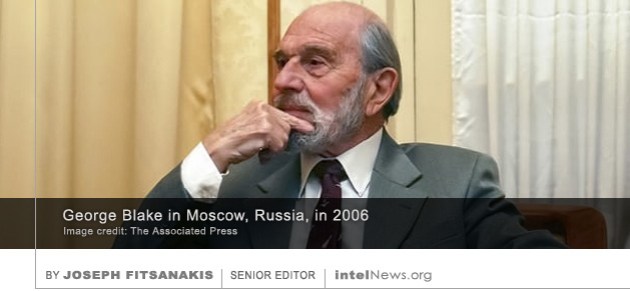
George BlakeOne of the Cold War’s most recognizable spy figures, George Blake, who escaped to the Soviet Union after betraying British intelligence, issued a rare statement last week, praising the successor agency to Soviet-era KGB. Blake was born George Behar in Rotterdam, Holland, to a Dutch mother and a British father. Having fought with the Dutch resistance against the Nazis, he escaped to Britain, where he joined the Secret Intelligence Service, known as MI6, in 1944. He was serving in a British diplomatic post in Korea in 1950, when he was captured by advancing North Korean troops and spent time in a prisoner of war camp. He was eventually freed, but, unbeknownst to MI6, had become a communist and come in contact with the Soviet KGB while in captivity. Blake remained in the service of the KGB as a defector-in-place until 1961, when he was arrested and tried for espionage.
After a mostly closed-door trial, Blake was sentenced to 42 years in prison, which at that time was the longest prison sentence ever imposed in Britain. However, he managed to escape in 1966, with the help of Irish republican prisoners in London’s Wormwood Scrubs prison, where he was serving his sentence. With the help of Soviet intelligence, Blake made his way to France and from there to Germany and East Berlin, hiding inside a wooden box in the back of a delivery van. He eventually resurfaced in Moscow, where he has lived ever since, in a small, government-provided dacha (Russian cottage) located on the outskirts of the Russian capital.

Last Friday, Blake issued a statement on the eve of his 95th birthday. The statement was posted on the SVR’s official website and published by several Russian news agencies. The convicted spy said that he placed his hopes for the peace of mankind on the “men and women” of Russia’s Foreign Intelligence Service —the main institutional descendant of the Soviet KGB. Blake praised the SVR’s officers as “heroes” who are engaged in “a true battle between good and evil” at a time when “the danger of nuclear war and the resulting self-destruction of humankind” is a real threat. The spy added that the prospect of nuclear annihilation has been “put on the agenda by irresponsible politicians”, in what Russian news agencies interpreted as a comment that was directed against United States President Donald Trump.

The end of Blake’s statement is followed by a second statement, written by the Director of the SVR, Sergei Naryshkin. Naryshkin, who was appointed to his current post by Russian President Vladimir Putin a year ago, congratulates Blake on his 95th birthday and calls him a “reliable old comrade” and “a man of great wisdom”. Blake is “a proficient teacher”, says  Naryshkin, who has been a longtime role model for the officers of the SVR.

Author: Joseph Fitsanakis | Date: 15 November 2017 | Permalink

Secret documents passed to the KGB by Kim Philby displayed in Moscow

Kim PhilbyThe life of Kim Philby, one of the Cold War’s most recognizable espionage figures, is the subject of a new exhibition that opened last week in Moscow. Items displayed at the exhibition include secret documents stolen by Philby and passed to his Soviet handlers during his three decades in the service of Soviet intelligence. While working as a senior member of British intelligence, Harold Adrian Russell Philby, known as ‘Kim’ to his friends, spied on behalf of the Soviet NKVD and KGB. His espionage lasted from about 1933 until 1963, when he secretly defected to the USSR from his home in Beirut, Lebanon. Philby’s defection sent ripples of shock across Western intelligence and is often seen as one of the most dramatic incidents of the Cold War.
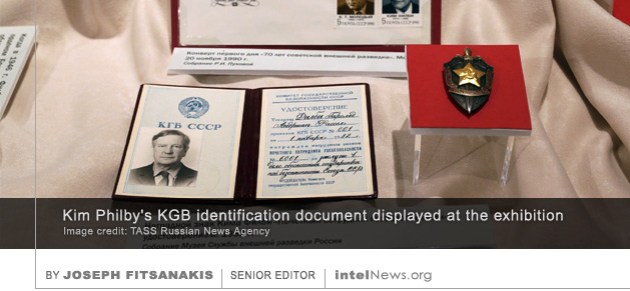
Now a new exhibition in Moscow has put on display some of Philby’s personal belongings, as well as a fraction of the many classified documents he passed on to his Soviet handlers during his 30 years of espionage. Entitled “Kim Philby: His Intelligence Work and Personal Life”, the exhibition is organized by the Russian Historical Society. The majority of the new documents appear to date from 1944, by which time Philby had been working for the NKVD for over a decade. Some of the documents are cables sent by Italian, Japanese or German diplomats prior to and during World War II, which were intercepted by British intelligence. Copies of some of these intercepts, which Philby passed to Moscow, are displayed in the exhibition. One document clearly bears the English-language warning: “Top Secret. To be kept under lock and key: never to be removed from this office”. Another document appears to be part of a report that Philby produced after teaching a seminar for KGB intelligence officers about how to operate in the West. It is dated 1982, by which time Philby had been living in Russia for nearly two decades.

Philby died in the Soviet capital in 1988, aged 76, and was survived by his fourth wife, Rufina Ivanovna Pukhova, whom he met after he defected to the USSR. Pukhova attended the opening of the exhibition in Moscow last week, as did over a dozen of Philby’s students at the former KGB. Russian media reported that the director and several officials of the Foreign Intelligence Service (SVR), one of the KGB’s successor agencies, were also present during the official opening of the exhibition.

Author: Joseph Fitsanakis | Date: 26 September 2017 | Permalink

Cold War files show CIA support for guerrilla warfare inside USSR (Part II)

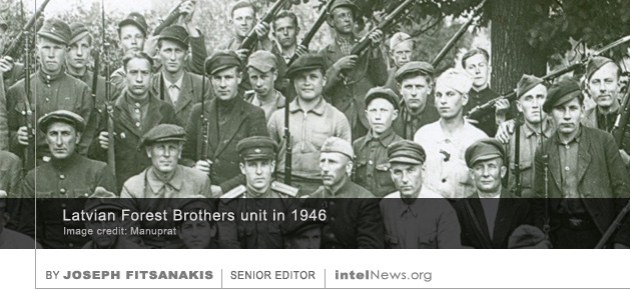
Latvia Forest BrothersThe role of the CIA in funding and helping to organize anti-Soviet groups inside the USSR has been known for decades. But, as intelNews explained in part I of this article, a batch of recently released documents, unearthed by Russian-language service of Latvian state television, sheds light into the CIA’s early understanding of the identity, strength and operations of these groups. They also contain new information about the background and structure of underground anti-Soviet groups like the Forest Brothers in Latvia.
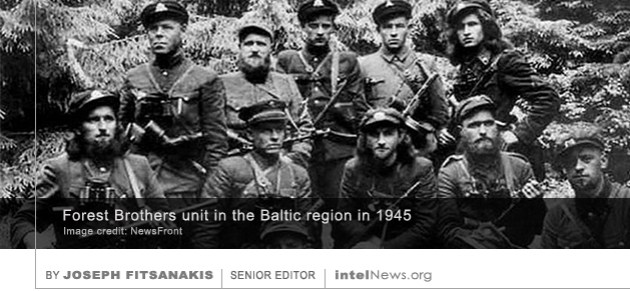
Judging that Latvia’s anti-Soviet underground movement could be “of considerable operational value”, the CIA initiated project ZRLYNCH in the summer of 1950. Operated out of the CIA’s Munich station in Germany, ZRLYNCH was intended as a long-term project supervised by the Office of Policy Coordination, an early Cold War covert operations outfit that in 1952 was absorbed into the CIA’s Directorate of Operations. The Latvia operation was part of a wider effort by the CIA, which was aimed at subverting Soviet power in Eastern Europe.

For the first year of ZRLYNCH, the CIA’s Office of Policy Coordination asked for —and received— a budget of $30,000. The top-secret document unearthed recently by Latvian state television states that the budget was to be used primarily for intelligence collection inside Soviet territory, as well as for covert operations by the Forest Brothers (for information about the group, see part I of this post). The latter were to conduct sabotage activities as part of organized guerrilla warfare. These activities are not specified in the CIA documents. By the end of the first year, it appears that the CIA had recruited three Latvian agents in Europe (one in Sweden and two in Germany), who were acting as mediators between the CIA and the Forest Brothers inside the USSR. Less than three years later, the ZRLYNCH budget had risen to $134,000, with $52,000 going toward covert —mostly psychological— operations and the rest being used to fund intelligence collection efforts. The CIA was also funding the travel expenses of leading Latvian émigré figures in the US, and was diverting tens of thousands of dollars toward Latvian émigré conferences in America, which aimed to unite the various political factions of the fragmented Latvian community in the States.

But the CIA officers behind ZRLYNCH were extremely concerned about operational security. They did not want the Kremlin finding out that the Agency was behind efforts to stir up armed resistance against Soviet power in the Baltic region. One CIA document states that there would be no tolerance for “any breaches of security” that compromised ZRLYNCH. Consequently, any action that uncovered the link between the US government and the Forest Bothers would lead “to an immediate cessation of financial support” for ZRLYNCH, states the memo.

Ultimately, ZRLYNCH failed to seriously challenge Soviet power in Latvia. Most of the members of the Forest Brothers were killed during Red Army counterinsurgency operations, and much of the organization’s structure was penetrated by agents of Soviet intelligence. Eventually, the Forest Brothers became extinct in 1957, when their last members emerged from the forest and surrendered to Latvian and Soviet authorities.

Author: Joseph Fitsanakis | Date: 11 August 2017 | Permalink

Cold War files show CIA support for guerrilla warfare inside USSR (Part I)

Latvian Forest BrothersRecently declassified documents from the archive of the Central Intelligence Agency detail financial and material support given by the United States to groups of armed guerrillas in Soviet Latvia in the 1950s. The documents, initially marked ‘Top Secret’ but now declassified, show that the CIA was aware and supported the activities of an anti-Soviet guerrilla army known as ‘the Forest Brothers’. Known also as ‘the Forest Brethren’, the group was formed in the Baltic States in 1944, as the Soviet Red Army established Soviet control over the previously German-occupied states of Estonia, Latvia and Lithuania. The Soviet Union had previously occupied and annexed the three Baltic countries, in a failed attempt to pre-empt Germany’s eastward military expansion. Groups like the Forest Brothers consisted of the most militant members of anti-Soviet groups in the Baltic States, many of whom were ideologically opposed to Soviet Communism.
The role of the CIA in funding and helping to organize anti-Soviet groups inside the USSR has been known for decades. But the recently released documents, unearthed by Russian-language service of Latvian state television, shed light into the CIA’s early understanding of the identity, strength and operations of these groups. They also contain new information about the background and structure of underground anti-Soviet groups like the Forest Brothers in Latvia.

The first declassified CIA document that contains information on anti-Soviet resistance in Latvia is dated November 29, 1949, and is titled “The Organization of the Underground Resistance Movement in Eastern Europe”. It was soon followed by two other documents, entitled “Latvian Resistance to Russian Occupation” and “Request for [Support] to the Latvian Resistance Movement”. The latter document was produced in mid-1950, after the CIA was able to establish contact with anti-Soviet Latvian expatriates living in Germany and Sweden. From these contacts, the CIA was able to determine that active (and possibly armed) resistance to the Soviet Red Army in Latvia was limited to approximately 5,000 individuals, many of whom conducted periodic guerrilla attacks against Soviet troops or installations. However, the CIA report said that, as of 1950, the majority of these armed guerrillas remained dormant, “waiting for a more opportune moment” to return to action. The CIA memorandum also stated that clandestine radio communication existed between the leadership of Latvia’s anti-Soviet underground in Riga and exile Latvian communities in Sweden.

Note: Part II of this report can be found here.

Author: Joseph Fitsanakis | Date: 10 August 2017 | Permalink

Industrial espionage damages a country’s long-term productivity, study finds

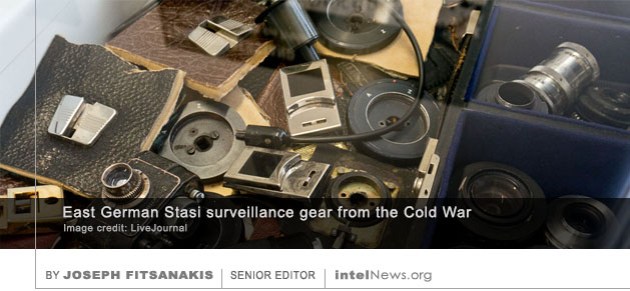
StasiState-sponsored industrial espionage aimed at stealing foreign technical secrets may boost a country’s technological sector in the short run, but ultimately stifles it, according to the first study on the subject. The study is based on over 150,000 declassified documents belonging to the East German Ministry for State Security, known as Stasi. The now-defunct intelligence agency of communist-era East Germany was known for its extensive networks of informants, which focused intensely on acquiring technical secrets from abroad.

The history of industrial and economic espionage by governments is indeed extensive. It includes lucrative efforts by the United States to steal industrial production methods from Europe in the 19th century, and successful attempts by the Soviet Union to steal atomic technology from the American-led Manhattan Project in the 1940s. But there have been no systematic attempts to evaluate the effect of state-sponsored industrial espionage on the entire economy of the sponsoring nation –until now.

This new study –the first of its kind– was carried out by two economists, Erik Meyersson, from the Stockholm School of Economics in Sweden, and the Spain-based Albrecht Glitz of Pompeu Fabra Univeristy in Barcelona. The two researchers describe their preliminary findings in a working paper entitled: “Industrial Espionage and Productivity”, published by the Institute of Labor Economics in Bonn, Germany. Its findings are based on an analysis of nearly 152,000 declassified industrial-espionage-related communiqués sent by Stasi spies to their handlers between 1970 and 1988. The communiqués were examined with reference to their date of authorship and the content-descriptive keywords appended to them by the Stasi.

The report concludes that stealing industrial secrets can boost a nation’s economic activity in the short run. However, in the long run, a nation’s strategic focus on industrial espionage tends to impede homegrown research and development, and ultimately stifles technological productivity on a national scale. This is because “easy access to secrets” from abroad tends to “discourage both state and private investment in research and development”, according to Meyersson and Glitz. That is precisely what happened to East Germany, argues the report. The country’s total factor productivity (TFF –the growth of its output measured in relation to the growth in inputs of labor and capital) rose significantly as a result of its industrial espionage.That was especially noticeable in the digital electronics sector, where the output gap between East and West Germany was narrowed by a fourth. However, that trend was temporary, and East Germany was never able to develop an organic digital-electronics industry. Industrial espionage is like “research and development on cocaine”, professor Meyersson told Science, the magazine of the American Association for the Advancement of Science. “Maybe you can have a little bit of fun with it, but it’s not good for you in the long run”.

Author: Joseph Fitsanakis | Date: 01 August 2017 | Permalink

Yuri Drozdov, handler of Soviet undercover spies during Cold War, dies at 91

Yuri DrozdovGeneral Yuri Ivanovich Drozdov, who held senior positions in the Soviet KGB for 35 years, and handled a global network of Soviet undercover officers from 1979 until 1991, has died at the age of 91. Drozdov was born in Minsk, Soviet Belarus, in 1925. His father, Ivan Dmitrievich Drozdov, was an officer in the tsarist army who sided with the communists in the 1917 Bolshevik Revolution. After serving in World War II, Yuri Drozdov joined the KGB in 1956. Following his training, he was appointed liaison officer between the KGB and East Germany’s Ministry of State Security, commonly known as the Stasi.
His knowledge of East German intelligence affairs prompted his involvement in the famous 1962 spy-swap between the United States and the Soviet Union. The Soviets surrendered the American pilot Francis Gary Powers, who had been captured in May 1960, when the U-2 spy plane he was piloting was shot down over Soviet airspace. In return, they received Rudolf Abel (real name Vilyam Fisher) a Soviet undercover spy who was captured in New York in 1957, posing as an American citizen. From 1964 until 1968, Drozdov was stationed in Beijing, China, where he served as the KGB rezident, effectively the agency’s chief of station. He returned to Moscow and in 1975 was posted under diplomatic cover in the United States, where he commanded the KGB’s station in New York until 1979.

Upon his return to the USSR, Drozdov was promoted to chief of the KGB’s Directorate S, which handled the agency’s worldwide network of so-called illegals —intelligence officers serving abroad without official cover or formal connection to the Soviet Union. Shortly after his return to Moscow, Drozdov also headed Operation STORM-333, a daring attack on the presidential palace in Afghanistan, during which Soviet special forces killed Afghan President Hafizullah Amin and essentially fired the opening shots of the decade-long Soviet-Afghan war. The experience prompted Drozdov to recommend to his superiors the establishment of a new KGB special-forces unit. It was created in 1981 under the name Vympel (Pennant) and headed by Drozdov himself. He commanded several Vympel missions in and out of the USSR before resigning from the KGB in 1991.

Little is known about the specifics of Drozdov’s death. It is believed that he died on June 21, surrounded by his family. The Russian Foreign Intelligence Service (SVR), a successor agency of the KGB, issued a brief statement commemorating Drozdov’s service. It was followed by a statement issued by the office of the Russian President Vladimir Putin, which praised Drozdov as “a legendary spy, outstanding professional […], incredible person and true patriot”.

Author: Joseph Fitsanakis | Date: 26 June 2017 | Permalink

Canada suspected Soviets of stealing prime minister’s private diary

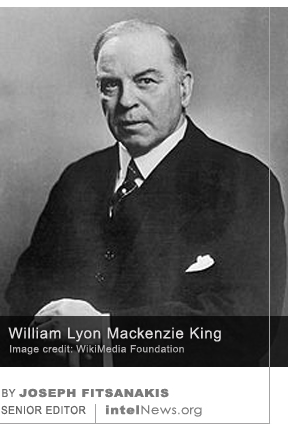
William Lyon Mackenzie KingCanadian officials speculated that Soviet spies stole a missing volume from the private diary collection of William Lyon Mackenzie King, Canada’s longest-serving prime minister, who led the country in the run-up to the Cold War. A liberal anticommunist, Mackenzie King was Canada’s prime minister from 1925 to 1948, with a break from 1930 to 1935. He is known for having led the establishment of Canada’s welfare state along Western European standards.
When King died in 1950, he left behind instructions asking for his private diaries to be destroyed. However, the executioners of his will decided instead to turn over King’s private papers —including his diaries— to the Canadian state. In 1975, the Library and Archives of Canada began releasing King’s private diaries to the public. The diaries contain daily entries that span over half a century, up until King’s death. One crucial volume, however, is missing. It covers the last two months of 1945, when Canada was engaged in intensive deliberations with the Allies about the shape of postwar Europe and Asia. These deliberations also involved frank discussions between King and his British and American counterparts about the atom bomb, and possibly measures to uncover suspected infiltration of Western government institutions by communist sympathizers.

Now a new book, written by Trent University history professor Christopher Dummitt, reveals
that Soviet spies were suspected of stealing the missing volume. The book, Unbuttoned: A History of Mackenzie King’s Secret Life, claims that the Canadian Security Intelligence Service (CSIS) was notified of the missing diary volume in 1969. Shortly afterwards, the CSIS launched an investigation into the missing memoir. In 1985, says Dr. Dummitt, a CSIS memo speculated that an agent of the Soviet KGB might have stolen the diary, because it contained information that was of interest to Moscow. Interestingly, however, the previous diary volume, which covers the case of Igor Gouzenko, is not missing. Gouzenko was a cipher clerk at the Soviet embassy in Ottawa, whose 1945 defection to Canada is sometimes credited with starting the Cold War. Why would a Soviet spy not steal that volume as well, the skeptics ask?

Professor Dummitt entertains a simpler idea in his book, which is that Jean-Louis Daviault, an employee of the Library and Archives of Canada, may have stolen the volume. Daviault, who had been tasked with photographing King’s diary collection, was caught trying to sell parts of the diary to a Canadian newspaper. It was probably he who stole the missing volume, in order to sell it to the press, or a rival intelligence agency, argues Dr. Dummitt.

Author: Joseph Fitsanakis | Date: 17 May 2017 | Permalink

Werner Stiller, one of the Cold War’s most notable defectors, dies

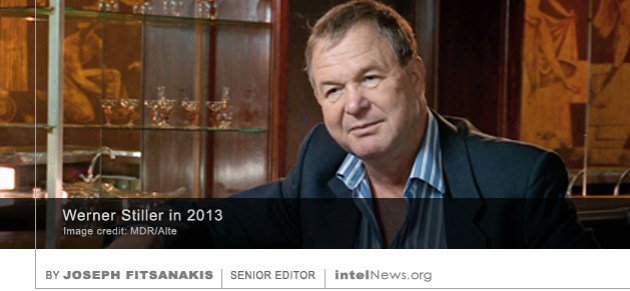
Werner StillerWerner Stiller, also known as Klaus-Peter Fischer, whose spectacular defection to the West in 1979 inflicted one of the Cold War’s most serious blows to the intelligence agency of East Germany, has died in Hungary. Stiller, 69, is believed to have died on December 20 of last year, but his death was not reported in the German media until last week. Born in 1947 in the German Democratic Republic, Stiller excelled in the sciences from an early age and eventually studied physics at the University of Leipzig, which was known at the time as Karl Marx Universitat. Shortly after graduating, he joined the GDR’s Ministry of State Security, commonly known as the Stasi. Within a few years, he was working as a case officer for the Main Directorate for Reconnaissance, the Stasi’s foreign intelligence division, where he was in charge of scientific espionage in the West. By the late 1970s, Stiller was handling nearly 30 spies —most of them abroad— who were regularly providing him with intelligence relating to nuclear research, weapons technologies, and biomedical research.

However, the Stasi vehemently disapproved of Stiller’s promiscuous lifestyle —he was married five times in his life and was reputed to have had many more affairs— which was one of the reasons why he decided to seek a new life in the West. In January of 1979, with the help of a waitress he was having an affair with, Stiller defected to West Germany along with a packet of microfiche containing hundreds of classified Stasi documents. He later helped the waitress escape to the West with her young son and an estimated 20,000 more pages of classified documents. The West German Federal Intelligence Service (BND) eventually shared the information from Stiller’s defection with the United States Central Intelligence Agency. It led to the dramatic arrests of 17 Stasi agents and officers in Europe and the US, while at least 15 others escaped arrest at the last minute, after being urgently recalled back to East Germany. The Stasi is believed to have recalled an additional 40 operatives from several Western countries as a precaution in response to Stiller’s defection. The information that Stiller gave to the BND also helped visually identify the longtime director of the Stasi’s Main Directorate for Reconnaissance, Markus Wolf. Previously, Western intelligence services had no photographs of Wolf, who was known as ‘the man without a face’, due to the many decades he spent as an undercover officer.

In 1981, Stiller moved to the US, where the CIA provided him with a new identity, using the fake name Klaus-Peter Fischer, a Hungarian émigré. He studied economics at Washington University in St. Louis, Missouri, before working as an investment banker for Goldman Sachs in the US and eventually an exchange broker for Lehman Brothers in Germany. It is believed that the Stasi kept looking for Stiller until the dissolution of the GDR in 1990, with the intent of abducting him or killing him. In 1999, Stiller moved to Hungary, where he stayed until the end of his life. He is survived by a son and a daughter.

Author: Joseph Fitsanakis | Date: 04 April 2017 | Permalink