Colombian intelligence spied on Russian and Cuban diplomats, reports claim
January 18, 2023 1 Comment
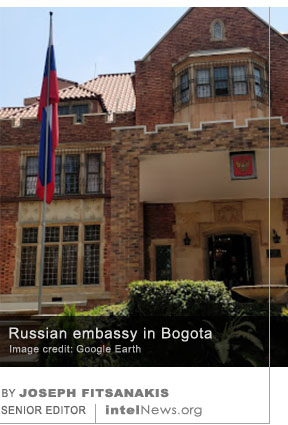 COLOMBIAN INTELLIGENCE CARRIED OUT surveillance operations against Russian and Cuban diplomats stationed in Colombia between 2016 and 2019, according to media reports that surfaced earlier this week. The reports claim that Colombia’s National Intelligence Directorate (DNI) was behind the operations, which involved physical, as well as electronic, surveillance.
One of the operations was reportedly codenamed CATEDRA, and targeted three senior staff members of the Russian embassy in the Colombian capital Bogota. In addition to the diplomats themselves, DNI agents allegedly spied on the diplomats’ spouses and their children. In some cases, DNI agents disguised themselves as “street vendors” in order to spy on the homes of the diplomats. The agency also planted electronic devices in hotels around Colombia —notably in the resort town of Melgar in central Colombia, where over a dozen staff members of the Russian embassy holidayed in 2017.
Allegedly, Operation CATEDRA also involved the interception of communications of at least two Russian diplomats. These were identified as Denis Viktorovich Khromov, who served as the second secretary at the Russian embassy in Bogota, as well as Aleksandr Nikolayevich Belousov, who in late 2020 was declared persona non grata and expelled by the Colombian government on charges of espionage. Colombian media said at the time that Belousov had been outed as an intelligence officer, following a two-year DNI operation codenamed ENIGMA.
The DNI also spied on at least 10 Cuban diplomats and other members of the embassy of Cuba in Bogota, according to the same reports. The operation, codenamed MATIAS, investigated alleged “Cuban interference” in Colombia, and took place while the Cuban government was hosting peace talks between the Colombian government of then-president Juan Manuel Santos and leaders of the country’s largest militant groups, the Revolutionary Armed Forces of Colombia (FARC) and the National Liberation Army (ELN).
According to the reports, the DNI recruited a Cuban embassy worker, instructing her to “install [surveillance] devices and extract information from the building where control targets [were] located”. This eventually enabled the DNI to gain “access to security cameras and rooms throughout the building” of the Cuban embassy, the reports claim. Operations MATIAS and CATEDRA were reportedly concluded in 2019.
► Author: Joseph Fitsanakis | Date: 18 January 2023 | Permalink
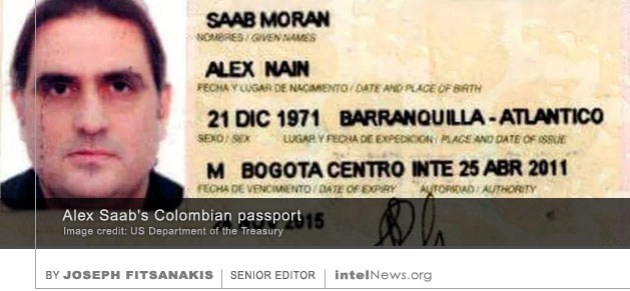 A WEALTHY BUSINESSMAN AND close ally of Venezuelan President Nicolás Maduro, who is being tried in the United States on money-laundering charges, was a “law enforcement source” for the Drug Enforcement Administration, according to documents unsealed this week in a Florida court. The businessman, Alex Nain Saab Moran, 51, comes from a Colombian family of Lebanese descent. For the past decade, he has been one of a number of international investors who have done extensive business with the government of Venezuela.
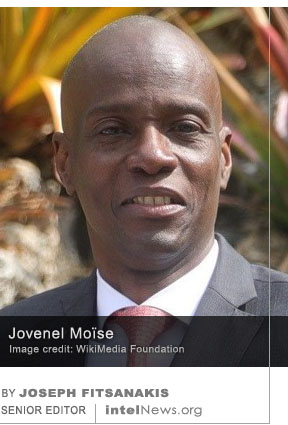 NEARLY ALL MEMBERS OF the heavily armed commando team that killed Haiti’s President on July 7 were Colombian citizens, while several served in the military, according to the Haitian National Police. The attack on the president’s residence, located in the Pétion-Ville suburb of Port-au-Prince, began after midnight local time on Wednesday, when a convoy of at least five vehicles carrying dozens of men arrived at the scene.
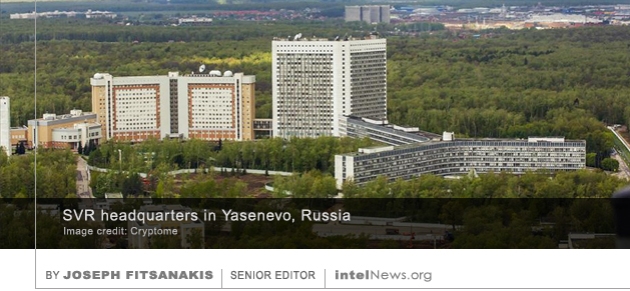 COLOMBIA EXPELLED TWO RUSSIAN diplomats earlier this month, without publicly explaining why, according to news reports. Several Colombian news outlets reported on Tuesday that the two Russians were expelled after they were found engaging in espionage. Also on Tuesday, Colombian officials confirmed earlier reports that Moscow had expelled two Colombian diplomats in a tit-for-tat response.
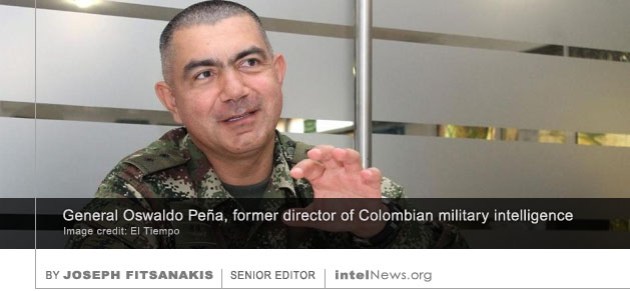 Colombia’s military spy chief has resigned, after the Colombian president was found to have misused intelligence at a United Nations speech to blame Venezuela for allegedly aiding paramilitary groups. For many years, authorities in Bogotá have accused Venezuela of aiding armed groups such as the National Liberation Army (ELN) and the Revolutionary Armed Forces of Colombia (FARC). These groups have been engaged in a decades-long guerrilla war against the Colombian state. In 2017, the largest of these groups, the FARC, laid down its weapons and signed a peace treaty with the Colombian government. But the ELN has refused to follow suit, while a number of hardline FARC leaders recently announced that they would be resuming their armed struggle against the Colombian authorities.
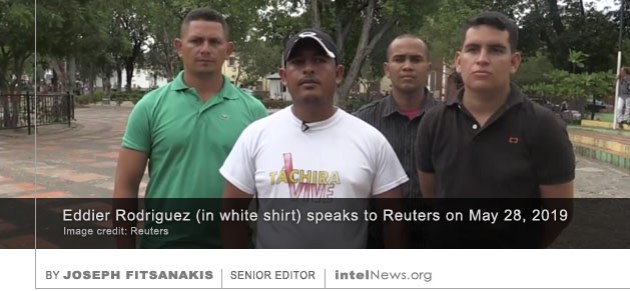 Groups of Venezuelan expatriates are reportedly forming armed militias in Colombia and say they are preparing to launch cross-border attacks to topple the government of President Nicolás Maduro in Caracas. It is
  Authorities in Colombia said that three Venezuelans, who were arrested in Colombia’s Caribbean coast with submachine guns and explosives, were planning to assassinate President Iván Duque. The claim was aired in a
 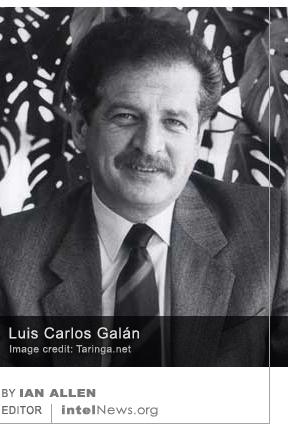 The former director of Colombia’s intelligence service returned to court this week to face charges of complicity in the assassination of a leading presidential hopeful, who was gunned down in 1989 by a powerful drug cartel. Luis Carlos Galán, a senator and former minister, was tipped to win the 1990 presidential election in which he stood on the Liberal Party ticket. His popularity with the electorate is largely attributed to his uncompromising stance against Colombia’s powerful drug cartels. He had vowed to arrest leading drug lords and send them to the United States to face criminal charges. He would do so, he said, after signing a mutual extradition treaty with Washington. However, Galán was assassinated on August 18, 1989, during a campaign rally in Soacha, a working-class suburb of Colombia’s capital, Bogotá. The assassination took place before thousands of spectators who were present at the rally, and is considered one of the highest-profile political killings in the history of Colombia.







 intelNews.org
Colombian spy chief claims intelligence-sharing with CIA continues despite dispute
December 1, 2025 by Joseph Fitsanakis 3 Comments
The political dispute between the two countries made headlines on November 11, when Colombian President Gustavo Petro (pictured) ordered his government’s intelligence agencies to “suspend intelligence sharing with US intelligence agencies”. The leftist leader made the announcement in response to the targeting of Colombian boats that Washington accuses of involvement in narcotics smuggling in the Caribbean. Two weeks earlier, the White House had personally accused Petro of participating in illicit drug trade activities and imposed sanctions on him and his immediate family.
Two days after the dramatic breakdown in intelligence cooperation between Colombia and the United States, Colombian officials claimed that Bogota would continue to share intelligence with international spy agencies, including those of the United States. Petro’s Minister of the Interior, Armando Benedetti, said that reports about the alleged breakdown in intelligence cooperation between the two countries were due to “a misunderstanding”. He added that Colombia would “continue working […] against drug trafficking and crime with the United States”.
Now the director of the DNI, Jorge Lemus, has told Agence France Presse that his agency’s relationship with the CIA had not been disrupted, despite the high-level political dispute between Colombia and the United States. The CIA “are collaborating a lot, and so are we”, said Lemus. The spy chief added that Colombian counternarcotics forces had destroyed “over 10,000” illicit cocaine labs in 2025 and were continuing operations against drug cartels “together with them [the CIA], hand-in-hand with them. We continue exactly as before […] not only with the CIA, but with all agencies”.
Lemus’ comments are reportedly the first high-level confirmation of Benedetti’s November 13 statement that intelligence cooperation between Colombia and the United States continued unabated despite the political falling-out between the two countries’ leaders.
► Author: Joseph Fitsanakis | Date: 01 December 2025 | Permalink
Filed under Expert news and commentary on intelligence, espionage, spies and spying Tagged with Colombia, Gustavo Petro, intelligence cooperation, intelligence sharing, narcotics trade, National Intelligence Directorate (Colombia), News, United States