News you may have missed #639

GCHQ

GCHQ

►►GCHQ will sell cyberdefense tech to private firms. The GCHQ, Britain’s signals intelligence agency, is to market some of its security technologies to companies in the private sector, in an attempt to bolster defenses against the foreboding threat of cyberwarfare. The UK government’s “cyber security strategy”, which was unveiled this month, has earmarked £650 million in public funding to set up a four-year National Cyber Security Program, a percentage of which will be used to collaborate with private companies. Click here for an excellent analysis on the public-private cybersecurity collaboration in Britain.
►►Was there a coup attempt in Trinidad? Many in Trinidad and Tobago were expressing skepticism yesterday about an alleged assassination plot, which Prime Minister Kamla Persad-Bissessar said had been uncovered against her and several of her ministers. Police said nearly a dozen people had been arrested, including members of the army and police, but authorities have not given more details, citing the need to maintain security in operations to dismantle the plot.
►►US Senators resist $7 Billion in spending cuts for spy satellites. The Obama Administration wants to stop incessant spending by Defense Department contractors, especially those who have wasted billions of US taxpayers’ money in failed spy satellite projects. But the contractors’ friends in Congress, including lawmakers on the US Senate Intelligence Committee, are trying to stop the White House from cutting a $7 billion commercial satellite program being developed by GeoEye Inc. and DigitalGlobe Inc. What else is new?

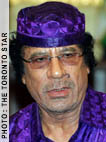
Were British-funded mercenaries protecting Gaddafi in his final moments?

Muammar al-Gaddafi

Gaddafi

By JOSEPH FITSANAKIS | intelNews.org |
The South African intelligence services are reportedly investigating reports that a British security company was providing protection for Muammar al-Gaddafi when he was killed by rebels. On October 20, the Libyan leader and his armed entourage were traveling from his hometown of Sirte toward the Libya-Niger border, when they were hit by NATO missiles. Colonel Gaddafi was later captured and lynched by armed rebels loyal to Libya’s National Transitional Council (NTC). But British newspaper The Daily Telegraph reports that an unnamed British security company was paid millions of dollars by the Libyan leader to smuggle him out of Sirte and into Niger. According to The Telegraph, the company is now under investigation by South African authorities, because one of its agents, a woman based in Kenya, allegedly recruited at least 19 South African mercenaries for the operation to exfiltrate Gaddafi from Libya. The 19 joined a group of approximately 50 mercenaries, who were sent to Libya and were with the Libyan leader when he was captured by the NTC rebels on October 20. The paper says that several members of the mercenary group were former associates of Simon Mann, a British former Special Forces (SAS) officer who was arrested in Zimbabwe in 2004 while planning a coup against Teodoro Obiang, longtime dictator of energy-rich Equatorial Guinea. The Telegraph article quotes Danie Odendaal, a former member of South Africa’s apartheid-era security services, who claims he was among Gaddafi’s armed entourage during his capture on October 20. Odendaal claims that many South Africans were injured and at least two were killed along with Gaddafi. Read more of this post
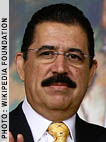
White House reinstalls visas for 2009 Honduran coup plotters

Manuel Zelaya

Manuel Zelaya

By JOSEPH FITSANAKIS | intelNews.org |
On June 26, 2009, a clandestine meeting of the Honduran Supreme Court issued a secret warrant for the arrest of the country’s democratically elected President, Manuel Zelaya. Less than 48 hours later, in the early hours of June 28, uniformed officers of the Honduran Army stormed the Presidential Palace in Tegucigalpa and arrested Zelaya. Shortly afterwards, the deposed President was placed on a plane and sent into enforced exile. It was the first coup d’état in the Central American country since 1978, and the first in Latin America in several years. The US administration of President Barack Obama almost immediately condemned the coup and halted American military aid to Honduras; but it failed to officially designate Zelaya’s ouster as a ‘military coup’, which would have required Washington to outlaw and terminate nearly all forms of government —and some private— aid to Honduras. In August, after several weeks of heavy criticism from Latin American governments, the Obama White House proceeded to “temporarily suspend” non-immigrant visas for over 1,000 Honduran military and civilian leaders, who had endorsed President Zelaya’s unconstitutional ouster. Many of whom had participated in the first post-coup government of former Speaker of the Honduran Congress, Roberto Micheletti. But a news report by the Associated Press suggests that Washington may now be quietly reinstating visas to Micheletti government officials, and that some of them are already travelling to and from the United States. The article quotes a “US embassy spokesperson”, who “spoke on condition of anonymity”, as saying that “the Department of State has determined that some of the Hondurans whose eligibility for visas was restricted following the June 2009 coup d’etat are again eligible to be considered for visas”. Read more of this post

News you may have missed #586

Stewart David Nozette

David Nozette

►►Top CIA official says Obama ‘changed virtually nothing’. An examination of Top Secret America, which aired on PBS’s Frontline yesterday, includes a rare and lengthy interview with 34-year-CIA-veteran John Rizzo, who is described as “the most influential lawyer in CIA history”. Among other things, Rizzo told Frontline that “with a notable exception of the enhanced interrogation program, the incoming Obama administration changed virtually nothing with respect to existing CIA programs and operations. Things continued. Authorities were continued that were originally granted by President Bush beginning shortly after 9/11. Those were all picked up, reviewed and endorsed by the Obama administration”.
►►Turkish military intel chief arrested in coup plot. Lt. General Ismail Hakki Pekin, the head of the Intelligence Department of the Turkish General Staff, has been arrested pending trial over an alleged plot to overthrow the government. Around 200 members of the military are thought to have planned attacks on mosques and worked to create tension in neighboring Greece to pave the way for a coup to topple the government, as part of the Ergenekon operation.
►►US scientist accused of spying reaches plea deal. US government space scientist Stewart David Nozette, who is accused of trying to sell secrets to Israel, has reached a plea deal with prosecutors. US District Judge Paul Friedman scheduled a hearing Wednesday morning to take Nozette’s plea.

Documents reveal MI5 role in Guyana coup

Cheddi and Janet Jagan

The Jagans

By JOSEPH FITSANAKIS | intelNews.org |
Secret intelligence documents declassified last week reveal that Britain’s Security Service, known as MI5, played a significant role in the lead-up to the 1953 coup that toppled the democratically elected government of British Guiana. The Latin American territory, which borders Suriname, Venezuela and Brazil, was once one of the British Empire’s most lucrative sugar-producing colonies. In 1963, after gaining its independence from Britain, it was officially renamed the Co-Operative Republic of Guyana. Instrumental in the fight for independence was Cheddi Jagan —an ethnic Indian former dentist who is today considered the father of the nation— and his American-born wife Janet (née Rosenberg). In 1950, the couple founded the People’s Progressive Party (PPP), which became the primary pro-independence political vehicle in the British colony. But dozens of folders of classified documents that were released last Friday by Britain’s National Archives show that MI5 was suspicious of the Jagans, and believed that Janet had been a member of the Communist Party of the United States in the 1940s. Several MI5 reports from the 1950s express concern that the PPP intended to establish close proximity between a newly independent Guyana and the Soviet Union. The declassified MI5 archives contain countless transcribed telephone conversations between the Jagans and their political allies, as well as copies of intercepted correspondence and reports of physical surveillance by MI5 informants. They reveal that British intelligence closely monitored the Jagans for at least a decade. Even though MI5 concluded that the PPP had no close contacts with Soviet agents or agencies, and that the party was “not receiving any financial support from any Communist organization outside the country”, it continued to describe Janet Jagan as “a committed communist” and remained apprehensive of the couple’s “disruptive antics”. The British government of Winston Churchill decided to take aggressive action in 1953, after a landslide election victory for the PPP in British Guiana elections. Read more of this post

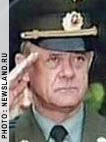
Did Russian secret services avert military coup in Sverdlovsk?

Vladimir Kvachkov

V.V. Kvachkov

By JOSEPH FITSANAKIS | intelNews.org |
The Russian intelligence services arrested members of an illegal paramilitary unit that planned an armed insurrection in one of central Russia’s biggest cities. According to reports from Yekaterinburg, the administrative capital Russia’s Sverdlovsk province, leaders of the alleged paramilitary unit hoped that their action would lead to a nationwide rebellion, eventually resulting in a military coup in Moscow. Several people were arrested by security forces of the FSB, Russia’s Federal Security Service a few days before August 2, the day when the alleged insurrection was to have taken place. Sources from the FSB say that the plotters were working on a four-step plan of action. First, they planned to attack the FSB’s Sverdlovsk district command center, the Russian Ministry of the Interior’s regional headquarters, as well as the offices of Russia’s Ministry of Emergency Situations, and capture or kill all senior staff. They would then blow up key power stations around Yekaterinburg, effectively shutting down the city’s electricity network. Taking advantage of the widespread confusion among the regional security apparatus and the population, they would move to seize local weapons depots. The alleged insurrection plan called for distributing the seized weapons among members of Yekaterinburg’s urban poor, in an attempt to widen the base of the rebellion. The plan’s final step viewed a widening insurrection in Yekaterinburg as a spark that would trigger similar Libya-style uprisings across Russia, resulting in a coup that would depose the current government in Moscow and replace it with a transitional military regime. According to news reports, the FSB arrested several leaders of the alleged insurrection, including former members of the Russian military, who are said to be linked with the People’s Militia, an insurrectionist group composed by former military and intelligence officials, led by Colonel Vladimir Kvachkov. Kvachkov, a retired Colonel in the Russian Military Intelligence Directorate (GRU), was arrested in December of 2010 on charges of planning “an armed rebellion for the forceful seizure of power in Russia”. Read more of this post

Tunisian security officials arrested, killed, amid counter-coup fears

Ali Seriati

Ali Seriati

By JOSEPH FITSANAKIS | intelNews.org |
Several key figures in Tunisia’s crumbling security apparatus have being either apprehended or killed, amid fears that they were planning a countercoup against the country’s new unity government. Most notable among the arrestees is General Ali Seriati, longtime director of deposed Tunisian dictator Zine al-Abidine Ben Ali’s Presidential Security Force. Seriati was arrested on Sunday, reportedly “by citizens as he tried to cross into Libya”. Reports from Tunis suggest that Ben Ali’s Interior Minister, Rafik Belham Kacem, who commanded the country’s’ domestic intelligence apparatus, has also been detained. Meanwhile, the BBC reports that Imed Trabelsi, a politically powerful nephew of the former dictator’s wife, was lynched to death late on Saturday. Seriati and Kacem’s arrests are seen as attempts by the new government to prevent a widely feared coup plot, organized by the remnants of Ben Ali’s security apparatus, aimed at returning him to power. Initial stages of the coup materialized on Saturday, when several gunmen riding in unmarked cars launched a wave of armed attacks against opposition targets in capital Tunis and elsewhere. Political observers in the country appeared to immediately connect the attacks with General Seriati’s Presidential Security Force, said to include some of the former president’s staunchest supporters. Read more of this post

US denies Ivory Coast coup claim

Emile Guirieoulou

Emile Guirieoulou

By IAN ALLEN | intelNews.org |
The United States has emphatically rejected assertions by officials in the Ivory Coast that it is plotting to overthrow the government of the West African country. For weeks now, Washington has been echoing calls by the United Nations, the African Union and the European Union for Ivorian President Laurent Gbagbo to stand down, after losing in the November 28 national elections. But Gbagbo’s government, which controls most of the military, rejects the alleged election victory of his political rival Alassane Ouattara, and refuses to hand over power. On December 29, the Ivory Coast’s Minister of the Interior, Emile Guirieoulou, told a press conference that the United States had dispatched at least ten German “mercenaries” to its embassy in Abidjan, as part of a multinational Western plot to overthrow Laurent Gbagbo. He told journalists that the German mercenaries were onboard a US-operated flight from Algiers to Bouake, Ivory Coast’s second-largest city. Read more of this post

Some underreported WikiLeaks revelations

WikiLeaks

WikiLeaks

By JOSEPH FITSANAKIS | intelNews.org |
There is little point in recapping here the bulk of disclosures contained in the ongoing WikiLeaks revelations. The news sphere is jam-packed with them —and perhaps this is the real story in the WikiLeaks revelations, namely the fact that espionage and intelligence issues have near-monopolized the global news cycle for the first time since the post-Watergate Congressional investigations of the 1970s. But it is worth pointing out a handful of news stories on the WikiLeaks revelations that have arguably not received the media coverage that they deserve. Undoubtedly the most underreported disclosure concerns a 2007 meeting between US officials and Meir Dagan, the then Director of Israel’s Mossad intelligence agency. During the meeting, Dagan apparently “presented US with five-step program to perform a coup in Iran“.  But there are other underreported disclosures. Take for instance the revelation that US Secretary of State Hillary Clinton personally authorized US diplomats to engage in all-out and indiscriminate spying on senior United Nations officials. Although there is nothing here that will surprise seasoned intelligence observers, the breadth of intelligence collection that US diplomats are instructed to engage in (which includes collecting credit card numbers and biometric data of UN officials) is astonishing and certainly unprecedented. Moreover, it should be noted that many senior UN officials are in fact American, which leads to the intriguing question of whether US diplomats are routinely required to engage in intelligence collection against American UN officials. Read more of this post

News you may have missed #444

News you may have missed #442

  • Israeli lobby intensifies Pollard release effort. As convicted spy Jonathan Pollard approaches 25 years behind bars, Israelis and others are renewing efforts to secure freedom for the former US Navy intelligence analyst, who is serving a life sentence in the United States for relaying military documents to Israel.
  • No compromise in WikiLeaks expose, concludes Pentagon. Much ado about nothing. The US Pentagon has concluded that no US intelligence sources or practices were compromised by the posting of secret Afghan war logs by the WikiLeaks website. Meanwhile, WikiLeaks is preparing to publish more revelations.
  • Niger ex-spy chief arrested. Seini Chekaraou, head of counterintelligence at the uranium-rich nation of Niger, has been arrested along with four senior members of the West African country’s ruling junta, allegedly on suspicion that they were “attempt[ing] to destabilize the [military] regime” that took power in the country last February.

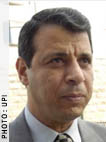
Comment: Is Palestinian Fatah Spying for Israel?

Mohammed Dahlan

Dahlan

By JOSEPH FITSANAKIS | intelNews.org |
Gaza-based Palestinian movement Hamas has again accused a senior official of rival Palestinian group Fatah of spying for Israel. Speaking last week from Gaza Damascus, Syria, Hamas official Mohammed Nazal said that Fatah Central Committee member Mohammed Dahlan, who has been tipped for the post of Vice President in Fatah-controlled Palestinian National Authority, is actively gathering information on behalf of Israeli intelligence. Nazal said Hamas received a tip-off about Dahlan from a former security officer in the Palestinian National Authority, who appears to have defected to Hamas. The unnamed informant reportedly met with Hamas defense officials on Friday, and told them that Dahlan had asked him to “collect detailed information” about the March 26 execution of two Palestinians, who were accused by Hamas of working for Israeli intelligence. He also claimed that Dahlan showed him a lengthy list of known Hamas operatives and asked him to determine the precise location of their residences in the Gaza strip. Read more of this post

News you may have missed #321 (CIA edition)

  • Uruguay ex-president sent to prison for 1973 coup. Declassified documents show that, at the time of the coup, Juan María Bordaberry told the US ambassador that “Uruguay’s democratic traditions and institutions […] were themselves the real threat to democracy”.
  • FSB ‘dropped the ball’ in Moscow metro bombings. Two Russian intelligence observers argue that Russia’s new strategy has shifted toward preventing coordinated actions by large groups of militants, which has come at the expense of taking measures to prevent individual suicide attacks, such as those of last Monday in Moscow.
  • Calls for expanded DoJ probe of FBI killing of Detroit imam. The US Justice Department is probing the killing of Detroit-area Islamic cleric Imam Luqman Ameen Abdullah, who was shot dead during an FBI raid shortly after being indicted on charges of conspiracy to commit federal crimes. The FBI said Abdullah was shot after he opened fire, but critics say he may have been targeted for assassination.

Bookmark and Share

News you may have missed #298

Bookmark and Share

News you may have missed #294

  • Tensions mount in Turkey over alleged coup plot. Simmering tensions between Turkey’s government and judicial elite erupted into open confrontation Thursday, over the handling of a probe into the Ergenekon network, an alleged military-intelligence plot to topple the Islamist-rooted government.
  • CIA recruiting Chinese-Americans. The CIA is posting recruitment advertisements in Southern California’s Chinese language media during the Lunar New Year, in an attempt to hire Chinese Americans. This is part of a wider effort by the Agency to increase numbers of ethnic minority employees by 22 to 30 percent by 2012.
  • Two alleged Israeli spies sentenced to death in Lebanon. Retired police officer Mahmoud Qassem Rafeh, who was arrested by Lebanese authorities in 2006, has been given a death conviction for “collaboration and espionage on behalf of the Israeli enemy”. Another defendant, Palestinian Hussein Khattab, has been convicted in absentia for his alleged involvement in the murders of members of Hezbollah and Islamic Jihad.

Bookmark and Share