Analysis: The significance of Osama bin Laden’s bookshelf release
May 22, 2015 4 Comments
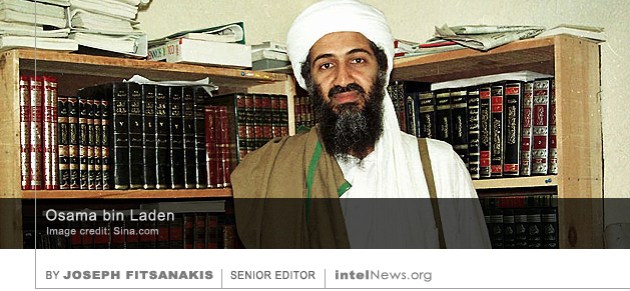 The release this week of material from Osama bin Laden’s personal stack of books and documents, which were confiscated from his Abbottabad compound, is timely as it is important. The decision by the United States Office of the Director of National Intelligence (ODNI) to declassify the documents was almost certainly in response to recent claims that bin Laden was being kept under house arrest by the Pakistani intelligence services at the time of his assassination. American journalist Seymour Hersh, who made the allegations in the London Review of Books earlier this month, said that the Pakistanis were forced to give Washington permission to kill bin Laden once the CIA was able to confirm his presence in Pakistan.
By releasing the documents, the ODNI hopes to show that the al-Qaeda founder could not possibly have been under house arrest and still have been able to communicate with his al-Qaeda lieutenants. But there is a counterargument too, which rests on the view that al-Qaeda has been integrated into the command structure of the Pakistani intelligence services ever since the days of the anti-Soviet jihad of the 1980s. According to this view, it would not have been especially difficult for bin Laden’s captors to permit him to maintain carefully supervised communications with his organization. This would have given the Pakistanis the benefit of monitoring the operational thinking of al-Qaeda, while at the same time dispelling any speculation about his rumored death, which was widespread in the decade prior to his actual demise. Additionally, the feeling one gets from reading Hersh’s article is that the Pakistanis’ arrangement with bin Laden was a cross between internment and protection, with the emphasis shifting from one to the other depending on the changing needs of Pakistan’s Inter-Services Intelligence directorate.
The documents themselves are also revealing. They show that, almost to the end of his life, bin Laden continued to regard the United States as the foremost target of militant Islam. To that extent, it is interesting that the ODNI’s release includes almost no documents about Israel, Russia, India, or China. This points to a tactical prioritization of America as a target, and perhaps also a sense of vendetta that bin Laden himself held against his former allies in the Soviet-Afghan war of the 1980s. Moreover, the documents show that bin Laden continued to favor attacks designed to cause mass casualties, in the style of 9/11. Knowing that, and considering that no such attack took place against the United States after 9/11, one might logically conclude that al-Qaeda has been willing but unable to carry one out. Read more of this post
















 intelNews.org
Judge orders release of key testimony from Rosenberg spy case
May 26, 2015 by Joseph Fitsanakis Leave a comment
However, although historians are confident that Julius Rosenberg was indeed an active member of the Soviet spy ring, there are doubts about Ethel. Many suggest that her involvement with her husband’s espionage activities was fragmentary at best, and that she refused to cooperate with the Federal Bureau of Investigation in an ill-judged attempt to protect her husband. The argument goes that Ethel was put to death as a warning to Moscow, as well as to intimidate other American spies, rather than on the basis of actual evidence of her involvement in espionage. Many years after the Rosenbergs’ execution, Greenglass claimed he had lied about Ethel’s role in the spy affair in order to protect his wife, who was the actual typist of the espionage ring.
The debate over Ethel Rosenberg’s fate will undoubtedly by rekindled by US District Judge Alvin Hellerstein’s decision last week to unseal Greenglass’ testimony. The documents could not be made public while Greenglass was alive, because he objected to their release. But he died last year in a nursing home in New York, so his testimony can now legally be made available to the public. In making his decision known, Judge Hellerstein said Greenglass’ testimony was a “critical piece of an important moment in our nation’s history”. The United States government is legally permitted to block the release of the documents should it decide to do so. But when a White House spokesperson was asked about the subject by the Associated Press, she decline to comment.
► Author: Joseph Fitsanakis | Date: 26 May 2015 | Permalink: https://intelnews.org/2015/05/26/01-1703/
Filed under Expert news and commentary on intelligence, espionage, spies and spying Tagged with Alvin Hellerstein, Cold War, counterintelligence, David Greenglass, declassification, espionage, Ethel Rosenberg, history, Julius Rosenberg, lawsuits, News, Rosenberg nuclear spy ring