Dissident playwright assassinated with poison pellet 35 years ago
September 9, 2013
 By JOSEPH FITSANAKIS | intelNews.org |
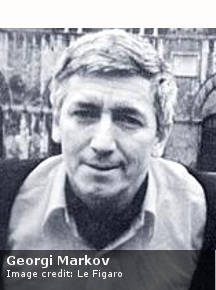
This past Sunday marked 35 years since the assassination with a poisoned umbrella pellet of Bulgarian literary icon and political dissident Georgi Markov. By 1969, when he defected from Bulgaria, Markov had achieved considerable fame in his homeland and was considered one of the Eastern Bloc’s most talented and promising young novelists. Increasingly, however, Markov fraternized with dissident artists and intellectuals, and several of his short stories and plays were disapproved by Bulgarian government censors. In 1969, while visiting his brother in Bologna, Italy, Markov decided to remain in the West. Two years later, he moved to the United Kingdom where he was offered a job at the Bulgarian unit of the BBC World Service. He also did contract work for Germany’s Deutsche Welle and Radio Free Europe, which was funded by the United States government. This prompted the Bulgarian authorities to view Markov’s actions as a defection, and he was sentenced in absentia to nearly seven years in prison by a court in Sofia. But Markov continued his work unabated, earning critical acclaim for his plays in the UK and elsewhere in the West. But on September 7, 1978, the Bulgarian dissident developed a powerful fever and was admitted to a London hospital, where he died 72 hours later, on September 11. Following an autopsy, Britain’s Metropolitan Police concluded that Markov had been poisoned by a micro-engineered pellet made of platinum, which had been filled with ricin. While on his deathbed, Markov had told police investigators that he had felt a sharp pinch on the back of his right thigh while walking across London’s Waterloo Bridge over the River Thames. When he turned around, prompted by the pinching feeling, he said he saw a well-dressed man picking up an umbrella from the ground. The man then quickly crossed the street and hailed a taxi. Since then, Soviet intelligence defectors, including Oleg Gordievsky and Oleg Kalugin, have suggested that Markov’s murder had been planned by the Soviet KGB and carried out by Bulgarian intelligence. Read more of this post










 intelNews.org
Commission urges probe of plane crash that killed UN secretary general
September 10, 2013 by Joseph Fitsanakis
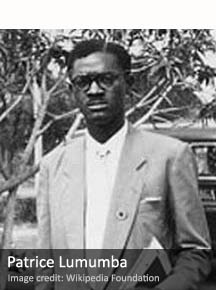
A commission of experts formed to examine the 1961 death of former United Nations Secretary General Dag Hammarskjöld has urged the reopening of an investigation into the airplane crash that killed him. Hammarskjöld died when the Douglas DC-6 transport aircraft that was carrying him crashed in the British-administered territory of Northern Rhodesia (now Zambia). He was on his way to Congo’s mineral-rich Katanga region to meet European-supported chieftains who in 1960 had seceded from the nationalist government of Congolese Prime Minister Patrice Lumumba. Two subsequent investigations into the crash, conducted by the Rhodesian Board of Investigation and the Rhodesian Commission of Inquiry, failed to determine the precise cause of the crash. But an official United Nations Commission of Investigation, conducted in 1962, concluded that deliberate sabotage could not be ruled out as a likely cause of the tragedy. In 2011, a Swedish investigator argued in a report that Hammarskjöld’s plane had been “shot down by an unidentified second plane”. The investigator told The Guardian newspaper that British colonial authorities had deliberately left the sole surviving airplane passenger, American sergeant Harold Julian, to die of his injuries at a makeshift hospital in Northern Rhodesia. In 2012, the Hammarskjöld Inquiry Trust appointed an international team of lawyers to study all available evidence and report to the United Nations. The team, called the Hammarskjöld Commission, is composed of a diplomat and three judges from the Netherlands, the United Kingdom, South Africa, and Sweden. On Monday, they held a press conference to present the findings of their investigation. Its conclusion is that the UN should reopen the 1962 probe into the plane crash, because “significant new evidence” has recently emerged. The Commission report suggests that American intelligence agencies, in particular the National Security Agency (NSA), may hold “crucial evidence” that could help clarify the causes of the crash. Read more of this post
Filed under Expert news and commentary on intelligence, espionage, spies and spying Tagged with assassinations, Dag Hammarskjöld, Hammarskjöld Commission, Hammarskjöld Inquiry Trust, history, News, Northern Rhodesia