Iran executes nuclear scientist who claimed he was kidnapped by CIA

Shahram AmiriAuthorities in Iran have admitted that they executed a former scientist for the country’s nuclear program, who claimed that he was abducted by the United States after disappearing from Iran for a year. Shahram Amiri worked for the Atomic Energy Organization of Iran, the government body that is responsible for operating and regulating the country’s nuclear installations. But in the summer of 2009, while on a religious pilgrimage to the Saudi Arabian city of Mecca, Amiri disappeared. Iranian authorities alleged at the time that Amiri had been kidnapped and possibly killed by Saudi, Israeli or American intelligence operatives.

Remarkably, the Iranian scientist reappeared almost a year later in Washington, DC. He entered the embassy of Pakistan in the American capital and asked to speak to the official in charge of the embassy’s Iranian interests section (since America and the Islamic Public have no official diplomatic relations, Pakistan’s embassy serves as an intermediary). He told officials at the embassy that he had been abducted by the Central Intelligence Agency after being drugged in Saudi Arabia. He also claimed that he was secretly transported to the US, where he was “subjected to intense psychological pressure” involving psychotropic drugs, interrogated and forced to reveal secrets about Iran’s nuclear program. But US officials denied Amiri’s claims and said the Iranian scientist had defected on his own accord and was free to return to Iran, if he wanted. Unconfirmed reports suggested that Amiri had changed his mind after defecting to the US, because he feared that Iranian authorities would harm his family. Some anonymous sources in Washington also claimed that Amiri had been offered $5 million for the information he gave the CIA, but that he had chosen to return to Iran instead of accepting the money.

On July 15, 2010, just three days after contacting the Pakistani embassy in DC, Amiri returned to a hero’s welcome in Iran, which was televised live. Meanwhile, Iranian officials accused the US and Israel of employing dirty tactics against the Islamic Republic. However, in May 2011 Amiri was suddenly arrested at his family home in Tehran and charged with treason. He underwent a secret trial, was convicted and was never again seen in public. On Saturday, Amiri’s family said they had received his body from the government, and that it appeared that he had died from hanging, judging by rope marks around his neck. On Sunday, Iran’s first deputy chief justice and former intelligence minister, Gholam-Hossein Mohseni-Eje’i, told reporters that Amir had indeed been executed by hanging. During his brief announcement, Mohseni-Eje’i said Amiri had endangered the Islamic Republic by giving “vital intelligence about the country to the enemy”, by which he said he meant the United States.

Author: Joseph Fitsanakis | Date: 07 August 2016 | Permalink

US ‘spied on Israeli prime minister’ during Iran nuclear talks

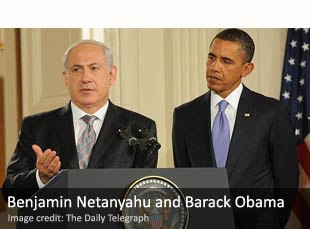
Netanyahu and ObamaAmerican intelligence agencies spied on Israeli Prime Minister Benjamin Netanyahu during the negotiations between the United States and Iran over the Islamic Republic’s nuclear program, according to officials. Tehran entered a deal, referred to as ‘the Geneva pact’, following drawn-out negotiations with a group of nations that came to be known as P5+1, representing the five permanent members of the United Nations Security Council plus Germany. The government of Israel, however, strongly criticized the negotiations. Prime Minister Netanyahu called the pact a “historic mistake” that would enable “the most dangerous regime in the world” to get closer to “attaining the most dangerous weapon in the world”. Israel’s strong reaction, which included open criticism of US President Barack Obama, caused some in the US to accuse Tel Aviv of trying to “manipulate American institutions”, while the White House did not hide its frustration with the Israeli leader.

Last week, The Wall Street Journal said in a leading article that the Obama administration spied systematically on Prime Minister Netanyahu, whom it suspected of actively trying to kill the Geneva pact. Citing interviews with “over two dozen past and present US officials”, The Journal claimed that the National Security Agency, America’s leading signals-intelligence collector, intercepted the communications between the Israeli prime minister and his senior advisors. The main purpose of the spy program was to find out whether the government of Israel was considering launching military strikes on Iran without first notifying Washington. Such a possibility was eventually ruled out. But in the process the NSA was able to listen in to private conversations between a number of senior Israeli government officials and American lawmakers. The latter were critical of the White House’s efforts to strike a deal with Iran, and were specifically asked by Israeli officials whether Israel could count on them to vote against the Geneva pact in Congress.

The NSA was also able to intercept conversations between Israeli leaders and American members of pro-Israel groups operating in the US. The newspaper implies that the Israeli leaders coached the Americans on how to campaign against the Geneva pact. Ironically, the NSA intercepts showed that Israel was itself spying on America in an effort to access inside information on the negotiations with Iran. The paper said that the Israelis would then regularly leak the information they acquired through espionage, in an effort to sabotage a possible deal. The Journal said it contacted the US National Security Council for a comment, and was told by a media representative that the US does “not conduct any foreign intelligence surveillance activities unless there is a specific and validated national security purpose. This applies to ordinary citizens and world leaders alike”, said the spokesman, refusing to elaborate.

Author: Joseph Fitsanakis | Date: 04 January 2016 | Permalink

US spy for Israel ‘may be released’ as part of Iran nuclear deal

Jonathan PollardA United States Navy intelligence analyst, who is serving a life sentence for spying on America for Israel, may soon be set free in an effort by Washington to quieten Israeli criticism of a recently struck international agreement on Iran’s nuclear program. Many in US counterintelligence consider Pollard, who acquired Israeli citizenship in 1995, one of the most damaging double spies in American history. But he is widely viewed as a hero in Israel, and many Israelis, as well as pro-Israel Americans, have been pressuring the US administration of President Barack Obama to release him. He has so far served nearly 30 years of his life sentence.
The Wall Street Journal published an article on Friday suggesting that the Obama administration was “preparing to release” Pollard. Citing unnamed US officials, the paper said Washington hoped that the move would “smooth [America’s] relations with Israel in the wake of the Iran nuclear deal”. The latter was signed earlier this month between Tehran and the so-called P5+1 nations, namely the five permanent members of the United Nations Security Council plus Germany. The New York Times added to the speculation on Saturday with a detailed front-page article, which confirmed that “some in Washington appear to be highlighting” Pollard’s upcoming 30-year parole hearing, which is set to take place in November. It added that the White House was contemplating using Pollard’s release to appease, not only Tel Aviv, but also pro-Israel supporters in Congress, many of whom have campaigned for years in favor of Pollard’s release.

But the paper also cautioned that linking a possible release of the jailed American spy with the Iranian nuclear deal was risky and could in fact provoke a serious backlash. It quoted Israeli and American analysts who said that, although Israel was in the past prepared to accept Pollard’s release in exchange for minor concessions in its conflict with the Palestinians, the coalition government of Israeli Prime Minister Benjamin Netanyahu considers the nuclear agreement with Iran to be “too serious a threat” to concede to, no matter what the trade-off is from Washington. Some Israeli commentators used strong words to describe Washington’s alleged plan to release Pollard as a way of appeasing Israel, describing it as “cynical, cheap and misguided”.

The Times said it contacted the US National Security Council on Friday and was told by a spokesman that there was “absolutely zero linkage between Mr. Pollard’s status and foreign policy considerations”.

Author: Joseph Fitsanakis | Date: 27 July 2015 | Permalink: https://intelnews.org/2015/07/27/01-1743/

Israel denies using computer virus to spy on Iran nuclear deal

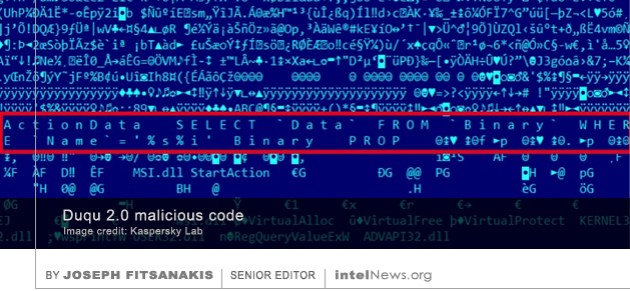
Duqu 2.0The Israeli government rejected reports yesterday that its spy agencies were behind a virus found on the computers of three European hotels, which hosted American and other diplomats during secret negotiations on Iran’s nuclear program. Cybersecurity firm Kaspersky Lab said on Wednesday that it first discovered the malware, which it dubbed “Duqu 2.0”, in its own systems. The Moscow-based firm said the sophisticated and highly aggressive virus had been designed to spy on its internal research-related processes. Once they detected the malicious software in their own systems, Kaspersky technicians set out to map Duqu’s other targets. They found that the virus had infected computers in several Western countries, in the Middle East, as well as in Asia. According to Kaspersky, the malware was also used in a cyberattack in 2011 that resembled Stuxnet, the elaborate virus that was found to have sabotaged parts of Iran’s nuclear program in 2010.
However, Kaspersky said that among the more recent targets of the virus were “three luxury European hotels”, which appear to have been carefully selected among the thousands of prestigious hotels in Europe. The three appear to have only one thing in common: all had been patronized by diplomats engaged in the ongoing secret negotiations with Iran over the Islamic Republic’s nuclear program. Kaspersky was referring to the so-called P5+1 nations, namely the five permanent members of the United Nations Security Council plus Germany, who lead ‘the Geneva pact’. Israel has condemned the negotiations and has repeatedly expressed anger at reports that the Geneva pact is about to strike an agreement with Tehran over its nuclear program.

However, Israel’s deputy foreign minister flatly rejected Kaspersky’s allegations on Wednesday, calling them “pure nonsense”. Speaking on Israel Radio, Eli Ben-Dahan said Israel had “many far more effective ways” of gathering foreign intelligence and that it did not need to resort to computer hacking in order to meet its intelligence quotas. Israeli government spokespeople refused to comment on the allegations when asked late Wednesday.

Author: Joseph Fitsanakis | Date: 11 June 2015 | Permalink: https://intelnews.org/2015/06/11/01-1713/

CIA chief paid secret visit to Israel ahead of Iran nuclear deal

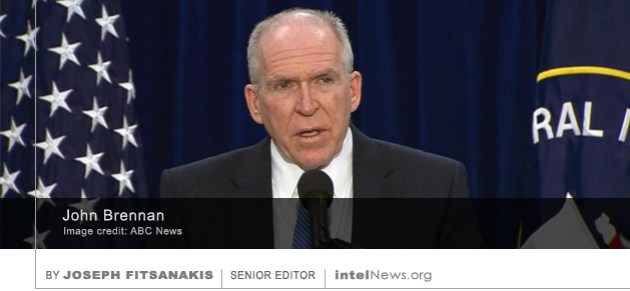
John BrennanThe director of the United States Central Intelligence Agency visited Israel in secret last week to discuss the Jewish state’s refusal to endorse an emerging deal with Iran over its nuclear program. Citing “two senior Israeli officials”, the Tel Aviv-based Israeli newspaper Haaretz said on Tuesday that CIA Director John Brennan arrived in Israel last Thursday. Although he was officially hosted by Tamir Pardo, director of Israeli intelligence agency Mossad, Brennan used the opportunity to hold secret meetings with several senior Israeli officials, said Haaretz. Among them were Prime Minister Benjamin Netanyahu, National Security Adviser Yossi Cohen, as well as Major General Hartzl Halevi, who heads Israel’s Military Intelligence Directorate.
According to Haaretz, Brennan’s visit to Israel had been planned “long ahead of time”, and should not be interpreted as a sudden diplomatic move from Washington. However, it came just weeks ahead of a deadline for a far-reaching settlement next month between Iran and six world powers over the Islamic Republic’s nuclear program. If successful, the much-heralded deal will mark the conclusion of ongoing negotiations between the Islamic Republic and a group of nations that have come to be known as P5+1, representing the five permanent members of the United Nations Security Council plus Germany. Israel, however, has strongly criticized the negotiations, referred to as ‘the Geneva pact’. Last year, the Israeli Prime Minister called the pact a “historic mistake” that would enable “the most dangerous regime in the world” to get closer to “attaining the most dangerous weapon in the world”.

It is not known whether Brennan brought with him a message from US President Barack Obama addressed to the Israeli Prime Minister, said Haaretz. On Monday, just 72 hours after Brennan’s departure, another senior American official landed in Tel Aviv —openly this time. It was General Martin Dempsey, Chairman of the US Joint Chiefs of Staff, who was hosted by his Israeli counterpart, General Gadi Eisenkot. Like Brennan before him, General Dempsey met with Prime Minister Netanyahu and Minister of Defense Moshe Yaalon. Haaretz contacted the CIA about Brennan’s secret visit to Israel, but an Agency spokesperson refused to comment.

Author: Joseph Fitsanakis | Date: 10 June 2015 | Permalink: https://intelnews.org/2015/06/10/01-1712/

Israel, Saudi Arabia, acknowledge holding secret talks on Iran

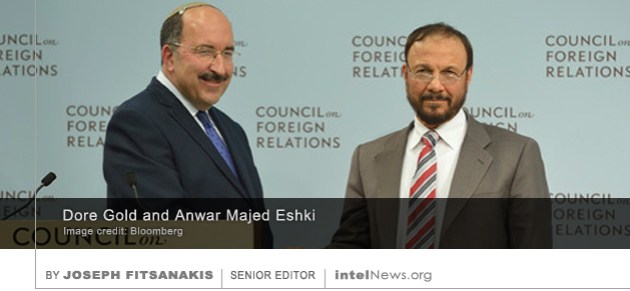
Dore Gold and Anwar Majed EshkiRepresentatives from Israel and Saudi Arabia have publicly admitted for the first time that they met secretly to discuss their common foe Iran, even though Saudi Arabia does not officially acknowledge Israel’s existence. The admission was made at a symposium held on Thursday at the Council on Foreign Relations, a foreign-policy think tank based in Washington, DC.
According to Bloomberg’s Eli Lake, who covered the event, it featured speeches by Saudi General (ret.) Anwar Majed Eshki, and Israeli career diplomat Dore Gold. Eskhi is a former adviser to Saudi Arabia’s ambassador to the United States, Prince Bandar bin Sultan. Gold is Israel’s former ambassador to the United Nations, and is currently seen as a strong candidate to lead Israel’s Ministry of Foreign Affairs. Lake notes that Eshki gave his speech in Arabic, Gold gave his in English, and that no questions were taken from the audience.

At least five meetings appear to have taken place between senior Israeli and Saudi officials since early 2014, in secret venues located in Italy, India and the Czech Republic. The main purpose of the clandestine meetings was to discuss what Tel Aviv and Riyadh see as Iran’s increasingly powerful role in Middle Eastern affairs, and to explore ways of stopping Tehran from building nuclear weapons.

The admission of the secret meetings between Israeli and Saudi diplomats will not come as a surprise to seasoned Middle East observers. Many have suspected that the two countries, who have historically been bitter enemies, have sought to collaborate behind the scenes against Iran. However, as Lake correctly points out, this week’s acknowledgement is the first time that this collaboration has been openly admitted by the two sides. He quotes one participant at Thursday’s symposium, Israeli General (ret.) Shimon Shapira, who says that Tel Aviv and Riyadh have also discussed “political and economic” means of thwarting Iran’s nuclear ambitions.

This admission, however, does not mean that the Saudis are about to recognize Israel, or that the Israelis are any closer to accepting the Saudis’ 2002 Arab-Israeli peace plan, which Tel Aviv has flatly rejected, says Lake. Admittedly, the rising power of Iran can only do so much to bring Israelis and Arabs closer.

Author: Joseph Fitsanakis | Date: 05 June 2015 | Permalink: https://intelnews.org/2015/06/05/01-1709/

Senior Iranian aide defects during nuclear talks in Lausanne

Amir Hossein MotaghiBy JOSEPH FITSANAKIS | intelNews.org

A media advisor to the Iranian president, who was in Switzerland to cover the ongoing international negotiations on the country’s nuclear program, has defected. Amir Hossein Motaghi is credited with having helped secure the impressive ascent of Hassan Rouhani to Iran’s presidency in 2013. Rouhani, who swept to power with over 50 percent of the vote, over 30 percentage points ahead of his nearest rival, owes much of his victory to his popularity among the youth. Motaghi led the media team that promoted Rouhani’s image among younger voters by cleverly employing online platforms such as Facebook and Twitter.

Following Rouhani’s victory, however, Motaghi repeatedly voiced impatience with the slow pace of social and political reforms in Iran. Recently he spoke in favor of the release of Jason Rezaian, the Iranian-American Tehran bureau chief for The Washington Post, who has been denounced as a spy and imprisoned by the Iranian government. There have been rumors in the Iranian media that Motaghi had been ordered to report once a week to Iran’s Ministry of Intelligence; some say he had been privately warned that he faced arrest upon his return to Iran.

Motaghi had reportedly been sent to the Swiss city of Lausanne by the Iran Student Correspondents Association (ISCA). His task was to cover the ongoing talks that aim to bring an end to the dispute between the Islamic Republic and a group of nations that have come to be known as P5+1, representing the five permanent members of the United Nations Security Council plus Germany. However, according to Iranian opposition sources, the media aide resigned from his ISCA post before filing an application for political asylum in Switzerland.

Soon afterwards, Motaghi gave an interview to Irane Farda, a pro-reform Iranian television station based in London, in which he explained the reasons for his defection. He accused the Iranian government of controlling Iranian media reports about the talks, by staffing its reporter entourage in Lausanne with undercover intelligence officers. He also said he could no longer pursue his profession conscientiously because he was only allowed to report approved news items. Furthermore, he accused the American delegation to the talks as “mainly speak[ing] on Iran’s behalf with […] the 5+1 countries [so as to] convince them to consent to an agreement”.

Late on Sunday, ISCA, the press agency believed to have sent Motaghi to Switzerland, released a statement claiming it did not employ the journalist and that his job had been terminated prior to the nuclear talks in Lausanne.

‘Gloves are coming off’ in US-Israel clash over Iran, says intel insider

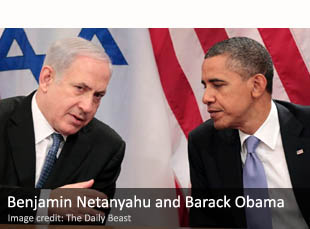
Benjamin Netanyahu and Barack ObamaBy JOSEPH FITSANAKIS | intelNews.org
An American former intelligence operative has called the latest revelations of Israeli spying against the United States “appalling” and warned that “the gloves are coming off” in the clash between Washington and Tel Aviv over Iran. The unnamed former operative, described as having “long, firsthand familiarity with Israeli operations”, told Newsweek magazine’s intelligence correspondent Jeff Stein that he was not surprised to find out Israel has been spying on the closed-door talks between the US and the Islamic Republic.

He was referring to The Wall Street Journal’s leading article on Monday, which alleged that the Jewish state’s intelligence services have been spying on American officials during their closed-door negotiations with the government of Iran over its nuclear program. The paper said the spy operation against the US forms part of a broader campaign by Tel Aviv to sabotage the talks, which aim to bridge the differences between the Islamic Republic and a group of nations that have come to be known as P5+1, representing the five permanent members of the United Nations Security Council plus Germany.

Newsweek has reported before allegations about aggressive Israeli espionage against the US. Last year, Stein elicited a strong reaction from the Israeli government when he quoted Congressional staffers saying that America’s Jewish allies had “crossed red lines” in their efforts to steal American secrets. According to Stein, intelligence representatives had briefed members of Congress about Israeli spy operations against US interests that were “unrivaled and unseemly” and had reached levels far higher than similar activities by other allied countries, such as Britain or Japan.

This time, however, says Stein, Israeli actions “mark a new frontier” in the intelligence rivalry between Washington and Tel Aviv. He quotes an American former intelligence insider who condemns Israeli efforts to sabotage US-Iranian talks as “manipulation of our institutions” and blasts American lawmakers siding with Israeli Prime Minister Benjamin Netanyahu as “useful idiots” who “sacrifice the US national interest for a foreign ideology”, namely “Likud rightwing Zionism”. The unnamed source added that the controlled leaks about the widening rift in US-Israeli relations reveal the anger currently being felt in Washington against the Israeli government. Behind closed doors, officials in the White House, the foreign-policy and intelligence communities “are prepared to act on that anger”, he concluded.

Israel ‘spied on the United States’ during Iran nuclear negotiations

Benjamin Netanyahu and Barack ObamaBy JOSEPH FITSANAKIS | intelNews.org

The intelligence services of Israel have allegedly been spying on American officials during their closed-door negotiations with the government of Iran over its nuclear program. The Wall Street Journal said the spy operation forms part of a broader campaign by Tel Aviv to sabotage the talks, which are aimed at bridging the differences between the Islamic Republic and a group of nations that have come to be known as P5+1, representing the five permanent members of the United Nations Security Council plus Germany.

In a leading article published on Monday, the paper said it decided to reveal the existence of the Israeli spying program after interviewing “more than a dozen current and former US and Israeli diplomats, intelligence officials, policy makers and lawmakers”. Ironically, according to The Journal, the administration of US President Barack Obama found out about the Israeli spying after instructing American intelligence agencies to conduct a counterintelligence operation against Tel Aviv, in order to see what they knew about the secret negotiations with Iran. After spying on Israeli government officials, the American agencies concluded that they were in possession of confidential information that could only have been acquired from spying on participants in the negotiations.

According to The Journal, American officials were not surprised by the spying. But they were especially perturbed, said the paper, to find out that the Israeli government proceeded to leak the secret information to American lawmakers opposed to a possible deal with Iran, in order “to undermine US diplomacy”, according to one unnamed senior American official.

Israeli officials told The Journal that Tel Aviv had indeed acquired confidential information about the negotiations, but that they had done so by spying on Iranian, not American, negotiators. Speaking late on Monday, a spokesman for the office of the Israeli Prime Minister Benjamin Netanyahu said the American newspaper’s allegations were “utterly false. The state of Israel does not conduct espionage against the United States or Israel’s other allies”, he said, adding that the “false allegations” were “clearly intended to undermine the strong ties between the United States and Israel”.

Ex-Mossad chief calls for ouster of Israeli prime minister

Meir DaganBy JOSEPH FITSANAKIS | intelNews.org
A longtime former director of the intelligence agency Mossad has called for the ousting of the country’s Prime Minister Benjamin Netanyahu, dismissing him as dangerous for Israel’s security. Meir Dagan stepped down from his post as head of the Mossad in November of 2010, after leading the agency for over eight years —the longest tenure of any Mossad director in history. Soon after his retirement, Dagan emerged as a leading critic of the government of Prime Minister Netanyahu, whom he accuses of endangering Israel’s security by wrecking its international reputation and isolating the country from its friends and allies around the world. In 2011, Dagan gave a lengthy interview in which he admonished calls by Netanyahu to bomb Iran’s nuclear facilities as “the stupidest idea” he had ever heard. In a subsequent interview to Reuters news agency, Dagan insisted that the military option should be last on the table and said that the Iranian nuclear issue should be “left in the hands of the international community”.

Responding to the Israeli Prime Minister’s controversial trip to the United States last week, Dagan said last week it had been destructive to Israel’s interests. Speaking on Israel’s Channel 2 television, the former spy chief did not deny that Iran’s nuclear program was a potential threat to Israel’s security, “but going to war with the US [over Iran] is not the way to stop it”, he said. Dagan’s supporters, who come mostly from the center-left of the Israeli political scene, accuse the government of Prime Minister Netanyahu of focusing almost exclusively on the Iranian nuclear program and neglecting the increasingly volatile relationship between Israel and the Palestinians. Many Israeli left-of-center voters blame the Prime Minister for the 2014 war in the Gaza Strip, which they say damaged Israel’s reputation and failed to provide a long-term solution to the lingering Palestinian issue.

Last weekend, the former Mossad chief was the keynote speaker at a rally against the Netanyahu administration that brought together nearly 40,000 people in Tel Aviv. He told the crowd that the prime minister’s policies were leading to an apartheid state in the Occupied Territories and was making Israel less safe. “For 45 years I have served this country, all of them dedicated to safeguarding its security”, said Dagan. “I don’t want that dream to disappear”, he added, at one point breaking down in tears. Many of the speakers at the rally also called on the Israeli government to refocus its policy priorities away from Iran and toward domestic social issues, including education, housing, healthcare, income levels in relation to the rising cost of living, and services for the elderly.

Mossad saw pause in Iran nuke program in 2012, leaked file shows

Benjamin NetanyahuBy JOSEPH FITSANAKIS | intelNews.org

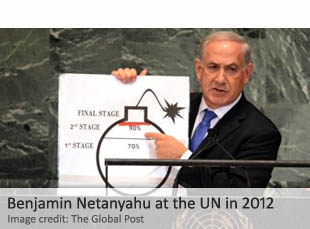
A file leaked to the media on Monday shows that the Israeli intelligence agency Mossad differed from the Israeli leadership’s position that Iran was advancing its nuclear weapons program in 2012. In September of that year, Israeli Prime Minister Benjamin Netanyahu addressed the United Nations in New York with a dramatic plea to help stop the Iranian nuclear program before it was too late. Holding a diagram showing a bomb about to explode, the Israeli leader urged UN member states to “draw a clear red line” forbidding the Islamic Republic from acquiring nuclear weapons in less than two years’ time, as it was poised to do, he said.

But a report drafted by the Mossad just weeks after Netanyahu’s UN address, said that Iran appeared to have stopped pursuing activities that were necessary to building a nuclear arsenal. The report was produced by the Mossad and distributed to a number of allied intelligence agencies around the world, including those of South Africa, from where it was presumably leaked to the media. British quality broadsheet The Guardian, which published the report, said it was able to “independently authenticate” the report, and added that it clearly went against Prime Minister Netanyahu’s assessment about the Iranian nuclear program. The top-secret document, which was communicated to the South Africans by the Mossad in late October of 2012, was also published by Qatar-based news agency Al Jazeera. It states that Iran did “not appear to be ready to enrich [uranium] to higher levels” and was thus “not performing the activity necessary to produce [nuclear] weapons”. According to The Guardian, the content of the Mossad communique is “in stark contrast to the alarmist tone set by Netanyahu” in his September 2012 address before the UN.

If the leaked document is genuine, it would appear to confirm previous indications of a difference of opinion on the matter of Iran’s nuclear program between Israel’s political leadership and its intelligence community. In January of this year, the Bloomberg news agency reported that the Mossad had been discreetly approaching US officials and politicians in order to raise support for a pending agreement between Iran, the United States and other countries, which would ease economic sanctions on the Islamic Republic in exchange for a short-term suspension of core aspects of its nuclear program. According to Bloomberg, the Mossad appeared to be acting behind the back of the Israeli prime minister, who has blasted the agreement as a “historic mistake” that enabled “the most dangerous regime in the world” to get closer to “attaining the most dangerous weapon in the world”. But in contrast to the Israeli leader, the Mossad appears to have urged American officials to support the agreement, saying that any move “that triggers [further] sanctions [against Iran] would collapse the talks” between Tehran and Washington, something which Israeli intelligence officials do not wish to see.

Mossad breaks with Israeli PM, cautions against new Iran sanctions

Benjamin Netanyahu and Barack ObamaBy JOSEPH FITSANAKIS | intelNews.org
The Israeli intelligence agency Mossad has broken ranks with the Israeli government of Prime Minister Benjamin Netanyahu, cautioning American members of Congress against imposing new sanctions on Iran. In November of 2013, Iran signed a Joint Plan of Action with six world powers in Geneva, Switzerland. Known as the Geneva interim agreement, the pact eases economic sanctions on the Islamic Republic in exchange for a short-term suspension of core aspects of the Iranian nuclear program. But two members of the Republican-controlled Senate in the United States, Robert Menendez and Mark Kirk, have voiced strong displeasure with what they see as the slow pace of progress in the talks. The two senators are co-sponsors of a proposed bill that would impose new sanctions on Iran if the Islamic Republic fails to make substantial progress toward the Geneva agreement by next June. US President Barack Obama opposes the bill, arguing that it would actually prompt Iran to accelerate its nuclear program, and has publicly said he would veto it. Meanwhile, his Secretary of State, John Kerry, quoted this week an Israeli intelligence official who allegedly told him that, if enacted, the Menendez-Kirk bill would “throw a grenade into the process”. It is no secret that the bill enjoys strong support from Netanyahu’s government. Last year, the Israeli Prime Minister called the Geneva pact a “historic mistake”, which enabled “the most dangerous regime in the world” to get closer to “attaining the most dangerous weapon in the world”. Late on Wednesday, however, the Bloomberg news agency reported that the Mossad has been discreetly approaching US officials and politicians and cautioning them that the Menendez-Kirk bill would indeed torpedo the Geneva agreement. The news agency said that the Israeli intelligence agency has been warning American officials abroad and it recently contacted a US Congressional delegation visiting Israel. The Bloomberg report cited two unnamed “senior US officials”, one of whom told the news agency that “any bill that triggers sanctions [against Iran] would collapse the talks”. If confirmed, the Bloomberg allegations would mean that the Mossad, Israel’s principal intelligence agency, is sharply breaking ranks with the government of Prime Minister Netanyahu on Iran. The Bloomberg article further states that Senator Menendez has contacted Ron Dermer, Israel’s Ambassador to the US, to complain about the actions of the Mossad, which, say critics, break diplomatic protocol.

Iran says it foiled Mossad assassination of nuclear scientist

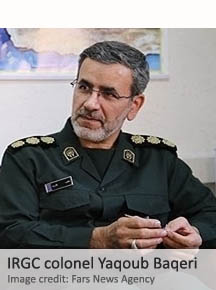
Yaqoub BaqeriBy IAN ALLEN | intelNews.org
A senior Iranian military official has claimed that Tehran foiled an attempt by Israeli spies to assassinate a scientist working for Iran’s nuclear program. In a report filed on Saturday, Iran’s semi-official Fars News Agency quoted Colonel Yaqoub Baqeri saying that the Islamic Revolutionary Guards Corps (IRGC) had managed to prevent Israel from killing the scientist “during the last two years”. Baqeri is deputy chief liaison officer in the air force division of the IRGC, a branch of Iran’s armed forces dedicated to protecting and furthering the goals of the 1979 Islamic Revolution. Baqueri told Fars, which is known to have strong links with the IRGC, that Israel’s covert-action agency, the Mossad, had been “trying hard to assassinate an Iranian nuclear scientist”, but that the well-timed involvement of the IRGC had “thwarted the terrorist operation”. At least five Iranian nuclear scientists have been targeted by unknown assailants since 2007, when Ardeshire Hassanpour, who worked at Iran’s Isfahan nuclear facility, was found dead in his Tehran apartment, allegedly having suffocated in his sleep from fumes from a faulty gas pipe. Another Iranian nuclear scientist, Shahram Amiri, disappeared in 2009, while Masoud Ali Mohammadi, described by the Iranian government as a “dedicated revolutionary professor”, was killed in 2010 by a remotely controlled explosive device that had been planted at the entrance of his residence. Later that year, two near-simultaneous bomb attacks killed Majid Shahriari and injured Fereydoon Abbasi Davan, nuclear researchers and professors at the Shahid Beheshti University. The two were attacked in separate incidents by motorcyclists who targeted them during the morning rush hour in Tehran as they were driving to work. The assailants attached small bombs to the car surfaces of their targets and detonated them from a relatively safe distance before speeding away through heavy traffic. The Fars News Agency report also claimed that Iran’s intelligence agencies had uncovered secret training bases run by the Mossad and located “within the territories of one of Iran’s western neighbors”, in which teams of assassins were allegedly being “trained and assisted” by the Israelis. In 2012, Israel’s two leading intelligence correspondents, Dan Raviv and Yossi Melman, claimed in their book Spies Against Armageddon: Inside Israel’s Secret Wars, that the “decapitation program” against the Iranian nuclear effort was led by Israel with the expressed but passive endorsement of the United States.

Iran announces arrest of alleged spies at Bushehr nuclear plant

Bushehr nuclear power plantBy IAN ALLEN | intelNews.org
Senior Iranian government officials have announced the arrest of a group of alleged spies in Iran’s southwestern province of Bushehr, home to the country’s only nuclear energy plant. Iranian Intelligence Minister Seyed Mahmoud Alawi told the semi-official Fars News Agency on Tuesday that the spies had been “identified and sent to justice”. Located along Iran’s coastal Persian Gulf region, the Bushehr nuclear power plant has a long history. Its construction initially began in the mid-1970s by German engineers. But work on the plant was halted in 1979, immediately following the Islamic Revolution. Iraqi forces repeatedly bombarded the site during the Iran-Iraq war in the 1980s. But the government began to rebuild it in the 1990s with the help of Russian technicians. In September of 2011, the Bushehr nuclear power plant was inaugurated in a widely publicized ceremony that was attended by several Russian officials, including Minister of Energy Sergei Shmatko. The completion of the facility made it the first civilian nuclear power plant anywhere in the Middle East. On Tuesday, Intelligence Minister Alawi said the arrested spies were engaged in physical surveillance and intelligence-gathering at the plant, in the service of a foreign intelligence agency. But he refused to specify how many alleged spies were arrested. News of the arrests comes less than two weeks following a mystery explosion at the Parchin military complex, located approximately 20 miles southeast of Iranian capital Tehran. The Islamic Republic News Agency reported on October 7 that the explosion had been caused by a “fire [that] broke out in an explosive materials production unit”, and that two people had died. Several countries, including Israel and the United States, accuse Iran of conducting nuclear experimentation at Parchin. The last time that the site was inspected by the International Atomic Energy Agency was in 2005. Read more of this post

Iran silent about deadly blast that ‘lit up sky’ near Tehran

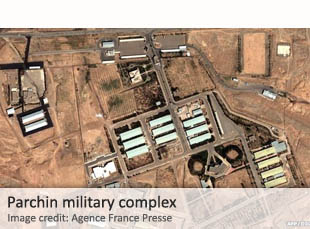
Parchin military complexBy JOSEPH FITSANAKIS | intelNews.org

The government of Iran is refusing to comment on a reported blast at a secretive military facility that some sources say “lit up the sky” last week. The blast is said to have taken place on Sunday night at the Parchin military complex, located approximately 20 miles southeast of Iranian capital Tehran. The semi-official Islamic Republic News Agency (IRNA) reported on Monday that the explosion had been caused by a “fire [that] broke out in an explosive materials production unit” east of Tehran, and that two people had died. Interestingly, however, the news agency did not specify the precise location of the blast, nor did it identify the “explosive materials production unit” in question. There was also no mention of the cause of the fire that allegedly resulted in the blast. A few hours later, the Iranian-language news site SahamNews, which is politically linked to the Iranian opposition, claimed that the blast happened at Parchin and that it was a “massive explosion” that “lit up the evening sky” and caused windows to shatter as far as 9 miles away from the complex. It is worth noting that the blast was reported just hours after Israeli officials accused Iran of conducting nuclear implosion tests at a host of nuclear facilities, including Parchin. Israel is among several countries, including the United States, that have accused Iran of conducting nuclear experimentation at Parchin. The last time that the site was inspected by the International Atomic Energy Agency was in 2005. Since then, Iranian authorities have rejected repeated IAEA requests for access to the site. There are suspicions that the latest explosion may be part of what many suspect is a longstanding campaign of sabotage against the Iranian nuclear program, orchestrated by Israel with the possible cooperation of the US and other countries. The campaign is believed to include psychological operations, sabotage, as well as targeted assassinations of senior Iranian nuclear scientists. Read more of this post