Cyprus issues international arrest warrants for three Israelis wanted for spying

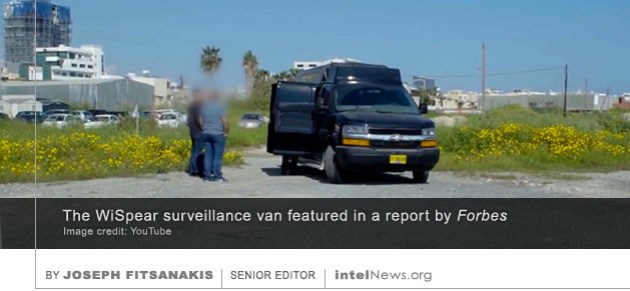
WiSpear surveillance vanThe government of Cyprus has issued international arrest warrants for three Israeli citizens, who are wanted in connection with a private security company that allegedly carried out espionage operations on the Mediterranean island. The warrants were sparked by what has become known in Cyprus as the “spy van case”.
It began on November 16, 2019, when Cypriot police arrested two local men and a woman who were registered as employees of a company called WiSpear. The firm was reportedly registered in Cyprus in 2013 and began offering services relating to communications interception and surveillance in 2017. Its owner is Tal Dilian, an Israeli former intelligence officer. WiSpear provides services to customers in Africa, the Gulf and Southeast Asia, but not to the government of Cyprus, or to Israel.

The company became widely known on the island following a promotional interview given by Dilian to Forbes, during which he allowed a film crew to tour a surveillance van (pictured) belonging to WiSpear. Dilian told the Forbes reporters that the van —a remodeled ambulance— had been fitted with over $9 million worth of surveillance equipment and could intercept Internet-based applications and telephone messages. The report became viral in Cyprus and prompted calls for an investigation into WiSpear.

On Thursday, the Cypriot government issued international arrest warrants for three Israeli citizens, including Dilian and Shahak Avni, a prominent member of Cyprus’ Jewish community. All are believed to be in Israel, and it is doubtful that they will ever be extradited to Cyprus. The Israeli government has not commented on the case. WiSpear said on December 26 that it was “cooperating fully with Cypriot law enforcement”.

Author: Joseph Fitsanakis | Date: 7 January 2020 | Permalink

Denmark arrests 22 in counter-terrorism raids, allegedly with help from Israel

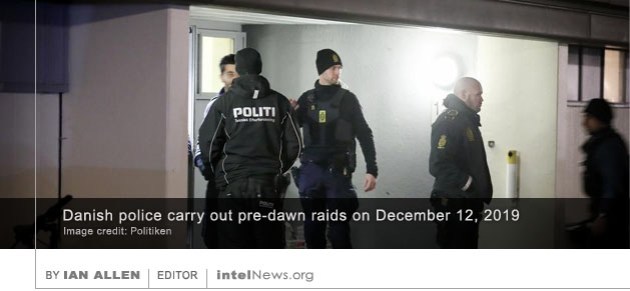
Danish policeLast Thursday Danish authorities arrested 22 terrorism suspects in early morning raids across the country. Reports from Israel suggest that the raids were carried out following a tip from Israeli intelligence. The 22 suspects include men and women. Danish police said they were involved in the final stages of a plot to carry out attacks “in Denmark or abroad”, but have provided no specific information, except to say that the attacks were “thwarted” while they were well underway.
Danish media reported that the early-morning raids by police and intelligence personnel resulted in the arrest of 22 individuals. These have not yet been named in accordance with Denmark’s strict privacy laws. Among them are four men between 21 and 25 years of age, and a 38-year-old woman. All were remanded in a court in Copenhagen on Thursday and Friday of last week. A sixth individual, aged 28, was remanded to custody separately from the other five. His hearing was reportedly held in secret, and no information other than his age and gender has been made public.

The six suspects are accused of trying to build bombs using triacetone triperoxide (TATP) explosive. They are also accused of trying to purchase guns, ammunition and sound suppressors, commonly known as silencers. Danish police said the suspects planned to use the explosives and guns “in connection with one or more terrorist attacks inside Denmark or abroad”. However, no further information has been provided about the targets of the alleged terrorist plot.

Meanwhile on Saturday, Israel’s Channel 12 television claimed that the Danish counter-terrorism raids were sparked by information provided to Danish authorities by the Mossad, Israel’s primary external intelligence agency. The channel, a popular privately owned television station, did not provide evidence of the claim, or any specific information about the alleged intelligence tip.

Danish police said on Monday that 16 of those arrested last week have been released, but remain suspects in the investigation. The remaining six suspects all pleaded not guilty to charges of terrorism on Saturday. They will remain in prison on pre-trial custody while the authorities continue to investigate the alleged terrorist plot.

Author: Ian Allen | Date: 17 December 2019 | Permalink

Turkey offers to send troops to Libya as tensions rise with Greece, Egypt

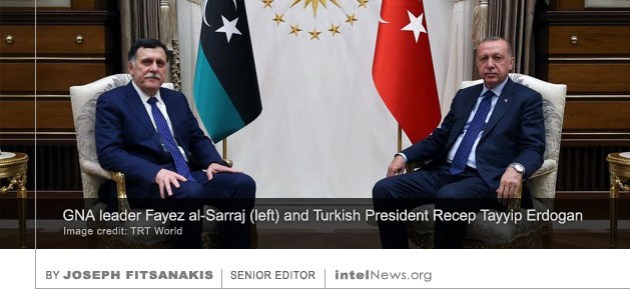
Turkey LibyaTurkish President Recep Tayyip Erdoğan has said his country is prepared to deploy troops to Libya, just days after Ankara surprised analysts by announcing an agreement with the embattled Libyan government in Tripoli. The Turkish-Libyan agreement has spurred angry reactions from Israel, Greece and Egypt, all of which are competing with Turkey for control of newly discovered gas fields in the eastern Mediterranean seabed.
The Turkish-Libyan agreement merges the two countries’ Exclusive Economic Zones (EEZ) and ostensibly prevents other players in the area, including Greece, Egypt, Israel and Cyprus, from drilling for natural gas without the consent of Ankara and Tripoli. However, according to Greece, the agreement disregards the presence of several Greek islands —including the largest one, Crete— in the Turkish-Libyan EEZ. Athens says that it views the Turkish-Libyan agreement as a direct claim against its territory. Last week the Greek government summarily expelled the Libyan ambassador from the country, marking a dramatic deterioration in the historically close relationship between Athens and Tripoli.

To further-complicate matters, several European countries, as well as Russia and the United States, do not support the Tripoli-based Government of National Accord (GNA), with which Turkey has signed its agreement. Instead, they support the Libyan National Army (LNA), which is commanded by Field Marshal Khalifa Haftar, an old adversary of the Libyan leader Muammar al-Gaddafi. Haftar lived in the United States under Washington’s protection for several decades before returning to Libya in 2011. The LNA, which is based in eastern Libya, is also supported by Saudi Arabia, the United Arab Emirates, and other American allies in the Persian Gulf.

It follows that, if Turkey deploys troops to Libya, it may be entering a collision course with several of its North Atlantic Treaty Organization (NATO) allies. Ankara’s move will also be confronted by Russia, which is purported to have troops in eastern Libya. On Tuesday, however, Turkish President Erdoğan seemed determined to proceed with his plan. In a speech at a university in Ankara, the Turkish leader proclaimed that, “if Libya were to make a request, we would send a sufficient number of troops”, adding that “there is no hurdle” to doing so “after the signing of the security agreement” between Ankara and Tripoli.

This is the first time that Turkey has secured an agreement with a regional ally in the matter of energy exploration rights. Previously, Greece, Israel, Egypt and Cyprus struck a deal to coordinate their gas exploration activities, and eventually supply Europe with Israeli and Cypriot natural gas via a projected gas pipeline that would pass through Greece. But the Turkish move raises doubts about the prospects of such a project, with some analysts even speculating whether centuries-old rivals Greece and Turkey may be getting closer to war.

In a speech on Monday, Greek President Prokopis Pavlopoulos warned Ankara that “Greece will defend its borders [and] territory”. Meanwhile European Union leaders met on Monday behind closed doors to discuss the imposition of sanctions on Turkey as punishment for disputing the maritime territorial boundaries of Cyprus, a European Union member.

Author: Joseph Fitsanakis | Date: 11 December 2019 | Permalink

WhatsApp sues Israeli firm for enabling spy attacks on 1,400 users worldwide

NSO GroupThe Facebook-owned company WhatsApp has filed a lawsuit against a leading Israeli technology firm, accusing it of enabling governments around the world to spy on 1,400 high-profile users, including politicians and diplomats. The Reuters news agency said it spoke to “people familiar” with the investigation into the spy scandal, which it says was launched “earlier this year”.
What is interesting about the case, says Reuters, is that a “significant” proportion of the hundreds of WhatsApp users who were targeted by governments worldwide are “high profile” officials. The victims reportedly serve in various government agencies, including the armed forces, of at least 20 countries on five continents. They allegedly include politicians, diplomats, military officers, academics, journalists, lawyers and human-rights activists in countries such as the United States, India, Mexico, Bahrain, the United Arab Emirates and Pakistan.

WhatsApp alleges that the spy activities against these individuals were enabled by NSO Group, an Israeli software development company that specializes in surveillance technologies. The Facebook-owned company alleges that NSO Group specifically developed a hacking platform that allows its users to exploit flaws in WhatsApp’s servers in order to gain access to the telephone devices of targeted individuals. At least 1,400 of WhatsApp’s users had their telephones compromised between April 29 and May 10, 2019, says WhatsApp.

NSO Group, whose clientele consists exclusively of government agencies worldwide, denies any wrongdoing. The company claims that its products are designed to “help governments catch terrorists and criminals”, says Reuters. But WhatsApp and Citizen Lab, a research initiative based at the University of Toronto, which worked with WhatsApp on the NGO Group case, claim that at least 100 of the 1,400 victims were news journalists, political activists and the lawyers who defend them. There was no overlap between ongoing criminal or terrorism investigations and those targeted by NSO Group’s software, they claim.

The names on the list of espionage victims are not known. But Reuters said that, depending on how high-profile the victims are, the WhatsApp-NSO Group spy scandal could have worldwide political and diplomatic consequences.

Author: Joseph Fitsanakis | Date: 01 November 2019 | Permalink

Mossad chief comments on policy of assassinations in rare interview

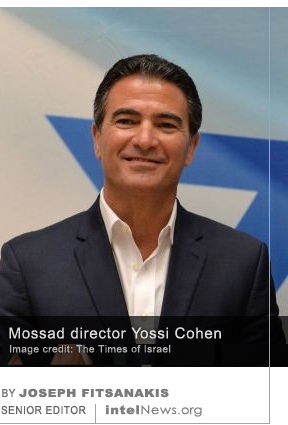
Yossi CohenYossi Cohen, the chief of the Mossad —Israel’s main external intelligence agency— said he has authorized “more than a few” assassinations during his tenure and warned that more may be on the way. Cohen, 57, who took command of the Mossad in 2016, spoke last week to Mishpacha, a magazine aimed at ultra-orthodox Jews. His comments were covered widely by Israeli media over the weekend.
Cohen was asked to respond to recent allegations made by the Iranian government that Israel worked with “Arab countries” to assassinate General Qassem Suleimani, the head of the Quds Force, an elite paramilitary unit in Iran’s Islamic Revolutionary Guard Corps (IRGC). Suleimani claimed that several individuals were arrested last month in connection with the alleged plot. He also said that Israel tried to kill him and Hassan Nasrallah, leader of the Lebanese Hezbollah group, in 2006.

The head of the Mossad told Mishpacha that Suleimani had not “necessarily committed the mistake yet that would place him on the prestigious list of Mossad’s assassination targets”. However, “he knows very well that his assassination is not impossible” because “the infrastructure he built presents a serious challenge for Israel”, said Cohen. Regarding Nasrallah, Cohen said that the Hezbollah strongman “knows we have the option of eliminating him”. When asked why the Mossad had not exercised that option, Cohen said he preferred not to answer.

In regards to Hamas, the Palestinian militant group that controls the Gaza Strip, Cohen admitted that the Mossad has been behind a string of assassinations of Hamas officials around the world in recent years. “If there is one target that we eliminate without hesitation, it is Hamas officials abroad. [These range] from local agents to those who manage acquisitions of weapons pointed towards Israel”, said Cohen. He added that there had been “more than a few assassinations” in recent years, but not all were admitted to by Hamas. “The enemy has changed tactics. It is not quick to attribute assassination to us, for its own reasons”, said the Mossad chief.

Author: Joseph Fitsanakis | Date: 14 October 2019 | Permalink

US and Saudi Arabia ‘suffered intelligence blackout’ during Iran drone strikes: sources

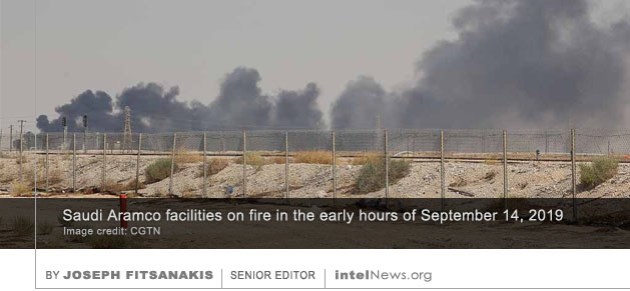
Saudi AramcoSaudi Arabia and the United States suffered “a total and embarrassing [intelligence] failure” in the lead-up to the drone strikes that shut down half of the kingdom’s oil production last month, according to Israeli sources. In the early hours of September 14, missiles struck two refineries belonging to the world’s largest crude oil processing facility in eastern Saudi Arabia. The facilities, which belong to Aramco, Saudi Arabia’s government-owned oil conglomerate, were forced to cease operation so that repairs could be carried out. This drastically reduced Saudi Arabia’s oil production by close to 50 percent, which amounted to a 5 percent drop in global oil production. By Monday morning, global oil prices had seen their most significant one-day surge since the 1991 Gulf War.
Soon after the attacks, Saudi and American officials accused Iran of having launched the missile strikes. But according to Breaking Defense, Riyadh and Washington suffered “a total and embarrassing [intelligence] failure” in the hours prior to and following the attacks. The US-based website cited a number of anonymous Israeli sources, who said that officials in Tel Aviv were surprised by the lack of intelligence in the US and Saudi Arabia about the missile strikes. The Israelis told Breaking Defense that Saudi intelligence agencies “had no idea Iran was planning to attack the kingdom’s oil facilities […]. It seems that the Americans were also in the dark [or that possibly] Washington […] did not share the data in time with the Saudis”, they added.

The above information was allegedly discussed at an emergency meeting of the Israeli defense cabinet on October 6, which included a briefing on the attacks by the Mossad, Israel’s main external intelligence agency. According to the Israeli sources, Mossad officials were quickly able state with high confidence that the missiles had been launched from military bases in southeast Iran or by Iranian militias in Iraq. It was only following an examination of missile fragments that Saudi and American intelligence officers were able to point the finger at Iran, according to Aahron Ze’evi Farkash, former director of the Israeli Military Intelligence Directorate.

Breaking Defense also said that Israeli intelligence analysts were impressed by the precision of the weapons systems used in the Iranian strikes. Additionally, the specific targets of the attacks were selected with the help of “very accurate intelligence”, said the Israeli sources.

Author: Joseph Fitsanakis | Date: 11 October 2019 | Permalink

Israel planted surveillance devices targeting Trump, claims report

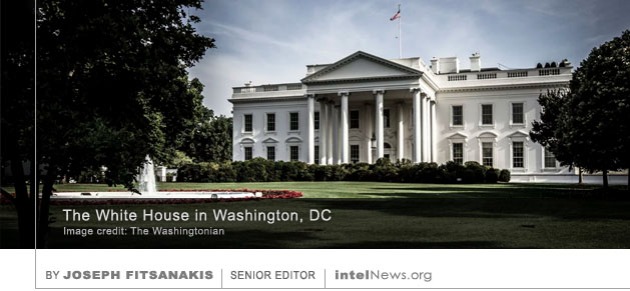
White HouseThe intelligence services of Israel planted surveillance devices around the White House in an attempt to spy on United States President Donald Trump and his senior advisors, according to a report published on Thursday. The report, authored by Politico’s Daniel Lippman, cited three former US officials with knowledge on the matter, “several of whom served in top intelligence and national security posts”, it said.
According to Politico, the Israelis planted International Mobile Subscriber Identity (IMSI) catchers —known in technical-surveillance lingo as “StingRays” after a leading hardware brand. StingRay devices are designed to simulate the activity of legitimate cell towers in order to trick cell phones into communicating with them. That allows StingRay users to monitor the physical whereabouts of targeted cell phones. Some of the more expensive Stingray models can intercept the actual content of telephone conversations and can even plant Trojans on the compromised phones of unsuspecting users.

Politico said that the StingRays found around the White House were of the highest technical sophistication, and were “likely intended” to spy on President Trump, his senior advisers and other close associates. Politico said it had no information on whether the attempt was successful. The spy devices were detected by the Department of Homeland Security (DHS) in 2017 and acknowledged by US government officials in 2018. Senior American intelligence officials allegedly told Politico that an exhaustive two-year investigation into the matter showed “with confidence [that] the Israelis were responsible” for the StingRays.

The investigation was led by the counterintelligence division of the Federal Bureau of Investigation with the help of the DHS and the Secret Service. The National Security Agency and the Central Intelligence Agency are also known to assist such counterintelligence investigations. The devices were disassembled and their technical specifications were carefully inspected to assess their history and origins. Investigators reportedly concluded that very few countries have the technical and financial capabilities to build and plant such devices in the US, and that Israel was the most likely culprit.

Politico also said that some intelligence officials are unhappy about the Trump administration’s lack of response to the alleged spying by Israel. According to the officials, the White House did not file a protest —either publicly or privately— with the Israeli government, and “there were no consequences for Israel’s behavior”.  On Thursday afternoon, the US president voiced skepticism when asked by reporters about the Politico report: “I really would find that hard to believe”, said Trump, adding that his “relationship with Israel has been great”. Meanwhile the office of the Israeli Prime Minister Benjamin Netanyahu dismissed the Politico report as “a blatant lie” and noted that Israel’s spy services had “a directive from the Israeli government not to engage in any intelligence operations in the US”.

Author: Joseph Fitsanakis | Date: 13 September 2019 | Permalink

Shia militia blames US and Israel for mystery explosions throughout Iraq

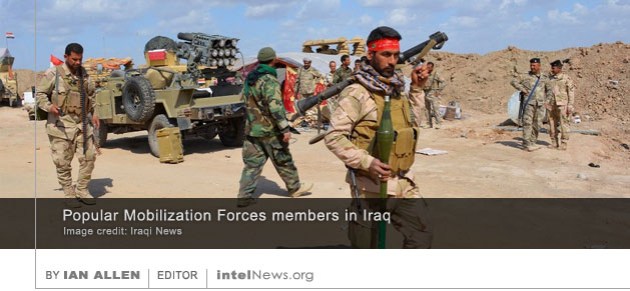
Popular Mobilization ForcesIraq’s largest Shia militia, which controls parts of Iraq’s territory that were aptured from the Islamic State, has accused the United States and Israel for a series of mystery explosions at its arms depots around the country. Much of the territory captured from the Islamic State (known also as the Islamic State of Iraq and Syria, or ISIS) in northern Iraq is currently controlled by the Popular Mobilization Forces (PMF), a collection of around 40 Shia militias consisting of over 150,000 armed fighters. The Iranian-supported PMF proved instrumental in the territorial defeat of ISIS. However, the group’s leadership is ideologically aligned with Iran, and many of its members will not cooperate with the Iraqi Armed Forces because they view them as American-supported.
In the past month, however, there have been at least three mystery explosions at arms depots controlled by the PMF throughout Iraq. On July 19, Arab media reported that a blast killed two Iranian military engineers at a PMF facility. Then on August 12 a massive explosion destroyed part of the al-Saqr military base in Baghdad, killing at least one person and injuring 30. The base reportedly housed an arms depot that was shared by the Shia-dominated Iraqi federal police and the PMF (the two are often indistinguishable in post-ISIS Iraq). On August 20 two more explosions were reported at a PMF arms depot located about 55 miles north of Baghdad. It is not known if anyone was killed or injured in the latest attack. Prior to the August 20 explosions, Iraqi Prime Minister Adil Abdul-Mahdi had banned all unauthorized flights over Iraq in an attempt to prevent further attacks on arms depots. But the move did not prevent yet another mystery attack.

In recent days, Iraq has been rife with rumors and conspiracy theories about who could be behind the attacks. Many are accusing the United States and Israel, while some are blaming ISIS or Iraqi militias who are competing against the PMF for control. A leaked Iraqi government report into the incidents claimed that they were caused by drone strikes. On Wednesday, a spokesman for the PMF said that the attacks had been carried out by Israeli drones with American intelligence support in order to weaken Shia influence in Iraq. When asked about the mystery explosions, Israeli Prime Minister Benjamin Netanyahu said that “Iran has no immunity anywhere […]. We will act and are currently acting against Iran wherever necessary”. Meanwhile, the PMF pledged to use “all means at its disposal to deter and prevent [future] attacks” on its facilities.

Author: Ian Allen | Date: 22 August 2019 | Permalink

Palestinian intelligence report warns of possible uprising in occupied territories

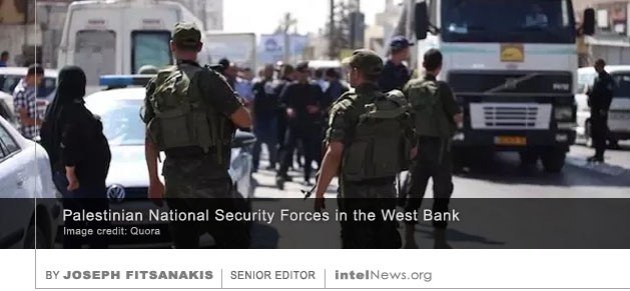
PNA police West BankA leaked report authored by the Palestinian National Authority’s intelligence service warns that economic depression and lack of opportunity may soon spark a popular uprising in the occupied territories. The report was submitted to the PNA’s leadership in early August. It was accessed by Yedioth Ahronoth, Israel’s highest-selling newspaper, which is based in Tel Aviv. It report concludes that if the economic stagnation in the West Bank continues in its present state, and if the negotiations between Israel and the Palestinians remain unproductive, there could be “another breakout of violent uprising” in the West bank, which will likely destabilize the PNA.

The report draws on data collected from interviews conducted with young Palestinians in the West Bank, surveillance of militant groups, interrogations with young militant detainees, as well as opinion trends on social media. Much of the data represents the views of Palestinians who are between the ages of 20 and 30. It suggests that they are angry about the lack of opportunity in their homeland and see no future for themselves and their families. They are therefore susceptible to calls for violent action against Israel and against the leadership of the PNA, the report warns. The PNA is accused by young Palestinians of having failed to receive any concessions from Israel in return for its policies of collaborating with Israeli authorities for nearly a decade. It follows that young Palestinian see “no political benefit” in cooperating with Israeli authorities. At the same time, says the report, young Palestinians in the West Bank view Hamas’ call for violent resistance against Israel in an increasingly favorable light. They believe that exercising pressure on Israel through violence is more likely to draw a positive response from the Jewish state in the form of political recognition and financial aid.

The classified report warns that if the economic stagnation in the West Bank persists, and if young Palestinians continue to perceive the PNA’s cooperation with Israel as unproductive, there will be an increase in “shooting incidents and the use of explosive devices” against Israeli targets. Such actions will be easily facilitated by the widespread black market in weapons and explosives in the region, states the report. It also notes that calls for radical action are not only coming from members of Hamas, but also from younger activists within Fatah, the main political faction that makes up the PNA.

Author: Joseph Fitsanakis | Date: 20 August 2019 | Permalink

Mossad chief sees historic shift of alliances as Arab states side with Israel against Iran

Yossi CohenIn a rare public appearance, the director of the Mossad spy agency said that the Middle East is witnessing a historic shift of alliances as many Arab states are forming tacit pacts with Israel against Iran and its proxies. Yosef “Yossi” Cohen spoke on Monday morning at the Herzliya Conference, a security-themed event organized by the Interdisciplinary Center, a university in Herzliya, just north of Tel Aviv.
In his 40-minute speech Cohen said that the Mossad had identified the present time as “a rare opportunity —perhaps the first in the history of the Middle East— to reach a regional understanding that would lead to an inclusive regional peace agreement” between Israel and most of the Arab states. He justified his reasoning by claiming that many Arab states are siding with Israel to pursue “common interests [such as] the fight against rivals like Iran and jihadist terrorism”. This historic shift in alliances is happening as Israel is enjoying “close relations with the White House” and keeping open “channels of communication with the Kremlin”, said the spy chief. These factors “combine to create what might be a one-time window of opportunity” for Israel to form a strategic alliance with the majority of its Arab neighbors, said Cohen.

The Mossad chief went on to allege that the Islamic Revolutionary Guard Corps (IRGC) were behind the recent bombings of commercial oil tankers in the Persian Gulf. He told the conference that he could “say with certainty that Iran was behind these attacks” and that they were “approved by the Iranian leadership and carried out by the [IRGC]”. Cohen cited “the best sources of Israeli and Western intelligence” but did not provide specific evidence to support his allegation, which Iran denies. Later in his speech, Cohen said that the IRGC and Iranian intelligence agencies had carried out assassinations throughout Europe and had discussed further plans to attack Jewish and Israeli targets in Denmark, Azerbaijan and the North America. “And that is only the tip of the iceberg”, said Cohen, and went on to claim that the IRGC had set up a network of 300 agents in the African continent and was heavily present in Syria, mainly through its Lebanese proxy Hezbollah.

At the conclusion of his speech, the Mossad chief repeated prior warnings by Israeli officials that the Jewish state would never allow the development of an Iranian nuclear arsenal. “Mossad and the State of Israel have not signed the nuclear deal and will do all to ensure Iran will never possess a nuclear arsenal”, said Cohen.

Author: Joseph Fitsanakis | Date: 02 July 2019 | Permalink

Israeli officials announce arrest of alleged deep-cover spy for Iran

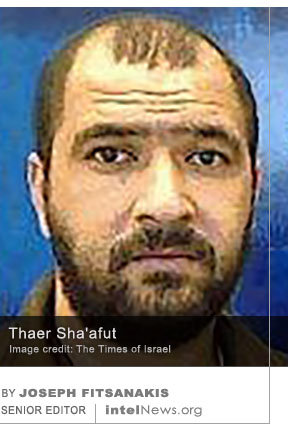
Thaer Sha'afutIsraeli authorities announced on Thursday the arrest of a deep-cover intelligence operative who allegedly attempted to establish a base for Iranian intelligence in Israel and the West Bank, according to news reports from Israel. Shin Bet, Israel’s domestic security and counterintelligence agency, said it arrested Thaer Sha’afut (pictured), a Jordanian national, on espionage charges. The arrest reportedly occurred in April, but was only announced this week. According to Shin Bet officials, Sha’afut was an accredited deep-cover intelligence operative for the Iranian spy services. He was allegedly was commissioned “to carry out missions that were meant to establish a network in Israel and the West Bank, which would be used for covert operations by the Iranians”.
Israeli officials said Sha’afut received instructions from his Iranian handlers to enter Israeli territory between July and August of 2018. After entering Israel, his goal was “to form business ties” in the West Bank and in Israel proper. He planned to do that, said the Shin Bet, by hiring Shiite Muslims to staff a new factory in Jordan and then use the new venture “as an anchor for future Iranian activities in Israel and the West Bank”. These activities included the eventual recruitment of “spies who would help collect intelligence for Iranian interests”, according to court documents. The Shin Bet said that Sha’afut’s handlers were two Arabic-speaking Iranian intelligence officers based in Lebanon and Syria, who went by the names Abu Sadek and Abu Jaffar. They allegedly provided Shafut with “an encrypted communication device”, which he used to arrange clandestine meetings with them throughout 2018 and 2019.

Sha’afut’s Iranian handlers allegedly planned to use him as a conduit for transferring funds to spies in the West Bank and Israel. They had told Sha’afut that Iranian intelligence would make an initial investment of $500,000 in his factory venture in Jordan and to an import-export business, in order to sustain his base of operations, with more funds to follow. Once the factory was set up, Sha’afut was expected to travel clandestinely to Iran in order to complete his training as a deep-cover case officer. Israeli daily Haaretz said on Thursday that Sha’afut was indicted earlier this month by military prosecutors in Jerusalem for “contact with an enemy country, contact with a hostile organization, and conspiracy to funnel money from an enemy entity”.

Author: Joseph Fitsanakis | Date: 21 June 2019 | Permalink

Israel leaked video that brought down Austrian government, says German ex-spy chief

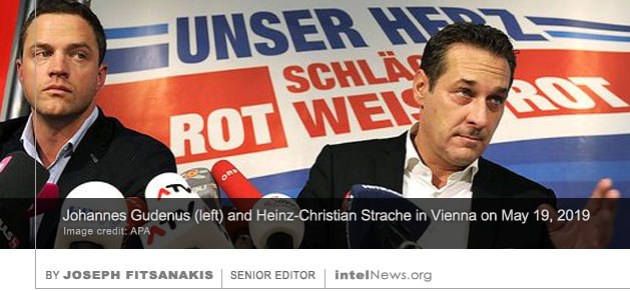
Strache GudenusIsraeli intelligence was likely behind the leaked video that brought down the far-right governing coalition in Austria on Monday, according to the former deputy director of Germany’s spy agency. The surreptitiously recorded video was leaked to two German media outlets on May 17, days before Austrian voters participated in the continent-wide elections for the European Union. In the video, two senior members of Austria’s governing far-right Freedom Party are seen conversing with an unnamed woman posing as a Russian investor. The two men in the video were Heinz-Christian Strache, the the Freedom Party’s leader and until recently Austria’s Vice Chancellor, and Johannes Gudenus, the party’s deputy leader and a member of parliament. In the video, Gudenus and Strache promise to award the woman’s firm state contracts if her uncle —a Russian oligarch— purchases an Austrian newspaper and uses it to support the Freedom Party. The video threw Austria’s political system into disarray and prompted the resignations of both Strache and Gudenus. On Monday, Austria’s Chancellor, Sebastian Kurz, was removed from power during a special parliamentary session in Vienna.

But the question is who leaked the video, and why? In an article in the Cicero, a monthly political magazine based in Berlin, a former senior official in Germany’s Federal Intelligence Service (BND) argues that Israeli intelligence was probably behind the leak. The article’s author is Rudolf Adam, who served as deputy director of the BND from 2001 to 2004, before serving as president of the Federal Academy for Security Policy of the German Ministry of Defense. Adam argues that the actions of Strache and Gudenus, as shown in the leaked video, seem “half mafia-like and half-treasonable”, and that the two should face legal consequences. But he goes on to ask “a far more interesting question”, namely “who is behind this intrigue [and] what were the intentions of its initiators?”. Adam points out that nothing is known about the woman in the video; she reportedly met Gudenus several months before the video was filmed. She posed as the Latvian niece of a Russian oligarch with ties to Russia’s President Vladimir Putin. In exchanges that lasted for several months, the woman told Gudenus that she planned to move with her daughter to Vienna and was interested in investment opportunities. She eventually invited him and Strache to a meeting in a villa in the Spanish resort island of Ibiza. It was there where the video was recorded. Read more of this post

Jonathan Pollard, US spy for Israel, complains of neglect by Israeli state

Jonathan PollardJonathan Pollard, an American who spied on his country for Israel in the 1980s, and is now free after spending 30 years in prison, has spoken of his frustration with the Israeli government, which it claims has forgotten about him. Pollard, a former intelligence analyst for the United States Navy, was released from an American prison in 2015, after serving a lengthy sentence for selling US government secrets to Israel. Throughout Pollard’s time in prison, the government of Israel lobbied for his release, claiming that the convicted spy did not harm American interests, but was simply trying to help Israel. But the US Intelligence Community and successive American presidents consistently rejected Israel’s claims, arguing that Pollard’s activities were severely detrimental to US interests. Pollard was eventually released after serving the entirety of his sentence. Ever since his release, Pollard has been required to wear an ankle monitor at all times. His Internet browsing is strictly regulated by the US government and he is not permitted to leave his New York home after sunset. He is also not permitted to leave the US, and Washington has refused to allow him to move to Israel.

Last week, Israel’s Channel 12 television station aired a rare interview with Pollard, in which the former spy claimed he had been “forgotten” by the Israeli government. Speaking from a restaurant in New York with his wife Esther by his side, Pollard told Channel 12 that no officials from the Israeli government had made contact with him since his release. He added that he felt “there is always something more urgent than me” for the government of Israel, whether it is “the [nuclear] deal with Iran or the [US] embassy’s move to Jerusalem, or the sovereignty of the Golan Heights”. When the Channel 12 reporter asked him whether he was disappointed by Israel’s perceived lack of efforts to bring him to Israel, Pollard replied that he would be “very depressed” if his “faith in God and [his] love for Israel and its people [was not] so strong”. At another point in the interview, Pollard appeared to criticize the Israeli government of Prime Minister Benjamin Netanyahu. “I am very concerned about what this entails for the [government’s] commitment and for [Israel’s] security”, he said. “If you do not care about someone like me, who spent 30 years in prison for the land of Israel and its citizens, how much concern is there for others in the country, [whether they are] soldiers or civilians?”.

In November of 2017, Israel’s Channel 2 television reported that Israeli Prime Minister Netanyahu had asked the United States President Donald Trump to allow Jonathan Pollard to move to Israel. However, despite the popular perception of the Trump administration as strongly pro-Israel, there are no indications that such a move may be taking place any time soon.

Author: Joseph Fitsanakis | Date: 27 May 2019 | Permalink

Intel that prompted US to deploy aircraft carrier to Middle East ‘came from Israel’

USS Abraham LincolnThe sudden decision by the United States to deploy significant firepower to the Middle East was partly in response to intelligence that was given to Washington by Israeli officials, according to a report. On Wednesday, the US announced that the USS Abraham Lincoln carrier strike group had received instructions to sail to the Middle East. The aircraft carrier is reportedly sailing alongside a cruiser and four destroyers, while an unspecified number of B-52 heavy long-range bombers have been ordered to fly to a US military base in Qatar.

Commenting on this last-minute development, US National Security Adviser John Bolton warned Iran that it would face “unrelenting force” if it threatened American interests in the Middle East and beyond. The Chairman of the Joint Chiefs of Staff, General Joseph Dunford, said that the move aimed to “deter Iran […] so that there would be no ambiguity about our preparedness to respond to any threat against our people or partners in the region”. Speaking in Congress, the US Acting Secretary of Defense Patrick Shanahan said that the decision to move a significant amount of firepower to the Middle East came in response to intelligence showing that Iran had “made plans to target US forces in Iraq and elsewhere in the Middle East”. According to ABC News, the intelligence suggested that “Iran or its proxies were planning attacks against US forces in Iraq, Syria and at sea”. But there was no further information reported about the precise nature of the alleged warnings.

Meanwhile, the American news and information website Axios said on Monday that the intelligence that caused Washington’s response was given to the US by Israeli officials. Citing “senior Israeli officials”, the website said that the intelligence given to the US had been gathered “primarily by the Mossad”, Israel’s main external intelligence agency. It added that the information about possible Iranian attacks against the US or its allies in the Middle East was “raised two weeks ago” during closed-door talks at the White House between a US team led by Bolton and an Israeli delegation headed by his Israeli counterpart, Meir Ben Shabbat. The intelligence, said Axios, showed that the US or its allies, including the United Arab Emirates or Saudi Arabia, would be targeted by Iran. The information is “understood to be part of the reason for Bolton’s announcement” this week, said Axios.

Author: Joseph Fitsanakis | Date: 09 May 2019 | Permalink

Israel extends intelligence document classification period to 90 years

MossadThe government of Israel has increased to 90 years the period during which documents belonging to intelligence and security agencies can remain secret, extending it by 20 years. Until last month, government documents produced by Israeli spy agencies, such as its external spy organization, the Mossad, or its domestic security agency, the Shin Bet, could remain hidden from public view for up to 70 years. Last year, however, the administration of Prime Minister Benjamin Netanyahu commissioned a study into the possibility of extending the classification period for such documents. Israel’s Supreme Council of Archives, a body within the Israel State Archives that advises the Office of the Prime Minister on matters of classification, recommended against extending the classification period by more than five years.

Last month, however, Netanyahu rejected the recommendation of the Supreme Council of Archives and managed to pass an amendment to the classification regulations that will keep documents secret for 90 years from now on. The existence of the amendment was revealed publicly for the first time on Monday of this week. In addition to agencies such as the Mossad and the Shin Bet, the extended regulation will also apply to several cyber-oriented military units, as well as to government-run research institutes and commissions, including the Israel Institute for Biological Research and the Israel Atomic Energy Commission. The Israeli newspaper Ha’aretz, which published news of the amended regulation on Tuesday, said that documents from 1949, the year that the Shin Bet and the Mossad were founded, would normally have been published this year. But now they will remain hidden from public view until 2039. Documents relating to more recent cases, such as the death of Ben Zygier, Mossad’s so-called ‘prisoner X’, or the assassination of Hamas arms procurer Mahmoud al-Mabhouh in Dubai, which took place in 2010, will not be released until 2100.

The office of President Netanyahu said on Monday that the goal of the amendment was to protect Israel’s assets and informants who remain alive, or their descendants in foreign countries. It added that many documents produced by Israel’s spy agencies described operational methods that were “still in use today” and could therefore “harm national security”. Last but not least, said the Prime Minister’s Office, some of the information in classified documents “could harm Israel’s foreign relations”. The statement did not elaborate on these claims.

Author: Joseph Fitsanakis | Date: 06 February 2019 | Permalink