Mossad helped Syrian intelligence official flee to Austria, despite alleged crimes
December 2, 2020 Leave a comment
 A SYRIAN INTELLIGENCE OFFICIAL, who was denied political asylum in France due to claims he committed serious war crimes, received protection from Austria with assistance from Israel, according to a report. This was revealed on Sunday by British newspaper The Telegraph, which said it had been given the information by “a judicial source”.
The Syrian official in question is Khaled al-Halabi, a former Brigadier General in the Syrian Military Intelligence Directorate (MID). He served as head of the MID in the northern Syrian city of Raqqa amidst the Syrian Civil War, which began in 2011. But in 2013, as the civil war became fiercer, al-Halabi defected from Syria and took his family to France, where applied for political asylum.
Two years later, al-Halabi was notified by the French authorities that his application for political asylum had been denied, due to serious concerns that he had been involved in criminal acts against opponents of the regime of Syrian President Bashar al-Assad. However, soon after being notified that his application for asylum had been rejected, al-Halabi mysteriously disappeared from France, and was never seen there again.
According to The Telegraph, while waiting for a decision from the French authorities in regards to his application for asylum, al-Halabi was negotiating with the Israeli external intelligence agency, the Mossad. The Israeli spy agency allegedly whisked al-Halabi away from France and took him to nearby Austria. Once there, al-Halabi went into the custody of the Office for the Protection of the Constitution and Counterterrorism (BVT), Austria’s primary intelligence agency.
In December of 2015, al-Halabi was granted asylum in Austria, and today he is believed to live in Vienna, in a four-bedroom apartment provided to him by the Austrian government. The decision by the Austrian government to give the former Syrian spy official asylum made headlines in Austria in October, causing significant controversy. This is because at least one lawsuit has been filed against al-Halabi for his alleged participation in war crimes and crimes against humanity during the Syrian Civil War, according to The Telegraph.
But the alleged involvement of the Mossad in al-Halabi’s case was not known until last Sunday. If true, the Mossad’s role in this case could signify that al-Halabi had established a relationship with the Israeli spy agency prior to his defection from Syria in 2013. According to the Austrian press, al-Halabi denies that he was involved in war crimes and crimes against humanity.
► Author: Joseph Fitsanakis | Date: 02 December 2020 | Permalink
 REPORTS IN BRITAIN AND Israel claim that Iranian authorities have visually identified the assassins who were allegedly involved in the killing of Mohsen Fakhrizadeh, a nuclear scientist believed to have led Iran’s nuclear program. Fakhrizadeh was a brigadier general in the Islamic Revolutionary Guard Corps (IRGC), Iran’s elite paramilitary force. He was accused by the United States and Israel of leading the Islamic Republic’s nuclear weapons program, whose existence Tehran strongly denies.
 A UNITED STATES NAVY analyst who spent 30 years in prison after being convicted of spying on the United States for Israel, is expected to receive a hero’s welcome in Israel in the coming days, after the administration of President Donald Trump lifted his parole restrictions that prevented him from leaving the country. Jonathan Pollard, a former intelligence analyst for the United States Navy, was
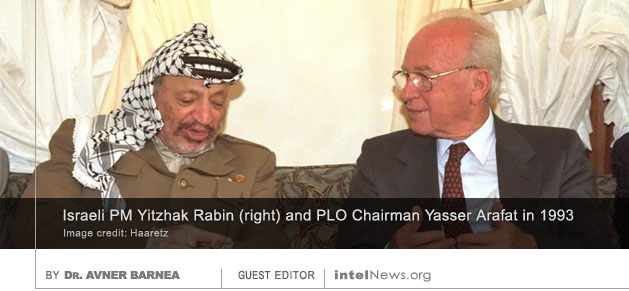

 On the 20th anniversary of the outbreak of the second intifada (October 2000), the debate arises again in Israel as to whether the Palestinian move was an initiative of Chairman Arafat and the Palestinian Authority or whether it was a spontaneous evolution on the Palestinian side that largely surprised not only Israel but also the Palestinians.
 Intelligence insiders, including a former senior Central Intelligence Agency operations officer who spent decades in the Middle East, have described the establishment of official relations between Israel and some Gulf States as “the biggest change in the region in decades”.
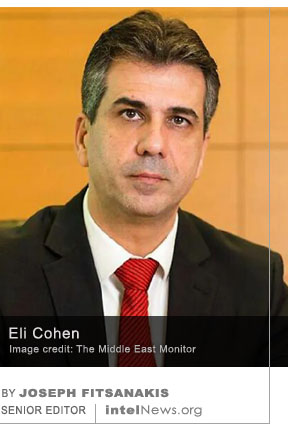 Israel’s minister of intelligence has said Bahrain and Oman could follow the United Arab Emirates in establishing diplomatic relations with Israel, following last week’s historic announcement. Israel said on Thursday that the UAE had
 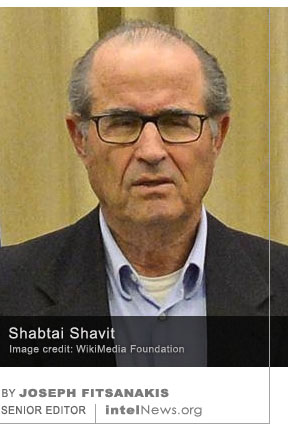 Shabtai Shavit, one of the longest-serving directors of the Israeli spy agency Mossad, has said that Israel and the world cannot stop Iran from developing a nuclear arsenal, and should focus instead on establishing a deterrence mechanism. Shavit, who is now 80, rose through the ranks of the secretive intelligence agency and became its director in 1989, under Labor Party leader Yitzhak Rabin. He stepped down in 1996 and was succeeded by Danny Yatom.
 There is growing speculation that Israel’s intelligence services may be behind a spate of blasts that have damaged military and civilian industrial sites in Iran in recent days. Citing a “Middle Eastern intelligence official”, The New York Times
  • Russian spy chief in rare interview with the BBC. In an exclusive








Isaac Shoshan, Israeli undercover operative and case officer, dead at 96
January 6, 2021 by intelNews 3 Comments
In 1942, Shoshan, a Syrian Jew, traveled for the first time from his native Aleppo to Palestine, which was then under a British mandate. The 18-year-old was soon recruited by the Palmach, the intelligence wing of the Haganah, an armed underground Zionist organization. He carried out undercover work under the Palmach’s so-called ‘Arab Section’, or ‘Arab Platoon’, which consisted of Zionist paramilitaries and intelligence collectors who had grown up speaking Arabic.
After undergoing Islamic religious and cultural training, Shoshan participated in a Palmach operation to kill Sheikh Nimr al-Khatib, in early 1948. Al-Khatib was a Palestinian warlord that the Haganah feared would lead an Arab insurrection against Israel after the impending British withdrawal from Palestine. Although the assassination operation failed, al-Khatib was seriously injured and effectively incapacitated for the rest of his life.
Shoshan was then tasked with carrying out operations in several Arab countries, posing as an Arab. His base was Beirut, where he operated a taxi and worked at a kiosk as a cover. His activities included an elaborate assassination operation against Lebanon’s Prime Minister, Riad al-Suhl, which was aborted at the last minute by the Israeli leadership.
In the mid-1950s, Israeli intelligence disbanded its Arab units, following several failed operations, such as the so-called ‘Lavon affair’, which led to the arrests and executions of some of its undercover operatives. At that time, Shoshan was recalled to Israel, where he began to work as a case officer, with occasional undercover trips abroad, during which he posed as an Arab. He retired in 1982, but continued to carry out contracting work for the Mossad and other Israeli intelligence agencies until the late 1980s.
► Author: Joseph Fitsanakis | Date: 05 January 2021 | Permalink
Filed under Expert news and commentary on intelligence, espionage, spies and spying Tagged with Haganah, Isaac Shoshan, Israel, Mossad, News, non-official-cover, obituaries, Palmach