December 11, 2019
by Joseph Fitsanakis
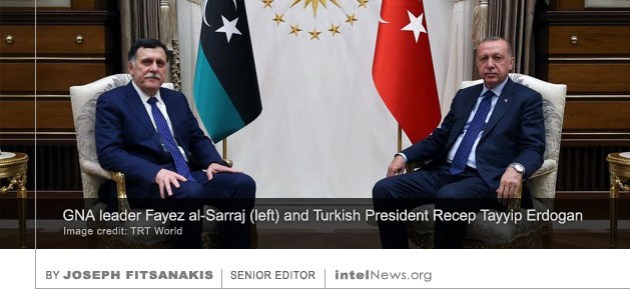 Turkish President Recep Tayyip Erdoğan has said his country is prepared to deploy troops to Libya, just days after Ankara surprised analysts by announcing an agreement with the embattled Libyan government in Tripoli. The Turkish-Libyan agreement has spurred angry reactions from Israel, Greece and Egypt, all of which are competing with Turkey for control of newly discovered gas fields in the eastern Mediterranean seabed.
The Turkish-Libyan agreement merges the two countries’ Exclusive Economic Zones (EEZ) and ostensibly prevents other players in the area, including Greece, Egypt, Israel and Cyprus, from drilling for natural gas without the consent of Ankara and Tripoli. However, according to Greece, the agreement disregards the presence of several Greek islands —including the largest one, Crete— in the Turkish-Libyan EEZ. Athens says that it views the Turkish-Libyan agreement as a direct claim against its territory. Last week the Greek government summarily expelled the Libyan ambassador from the country, marking a dramatic deterioration in the historically close relationship between Athens and Tripoli.
To further-complicate matters, several European countries, as well as Russia and the United States, do not support the Tripoli-based Government of National Accord (GNA), with which Turkey has signed its agreement. Instead, they support the Libyan National Army (LNA), which is commanded by Field Marshal Khalifa Haftar, an old adversary of the Libyan leader Muammar al-Gaddafi. Haftar lived in the United States under Washington’s protection for several decades before returning to Libya in 2011. The LNA, which is based in eastern Libya, is also supported by Saudi Arabia, the United Arab Emirates, and other American allies in the Persian Gulf.
It follows that, if Turkey deploys troops to Libya, it may be entering a collision course with several of its North Atlantic Treaty Organization (NATO) allies. Ankara’s move will also be confronted by Russia, which is purported to have troops in eastern Libya. On Tuesday, however, Turkish President Erdoğan seemed determined to proceed with his plan. In a speech at a university in Ankara, the Turkish leader proclaimed that, “if Libya were to make a request, we would send a sufficient number of troops”, adding that “there is no hurdle” to doing so “after the signing of the security agreement” between Ankara and Tripoli.
This is the first time that Turkey has secured an agreement with a regional ally in the matter of energy exploration rights. Previously, Greece, Israel, Egypt and Cyprus struck a deal to coordinate their gas exploration activities, and eventually supply Europe with Israeli and Cypriot natural gas via a projected gas pipeline that would pass through Greece. But the Turkish move raises doubts about the prospects of such a project, with some analysts even speculating whether centuries-old rivals Greece and Turkey may be getting closer to war.
In a speech on Monday, Greek President Prokopis Pavlopoulos warned Ankara that “Greece will defend its borders [and] territory”. Meanwhile European Union leaders met on Monday behind closed doors to discuss the imposition of sanctions on Turkey as punishment for disputing the maritime territorial boundaries of Cyprus, a European Union member.
► Author: Joseph Fitsanakis | Date: 11 December 2019 | Permalink
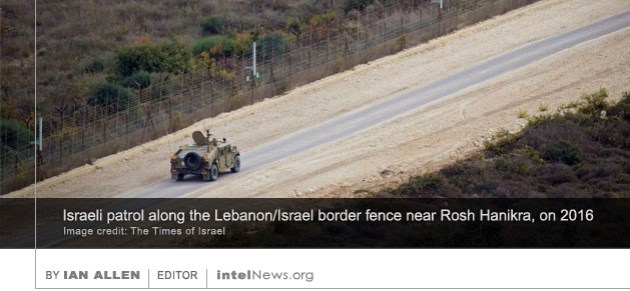 • State-level espionage on EU a ‘very high threat’ says report. The most successful attempts of espionage at a top EU institution are state sponsored, according to an internal document produced by a subcommittee of the European Council, which is composed of heads of state or government of all European Union member-states. The restricted document presents an analysis of threats to the security of information at the General Secretariat of the Council.
 •
• 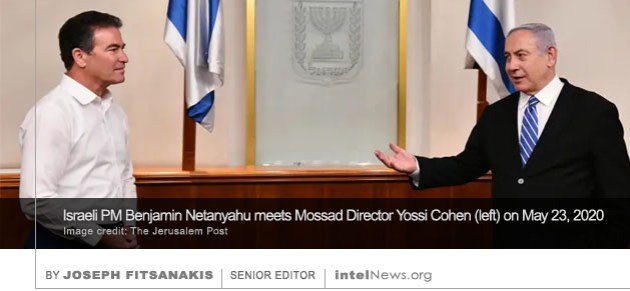 The embattled Prime Minister of Israel, Benjamin Netanyahu, met publicly with the Director of the Mossad, Yossi Cohen, and thanked him for leading the country’s procurement efforts during the COVID-19 crisis. The meeting was a rare public acknowledgement of the central role that the secretive spy agency played during the pandemic.
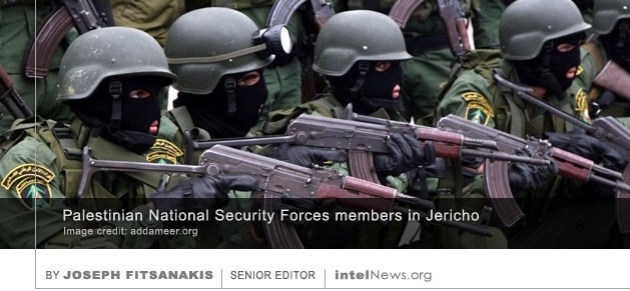 The Palestinian Authority has announced an immediate cessation to all intelligence and security ties with Israel and the United States. The announcement, made on Thursday by Palestinian Authority President Mahmoud Abbas, marks the strongest response so far by the Fatah-dominated administration to the Israeli government’s plan to annex large parts of the occupied West Bank.
 The intelligence agencies of Israel are playing an increasingly important role in the Jewish state’s effort to combat the effects of the novel coronavirus pandemic in its territory. Israel’s intelligence agencies are known to be very secretive, but the government has gone out of its way to
  The government of Cyprus has issued international arrest warrants for three Israeli citizens, who are wanted in connection with a private security company that allegedly carried out espionage operations on the Mediterranean island. The warrants were sparked by what has become known in Cyprus as the “spy van case”.
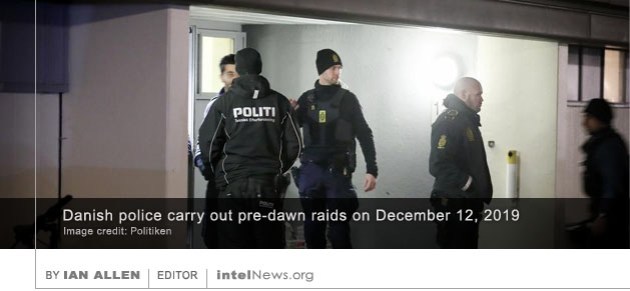 Last Thursday Danish authorities arrested 22 terrorism suspects in early morning raids across the country. Reports from Israel suggest that the raids were carried out following a tip from Israeli intelligence. The 22 suspects include men and women. Danish police said they were involved in the final stages of a plot to carry out attacks “in Denmark or abroad”, but have provided no specific information, except to say that the attacks were “thwarted” while they were well underway.
 The Facebook-owned company WhatsApp has filed a lawsuit against a leading Israeli technology firm, accusing it of enabling governments around the world to spy on 1,400 high-profile users, including politicians and diplomats. The Reuters news agency
 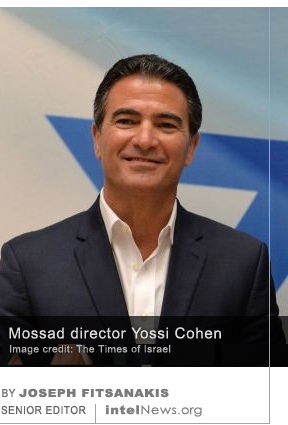 Yossi Cohen, the chief of the Mossad —Israel’s main external intelligence agency— said he has authorized “more than a few” assassinations during his tenure and warned that more may be on the way. Cohen, 57, who took command of the Mossad in 2016, spoke last week to Mishpacha, a magazine aimed at ultra-orthodox Jews. His comments were
 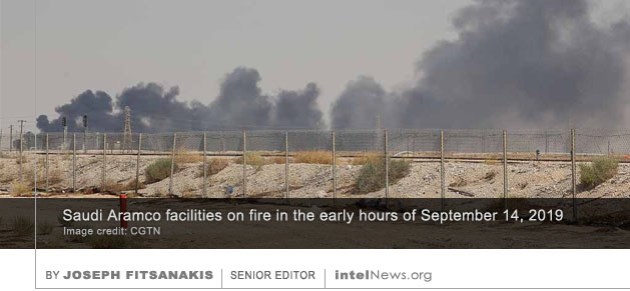 Saudi Arabia and the United States suffered “a total and embarrassing [intelligence] failure” in the lead-up to the drone strikes that shut down half of the kingdom’s oil production last month, according to Israeli sources. In the early hours of September 14, missiles
 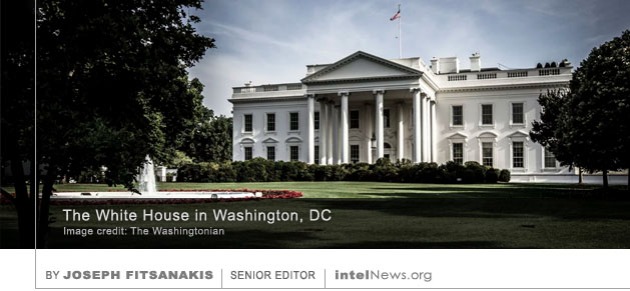 The intelligence services of Israel planted surveillance devices around the White House in an attempt to spy on United States President Donald Trump and his senior advisors, according to a report published on Thursday. The
 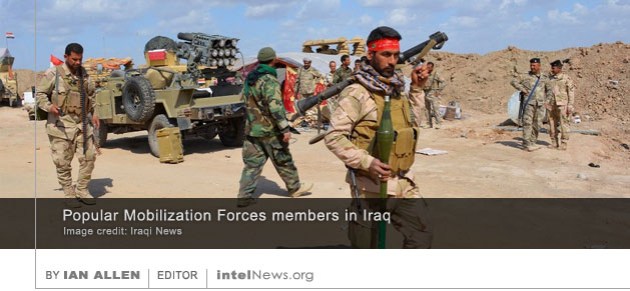 Iraq’s largest Shia militia, which controls parts of Iraq’s territory that were aptured from the Islamic State, has accused the United States and Israel for a series of mystery explosions at its arms depots around the country. Much of the territory captured from the Islamic State (known also as the Islamic State of Iraq and Syria, or ISIS) in northern Iraq is currently controlled by the Popular Mobilization Forces (PMF), a collection of around 40 Shia militias consisting of over 150,000 armed fighters. The Iranian-supported PMF proved instrumental in the territorial defeat of ISIS. However, the group’s leadership is ideologically aligned with Iran, and many of its members will
 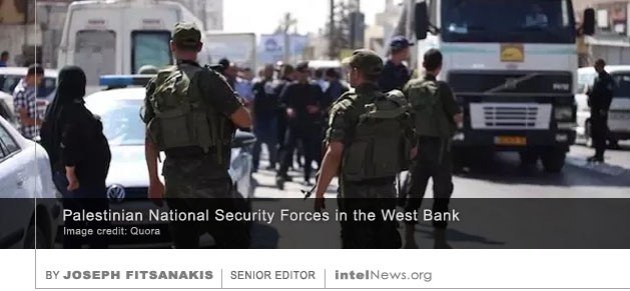 A leaked report authored by the Palestinian National Authority’s intelligence service warns that economic depression and lack of opportunity may soon spark a popular uprising in the occupied territories. The report was submitted to the PNA’s leadership in early August. It was accessed by Yedioth Ahronoth, Israel’s highest-selling newspaper, which is based in Tel Aviv. It






 intelNews.org
Researchers claim discovery of remote eavesdropping method using light bulbs
June 15, 2020 by Joseph Fitsanakis 1 Comment
The announcement was made by Ben Nassi, Yaron Pirutin and Boris Zadov, who work at the Ben-Gurion University of the Negev and the Weizmann Institute of Science, near Tel Aviv. The three researchers said they used a low-cost telescope, which they placed nearly 100 feet from a target room containing a commercially available standard light bulb. They then placed each telescope behind a $400 electro-optical sensor. The goal of the contraption was to measure the minuscule changes in light output from the bulb, which are caused by sound vibrations off the bulb’s surface.
The electrical signals captured by the telescopes were digitized using commercially available analog-to-digital converters, before being transferred onto a laptop. The researchers then used commercially available software to filter out noise, and were gradually able to reconstruct clearly audible recordings of the sounds inside the target room. They claim that the resulting recording is clearly audible and can even be transcribed using Google speech-to-text software.
The three Israeli researchers say they now plan to present their findings at the Black Hat security conference in August, which will be held virtually due to health concerns caused by the coronavirus pandemic. Speaking to Wired magazine last weekend, they said that their goal is “not to enable spies or law enforcement, but to make clear to those on both sides of surveillance what’s possible”. “We’re not in the game of providing tools”, they said.
► Author: Joseph Fitsanakis | Date: 15 June 2020 | Permalink
Filed under Expert news and commentary on intelligence, espionage, spies and spying Tagged with academic research, Black Hat Technical Security Conference, eavesdropping, Israel