Israeli team spotted in Gaza was installing advanced surveillance system, says Hamas

IDF Gaza Strip HamasAn undercover Israeli team that clashed with Hamas in Gaza on November 11 —an incident that brought the region to the brink of war— was installing an advanced surveillance system, according to Palestinian sources. Local media reports said that the Israeli undercover team —believed to be members of the Israel Defense Forces (IDF)— killed seven members of Izz ad-Din al-Qassam Brigades, the military arm of Hamas’ armed wing. The IDF troops eventually escaped into Israel with the help of air support, having lost one team member. The incident was followed by a barrage of nearly 500 rockets and mortars fired from the Gaza Strip into Israel. The Israelis responded by firing more than 160 missiles that fell throughout the Palestinian enclave. Hostilities were halted on November 13, when Hamas declared a unilateral ceasefire brokered by Egypt. The incident prompted the resignation of Israel’s Defense Minister, Avigdor Liberman, and may bring about early parliamentary elections in the Jewish state.
In the ensuing political crisis, little has been said about the reason for the Israeli undercover incursion into Gaza. The IDF has refused to comment on the team’s mission, admitting only that its troops “operated […] in the Gaza Strip”. It is believed that the members of the undercover team were dressed in civilian clothes and that at least two of them were disguised as women. After entering Gaza in a civilian Volkswagen vehicle, they drove to Khan Yunis, a city in the south of the Strip, near the Egyptian border. It was there that they were discovered by the al-Qassam Brigades, who stopped them at a checkpoint, asking for identification. The Israeli team killed at least one Palestinian at the checkpoint by shooting him with a silenced gun. Following a high-speed car chase, they left via helicopter after their pursuers were killed by Israeli tank and aircraft fire. Their abandoned Volkswagen car was then blown up by an Israeli fighter jet.

Speaking on Saturday at a media conference held in Gaza City, and aired live on the Hamas-affiliated Al-Aqsa TV, Hamas’ Gaza City Deputy Chief Khalil al-Hayya claimed that the Israeli undercover incursion was significant. Had it been successful, said al-Hayya, the IDF would have “achieved a major security breakthrough” by installing a new, state-of-the-art surveillance system. Had it been able to “install the surveillance equipment”, the undercover team would have given Israel the ability “to kill, hack and abduct”, and it would have “possibly made it easy for [Israel] to discover tunnels and other” activities pursued by Hamas, according to the Palestinian side. Video footage aired by Al-Aqsa TV on Sunday showed what the television station said was remnants of “surveillance devices” left behind by the IDF undercover team. Al-Hayya finished his statement on Saturday with a warning, saying that “penetrating the security of the Gaza Strip will not be an easy task”.

Author: Ian Allen | Date: 19 November 2018 | Permalink

Iran has clandestine missile factories in Lebanon, claims Israel’s ex-spy chief

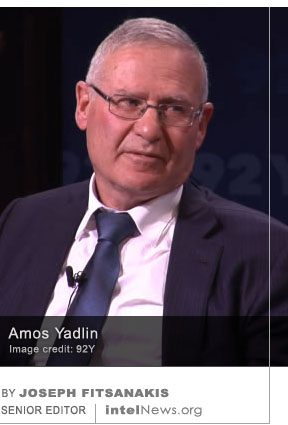
Amos YadlinThe government of Iran is smuggling parts for ballistic missiles to Lebanon, where they are secretly assembled in clandestine factories operated by the Shiite militant group Hezbollah, according to Israel’s former spy chief. For several months now, the international news agency Reuters has been claiming that Tehran has transported short-range ballistic missiles to secret bases controlled by pro-Iranian militias in Iraq. Iran’s move was aimed at “deterring attacks on [Iran’s] interests in the Middle East and to give it the means to it reginal foes”, said Reuters, citing “Iranian, Iraqi and Western sources”. Both Iran and Iraq denied the Reuters report.
In September, another report, citing “Western intelligence sources”, said that Iran had begun smuggling parts of short-range ballistic missiles to Hezbollah-controlled areas of Lebanon, using commercial flights. The report pointed to at least two flights that are suspected by Western intelligence agencies of having illegally transported precision weapon parts to Lebanon. Both flights were operated by Qeshm Fars Air, a company believed to be used by Iran’s Islamic Revolutionary Guard Corps (IRGC). Members of the IRGC, arguably the most loyal branch of the Iranian military, are selected on the basis of their ideological commitment to the defense of the 1979 Islamic Revolution. The two flights identified in the report departed from commercial and military airports in Tehran and landed in Lebanon after taking “uncharacteristic flight paths” through Syria, said Western intelligence sources.

On Sunday, Israel’s highest-circulation newspaper, Yedioth Ahronoth, carried an interview with the former director of the Jewish state’s Military Intelligence Directorate, Major General (ret.) Amos Yadlin. Yadlin, who also served as Israel’s military attaché in Washington, said that Iran used to hide ballistic missile parts in Syria, hoping to establish de facto missile bases there. However, Tehran’s plan suffered a major setback last May, said Yadlin, when Israel’s air force destroyed approximately 50 targets inside Syria, including —according to Yadlin— Iranian missile factories. Since then, he said, Tehran has been relocating its missile factories to Lebanon, believing that Israel will not attack its neighbor to the north. But Yadlin, who is a known supporter of left-of-center parties in Israel, and a proponent of the two-state solution to the Palestinian problem, argued that Israel should consider attacking Iran’s military factories in Lebanon. The Jewish state faces two choices, said Yadlin: “to strike [Lebanon], not necessarily by air”, or to allow Hezbollah to acquire precision missiles. “Israel will not accept this change”, he added.

Author: Joseph Fitsanakis | Date: 22 October 2018 | Permalink

Syrians accuse Israel of assassinating top missile scientist in Hama province

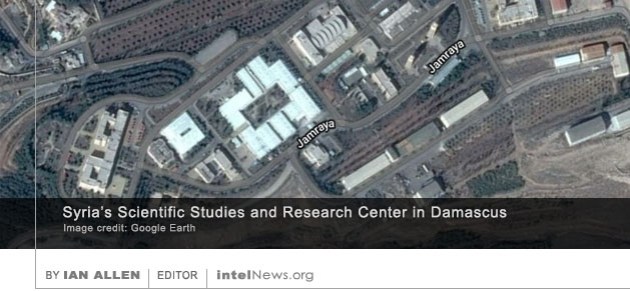
Syrian Scientific Studies and Research CenterOne of Syria’s leading pro-government newspapers has said that Israel was behind a bomb blast in Hama province that killed a senior scientist working for the country’s missile program. Aziz Azbar was reportedly a senior research director at the Syrian Scientific Studies and Research Center, known as CERS. The Damascus-based agency is thought to be at the center of the Syrian government’s formidable chemical weapons program. Last year, the United States Department of the Treasury imposed economic sanctions on nearly 300 CERS employees, after Washington accused them of being directly responsible for the Syrian government’s repeated use of chemical weapons against rebels and civilians. The European Union, as well as the French and British governments, also imposed sanctions on CERS and its staff.

According to Syrian media, Azbar specialized in developing and maintaining rocket systems in the city of Masyaf, located about 160 miles north of Damascus, where CERS maintains a research facility. He reportedly died last Saturday night when his car suddenly blew up. According to some reports, the blast originated from a bomb that had been placed in the headrest of his car seat and was detonated remotely. His driver was also killed in the blast, according to Syrian media reports. An insurgent group calling itself the Abu Amara Battalions, which is linked with the Sunni Levant Front in Syria’s Aleppo province, issued a statement claiming responsibility for Azbar’s killing. The Abu Amara Battalions have previously issued similar statements after reportedly assassinating Syrian government officials or militia commanders.

However, on Sunday Syria’s al-Watan newspaper said that the Israeli intelligence agency Mossad was responsible for Azbar’s death. The Syrian scientist was “a person of the utmost interest to Israel” said the paper, because of his direct connection to Damascus’ Russian- and North Korean-built Scud missile arsenal. However, officials in Israel refused to acknowledge that Tel Aviv had any connection with Azbar’s killing. “Every day in the Middle East there are hundreds of explosions and settling of scores”, said Israel’s Defense Minister Avigdor Liberman. “Every time they try to pin the blame on [Israel], so we won’t take this [latest accusation] too seriously”, he added. The Syrian government has not made any formal statements regarding Azbar’s death.

Author: Ian Allen | Date: 06 August 2018 | Permalink

Israel says it foiled Iranian-sponsored bomb attack in France

MossadIsrael helped foil an alleged Iranian-sponsored bomb attack in Paris, which involved arrests of several Iranian agents and at least one diplomat in France, Belgium and Germany, according to media reports. As intelNews reported earlier this month, the arrests began on June 30, when members of Belgium’s Special Forces Group arrested a married Belgian couple of Iranian descent in Brussels. The couple were found to be carrying explosives and a detonator. On the following day, July 1, German police arrested an Iranian diplomat stationed in Iran’s embassy in Vienna, Austria. On the same day, a fourth person, who has not been named, was arrested by authorities in France, reportedly in connection with the three other arrests.

All four individuals appear to have been charged with a foiled plot to bomb the annual conference of the National Council of Resistance of Iran (NCRI) that took place on June 30 in Paris. The NCRI is led by Mujahedin-e Khalq (MEK), a militant group with roots in radical Islam and Marxism. The MEK was designated as a terrorist group by the European Union and the United States until 2009 and 2012 respectively. But it has since been reinstated in both Brussels and Washington, reportedly because it provides the West with a vehicle to subvert the Iranian government.

On Thursday, authorities in Israel announced the lifting of a blanket censorship decree that prevented local media from discussing the country’s role in helping the Europeans foil the alleged bomb attack in Paris. According to Israel’s Channel 2, a private television station based in Jerusalem, the Iranian attack was prevented after the Israeli agency Mossad detected the whereabouts of several suspects involved in it. The Mossad then supplied Germany, Belgium and France with intelligence that led to the arrests of some of those suspects. However, Channel 2 said that the Israeli government did not give a reason for the initial censorship imposed on the country’s media, nor did it explain why it had decided to lift it. On July 4, Israeli Prime Minister Benjamin Netanyahu appeared to hint that Israel had a role in the foiling of the alleged bomb attack in Paris. Speaking during a commemoration ceremony in Acre, Israel, Netanyahu said it was “no coincidence” that the attack in Paris had been stopped. But the Israeli leader did not expressly indicate that the Mossad had a role in the operation.

Following news of the arrests in Europe, the Iranian government said that it had no connection to the alleged plot in Paris and called the incident a “false flag” operation staged by Tehran’s enemies at home and abroad.

Author: Joseph Fitsanakis | Date: 20 July 2018 | Permalink

North Korea asked Israel for $1 billion to stop giving missile technology to Iran

Thae Yong-HoNorth Korea offered to stop selling missile technology to Iran and other enemies of Israel in exchange for $1 billion in cash from the Jewish state, according to former senior North Korean diplomat who has now defected. The account of the offer can be read in Password from the Third Floor, a book published earlier this year by Thae Yong Ho. Thae, a member of a prominent North Korean family, defected with his wife and children in 2016, while he was serving as a senior member of the diplomatic staff of the North Korean embassy in London. News of Thae’s defection emerged on August 16, 2016, when a South Korean newspaper reported that he had disappeared from London after having escaped with his family “to a third country”. Thae later emerged in Seoul, from where he publicly denounced the North Korean regime.
Now Thae has written a book about his experiences as a North Korean diplomat from a family that is close to the country’s ruling Kim dynasty. In his memoir, Thae claims that he acted as a translator during a series of meetings between Son Mu Sin and Gideon Ben Ami, respectively North Korea’s and Israel’s ambassadors to Sweden. The alleged meetings took place in secret in the winter of 1999 in Stockholm, says Thae. During the first meeting, Son allegedly told Ben Ami that Pyongyang had a series of agreements to sell ballistic missile technology and know-how to Israel’s adversaries, such as Syria, Pakistan and Iran. However, the North Korean government would be willing to scrap the agreements in exchange for $1 billion in cash from Israel, said Son. Ben Ami reportedly told his North Korean counterpart that he would pass along his offer to the Israeli government. Three days later, says Thae, the two men held another secret meeting, during which the North Korean ambassador was told that Israel was not willing to pay Pyongyang $1 billion in cash. However, it could offer humanitarian aid of equal value. But according to Thae the North Koreans refused and “the talks ended without an agreement”.

It is believed that North Korea then went ahead and supplied both Syria and Iran with missile and nuclear technology. On Sunday, The Wall Street Journal reported that it contacted the government of Israel with several questions stemming from Thae’s account of the alleged diplomatic exchange of 1999. However, it received no response. The paper also tried to elicit responses from Ben Ami and Son, but had no success. According to The Journal, Ben Ami said during a television interview last week that he held three meetings with a group of North Korean officials in 1999. But he did not name the diplomats, nor did he discuss the subject of his conversations with them.

Author: Joseph Fitsanakis | Date: 10 July 2018 | Permalink

Israel charges former cabinet minister with spying for Iran

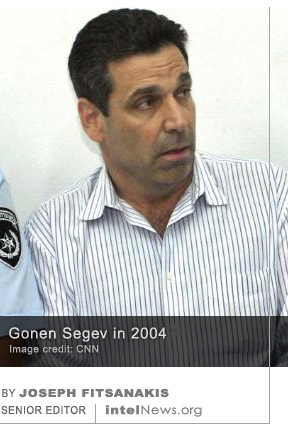
Gonen SegevIsrael has charged Gonen Segev, who served as the Jewish state’s Minister of Energy and Infrastructure, with spying for its archenemy, Iran. Segev, 62, was reportedly detained last month during a trip to Equatorial Guinea following a request by Israeli officials. He was then extradited to Israel and arrested as soon as he arrived in Tel Aviv last month, according to a statement by the Shin Bet, Israel’s domestic security service. On Monday it emerged that Israeli authorities had imposed a gag order on the case, forbidding Israeli media from reporting any information about it. The order appears to have now been lifted.

In 1992, when he was 35, Segev was elected as one of the Knesset’s youngest members, representing the conservative Tzomet party. Initially an opposition Knesset member, Segev eventually left Tzomet and joined a governing coalition with the Labor Party, in which he served as Minister of Energy and Infrastructure. After exiting politics, Segev, who is a medical doctor by training, became a businessman and traveled frequently abroad. But in 2004 he was arrested on a flight from Holland, while reportedly trying to smuggle several thousand ecstasy pills into Israel. He was jailed for five years but was released from prison in 2007, after a commendation for good conduct. Shortly after his release, Segev moved to the Nigerian city of Abuja, where he practiced medicine. It was there, the Shin Bet claims, that he was recruited by Iranian intelligence.

In a statement released on Monday, the Shin Bet said that Segev had admitted being in regular contact with Iranian intelligence agents in Nigeria and other countries around the world. He is reported to have said that he was given a fake passport by his handlers, which he used to visit Iran on two separate occasions in order to hold secret meetings with Iranian intelligence officers. He also traveled to several other countries in order to meet with his Iranian handlers and hand them information about Israel’s energy sector and the location of energy-related security sites in the country. The Shin Bet statement added that Segev introduced his Iranian handlers —who posed as foreign businessmen— to Israeli security officials on several occasions.

It is believed that Segev appeared before a court in Jerusalem on Friday. He was charged with “assisting an enemy in wartime” and with “carrying out espionage against the State of Israel”. The judge also charged him with numerous instances of transmitting classified information to a foreign power.

Author: Joseph Fitsanakis | Date: 19 June 2018 | Permalink

Israel has secretly worked with Emirates against Iran for decades, report alleges

Mohammed bin Rashid EmiratesA lengthy exposé by a leading American newsmagazine has claimed that Israel and the United Arab Emirates, two countries that officially have no relations, have been secretly collaborating for more than two decades. Their secret cooperation has been extremely tight and has included clandestine weapons sales and intelligence-sharing, according to the exposé, which was published on the website of The New Yorker on Monday and will feature in the magazine’s print edition on June 18. The lengthy piece, which deals with the changing geopolitics of the Middle East, is written by Adam Entous, national security correspondent for The Washington Post, who has previously reported for more than two decades for Reuters and The Wall Street Journal.
Officially, Israel and the UAE have never had bilateral relations. The Emirates, an Arab federal state ruled through an absolute monarchical system, does not recognize Israel as a country. Consequently, the two Middle Eastern states have no official diplomatic, economic or military relations. But in his lengthy article published on Monday, Entous claims that Israeli and Emirati officials have been meeting in secret for at least 24 years. He alleges that the first clandestine meeting between the two sides happened in 1994 in Washington, after Abu Dhabi sought to purchase a number of American-made F-16 fighter jets. The US warned the UAE that Israel would veto the deal, fearing that these fighter jets in the hands of Arabs may eventually be used against it. But Israel did not pose a veto. Motivated by the Oslo I Accord, which it had signed the previous year, the Israeli government of Prime Minister Yitzhak Rabin secretly reached out to the Emiratis and offered “to discuss the matter directly” with them.

The first series of meetings between the two sides took place “off the record […] in a nondescript office in Washington”, says Entous. Israeli and Emirati officials were diametrically at odds over the Palestinian issue, but were in almost complete agreement on the topic of Iran. Abu Dhabi saw Iran as a major threat to the stability of the Middle East, and so did Israel. Following the secret meetings, Israel lifted its objections to Washington’s sale of F-16s to the Emiratis. That, says Entous, helped “build a sense of trust” between the two Middle Eastern countries. By the end of the 1990s, there were allegedly regular secret meetings between Israeli and Emirati officials, which included the sharing of military, security and intelligence data.

Read more of this post

Television program about the Mossad prompts controversy, strong denials in Israel

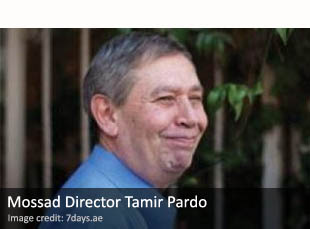
Tamir PardoIsraeli officials have denied reports that the head of the country’s internal security service was asked by the prime minister to spy on the director of the Mossad intelligence agency and the head of the military. The denials were prompted by allegations that will be made in full on Thursday, when the latest installment of the investigative news program Uvda (Fact) will be aired on Israel’s Channel 12 television channel. According to the program, the Israeli Prime Minister Benjamin Netanyahu requested that the personal phones of senior Israeli security officials, including those of the heads of the Mossad and the military, be wiretapped for security reasons.
The investigative news program reported on May 31 that the “unprecedented” request has its roots in a “major secret program” that was launched by the Israeli government in 2012. The program required a major transformation of the country’s intelligence budget, staffing and resources. Although numerous individuals from nearly every facet of the Israeli intelligence community had been briefed on the project, the Israeli prime minister was concerned about leaks to the media. He therefore kept his cabinet in the dark about the program, and did not consult with the Knesset, or even the members of the Knesset’s Subcommittee on Intelligence and Secret Services, which is required by law to be kept fully informed about Israeli intelligence operations.

Uvda further alleges that in 2013 Netanyahu convened an extraordinary meeting of senior officials, which included the participation of the attorney general, the head of the Shin Bet (Israel’s domestic security service) and others. It was during that meeting, according to Uvda, when Netanyahu allegedly approached Yora Cohen, the then-director of the Shin Bet, and asked him to “monitor the partners of the secret project”. When asked what he meant, Netanyahu allegedly said that the directors of the Israel Defense Forces (IDF) and the Mossad should have their telephones monitored for possible unauthorized leaks to the media. Two names mentioned during that meeting, according to Uvda: Tamir Pardo, head of the Mossad, and Benny Gantz, the IDF’s chief of staff. Both men were new at their posts. Eventually, however, when Cohen took Netanyahu’s request to senior officials at the Ministry of Defense, “they were shocked and rejected it”, Uvda reports.

On Sunday, Cohen took the unusual step of issuing a denial of Uvda’s allegations, calling “reports in the media” about the prime minister having instructed him to “specifically wiretap Gantz and Pardo […] untrue”. The Office of the Prime Minister also denied the Uvda report, describing it in a statement as “utterly baseless”. The statement went on to say that Uvda’s allegations represented “a total distortion of systemic efforts that are made from time to time to safeguard sensitive information related to Israel’s security”. Also on Sunday, Prime Minister Netanyahu directly criticized comments made by Pardo on the same program, which the Israeli leader saw as damaging to the reputation of the Mossad. Pardo told Uvda that “the fun part” about working for the Mossad was that the agency is “basically a crime syndicate with a license”. Netanyahu took exception to those comments on Sunday, saying that “the Mossad is not a criminal organization. It is a superb organization that does sacred work in the fight against terrorism and other threats to the state of Israel. We all salute it”.

Author: Joseph Fitsanakis | Date: 04 June 2018 | Permalink

Hamas accuses Mossad of assassinating Palestinian engineer in Malaysia

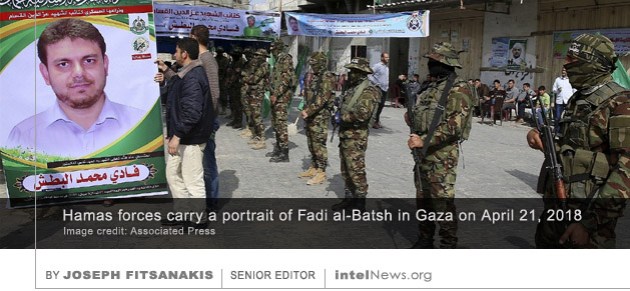
Fadi al-Batsh Fadi AlbatshMilitants in the Gaza Strip have accused Israel of assassinating a Palestinian engineer based in Malaysia, who was shot dead on Saturday by unknown assailants riding motorcycles. The victim has been identified as Dr. Fadi M. al-Batsh, 35, from the town of Jabalia in the Gaza Strip, a Palestinian enclave controlled by the militant group Hamas. Al-Batsh is believed to have completed undergraduate and Master’s degrees in electrical engineering at the Islamic University of Gaza. In 2011 he enrolled as a PhD student at the University of Malaya in Kuala Lumpur, from where he subsequently received his doctorate in electrical engineering. He was then employed as a lecturer by the University of Kuala Lumpur’s British Malaysian Institute. The Institute is located in the Jalan Gombak neighborhood of the Malaysian capital, where al-Batsh lived with his wife and three children. Some reports from Israel said that al-Batsh worked on drone technology and that he had authored scientific articles on the development of drone technology, as well as on the technical specifications of transmitters used to remotely control drones.
Local reports said al-Batsh was gunned down at around 6:00 a.m. on Saturday morning as he was walking from his home to a nearby mosque for early-morning prayers. Footage taken from nearby security cameras shows that al-Batsh was shot by two men riding on a large BMW 1100cc motorcycle, who waited for him to arrive at the scene for at least 20 minutes before opening fire. Malaysian police said the Palestinian man was pronounced dead at the scene, having sustained wounds from 14 bullets in the chest and head. A subsequent report by local police authorities said the incident was being treated as a “targeted killing”, not as a terrorist attack, because the assassins appeared to focus solely on al-Batsh while ignoring several bystanders that were present.

Shortly after al-Batsh’s killing some reports identified him as a relative of Khaled al-Batsh, a senior official in the Palestinian Islamic Jihad. A subsequent statement published by Hamas-affiliated media said al-Batsh was a commander in the Izz ad-Din al-Qassam Brigades, Hamas’ military wing. The militant group described him as a “loyal member” and called him a “shahid” (martyr), who was “assassinated by the hand of treachery”. The Gaza-based group also vowed retaliation against Israel and the Mossad intelligence agency.

Malaysian authorities said on Sunday that they did not rule out anything, including the possibility that al-Batsh may have been killed by militants belonging to the Islamic State. Malaysia’s Deputy Prime Minister, Ahmad Zahid Hamidi, said that the possible involvement of “foreign agents” in al-Batsh’s killing was also being looked at. He added that the two main suspects behind the killing were believed to be “white, European-looking men”. On Monday, Malaysian police released facial composites of the two suspects, based on eyewitness testimonies. An accompanying press release said the two suspects were “around 1.80 meters tall, well built, had fair complexions, and were believed to be of Middle Eastern or Western descent”.

Author: Joseph Fitsanakis | Date: 23 April 2018 | Permalink | Research credit: R.B. and C.F.

French consular employee caught smuggling guns to Gaza using diplomatic car

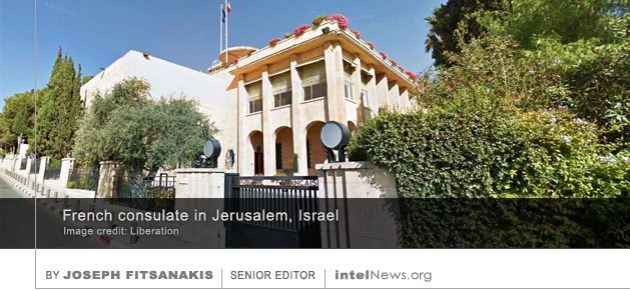
French consulate in JerusalemAn employee of France’s consulate in Jerusalem is under arrest for allegedly smuggling weapons from the Gaza Strip to the West Bank, according to French media reports, which have been confirmed by Israel. The consular employee has been identified by the Shin Bet, Israel’s domestic security agency, as Romain Franck, 23. He reportedly worked as a driver at the consulate, a job he managed to secure through a prestigious “international volunteer” program sponsored by the French government. The elite program allows recent French college graduates to gain work experience in various countries around the world. Although he had a relatively junior post at the French consulate, Franck carried a diplomatic passport, which allowed him to move through international borders without being searched, due to his diplomatic immunity privileges.
But, according to French newspaper Liberation, Franck was detained by Shin Bet officers on February 19 of this year, as he was trying to enter Israel from the Gaza Strip at the Erez border crossing. He was driving a car that bears French diplomatic license plates and belongs to the French consulate in Jerusalem. Inside the car, the Shin Bet officers reportedly found pistols and assault rifles. According to Liberation, Franck’s arrest has been kept secret. The Shin Bet admitted that the newspaper’s story was true on Tuesday afternoon. Franck reportedly told his Israeli captors that he had received the weapons from a Palestinian who worked at the French Cultural Center in Gaza. He then transported them over several trips to the West Bank, where other Palestinians picked them up, paid him, and sold them on to others.

Israel has reportedly arrested eight more people in connection with the gun running, all of whom are Palestinians. They include a Palestinian security guard at the French consulate. According to the Shin Bet, Franck was not ideologically or politically allied with Hamas, Fatah, or any other Palestinian group. Instead, he participated in the gun smuggling for financial gain. A spokesman at France’s embassy in Tel Aviv said that Paris was closely monitoring the incident and was “in close contact with the Israeli authorities on the matter”.

Author: Joseph Fitsanakis | Date: 21 March 2018 | Permalink | Research credit: MF

Sweden grants citizenship to man accused by Iran of being a Mossad spy

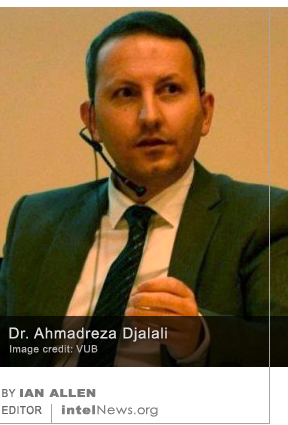
Ahmadreza DjalaliThe government of Sweden has granted citizenship to an academic who is on death row in Iran for allegedly helping Israel kill Iranian nuclear scientists. Sweden’s Foreign Affairs Ministry confirmed on Saturday that Ahmadreza Djalali, who lives in Sweden and has lectured at Stockholm’s renowned Karolinska Institute, is now a Swedish citizen. IntelNews has covered extensively the case of Dr. Djalali, 45, a professor of disaster medicine who has also taught at the Vrije Universiteit Brussel (VUB) in the Belgian capital, as well as in the VUB’s European Master’s program in Disaster Medicine in Italy.

It is believed that Djalali was arrested in Iran in 2016, during a visit from Sweden, where he has been living for several years. He was sentenced to death last year for allegedly helping Israel assassinate nuclear scientists and sabotage Tehran’s nuclear program. Four Iranian physicists, who were employed in Iran’s nuclear program, are known to have been assassinated between 2010 and 2012. Most were killed by magnetic bombs that were placed on their vehicles by unknown assailants, who were then able to escape on motorcycles. Tehran believes that the assassinations were carried out by the Mossad, Israel’s external intelligence agency, with the help of agents recruited by the Israelis from within Iran’s nuclear program.

The office of Tehran’s public prosecutor claims that Djalali admitted holding “several meetings with the Mossad”, during which he allegedly “provided [the Mossad] with sensitive information about Iran’s military and nuclear installations”. The Iranians further claim that Djalali gave Israel the names and addresses of at least 30 senior members of the country’s nuclear program. The list included nuclear physicists, engineers, as well as intelligence and military officials with nuclear specializations. In return for supplying inside information, the Israelis allegedly helped Djalali secure permanent residency in Sweden and financed his move there. Iran claims that the information given to the Mossad by Djalali resulted in the assassination of at least one Iranian scientist. But in a letter written from prison in Iran, the jailed academic claims that he was sentenced to death after he refused to carry out espionage operations on behalf of the Iranian state.

A spokeswoman for Sweden’s Ministry of Foreign Affairs said on Saturday that the Swedish government was aware that Djalali had been granted citizenship by the country’s Migration Board. Consequently, the Ministry was in touch with Iranian authorities and had requested access to the jailed scientist, she said. She added that the Swedish government’s demand was that “the death penalty is not carried out” in the case of Djalali.

Author: Ian Allen | Date: 19 February 2018 | Permalink

Lebanese media accuses Mossad of assassination attempt in Sidon

Mohammad HamdanMedia reports from Lebanon claim that Israel was behind a bomb explosion that injured an official of the Palestinian group Hamas in the southern Lebanese city of Sidon eight days ago. The official, Mohammad Abu Hamza Hamdan, who is originally from the Gaza Strip, suffered light wounds when his parked car blew up on January 14. Television footage posted online by Lebanon24 from the site of the alleged attack shows smoke coming out of a white BMW car, parked on the courtyard of Hamdan’s home. Reporters at the site said the car belonged to Hamdan and that it had been booby-trapped by unknown assailants. Hamdan was reportedly transported to a nearby hospital, where he received treatment for light wounds.

Reports quoted Lebanese officials who pointed to the fact that the booby-trapped car was parked inside the enclosed courtyard of Hamdan’s home as evidence that the attack was specifically targeted at Hamdan. Others said that the attackers may have originally planned to kill Hamdan’s brother, Osama Hamdan, also from the Gaza Strip, who has served as Hamas’ Lebanon representative for 30 years. Now a new article published by Lebanon’s Al Akhbar newspaper has accused Israel’s Mossad intelligence agency of having orchestrated the assassination attempt. The paper also said that Lebanese security officials had managed to identify the Mossad operatives that carried out the attack. It said they were headed by Ahmed Battiya, a Dutch-born Lebanese man who was recruited by the Mossad in Holland and has participated in prior assassination operations perpetrated by the Israeli spy agency. Al Akhbar said that Battiya had traveled extensively inside Lebanon on behalf of the Mossad, in order to identify Hamas officials and track their movements. The article was published hours after Hassan Nasrallah, leader of the Shiite paramilitary group Hezbollah, also accused Israel of attempting to kill Hamdan.

In Israel, however, government officials appeared to reject claims that the Mossad was behind the attack on Hamdan. The country’s Minister of Defense, Avigdor Liberman, told reporters that the Lebanese media blames Israel for everything that happens in Lebanon, and warned Hamas not to open a “new front against Israel from Lebanon”. Yisrael Katz, Israel’s Minister for Intelligence, said that, if Israel had been involved in the attack against Hamdan, “this wouldn’t have ended with him lightly wounded”.

Author: Joseph Fitsanakis | Date: 22 January 2018 | Permalink

Egyptian branch of ISIS declares war on Hamas as tensions rise in Sinai

Egypt Gaza borderThe Islamic State in Egypt’s Sinai Province has declared war on the Palestinian militant group Hamas, in a move that experts say will furhter-complicate an already volatile security situation in eastern Egypt. Many observers see the group, Wilayat Sinai, as the strongest international arm of the Islamic State of Iraq and Syria (ISIS). Known officially as ISIS – Sinai Province, Wilayat Sinai was behind the 2015 downing of Metrojet Flight 9268, which killed all 224 passengers and crew onboard, most of them Russians. The same group killed 311 people at a Sufi mosque in November of last year, in what has become known as the worst terrorist attack in Egypt’s modern history.

Israeli sources claim that, in the past, Wilayat Sinai has had limited cooperation with Hamas, the militant group that controls the Gaza Strip, a coastal section of the Palestinian territories that borders with Egypt’s Sinai Province. The two organizations are believed to have engaged in limited cross-border arms-smuggling, while some injured Wilayat Sinai fighters have been treated in Gaza Strip hospitals. But the two groups have major ideological differences that contribute to their increasingly tense relationship. The Islamic State objects to participation in democratic elections, which it sees as efforts to place human will above divine law. It has thus condemned Hamas’ decision to participate in the 2006 elections in the Palestinian territories. Additionally, even though it promotes Sunni Islam, Hamas is far less strict in its religious approach than the Islamic State, and does not impose Sharia (Islamic law based on the Quran) in the territory it controls. Furthermore, Hamas suppresses Saudi-inspired Wahhabism and its security forces often arrest ISIS and al-Qaeda sympathizers in the Gaza Strip. In the past month, ISIS accused Hamas of having failed to prevent America’s formal recognition of Jerusalem as the capital of Israel. Additionally, ISIS is opposed to the support that Hamas receives from Iran, a Shiite nation that ISIS regards as heretical.

There are reports that Hamas has been quietly collaborating with Egypt and even Israel in recent months, in order to combat the rise of ISIS in the region. For several months now, the Palestinian group has exercised stricter control over its seven-mile-long border with Egypt. It has rebuilt border barriers that had previously been destroyed and has installed security fences and a digital surveillance system. It has also launched a public-relations effort to shame the families of young men from Gaza who have joined ISIS forces in Sinai. In response to these moves, Wilayat Sinai has publicly urged its supporters to kill members of Hamas and attack the group’s security installations and public buildings. The ISIS-affiliated group has also urged its members to eliminate members of the small Shiite Muslim community in the Gaza strip. According to experts, the decision by Wilayat Sinai to declare war on Hamas means that the group has now virtually surrounded itself with adversaries. The move may also increase informal collaboration between Hamas and the Israeli government, say observers.

Author: Joseph Fitsanakis | Date: 12 January 2018 | Permalink

Israeli armed raid in Syria reportedly led to US banning laptops on some flights

Ibrahim al-AsiriA temporary ban issued by United States authorities on laptop computers onboard some commercial flights earlier this year came from a tip by Israeli intelligence, according to a new report. The report was published last week in the American magazine Vanity Fair. It claimed that Israeli commandos carried out a dangerous night-time operation deep inside Syria, in order to acquire physical proof that the Islamic State had  built bombs that were not detectable by X-ray screening systems at airports. But some Israeli intelligence officials became infuriated with Donald Trump after the US President allegedly gave Russia background information about the commando operation, according to the article.

The order to temporarily ban electronic devices larger than cellphones was issued by the US government on March 20, 2017. It applied to direct flights to the US departing from a dozen international airports in the Middle East. In June, the New York Times alleged that the ban was aimed at stopping Islamic State operatives from bringing onboard airplanes bombs disguised as laptop batteries. The paper also said that the information about these bombs had been acquired by Israeli government hackers who had penetrated Islamic State computer systems. But now a new report by Vanity Fair claims that Tel Aviv tipped off the Americans following a commando raid deep inside Syrian territory, which acquired physical evidence of the bombs. The magazine alleges that the raid was carried out by the Sayeret Matkal, an elite unit of the Israel Defense Forces, under the supervision of the Mossad, Israel’s external spy agency. Its target was a highly secretive cell of explosives experts, who were led Ibrahim al-Asiri, a Saudi militant who built bombs for the Yemen-based Al-Qaeda in the Arabian Peninsula. The Mossad shared some of the intelligence from that raid with the Central Intelligence Agency, which in turn told President Trump. That led to the decision to ban laptops from selected flights, until X-ray machines at airports were modified to detect the new type of bomb.

The Vanity Fair article repeats earlier claims that President Trump shared intelligence given to him by the Israelis with Russian Foreign Minister Sergei Lavrov and Russian Ambassador to the United States Sergei Kislyak, when he met them in May of this year. According to Israeli sources, Mr. Trump did not tell the Russian officials that Israel was behind the operation. But he allegedly identified the city in Syria where the raid took place, and in doing so placed the life of an Israeli human asset at risk, according to some. The Israeli government will not comment on these allegations. Additionally, Vanity Fair said that one “former Mossad officer with knowledge of the operation and its aftermath” would not say whether the asset in question had been safely exfiltrated from Syria or even whether he or she was still alive.

Author: Joseph Fitsanakis | Date: 27 November 2017 | Permalink

Netanyahu allegedly asked Trump to let spy Jonathan Pollard move to Israel

Jonathan PollardIsraeli Prime Minister Benjamin Netanyahu reportedly asked the United States President Donald Trump to allow Jonathan Pollard, an American who spied on his country for Israel in the 1980s, to immigrate to Tel Aviv. Pollard, a former intelligence analyst for the US Navy, was released from an American prison in 2015, after serving 30 years for selling US government secrets to Israel. Throughout Pollard’s time in prison, the government of Israel lobbied for his release, claiming that the convicted spy did not harm American interests, but was simply trying to help Israel. But the US Intelligence Community has consistently rejected Israel’s claims, arguing that Pollard’s activities were severely detrimental to American interests. At the end, successive American presidents refused to pardon Pollard. He was released in November of 2015, after serving his entire 30-year sentence.

Pollard, who was given Israeli citizenship in recognition for his services to the Jewish state, has repeatedly stated his desire to renounce his American citizenship and immigrate to Israel. However, the conditions of his release prevent him from doing so. Since his release, he has been forced to wear a GPS monitoring device at all times and is not allowed to leave his New York apartment between 7:00 p.m. and 7:00 a.m., nor is he allowed to leave the United States for any reason. It is speculated that this restriction is designed to prevent him from accessing close to $1 million in spy wages that his Israeli handlers are reputed to have deposited in a Swiss bank account.

But with a new administration now in Washington, the Israeli government believes that it may be able to press for the relaxation of some of the restrictions imposed on Pollard. According to the Israeli television station Channel 2, Prime Minister Netanyahu has personally lobbied President Trump to allow Pollard to leave America for Israel. According to the report, the Israeli prime minister told Mr. Trump that, if allowed to move to Israel, Pollard would abide by the same restrictions that he currently follows in New York. These reportedly include a strict daily curfew and limitations on foreign travel. Channel 2 said that Israeli is seeking to get custody of Pollard in return for its alleged efforts to re-enter negotiations with Fatah, the Palestinian group that governs the Occupied Territories. The television station said that American officials appear hesitant to allow Pollard to go to Israel. Even if Israel’s request is granted, the American side does not want to link Pollard’s case to the Arab-Israeli peace process, it said.

Author: Joseph Fitsanakis | Date: 02 November 2017 | Permalink