Germany convicts married couple of spying for Indian intelligence service
December 13, 2019 Leave a comment
 A court in Frankfurt has found a married couple guilty of spying in Germany on behalf of India’s external intelligence service. Due to Germany’s strict privacy laws, the couple have been identified only as 50-year-old Manmohan S. and his wife, Kanwal Jit K., who is 51.
According to the prosecution, Manmohan S. was recruited by India’s Research and Analysis Wing (RAW) in January of 2015. His wife joined his intelligence-collection activities in July 2017. Following their arrest, the couple told German authorities that they held regular meetings with a RAW case officer who was serving as a diplomat in the Indian consulate in Frankfurt. They also said they were paid nearly $8,000 for their services.
The two convicted spies said at their trial that they were tasked to spy on adherents of the Sikh religion and members of the Kashmiri expatriate community in Germany. The central European country is believed to host as many as 20,000 Indian Sikhs, many of whom openly proclaim secessionist aspirations. Many Sikhs in India and abroad campaign for the creation of a Sikh state in parts of northwestern India and Pakistan, which they call Khalistan. India is also concerned about the secessionist aspirations of Kashmiris, a predominantly Muslim population of 10 million that lives in the region of Jammu and Kashmir. Delhi has long claimed that expatriate groups living in Europe and the United States provide funding for secessionist groups that operate in the region.
On Thursday, Frankfurt’s Higher Regional Court found the couple guilty of conducting illegal espionage activities on German soil. It handed Manmohan S. a one-and-a-half-year suspended jail sentence, while Kanwal Jit K. was given a fine that equates to 180 days of income.
► Author: Joseph Fitsanakis | Date: 13 December 2019 | Permalink
 An unprecedented closed-door trial of a man identified only as “Witness J”, who was convicted earlier this year of a crime that cannot be revealed, has raised questions about the relationship between security and the law in Australia. The man, who is also known as “Prisoner 123458”, was sentenced to a jail sentence in February of this year. His sentencing came following a closed-door hearing, which was
  Spain’s second largest bank has been placed under investigation in connection with a probe into an illegal network that spied on scores of politicians, business executives, journalists and judges for over 20 years. The investigation centers on José Manuel Villarejo (pictured), a 67-year-old former police chief, who remains in pre-trial custody following his
  Prosecutors in the United States have informed lawyers representing the Chinese telecom- munications firm Huawei that they intend to use evidence obtained through secret surveillance in a lawsuit against the company. The case involves the arrest of
 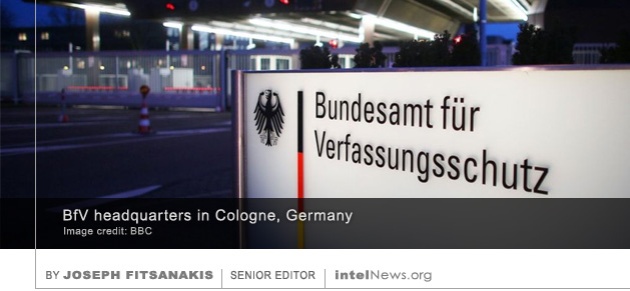 Germany’s largest far-right party, Alternative for Germany, has won a lawsuit against the country’s domestic intelligence agency, which is now barred from collecting intelligence on the group’s activities. Known by its German initials AfD, which stand for Alternative für Deutschland, the party was founded in 2013 on an anti-immigration, Eurosceptic, German-nationalist, and in some cases
  A judge in Spain has widened an investigation into an illegal network that spied on scores of politicians, business executives, journalists and judges for over 20 years, in return for payments by wealthy clients. At the center of the case is José Manuel Villarejo, a 67-year-old former police chief, who was arrested in November of 2017 for carrying out illegal wiretaps and remains in pre-trial custody. State prosecutors accuse Villarejo of running an illicit information-collection enterprise that violated the privacy of hundreds of unsuspecting citizens. The latter were targeted by corporate competitors and individual wealthy clients. Many of Villarejo’s targets were eventually blackmailed by the recipients of information collected by the former police chief and his network.
 A United States federal judge ruled on Monday that a tweet by President Donald Trump did not inadvertently disclose a top-secret program by the Central Intelligence Agency to aid rebel groups in Syria. The lawsuit, brought by The New York Times, centered on news reports published in 2017 by
  Chinese intelligence operatives gave a former officer of the United States Central Intelligence Agency “hundreds of thousands of dollars in cash” in exchange for carrying out espionage, according to court papers. The Federal Bureau of Investigation
  A case officer in the United States Central Intelligence Agency, who was arrested in January of this year for violating the Espionage Act, shared classified information with China, according to an official indictment. The Federal Bureau of Investigation
  The Syrian government tracked down and killed American journalist Marie Colvin in order to stop her from reporting about the Syrian Civil War, according to a Syrian intelligence officer who has defected to Europe. Colvin was an experienced war correspondent who worked for The Sunday Times. The British newspaper sent her to Syria soon after the outbreak of the war. From there, she gave live interviews to media outlets such as CNN and the BBC. But on the morning of February 22, 2012, Colvin was killed along with French war photographer Remi Ochlik. Their death came when Syrian government forces repeatedly shelled a media center in the city of Homs, which housed the two reporters.
 A former employee of Germany’s spy agency, who was recalled from his post abroad after dating a foreign woman, has lost his legal battle to be compensated for lost earnings. The former intelligence officer, who has not been identified by name, worked for Germany’s Federal Intelligence Service, known by its initials, BND. From 2006 to 2008, he served as the BND’s station chief in Riga, Latvia. The post implies that he the highest-ranking German intelligence officer in the small Baltic state. According to court documents, the BND station chief had explicit directions from his employer, in writing, not to fraternize with locals while serving in the Latvian capital. The instructions expressly forbade romantic affiliations with locals.
 Classified information stolen by a United States federal contractor, who was charged with espionage last month, includes the true identities of American intelligence officers posted in undercover assignments abroad, according to court documents. In August of this year, Harold Thomas Martin III, was arrested by the Federal Bureau of Investigation on charges of stealing government property and illegally removing classified material. Martin, 51, served as a US Navy officer for over a decade, where he acquired a top secret clearance and specialized in cyber security. At the time of his arrest earlier this year, he was working for Booz Allen Hamilton, one of the largest federal contractors in the US. Some media
  A court in Germany has sentenced a former officer of the country’s intelligence agency, who spied for the United States and Russia from 2008 to 2014. Regular readers of this website will recall the case of ‘Markus R.’, a clerk at the Bundesnachrichtendienst, or BND, Germany’s external intelligence agency. The 32-year-old was
  Two leading Turkish journalists, who claimed in a series of articles that Ankara has been arming militant Islamists in Syria, are facing espionage charges for “airing Turkish state secrets”. The two, Can Dündar and Erdem Gül, work for Cumhuriyet, (The Republic), Turkey’s oldest newspaper, which typically voices staunchly secularist views representing the center-left of the political spectrum. Last year Dündar, who is the paper’s editor, and Gül, who serves as the paper’s bureau chief in Ankara, published a series of articles claiming that the Turkish government was secretly supporting Salafi Jihadist groups in Syria.






 intelNews.org
German court stops spy agencies from conducting mass surveillance of foreigners
May 20, 2020 by Joseph Fitsanakis 3 Comments
Germany’s foreign intelligence agency, the Federal Intelligence Service, or BND, is uniquely positioned with access to a vast volume of telecommunications data and content. This is because Germany hosts some of the busiest and highest-capacity Internet exchange points in the world. The country’s extensive telecommunications infrastructure includes the so-called DE-CIX exchange in Frankfurt, believed to be the world’s second-busiest Internet node. It is believed that the DE-CIX Internet exchange alone carries over a trillion messages per day to and from Western Europe, Russia, the Middle East and North Africa.
The BND is not allowed to spy on the communications of German nationals. However, according to German media reports, the agency had until now assumed that Internet messages sent by foreigners, which passed through German-based exchanges, were fair game for interception and analysis. This was because, according to the BND, foreign nationals were not protected under Germany’s Basic Law —a term that refers to the German Constitution— which means they and their communications had no privacy protections under German law.
But this assumption was dispelled on Tuesday by the Federal Court of Justice, which is Germany’s highest court. The court ruled that telecommunications surveillance against foreigners is subject to Article 10 of Germany’s Basic Law, which affords German citizens the right to privacy. In other words, the law also protects the telecommunications of foreigners, according to the court, which means that surveillance of foreign communications should be carried out only in a targeted fashion, in response to specific cases or to target specific individuals. The court challenged the mass-surveillance —as opposed to a targeted surveillance— model of the BND’s data collection, and said that it the spy agency’s activities required more stringent oversight, especially in relation to the communications of reporters and lawyers. Finally, the court agreed with the plaintiffs that the constitutional safeguards against the BND’s ability to share its intercepted data with foreign spy agencies were insufficient.
In its ruling, the court gave the German government until December of 2021 to propose a new law governing telecommunications surveillance against foreigners, which will be compliant with the German Constitution.
► Author: Joseph Fitsanakis | Date: 20 May 2020 | Permalink
Filed under Expert news and commentary on intelligence, espionage, spies and spying Tagged with BND, civil liberties, DE-CIX (Germany), Germany, lawsuits, News, privacy, Reporters Without Borders