Third person charged in probe into alleged US Pentagon ‘rogue operation’
October 6, 2015 Leave a comment
 A third person has been charged in a complex criminal investigation into the procurement of weapon silencers by the United States Department of Defense, which one American newspaper has described as a possible “rogue operation”. The case concerns the Directorate for Plans, Policy, Oversight and Integration, an obscure civilian-led Pentagon office, whose stated mission is to provide logistical support and procurement for intelligence operations conducted by the US Navy and Marine Corps.
According to media reports, more than three years ago the Directorate ordered 349 weapon suppressors, known commonly as silencers. By general admission, silencers are not the type of military hardware used in conventional combat. More importantly, the procurement cost of the silencers should have been no more than around $10,000. However, purchase records show that the Directorate paid the supplier of the silencers over $1.6 million. The supplier then turned out to be the brother of the Directorate’s officer in charge of intelligence, David W. Landersman. Last week it was revealed that Landersman became the third person to face charges of theft and conspiracy as part of the investigation.
Initially, Pentagon officials suggested that the silencers had been purchased for a top-secret operation codenamed UPSTAIRS. The operation was allegedly a “special-access program” aimed at arming foreign paramilitary forces while avoiding the risk of the weapons being traced back to the US. Though limited details were provided, one government witness told the court that military hardware acquired through UPSTAIRS was intended for the US Navy’s Sea, Air, Land Team 6, commonly known as US Navy SEAL Team 6. The special-forces team became famous in 2010, when it carried out the Central Intelligence Agency’s operation NEPTUNE SPEAR, which killed al-Qaeda founder Osama bin Laden in Pakistan. Later during the course of the investigation, however, SEAL Team 6 representatives told court officials that their unit “had not ordered the silencers” and knew nothing about them. Following that development, government prosecutors objected to further discussion of the case in open court due to the alleged “sensitive nature” of the case. Since then, much of the court documentation on the case has been filed under seal on grounds of national security.
But the discrepancies in the case led The Washington Post to speculate last year that the procurement of the weapons silencers may have been part of a “rogue operation”, that is, a military activity not authorized by the Pentagon leadership. The Post spoke to an unnamed “former senior Navy official familiar with the investigation”, who said the Pentagon’s Directorate for Plans, Policy, Oversight and Integration was “building its own mini law enforcement and intelligence agency” without oversight from higher-ups. Another unnamed source, a former Pentagon official familiar with the Directorate, told the paper that “deeper issues might be in play” in the case.
Last week, a Pentagon spokesman said Landersman was “no longer performing duties in any way associated with intelligence” for the US government, though he appeared to still be employed by the US Navy in a clerical capacity, pending the outcome of the investigation.
► Author: Ian Allen | Date: 06 October 2015 | Permalink
 A German intelligence officer, who is accused of spying for the United States Central Intelligence Agency, has been
  The government of Rwanda uses intelligence operatives to systematically spy on, harass, and even kill opposition figures living abroad, according to a report issued by a Canadian security agency. The report was written by the National Security Screening Division of the Canada Border Services Agency, and was partly based on information from the Canadian Security Intelligence Service (CSIS). It was released as part of a court case involving a Rwandan man living in Canada, who was accused of working as a spy for the government of Rwanda.
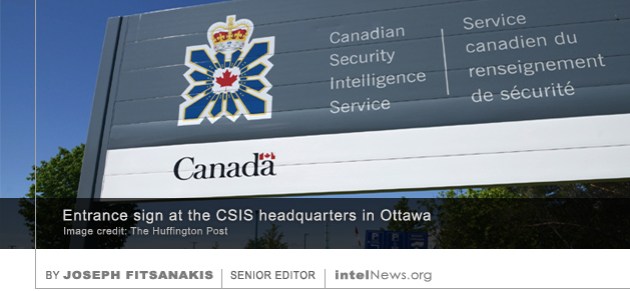 A government watchdog in Canada is preparing to hold a series of closed-door hearings to weigh accusations that the country’s intelligence services illegally spied on law-abiding activists opposing the construction of oil pipelines. The British Columbia Civil Liberties Association (BCCLA) sued the Royal Canadian Mounted Police (RCMP) and the Canadian Security Intelligence Service (CSIS) in February 2014,
  A Rwandan former intelligence chief, whose legal team is led by the wife of British former Prime Minister Tony Blair, has been freed after a court in the United Kingdom refused to extradite him to Spain to face war crimes charges. General Emmanuel Karenzi Karake, 54, was the most senior intelligence official in the administration of Rwandan President Paul Kagame. He rose to fame as a commander in the Rwandan Patriotic Front (RPF), an armed rebel group from Rwanda’s minority Tutsi tribe that fought to end the genocide inflicted upon the Tutsis by their rival Hutus. In 1994, following the death of nearly a million people, the RPF took power in Rwanda and ended the slaughter. That accomplishment caused a rapid upsurge in the popularity of Karake and other senior RPF leaders. Karake’s popularity remains strong among the Tutsis despite his dramatic falling-out with Kagame in 2010, which led to the general’s dismissal from the government.
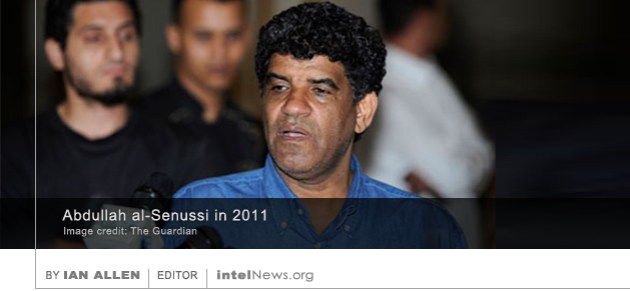 A group of American, British and Irish citizens are pressuring their respective governments to prevent the impending execution of Libya’s former intelligence strongman. Abdullah al-Senussi, 65, led Libya’s intelligence services during the regime of the country’s late dictator Muammar al-Gaddafi. Last week, however, he was sentenced to death by a court in Tripoli for his role in “inciting genocide” during the 2011 civil war that toppled Gaddafi’s regime. American, British and Irish officials are being urged to intervene to stop Senussi’s execution, so that he can help shed light on Libya’s role in international terrorist plots in the 1980s and 1990s.
 A government prosecutor in France has urged that a probe looking into whether the late Palestinian leader Yasser Arafat was poisoned with a radioactive substance should be dropped, because evidence shows he died of natural causes. Arafat was the founder of Palestinian nationalist group Fatah and led the Palestine Liberation Organization for over three decades before becoming the first president of the Palestinian Authority. He died in November 2004 at the Percy military hospital in Paris, France, weeks after being transferred there from his headquarters in Ramallah, West Bank. His official records indicate that he died from a stroke, which he suffered as a result of a blood disorder known as disseminated intravascular coagulation.
 The final piece of sealed testimony in one of the most important espionage cases of the Cold War has been released, 64 years after it was given. The case led to the execution in 1953 of Julius and Ethel Rosenberg, an American couple who were convicted of spying for the Soviet Union. The Rosenbergs were arrested in 1950 for being members of a larger Soviet-handled spy ring, which included Ethel’s brother, David Greenglass. Greenglass agreed to testify for the US government in order to save his life, as well as the life of his wife, Ruth, who was also involved in the spy ring. He subsequently fingered Julius Rosenberg as a courier and recruiter for the Soviets, and Ethel as the person who retyped the content of classified documents before they were surrendered to their handlers. That piece of testimony from Greenglass the primary evidence used to convict and execute the Rosenbergs.
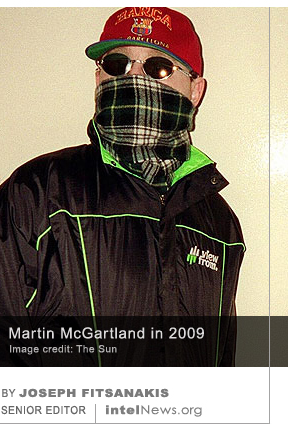 A lawsuit against Britain’s Security Service (MI5) by a former spy, who in the 1980s infiltrated the Provisional Irish Republican Army, commonly known as IRA, is to be judged in secret, a court in London has decided. The spy, Martin McGartland, of Belfast, Northern Ireland, was recruited by the Special Branch of the Royal Ulster Constabulary in the mid-1980s. The information he supplied to the security agencies over several years is widely credited with having saved the lives of at least 50 British police officers and soldiers. His autobiographical experiences formed the basis of the 2008 motion picture 50 Dead Men Walking.
 Kazakhstan’s former spy chief and a former presidential bodyguard have been acquitted by an Austrian jury, five months after a co-defendant in their double-murder trial, who was also the Kazakh president’s former son-in-law, was found dead in his Vienna cell. As intelNews has written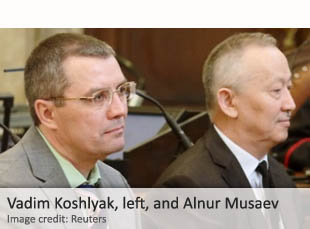







 intelNews.org
US defense contractors allegedly hired Russian computer programmers
November 12, 2015 by Joseph Fitsanakis Leave a comment
If true, Kingsley’s allegations would mean that Netcracker and CSC were in violation of federal regulations, which specify that only American citizens with the appropriate security clearances should be employed to work on classified communications systems. A subsequent government investigation, which lasted four years, gave rise to a lawsuit against the two companies. The court was told that the code written by the Russian programmers had allowed the installation of “numerous viruses” on the communications systems of the Pentagon “on at least one occasion”. Witnesses also accused Netcracker and CSC of being guided mainly by greed, since it was able to save over 60% of wage costs by employing the Russian programmers.
Last week, the two companies chose to settle the case, by paying the government a combined fee of nearly $13 million in civil penalties. It is important to note, however, that they both deny the government’s accusations that they violated the terms of their federal contract. In statement issued last week, the companies stated that their decision reflected their belief that it was “in the best interest of all stakeholders to settle the matter”. A spokeswoman for the DISA told The Daily Beast that she could not comment on the case, because doing so would “compromise the Agency’s national security posture”. According to The Daily Beast, last week’s settlement does not prevent the Department of Justice from filing criminal charges against Netcracker and CSC.
► Author: Joseph Fitsanakis | Date: 12 November 2015 | Permalink | News tip: C.H.
Filed under Expert news and commentary on intelligence, espionage, spies and spying Tagged with Computer Systems Corporation, cybersecurity, Defense Information Systems Agency, John C. Kingsley, lawsuits, Netcracker Technology Corporation, News, United States, US DoD