Malta protests French media claims that its Brussels embassy is bugged by China
May 18, 2020 2 Comments
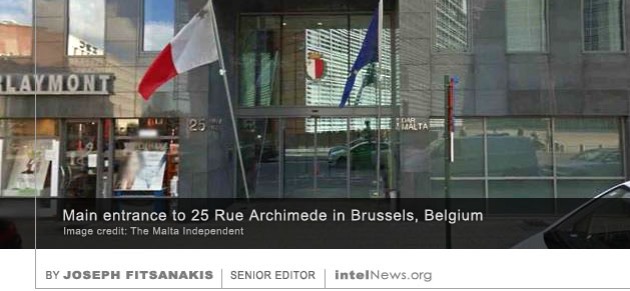 The Maltese government has strongly denied allegations, made by a leading French newspaper, that the island nation’s embassy in Brussels is being used by China to spy on European Union institutions. The allegations concern a nine-story building located at 25 Rue Archimede, in one of downtown Brussels’ most desirable areas. The building houses the Embassy of Malta in Belgium, as well as Malta’s Permanent Representation to the European Union. It is conveniently located across the street from Le Berlaymont —the headquarters of the European Commission, which is the European Union’s executive branch. It is also around the corner from the headquarters of the European Council, which operates as the collective presidency of the European Union.
Last Friday, leading French newspaper Le Monde, alleged that China had installed concealed surveillance equipment throughout the building at 25 Rue Archimede. The paper claimed that the Chinese had supplied the funds to buy and refurbish the building as a gift to Malta, a country with which Beijing has had traditionally warm relations since 1972, when Malta became the world’s first nation to formally recognize the People’s Republic of China. The paper also alleged that Belgium’s state security services had long suspected that the building “harbored technical [surveillance] equipment” planted by Chinese intelligence with the aim of spying on nearby European Union facilities located nearby. The report added that the Belgians had previously been initially alerted by British intelligence about the use of 25 Rue Archimede as a “spy tower” by the Chinese.
According to Le Monde, this information had been relayed to the Belgian Ministry of Foreign Affairs by Alain Winants, when he served as Director of Belgium’s State Security Service (SV/SE). However, both Winants and his successor, Jaak Raes, declined to comment when asked by Le Monde. The paper said that the Belgian Ministry of Foreign Affairs also declined an opportunity to comment, saying that “such affairs relate to the state affairs of Belgium”.
Over the weekend, the Maltese government issued a formal statement denying the clams by Le Monde, and protesting the “incorrect allegations” in the paper’s report. Additionally, Maltese officials told local media that the building in question had undergone successive “internal and external audits” by the Maltese Security Service and the European Council, and had been found to be clear of bugs every time. Another Maltese government source said that 80% of the building’s furniture had been “disposed of” in the past two years and replaced with “new furniture procured from Malta”.
Other sources told Maltese media that the allegations in Le Monde could be a form of retaliation against the government of Malta for seeking to withdraw from Operation IRINI, a European Union naval operation aimed at enforcing an international weapons embargo imposed on Libya. According to these claims, the embargo is preventing weapons from Turkey from reaching the United Nations-recognized Libyan Government of National Accord. If the embargo were to be lifted, or not thoroughly implemented, it could potentially strengthen the Libyan government, and thus hamper the efforts of Libyan warlord General Khalifa Haftar. Haftar is backed by France, among other Western powers.
► Author: Joseph Fitsanakis | Date: 18 May 2020 | Permalink
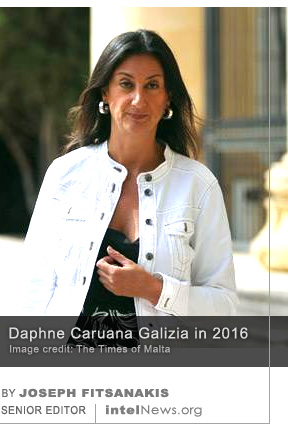 Malta’s best known investigative journalist, whose reporting about offshore tax evasion prompted a major political crisis in the European Union member-state, has been killed by a powerful bomb near her home. Daphne Caruana Galizia, who died Monday, aged 53, gained international prominence last year, when she used information from various sources, including the leaked “Panama Papers”, to accuse senior members of Malta’s government of implication in tax-evasion schemes. Her reporting led to the resignation and eventual re-election of the country’s Labor government last year.
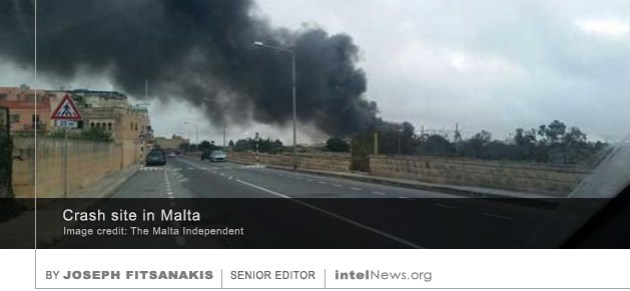 Despite initial denials, it appears that at least three of the five French citizens who were killed in an airplane crash in Malta earlier this week were employees of the country’s external intelligence agency. The crash happened in the early hours of Monday near the village of Luqa in southern Malta. Early reports identified that the plane as a light aircraft and was carrying five French citizens when it crashed, shortly after taking off from the nearby Malta International Airport. Initial statements from Maltese and French government officials said the plane was on a local flight route and had not been scheduled to land outside of the Mediterranean island. The five passengers were identified in press statements as “customs officers” who were conducting a joint project with their Maltese counterparts.
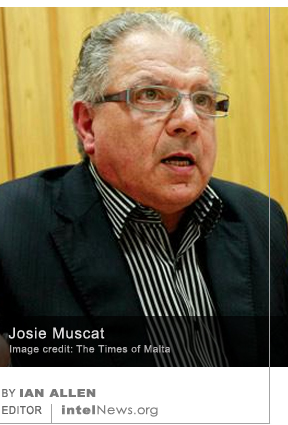 A Maltese ultra-nationalist group believed to be behind a string of bombings in the 1980s was believed by British intelligence to have links to the United States Central Intelligence Agency (CIA), according to recently declassified documents. The Front Freedom Fighters (FFF) was a staunchly anticommunist group whose members violently objected to what they saw as Malta’s overly close contacts with the Communist Bloc. During the 16-year rule of the Maltese Labour Party, which began in 1971, the Mediterranean island maintained close relations with countries during such as Libya and North Korea. The Maltese Nationalist Party, which formed the main opposition to Labour, was highly critical of these contacts, but failed to win three consecutive electoral contests and was thus unable to influence the country’s foreign policy in any significant way.







 intelNews.org
Investigation finds alleged loopholes in Malta ‘golden passport’ scheme
April 23, 2021 by Joseph Fitsanakis Leave a comment
The scheme allows foreign nationals with no family connection to the island country to acquire a Maltese passport, if they invest €600,000 ($720,000) in Malta and purchase a residential property worth at least €700,000. Alternatively, they can sign a five-year lease on a residential property and donate €10,000 to charity. They then need to live in Malta for three years before they can claim citizenship in the European Union nation. However, the residential period can be reduced to one year if they invest €750,000 instead of €600,000 in the island country.
The scheme has proven lucrative in the past. In the 12 months leading to mid-2018 alone, Malta raised over €162 million, which was equivalent to 1.4% of its gross domestic product. Maltese officials have stated that, during the COVID-19 pandemic, income from the so-called “golden passports” scheme has helped keep the country’s economy afloat. But the European Union has called on Malta, Cyprus, Bulgaria, and other member states to stop their cash-for-passports schemes, because they pose serious security issues and can attract corrupt individuals with an interest in tax evasion and money-laundering.
Now a joint probe by British newspaper The Guardian and several Maltese investigative groups, including the Daphne Caruana Galizia Foundation, has uncovered alleged evidence of legal loopholes in Malta’s scheme. The alleged loopholes implicate Henley & Partners, a British-based firm that operates Matla’s a passport sales program. The firm describes itself as a “global citizenship and residence advisory firm”, and advises governments around the world on how to design and implement economic citizenship schemes.
The investigation was based on leaked documents and “thousands of emails” about the scheme. The emails and leaks reveal the existence of loopholes that allow wealthy investors to spend an average of 16 days in Malta, rather than a minimum of a year, before being awarded citizenship. The BBC reported on the case of an individual from the United Arab Emirates, who received Maltese citizenship after spending just nine hours on the island country. Other wealthy investors acquire Maltese citizenship by rending empty residential properties, or even yachts.
In a statement, the London-based Henley & Partners said it is “fully aware of the potential inherent risks in handling client applications for residence and citizenship” in Malta, and that its staff are “committed to due diligence”. It added, however, that “ultimately it is the responsibility of the countries involved [in passport-for-cash schemes] to investigate and vet applicants”.
► Author: Joseph Fitsanakis | Date: 23 April 2021 | Permalink
Filed under Expert news and commentary on intelligence, espionage, spies and spying Tagged with corruption, economic citizenship, European Union, Malta, News, travel documentation