Congo accuses Rwandan spy cell of plot to shoot down president’s plane

M23 Congo RwandaTHE GOVERNMENT OF THE Democratic Republic of the Congo (DRC) has dismantled an alleged Rwandan spy network and has charged its members with plotting to assassinate the country’s president. This development, which was announced late last week by authorities in Kinshasa, has plunged relations between the two neighboring countries into a new low.
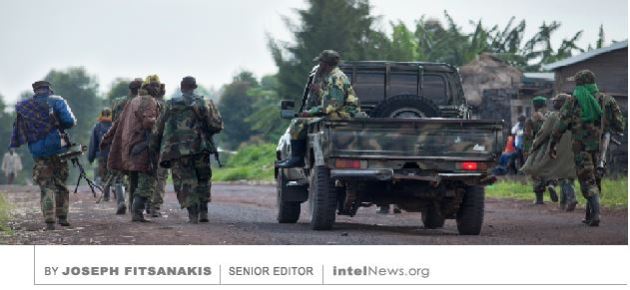
The DRC has long accused Rwanda of training and equipping members of the so-called March 23 Movement (M23), who have been engaged in a decade-long conflict with the Congolese state in the North Kivu province. Since March of last year, DRC government forces have been engaged in a major offensive against the M23, but the rebel group continues to control several strategic towns and villages in North Kivu. Meanwhile, Rwanda has accused the DRC of using the offensive as a pretext to invade Rwanda. Late last year, the Rwandan Defense Forces (RDF) captured Congolese territory, in what authorities in Kigali described as an attempt to create a buffer zone between Rwanda and the DRC military offensive. In response, the DRC suspended a host of bilateral agreements with Rwanda and expelled the Rwandan ambassador from Kinshasa.

Last Thursday, the DRC’s Deputy Minister of the Interior, Jean-Claude Mandongo, posted a video on social media, announcing the arrest of several members of an alleged Rwandan spy ring. According to Mandongo, the spy ring consisted of two alleged Rwandan spies and two Congolese accomplices. The two Rwandans have been identified in DRC media reports as Dr. Juvenal Nshimiyimana and Moses Mushabe, who is allegedly a serving intelligence officer in the RDF. According to Mandongo, the two Rwandans were stationed in the DRC in a non-official-cover capacity, as employees of a humanitarian non-governmental organization called African Health Development Organization (AHDO).

Authorities in the DRC seem to believe that the AHDO serves as a proprietary cover for Rwandan intelligence, although they have provided no evidence for this claim. Officials in Kinshasa also claim that Rwandan spies are operating in other AHDO branches across the DRC. Statements from the Ministry of the Interior suggest that more arrests of alleged Rwandan spies are imminent. According to DRC officials, AHDO facilities were strategically located adjacent to the N’djili International Airport in Kinshasa, in order to monitor the movements of the presidential air fleet. In a report published on Tuesday, DRC authorities claimed that the alleged Rwandan spy cell planned to assassinate DRC President Félix Tshiskedi, by shooting down his presidential jet. The Rwandan government has rejected these claims.

Author: Joseph Fitsanakis | Date: 04 January 2023 | Permalink

Germany is prepared for projected increase in Russian spy activity, says BfV director

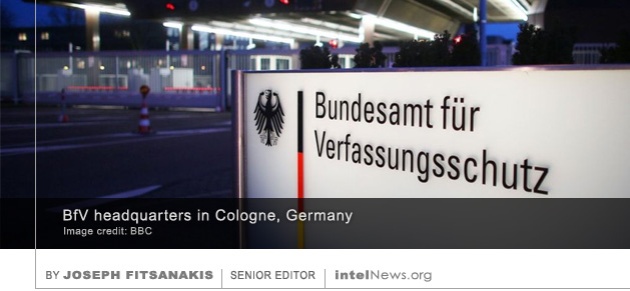
BfV GermanyRUSSIAN FOREIGN INTELLIGENCE ACTIVITIES in Germany have increased exponentially since the start of the war in Ukraine, and are projected to further-increase in 2023, according to the head of German counterintelligence. In an interview on Monday with the German Press Agency (DPA), Thomas Haldenwang, director of the Federal Office for the Protection of the Constitution (BfV), also warned that China, Iran and Turkey are intensifying their intelligence activities inside Germany.

In April of last year, the German government expelled 40 members of the diplomatic staff from Russia’s embassy in Berlin. It is believed that the majority of those expelled were intelligence officers operating under official cover. According to Haldenwang, the Kremlin has taken steps to compensate for the loss of its intelligence presence in Germany. This is largely being done in two ways: first, with “traveling operatives”, i.e. intelligence officers who are stationed in third countries and travel to Germany to carry out specific operations; second, with non-official-cover officers, i.e. intelligence operatives who have no overt relations with the Russian government. Moreover, Russia has been mounting its cyber-attacks and foreign-influence operations against Germany, according to Haldenwang.

In response to the Kremlin’s actions, German counterintelligence is making “great efforts to prevent […] people who may be connected to Russian intelligence from entering Germany” with valid visas, Haldenwang said. The BfV has hired more personnel and has “organizationally redesigned” its defensive and offensive counterintelligence capabilities, as well as cyber-defense expertise. As a result, the BfV “feels sufficiently prepared for the current challenges”, Haldenwang said. He also disputed allegations in Western media that the BfV had been relatively passive in countering Russian intelligence operations prior to the war in Ukraine.

Finally, Haldenwang cautioned that Iran and Turkey maintained a significant intelligence presence in Germany, and that the stormy domestic politics in those countries would “have an impact in Germany”, as “internal political conflicts [in those countries] are fought here”. This also applies to China, whose intelligence collection targets are no longer primarily economic, but are moving into the political domain. According to Haldenwang, a “pan-European solution is needed to reverse this trend, at least for the European [Union] states”.

Author: Joseph Fitsanakis | Date: 03 January 2023 | Permalink

Qatargate corruption scandal probe widens to include Moroccan spy services

European ParliamentTHE CRIMINAL CORRUPTION SCANDAL known as Qatargate, which has rocked the European Parliament in recent weeks, involves covert influence operations by Moroccan spies, in addition to Qatari intelligence operatives, according to news reports.
On December 9 and 10, Belgian and Italian police arrested a dozen politicians, European Parliament aides, civil servants, lobbyists, and members of their families. Over €2 million in cash and other assets has since been seized by authorities, as a Europe-wide investigation continues. Those arrested included Eva Kaili, vice president of the European Parliament, which is among the core legislative bodies of the European Union. Kaili and her co-conspirators are accused of selling their ability to influence European Union policies on Qatar, in exchange for cash and other perks. Although the government of Qatar vehemently denies having a role in the scandal, it is widely believed that operatives linked to Qatari authorities facilitated the bribes.

During the past week, however, several reports in European news outlets have been alleging that, in addition to Qatar, the Kingdom of Morocco also appears to have been involved in parallel efforts to buy influence within the European Parliament. Early clues of this development surfaced during the week of December 12 in the Belgian broadsheet Le Soir and the Italian daily La Republica. The reports focused on an intelligence operative codenamed M118, who allegedly worked for the General Directorate for Studies and Documentation (DGED), the foreign spy service of Morocco.

Last week, a new report in the German newsmagazine Der Spiegel supported the theory that M118 is Mohamed Belahrech. Belahrech is allegedly an identified DGED operative, who is believed to have recruited two members of the European Parliament from Italy, Antonio Panzeri and Andrea Cozzolino, as well as Francesco Giorgi, Kaili’s Italian partner. Giorgi, a key figure in Qatargate, remains in custody. Der Spiegel also claims that Abderrahim Atmun, Morocco’s ambassador to Poland, led the Moroccan government’s efforts to recruit the three Italians. According to the report, the three were in direct communication with Mohamed Yassine Mansouri, director general of the DGED.

Author: Joseph Fitsanakis | Date: 02 January 2023 | Permalink

North Korean hackers behind ‘sophisticated’ effort to elicit views of experts

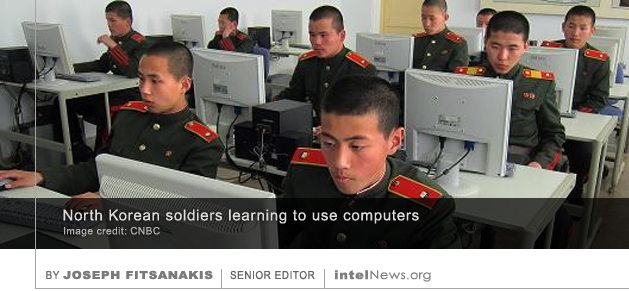
North KoreaA NOTORIOUS NORTH KOREAN hacker group is believed to be behind a “sophisticated” effort to elicit the views of international experts on issues that are of concern to Pyongyang, according to an investigation by Reuters. The news agency said its reporters had managed to uncover this previously unreported campaign with the help of cybersecurity experts and five individuals who had been targeted by the North Korean hackers.
The North Korean hacker group that is alleged to be behind this elicitation campaign is known among cybersecurity experts as Thallium, or Kimsuky. It has been active since at least 2012 and has orchestrated intensive “spear-phishing” attacks against international targets. Similarly to other hacker groups that have been active in the past decade, Thallium’s operations have centered on tricking its targets to download malware on their personal electronic devices, or to share sensitive information, including passwords.

Lately, however, the group has changed its tactics in striking ways, according to Reuters. Instead of trying to steal secrets, it has been involved in a campaign aimed at eliciting the views of Western experts on North Korean affairs. It has been doing so by directly contacting these experts with requests to review policy papers, or by commissioning opinion pieces on various aspects of North Korean politics, economy and society. The requests are camouflaged to appear as originating from respected think-tanks, universities or consultancy firms.

Since January of this year, when the first experts began to be contacted, “multiple” individuals have fallen victim to this elicitation campaign, according to experts at the Microsoft Threat Intelligence Center (MSTIC). They include policy experts working for Western governments, think-tank and university researchers, as well as human-rights campaigners. They have all fallen victim to “sophisticated” requests that use polished language and appear legitimate, according to Reuters.

In most cases, the elicitation emails promise a payment of $300.00 in return for reviewing a manuscript, authoring a short opinion piece, or recommending another expert who may be able to provide these services. However, none of the individuals who proceeded to provide these services have ever received any funds. Cybersecurity experts, who reviewed the elicitation campaign, told Reuters that the hackers never intended to provide any payments to targets.

Author: Joseph Fitsanakis | Date: 13 August 2022 | Permalink

Mystery surrounds arrest of alleged Russian spy couple in Sweden

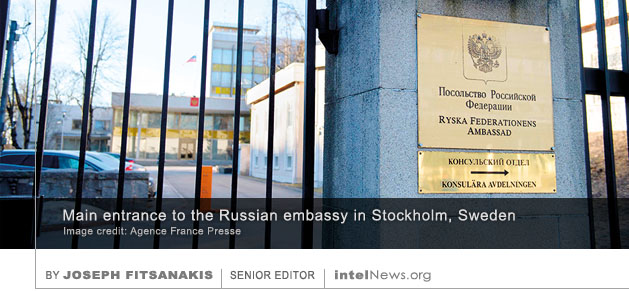
Russian Embassy SwedenNUMEROUS UNANSWERED QUESTIONS SURROUND the arrest of a Russian married couple in Sweden, on charges of espionage. The arrest took place in dramatic fashion in the early hours of Tuesday, November 22. According to the Swedish media, members of the security forces descended via tactical ropes from two Blackhawk helicopters, as startled residents in the typically quiet Stockholm suburb of Nacka looked on.

The raid was apparently conducted based on information received by Sweden’s counterintelligence agency, the Swedish Security Service (SAPO), coupled with tips from the United States Federal Bureau of Investigation (FBI). The targets of the operation were Sergei Nikolaevich Skvortsov and Elena Mikhailovna Kulkova, a Russian-born married couple, who moved to Sweden from Russia in 1999. According to their identity documents, Skvortsov was born in Perm on July 28, 1963, and Kulkova in Moscow on May 22, 1964.

Both Skvortsov and Kulkova are university-educated, with a background in science, mathematics and cybernetics. Upon settling in Sweden, they worked in the import-export technology sector. By 2013 they had become Swedish citizens and had a son. Kulkova also had a daughter from a previous marriage. The Russian investigative source The Insider reports that Kulkova’s daughter’s boyfriend worked for Swedish military intelligence.

Swedish authorities allege that the two suspects migrated to Stockholm on orders of the Main Directorate of the Russian Armed Forces General Staff, known as GRU. The GRU allegedly did not activate them until after they had acquired Swedish citizenship. According to the court indictment, Skvortsov and Kulkova began to actively spy against the United States in 2013 and against Sweden in 2014.

Some sources claim that the case of the Russian couple may be connected to the recent arrests of Payam and Peyman Kia, two Iranian-born Swedish brothers, who were arrested in 2021 and are now facing charges of engaging in espionage on behalf of the GRU. Payam Kia worked for SAPO and had access to classified information from a host of Swedish government agencies. SAPO reportedly launched the probe in 2017, following suspicions that it harbored a spy in its personnel ranks.

Author: Joseph Fitsanakis | Date: 05 December 2022 | Research credit: A.G. | Permalink

Israel beefs up protection of its senior spies, as proxy war with Iran intensifies

Iran UAV droneISRAELI AUTHORITIES HAVE STEPPED up measures to protect its senior intelligence and security figures, over concerns they may be targeted by agents of the Iranian state, according to news reports. The news comes amidst widespread concerns that the ongoing shadow conflict between Israel and Iran is escalating in the shadow of the Russo-Ukrainian war.
On Thursday, Israel’s state-owned broadcaster and news agency, Kan, reported that  the government of Israel had implemented additional security measures to protect current and former members of its security and intelligence agencies. The report added that the measures are focused largely on current and former members of Israel’s foreign intelligence agency, the Mossad, as well as those associated with Israel’s intelligence and security apparatus that are living abroad.

The report comes amidst concerns among security observers that a clandestine war between Israel and Iran is growing in intensity. To a notable extent, this growth is being fueled by the ongoing Russo-Ukrainian conflict. Iran’s supply of cheap and reliable attack drones appears to be enabling Moscow to subvert and outright destroy Ukraine’s national infrastructure. In what seems like a direct response to Iran’s actions, Israel war materiel is now flowing into Ukraine, reportedly through a NATO country.

There are indications that this proxy conflict between Israel and Iran is spreading in Europe and the Middle East. Seeing the success of the use of Iranian drones, some European countries with limited airstrike capabilities, like Serbia and Armenia, are reportedly considering purchasing drone attack systems from Tehran. Meanwhile, Israeli weapons exports to Arab states have skyrocketed since the normalization of Israel’s relations with a number Arab countries in recent years. According to a recent report, last year marked a historic record for the volume of Israeli military and security exports, which increased by 30 percent from 2020. Much of that increase is due to Israeli weapons exports to Arab states, such as Morocco, Bahrain and the United Arab Emirates.

Author: Joseph Fitsanakis | Date: 28 November 2022 | Permalink

Sweden charges two brothers with spying for Russian military intelligence

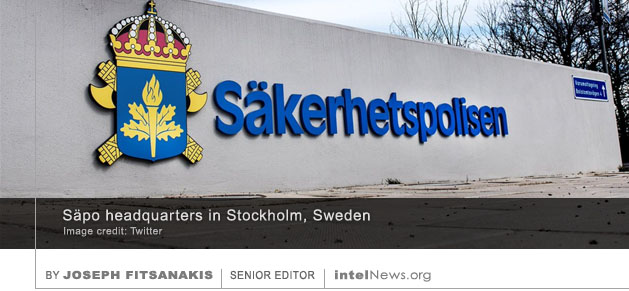
Säpo swedenAUTHORITIES IN SWEDEN HAVE charged two brothers, one of whom worked in a highly secretive Swedish intelligence unit, with spying for Russian military intelligence for a decade, according to news reports. The charges resulted from a six-year investigation led by the Swedish Security Service (SAPO), which is the country’s counterintelligence agency. SAPO reportedly launched the probe in 2017, based on suspicions that it harbored a spy in its personnel ranks.

The two brothers have been named by Swedish media as Payam Kia, 35, and Peyman Kia, 42. They were reportedly born in Iran and became Swedish citizens in 1994. It is also reported that Payam Kia worked for SAPO and had access to classified information from a host of Swedish government agencies. SAPO accuses the two men of having worked “jointly” to pass information to the Main Directorate of the Russian Armed Forces’ General Staff, known broadly as GRU.

According to Swedish authorities, the two men began spying for Russia in September of 2011 and continued until the fall of 2021. Peyman Kia allegedly acted as a courier, passing information and payments between his brother and his Russian handlers. Per Lindqvist, chief prosecutor for Sweden’s National Security Unit, told the Associated Press news agency that the Kia brothers case involved “extremely sensitive topics”, but did not elaborate. Some reports claim that Payam Kia had access to the files of Swedish spies operating abroad.

The younger of the two brothers was reportedly arrested in September of 2021. His older brother was arrested in November of the same year. They face up to life imprisonment. They both deny the charges against them.

Author: Joseph Fitsanakis | Date: 14 November 2022 | Permalink

Norway arrests alleged Russian illegal who spent years building cover in Canada

José Giammaria Mikhail MikushinAN ALLEGED RUSSIAN DEEP-cover intelligence operative, who was arrested by Norwegian police last week, spent years building his fake cover in Canada, while studying there as a Brazilian citizen, according to reports. Norway’s Police Security Service (PST) announced last week that it had arrested José Assis Giammaria, a 37-year-old Brazilian citizen, on suspicion of entering Norway on false pretenses. According to the PST, Giammaria is in fact a Russian citizen, who has been operating in Norway as a non-official-cover (NOC) intelligence officer.

According to Norwegian authorities, Giammaria worked as a researcher at the Arctic University of Norway. Known as UiT, the university is located in the northern Norwegian city of Tromsø. It has a worldwide reputation for research, and approximately 10 percent of its 17,000 students are international. While there, Giammaria was a volunteer researcher for a UiT GreyZone, a scholarly project that studies contemporary hybrid threats and grey zone warfare. His area of specialization appears to have been Arctic security.

Last Friday, the office of the Norwegian state prosecutor said it believed the suspect’s actual name is Mikhail Mikushin, a Russian citizen born in 1978. In a press statement, a Norwegian government representative said authorities were “not positively sure of his identity”, but it was clear that he was not a Brazilian national. Later on Friday, the Oslo-based Norwegian newspaper Verdens Gang (VG), in association with the investigative website Bellingcat, reported that Mikushin is a military intelligence officer, who holds the rank of colonel in the Main Directorate of the Russian Armed Forces’ General Staff, known as GRU. The newspaper claims that Mikushin left Russia in 2006 with a cover, a term that refers to a fake operational identity used for purposes of espionage. Read more of this post

A dramatic kidnap case in Malaysia may point to changes in Mossad’s tactics

Kuala Lumpur MalaysiaREPORTS FROM KUALA LUMPUR SUGGEST that Malaysian agents operating in the service of Israeli intelligence carried out the kidnapping of a Palestinian engineer, Omar al-Balbaisi, on September 28. According to the Malaysian newspaper The Straits Times, the kidnap operation was orchestrated by the Israeli external intelligence agency, the Mossad.

Omar al-Balbaisi completed a bachelor’s degree in computer science at the Islamic University in Gaza, where he allegedly joined the Izz-ad-Din Al-Qassam Brigades, specializing in hacking mobile phones. In or around 2020, al-Balbaisi left the Gaza Strip for Istanbul, where, according to reports, a Hamas secret intelligence and cyber unit was established in 2020. The unit allegedly operated on instructions from the Hamas leadership in Gaza, without the knowledge of the Turkish authorities.

When al-Balbaisi was kidnapped, he was reportedly returning from lunch with another Palestinian expatriate. According to the report, a white van drove toward the two men. Four people emerged from the van, grabbed al-Balbaisi and dragged him into the vehicle, while yelling at him: “our boss wants to talk to you”. The other Palestinian tried to help al-Balbaisi, but was warned to stay away from the scene. He subsequently filed a report at a police station, reportedly about 40 minutes after his friend was kidnapped.

According to the reports, the kidnapped Palestinian was taken bound and blindfolded to a safe house, where his Malaysian captors tied him to a chair. They then called two men, allegedly Israelis, who told the abductee: “you know why you are here”. According to another report, al-Balbaisi was interrogated, allegedly by two Israelis, believed to be Mossad agents, via a video call. However, the video call was disconnected when Malaysian police officers broke into the safe house.

Upon receiving the information about the kidnapping, Malaysian police immediately sought to locate al-Balbaisi. They subsequently managed to raid the house where the Palestinian was being held, while his interrogation was underway. A source told the Malaysian newspaper that “the Israelis wanted to know about [al-Balbaisi’s] experience in the field of software, about the strengths of Hamas in this field, and the members of the Izz ad-Din al-Qassam Brigades that he knew”. Read more of this post

More on Russian alleged spies expelled from the Netherlands and Belgium

Kremlin KootAs intelNews reported earlier this week, a joint investigative effort by Dutch and Belgian media exposed details about a group of alleged Russian intelligence officers, who were expelled by Belgium and The Netherlands in March 2022. Dutch state broadcaster NOS and its flagship current affairs program, Nieuwsuur, aired the names, photos and backgrounds of 17 Russian intelligence officers, who were expelled from the Netherlands in March of this year. According to the Dutch government, the expelled diplomats were involved in counterintelligence and in espionage targeting the country’s high-tech sector.

According to the reports, at least 20 Russian official-cover officers were active in the Netherlands in early 2022. The reporters said they spoke with intelligence sources and the Dossier Center. That organization is financed by banned Russian oligarch and Putin critic Mikhail Khodorkovsky, and claims to have access to leaked databases that contain information about the education and background of Russian intelligence officers.

Eight of the expelled officers work for the Russian Foreign Intelligence Service (SVR), while the other nine work for the Main Directorate of the Russian Armed Forces’ General Staff (GRU). Some of them presented themselves as trade representatives in Amsterdam, as military attachés, or as diplomats at the Organisation for the Prohibition of Chemical Weapons. Read more of this post

Journalists reveal names of Russian diplomats expelled by Netherlands for espionage

SVR hq

AN INVESTIGATION BY A consortium of journalists from the Netherlands and Belgium has revealed the identities of 17 Russian diplomats, who were expelled in April by Dutch authorities for allegedly engaging in espionage. The expelled diplomats were among hundreds of members of the Russian diplomatic corps, who were expelled from all over Europe in March and April of this year, in response to Russia’s invasion of Ukraine.

As intelNews reported on April 4, the diplomats who were expelled from the Netherlands were serving at the Russian embassy in The Hague. Some of them also represented Russia at the Organization for the Prohibition of Chemical Weapons (OPCW) headquarters in The Hague. Russia responded on April 19, by announcing the expulsion of 15 Dutch diplomats from the embassy of the Netherlands in Moscow. As is customary in such cases, neither the Netherlands nor Russia revealed the names of the expelled diplomats.

Now, however, the identities of the expelled Russian diplomats have been revealed, thanks to an investigation by of a group of Dutch and Belgian journalists. The investigation was conducted under the auspices of the Dossier Center, a London-based Russian-language organization that specializes in investigative reporting. The conclusions of the invesgitation were first reported by Belgian newspaper De Tijd and by Netherlands public television, NOS.

According to the investigation, eight of the 17 expelled Russian diplomats were employees of the Russian Foreign Intelligence Service, known as SVR. The remaining nine were employed by the Main Directorate of the Russian Armed Forces’ General Staff, which is commonly known as GRU. At least six of the expelled diplomats worked as encryption specialists. They handled the communications systems that the Russian intelligence personnel who were stationed in the Netherlands used in order to exchange secret information with Moscow. A smaller number worked in counterintelligence, and were tasked with preventing efforts by adversary intelligence services to recruit Russian diplomatic personnel stationed in the Netherlands.

The report by the Dossier Center includes information about the identities of the Russian diplomats, as well as photographs and detailed biographical data about their background. According to the authors of the report, all information included in the report was collected from open sources, including from social media accounts that were maintained by the expelled Russian diplomats.

Author: Joseph Fitsanakis | Date: 17 October 2022 | Permalink

Germany ‘erroneously’ granted entry visa to known Russian intelligence officer

BfV GermanyLAST SUMMER, GERMAN EMBASSY staff in Russia issued an entry visa to a Russian national, despite warnings by at least two European security agencies that he was a known intelligence officer, according to a report. The incident has fueled persistent allegations that Berlin’s counterintelligence posture against Russia is ineffective.

According to the German newsmagazine Der Spiegel, it was in July of this year when the German Embassy in Moscow received an application for an entry visa to Germany by a Russian national. The application included an official invitation issued to the visa applicant by the Russian Consulate General in the eastern German city of Leipzig. However, the application prompted a strong counterintelligence warning by the Federal Office for the Protection of the Constitution (BfV), Germany’s domestic security agency. According to Spiegel, at least one more European intelligence agency warned against allowing the Russian national to travel to Western Europe. The reason for the warnings was that the visa applicant was known to operate internationally under diplomatic cover, on behalf of a Russian intelligence agency.

The counterintelligence warnings were examined and caused the visa application to be rejected. However, a month later the applicant submitted a second application for an entry visa to Germany. Remarkably, the German embassy approved the second application, after “no longer recogni[zing] any suspicion of espionage” in association with this case. One possible reason, according to Spiegel, was that Russian officials had applied pressure on the German government, asking for a review of the application. When the issue was raised in Berlin, an internal review was launched. It reportedly found that the espionage warnings had been “overlooked due to an [administrative] error”. The visa was thus promptly canceled. Der Spiegel claims it is “possible that the accidental visa issue was related to [Berlin] wanting to show good will to the Russian side”.

What does that mean? Back in April, Germany expelled 40 suspected Russian intelligence officers, in response to Russian war crimes in Ukraine. As expected, Russia promptly expelled an equal number of German diplomats in a tit-for-tat move. The Russian Foreign Ministry made sure to point out that it would respond in a similar fashion, should Berlin choose to expel more Russian diplomats in the future. Such an eventuality, according to Spiegel, would run the risk of decimating Germany’s diplomatic presence in Russia, given that its size is considerably smaller than that of Russia’s in Germany. Germany, in other words, is not prepared to risk a complete breakdown in its diplomatic relations with Russia.

Some claim, however, that the current arrangement between the two countries is being exploited by the Kremlin. Der Spiegel notes that, according to intelligence experts, no European country hosts more Russian intelligence officers under diplomatic cover than Germany. It is estimated that at least 100 bogus diplomats are currently stationed in Russia’s diplomatic facilities throughout Germany.

Author: Joseph Fitsanakis | Date: 10 October 2022 | Permalink

Tip by Belgian spy agency helped US foil Islamic State plot to kill George Bush

George W. BushA TIP BY BELGIAN intelligence helped the Federal Bureau of Investigation foil a plot by Iraqi nationals to kill former United States President George W. Bush. American news outlets reported in May of this year that the FBI had prevented a scheme by an Iraqi national to smuggle Islamic State operatives into the United States, with the aim of killing the former president. Soon afterwards, the Department of Justice announced that the FBI Joint Terrorism Task Force had arrested Ahmed Shihab, an Iraqi national, who was the alleged mastermind of the operation.

Shihab, 52, had applied for political asylum in the United States. However, he had reportedly joined the Islamic State in secret, and had devised a scheme to kill Bush during a speech that the former president had been scheduled to deliver in Dallas, Texas. For several weeks, Shihab had allegedly surveilled Bush’s Texas homes in Dallas and Crawford, capturing footage in cellphones and video cameras. Shihab had the support of thee other alleged Islamic State supporters, who had traveled to the United States from Iraq through Denmark, Egypt and Turkey.

In a report that aired late last week, Belgium’s Flemish-language state broadcaster VRT, said that the plan to kill Bush had been foiled thanks to a tip shared with the United States by Belgian intelligence. Specifically, the information was reportedly shared by the State Security Service (VSSE), Belgium’s counterintelligence and counterterrorism agency. According to the VRT, the VSSE gave actionable intelligence about Shihab to the United States Secret Service, which then worked with the FBI to foil the alleged plot. The VRT report suggests that the VSSE was able to collect the intelligence through its systematic monitoring of Belgian Islamists, who fought in the Middle East between 2014 and 2016, before eventually making their way back to Belgium.

Author: Joseph Fitsanakis | Date: 19 September 2022 | Permalink

Austrian pro-Kremlin officials planned to launch shadow spy agency, report claims

Austria Foreign Affairs MinistryTHE AUSTRIAN STATE HAS launched a probe into an attempt by alleged pro-Russian government officials in Vienna to create a brand new intelligence service in 2018, according to news reports. The effort did not succeed. Some claim, however, that, had it become operational, the new spy service in this European Union state would have been under Russian influence. There are also questions about whether Austria’s foreign minister at the time, Karin Kneissl, was aware of this effort, which appears to have emerged from within her ministry.

The alleged effort to create a new intelligence agency in Austria occurred during the government of Chancellor Sebastian Kurz, a conservative politician belonging to the center-right Austrian People’s Party (ÖVP). Having failed to secure a majority in parliament in the 2017 national election, Kurz’s ÖVP formed a government through an uneasy coalition with the Freedom Party of Austria (FPÖ), a rightwing populist alliance of euro-skeptics, anti-immigration campaigners and strong critics of Islam. In joining Kurz’s governing coalition, the FPÖ was successful in installing Kneissl as Austria’s Minister for Europe, Integration and Foreign Affairs.

Although previously a supporter of the ÖVP, Kneissl had worked closely with the FPÖ —though never officially joined it— in the run-up to the 2017 national election. Prior to that, she had spent nearly a decade with Austria’s Foreign Office, where she had been able to utilize her near-fluent command of English, French, Spanish, and Arabic (she had spent much of her childhood in Jordan, where her father worked as a pilot). Even prior to heading the Foreign Affairs Ministry, Kneissl —and the FPÖ as a whole— was seen by her critics as being too close to the Kremlin. At her wedding in 2018, the list of guests included Russian President Vladimir Putin. Kneissl stepped down from her ministerial post in the summer of 2019. She has since blogged for the Kremlin-funded Russia Today television channel, while also serving —until earlier this year— on the board of the Moscow-headquartered energy company Rosneft. Read more of this post

Tip by confidential human source guided FBI search of Trump’s home, reports claim

Mar-a-Lago MULTIPLE NEWS OUTLETS CLAIMED on Wednesday that Monday’s search by authorities of a Florida residential compound belonging to former United States President Donald Trump was based on information provided to the Federal Bureau of Investigation by a confidential human source. The source reportedly gave the FBI details about a number of classified documents that were allegedly hidden in Trump’s Florida estate, as well as their precise location.

America’s troubled political waters turned stormy once again on Monday morning, when around 35 FBI special agents and technical support personnel arrived at Trump’s Mar-a-Lago estate in a convoy of unmarked vehicles. The FBI team proceeded to execute a search warrant, which authorized them to confiscate government files that were allegedly in storage at the luxury estate. According to the 1978 Presidential Records Act, these files belong to the state and should have been deposited to the National Archives upon Trump’s departure from the White House in January of 2021.

On Monday afternoon, the FBI staff reportedly left Trump’s residence with between 10 and 15 boxes of documents. In the ensuing hours, a number of commentators pointed out that, as per Trump’s attorney Lindsey Halligan, who observed the search in person, the FBI focused on just three rooms, ignoring the rest of the sprawling mansion —namely Trump’s office, a bedroom and a storage room. That, according to some, points to the strong possibility that the FBI special agents had prior information about the location of the files.

On Wednesday morning, Newsweek said it could confirm that the FBI had prior information about the precise location of the files. The news outlet cited two senior government officials, including “an intelligence source” who had “direct knowledge of the FBI’s deliberations” in the days leading up to the search. According to the sources, during the first week of August the government prosecutor in charge of the case was able to secure a search warrant by a West Palm Beach judge. The prosecutor reportedly did so by providing the judge with “abundant and persuasive detail” about the files, which “proved that those records were contained at Mar-a-Lago […] in a specific safe in a specific room”.

On Wednesday evening, The Wall Street Journal also reported that the FBI had been approached by “someone familiar with stored papers”. The source allegedly provided government investigators with information about the precise location of “classified documents” at Mar-a-Lago. The paper added that the FBI confidential source had direct access to the documents.

The US attorney general’s guidelines [PDF] define FBI confidential human sources as individuals who are “believed to be providing useful and credible information to the FBI for any authorized information collection activity”. They further stipulates that the FBI expects or intends to obtain “additional useful and credible information” from confidential human sources in the future, thus it usually builds a long-term relationship with these individuals. The guidelines also note that, given the sensitivity of the role of confidential human sources, their “identity, information or relationship with the FBI warrants confidential handling”.

Author: Ian Allen | Date: 11 August 2022 | Permalink