Intelligence historian calls on MI6 to declassify Lumumba files
April 4, 2013 3 Comments
 By JOSEPH FITSANAKIS | intelNews.org |
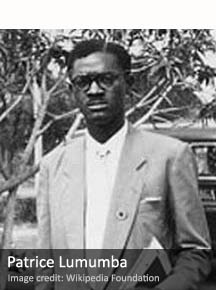
An historian whose book on British intelligence prompted the claim of Britain’s complicity in the 1961 assassination Patrice Lumumba has called for MI6 to declassify its secret files on the late Congolese Prime Minister. Calder Walton is a Cambridge University-educated intelligence historian whose first book, Empire of Secrets, examines the activities of British intelligence in the last days of the British Empire. A review of the book, published by Bernard Porter in The London Review of Books in March, prompted a claim that London had organized the assassination of the iconic pan-Africanist activist, who in 1960 had become Congo’s first democratically elected Prime Minister. Many believe that the United States had a hand in Lumumba’s assassination, which was aimed at preventing him from establishing close relations between uranium-rich Congo and the Soviet Union. But British Labour politician and Life peer Lord Lea of Crondall said in a letter published in response to the review of Walton’s book that Lumumba had been killed with the help of MI6, Britain’s primary external intelligence service. He claimed he had been told so by the late Baroness Park of Monmouth, who at the time of Lumumba’s death headed the Leopoldville station of MI6. In his book, Walton, who until 2009 served as research assistant for Professor Christopher Andrew’s authorized official history of MI5, Defence of the Realm, says it is unclear who organized Lumumba’s assassination. He argues that “at present, we do not know […] whether British plots to assassinate Lumumba […] ever amounted to anything”. But speaking to The London Times on Wednesday, the historian and author urged MI6 to declassify its internal archives on the Congolese leader. Read more of this post






 By IAN ALLEN | intelNews.org |













French spy agency forced Wikipedia volunteer to delete entry
April 9, 2013 by Joseph Fitsanakis 3 Comments
A French intelligence agency forced a volunteer for online open-source reference site Wikipedia to delete n entry that allegedly contained classified information about French nuclear defense systems. According to the Wikimedia Foundation, which publishes Wikipedia, the entry describes a radio relay system located at Pierre-sur-Haute military radio station in south-central France. Operated by the French Air Force, the station is said to have a central role in transmitting the order to launch France’s nuclear missiles in case of a full-scale thermonuclear war. The French-language Wikipedia webpage —which has since been fully restored— mentions, among other things, that the radio masts at Pierre-sur-Haute are designed to withstand the type of shockwave experienced in a thermonuclear attack. According to the Wikimedia Foundation, it was approached in early March, 2013, by the Direction Central du Renseignement Interieur (DCRI), which is tasked with domestic security and counterintelligence. The agency asked the Wikimedia Foundation to delete the entire webpage referring to the Pierre-sur-Haute military radio station, because it said it contravened French national security law. The Wikimedia Foundation, however, refused to comply with the request unless it was accompanied with either a court order or concrete information explaining why the Pierre-sur-Haute revelations were a threat to French national security. The DCRI reportedly backed down, promising to return with a formal justification for its request. However, instead of doing so, it contacted a French-based Wikipedia volunteer, who was summoned to the DCRI’s office under threat of legal action. Read more of this post
Filed under Expert news and commentary on intelligence, espionage, spies and spying Tagged with DCRI (France), France, French Air Force, government secrecy, Internet, News, Pierre-sur-Haute, Pierre-sur-Haute military radio station, radio communications, Wikipedia