Secret program gave CIA ‘unfiltered access’ to German communications

CIAThe United States Central Intelligence Agency had direct and unfiltered access to telecommunications data exchanged between German citizens, according to a new document that has surfaced in the German press. The program, codenamed GLOTAIC, was a collaboration between the CIA and Germany’s Federal Intelligence Service, known as BND. According to German newsmagazine Der Spiegel, which revealed the existence of the program last week, it lasted from 2004 to 2006. During those years, the CIA was given access to telephone and fax data carried by US telecommunications provider MCI Communications, which is owned by Verizon. The US-headquartered company owns a network switching facility in the German city of Hilden, located 10 miles east of Düsseldorf near the country’s border with Holland.

The existence of joint collection programs between the BND and American intelligence agencies has been established in the past, and has prompted the creation of a special investigative committee in the German parliament. The Committee of Inquiry into Intelligence Operations was set up in 2014, after files leaked by American defector Edward Snowden revealed that the US had been spying on the telephone communications of German Chancellor Angela Merkel. But it has also been investigating whether the BND’s collaboration with American intelligence agencies violated the rights of German citizens.

The committee had previously been told that all telecommunications data given to the US by German agencies had previously been vetted by BND officers. But the GLOTAIC documents published by Der Spiegel states that audio recordings of intercepted telephone calls were “directly routed to the US” in the interests of technical efficiency. The parliamentary committee had also been told that the data shared with the CIA concerned non-German citizens using German telecommunications networks. But the documents published last week state that a “technical glitch” in the GLOTAIC system allowed “massive German traffic” to be directly accessed by the CIA without having been first filtered by the BND.

Another document published by Spiegel reveals that the BND warned project CLOTAIC supervisors that the agency faced “serious risks” should the secret operation become public, because it had allegedly violated German federal privacy regulations.

Author: Joseph Fitsanakis | Date: 08 September 2015 | Permalink

Cambridge spy’s last years in Russia are detailed in new biography

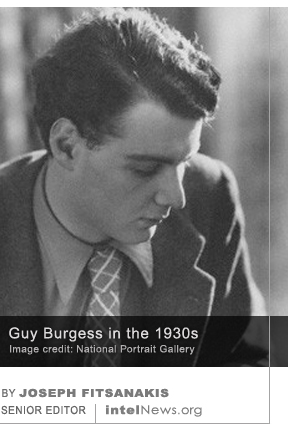
Guy BurgessThe life of Guy Burgess, one of the so-called ‘Cambridge Five’ double agents, who spied on Britain for the Soviet Union before defecting to Moscow in 1951, is detailed in a new biography of the spy, written by Andrew Lownie. Like his fellow spies Kim Philby, Donald Maclean, Anthony Blunt and John Cairncross, Burgess was recruited by the Soviets when he was a student at Cambridge University. He shook the British intelligence establishment to its very core when he defected to the USSR along with Maclean, after the two felt that they were being suspected of spying for the Soviets.

A few years after his defection, Burgess wrote to a close friend back in the UK: “I am really […] very well and things are going much better for me here than I ever expected. I’m very glad I came”. However, in his book, entitled Stalin’s Englishman: The Lives of Guy Burgess, Lownie suggests that Burgess’ life in the USSR was far from ideal. After being welcomed by the Soviets as a hero, the Cambridge University graduate was transported to the isolated Siberian city of Kuybyshev. He lived for several months in a ‘grinder’, a safe house belonging to Soviet intelligence, where he was debriefed and frequently interrogated until his Soviet handlers were convinced that has indeed a genuine defector.

It was many years later that Burgess was able to leave Kuybyshev for Moscow, under a new name, Jim Andreyevitch Eliot, which had been given to him by the KGB. Initially he lived in a dacha outside Moscow, but was moved to the city in 1955, after he and Maclean spoke publicly about their defection from Britain. He was often visited in his one-bedroom apartment by Yuri Modin, his Soviet intelligence handler back in the UK. According to Lownie, Burgess often complained to Modin about the way he was being treated by the Soviet authorities. His apartment had apparently been bugged by the KGB, and he was constantly followed each time he stepped outside.

The British defector worked for a Soviet publishing house and produced foreign-policy analyses for the Soviet Ministry of Foreign Affairs. He also produced a training manual for KGB officers about British culture and the British way of life. But he did not like living in the USSR and argued that he should be allowed to return to the UK, insisting that he could successfully defend himself if interrogated by British counterintelligence. Eventually, Burgess came to the realization that he would never return to his home country. He became depressed, telling friends that he “did not want to die in Russia”. But in the summer of 1963 he was taken to hospital, where he eventually died from acute liver failure caused by his excessive drinking.

Andrew Lownie’s Stalin’s Englishman: The Lives of Guy Burgess, is published by Hodder & Stoughton in the UK and by St Martins’ Press in the US. It is scheduled to come out in both countries on September 10.

Author: Joseph Fitsanakis | Date: 04 September 2015 | Permalink
Israeli nuclear whistleblower recalls his 1986 capture by the Mossad

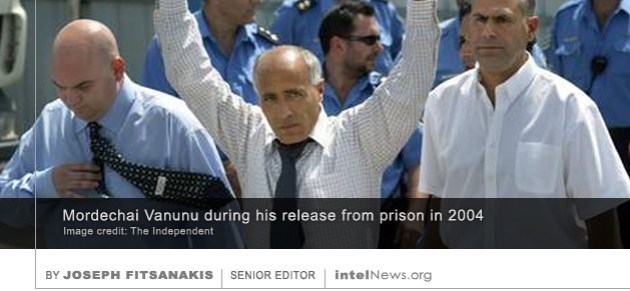
Mordechai VanunuIsraeli nuclear whistleblower Mordechai Vanunu, who spent 18 years in prison for revealing the existence of Israel’s nuclear program, has spoken for the first time about his 1986abduction by the Mossad in Rome. Vanunu was an employee at Israel’s top-secret Negev Nuclear Research Center, located in the desert city of Dimona, which was used to develop the country’s nuclear arsenal. But he became a fervent opponent of nuclear proliferation and in 1986 fled to the United Kingdom, where he revealed the existence of the Israeli nuclear weapons program to the The Times of London. His action was in direct violation of the non-disclosure agreement he had signed with the government of Israel; moreover, it went against Israel’s official policy of ‘nuclear ambiguity’, which means that the country refuses to confirm or deny that it maintains a nuclear weapons program.
Soon after Vanunu settled in London, the Israeli intelligence agency Mossad began making plans to capture him. The spy agency sent one of its American-born female officers, Cheryl Bentov, to befriend Vanunu. The decision was taken after Mossad psychologists determined that Vanunu was lonely and longed for female companionship. Masquerading as an American tourist by the name of ‘Cindy’, Bentov convinced Vanunu to go with her on Vacation to Rome, Italy. Soon after the couple arrived in the Italian capital, Vanunu was abducted by a Mossad team who injected him with a paralyzing drug before taking him away in a van. Vanunu was then transferred onboard the INS Noga, an Israeli signals-intelligence ship masquerading as a merchant vessel, which transported him to Israel. He was convicted to 18 years in prison and was released in 2004, after having spent 11 years in solitary confinement.

On Wednesday, Israel’s Channel 2 television showed excerpts of Vanunu’s first-ever interview to an Israeli media outlet. The interview, which is to be aired in full on Friday, includes Vanunu’s personal account of his capture by the Mossad. He told the interviewer that ‘Cindy’ first spoke to him as she walked alongside him while the two of them were crossing a London street. But he said that it was he who “initiated the relationship” with the woman posing as an American tourist. That was a critical moment in the whole process, said Vanunu, because “if she initiates you’ll suspect her”. The nuclear whistleblower insisted, however, that he did not “fall in love with her”, as some accounts of the Mossad operation have suggested, though he was “definitely attracted” to her, he said.

Vanunu added that the thought of ‘Cindy’ being a Mossad officer had initially crossed his mind; but he disregarded it and did not realize he was being tricked “until the very last moment”. He told Channel 2 that even after several days after his capture, he still believed that ‘Cindy’ had also been abducted. It was only later that he “reached the conclusion that she was part of the plan”, he said. At another point in the interview, Vanunu said that ‘Cindy’ was not the only Mossad officer who had tried to befriend him while he was in London, but that he was able to detect every other attempt by Israeli intelligence operatives.

Author: Joseph Fitsanakis | Date: 03 September 2015 | Permalink

Obama authorizes Special Forces, CIA, to conduct assassinations in Syria

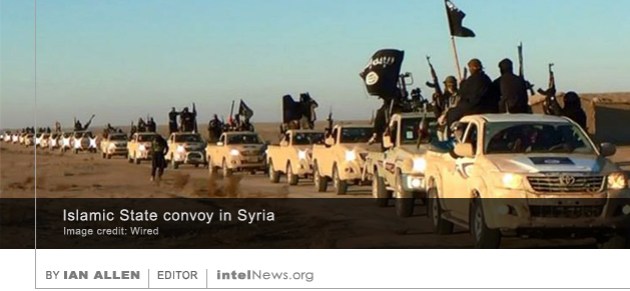
Islamic State convoy in SyriaThe United States Central Intelligence Agency is collaborating with the country’s Special Forces in a targeted killing program aimed against senior members of the Islamic State and other militant groups in Syria. The program, which has been directly authorized by US President Barack Obama, is limited in scope and has so far involved fewer than a dozen strikes against suspected militants. But it is believed to reflect increasing frustration in Washington about the lack of progress shown by the military campaign against the Islamic State. Recent reports by American intelligence agencies confirm that the militant group is “fundamentally no weaker” today than it was a year ago, despite an intense US-led bombing campaign involving thousands of airstrikes in Iraq and Syria.
The Washington Post, which revealed the existence of the program on Tuesday, said it brought together the CIA’s Counterterrorism Center (CTC) and the Joint Special Operations Command (JSOC). The CTC is believed to be primarily responsible for identifying and locating senior Islamic State figures in Syria, while the JSOC is in charge of killing them, mostly through the use of unmanned drones, according the paper. The two agencies continue to operate separate drone centers, said The Post, in Virginia and North Carolina respectively; but they have exchanged several of advisors who have constant access to each other’s drone video feeds.

The goal of the targeted killing program is to assassinate what the CIA refers to as “high-value targets”, which includes Islamic State leaders and those members of the organization whose job is to build a membership base outside the territorial boundaries or the Islamic State’s self-described caliphate. The Post said that the list of Islamic State members killed by the CIA-JSOC program includes Junaid Hussain, a British citizen who was instrumental in building and maintaining the Islamic State’s outreach campaign on social media. The paper noted that the CIA-JSOC targeted killing campaign is not part of the wider American military offensive against the Islamic State.

Author: Ian Allen | Date: 01 September 2015 | Permalink

‘Day of the Jackal’ author reveals he was MI6 agent for 20 years

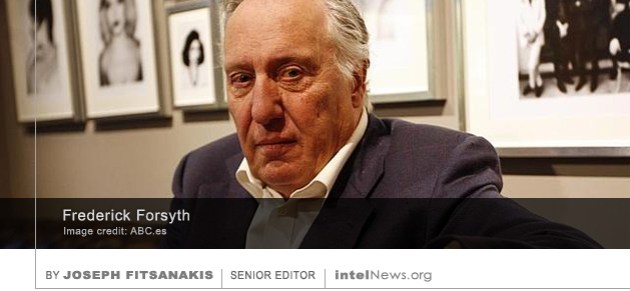
Frederick ForsythFrederick Forsyth, the esteemed British author of novels such as The Day of the Jackal, has confirmed publicly for the first time that he was an agent of British intelligence for two decades. Forsyth, who is 77, worked for many decades as an international correspondent for the BBC and Reuters news agency, covering some of the world’s most sensitive areas, including postcolonial Nigeria, apartheid South Africa and East Germany during the Cold War. But he became famous for authoring novels that have sold over 70 million copies worldwide, including The Odessa File, Dogs of War and The Day of the Jackal, many of which were adapted into film. Several of his intelligence-related novels are based on his experiences as a news correspondent, which have prompted his loyal fans to suspect that he might have some intelligence background.
But Forsyth had never commented on these rumors until last weekend, when was interviewed on the BBC’s main evening news program. He spoke to the station on the occasion of the upcoming publication of his autobiography, The Outsider: My Life, which will be in stores in October. He told the BBC that he was first recruited by the Secret Intelligence Service (MI6) in the late 1960s while covering the Nigerian Civil War. The bloody conflict, which is also known as the Biafran War, pitted the separatist Igbo people against the Nigerian federal government. Like other military conflicts in postcolonial Africa, it attracted the attention of the world’s powers, including France, the Soviet Union, the United States, and Britain. London was firmly on the side of the government in Lagos, but MI6 had reservations, believing that the Nigerian military forces were committing mass atrocities in Biafra. Forsyth said he was recruited by an MI6 officer who wanted to know if children were dying in Biafra as a result of the Nigerian government’s military policies against the Igbo separatists. The intelligence service were apparently hoping that they could use this information to change London’s stance on the brutal civil war. The author told the BBC that he spent the rest of the war “sending both journalistic reports to the media and other reports to my new friend”, referring to his MI6 handler.

When asked if he was paid for his services, he said his assistance to MI6 was provided on a strictly voluntary basis. “The attitude, the spirit of the age, was different back then”, he said, adding that “the Cold War was very much on” and when the British government asked a reporter for a favor it was “very hard to say no”. He did say, however, that MI6 promised to approve passages of some of his novels by way of payment. The author of The Day of the Jackal said he was given a number to call and told to send MI6 his manuscripts for vetting. “If they are too sensitive, we will ask you not to continue”, Forsyth told the BBC.

Author: Joseph Fitsanakis | Date: 31 August 2015 | Permalink

US Pentagon probing claims of falsely optimistic intel reports on ISIS

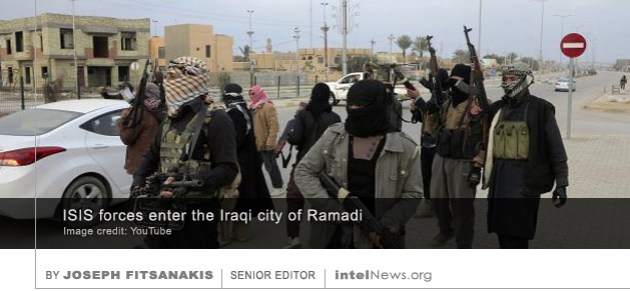
ISIS forces in RamadiThe United States Department of Defense is investigating claims that some of its officials doctored intelligence reports to give a falsely optimistic account of the campaign against the Islamic State. Citing “several officials familiar with the inquiry”, The New York Times said in a leading article on Tuesday that the Pentagon launched a probe into the allegations in recent weeks. According to the paper, the probe was launched following a complaint filed by at least one analyst in the Defense Intelligence Agency (DIA), the Pentagon’s primary human-intelligence agency. According to the analyst, intelligence reports were deliberately tweaked by officials at the US Central Command (CENTCOM), the Pentagon body that directs and coordinates American military operations in Egypt, the Middle East and Central Asia. The reports related to the Islamic State, known also as the Islamic State of Iraq and al-Sham (ISIS), a militant Sunni organization that currently controls large swathes of territory in Iraq and Syria.
Many Middle East observers, including this website, have made notably dire projections about the continuing reinforcement and territorial expansion of ISIS. Earlier this month, the Associated Press published an unconfirmed assessment of a “strategic stalemate” in Syria, which allegedly represented the views of the Central Intelligence Agency (CIA), the DIA and other members of the US Intelligence Community. According to the news agency, the report said that ISIS is “fundamentally no weaker” today than it was a year ago, when the United States began a bombing campaign targeting ISIS strongholds.

But earlier assessments by DIA, which were communicated to senior US policymakers, including President Barack Obama, were far more optimistic about America’s ability to defeat the militant group, said The Times. According to the paper, the DIA analyst had evidence showing that CENTCOM officials had systematically doctored the conclusions of intelligence reports about ISIS before passing them on to American leaders. It appears that the evidence pointing to deliberate manipulation of intelligence assessments was convincing enough to prompt the Pentagon’s Office of the Inspector General to launch an official probe into the matter.

When asked to respond to The Times’ allegations, CENTCOM spokesman Colonel Patrick Ryder said he was unable to comment on an ongoing investigation by the Inspector General. If the allegations are substantiated by the probe, the Inspector General is legally required to share them with the intelligence oversight committees of the US Congress.

Author: Joseph Fitsanakis | Date: 27 August 2015 | Permalink

Maltese far-right party had links to CIA, British documents suggest

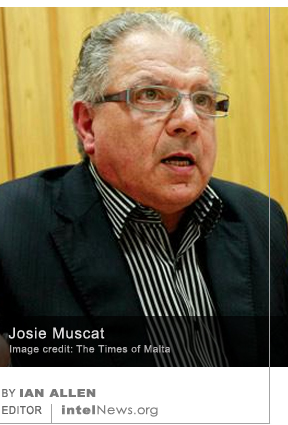
Josie MuscatA Maltese ultra-nationalist group believed to be behind a string of bombings in the 1980s was believed by British intelligence to have links to the United States Central Intelligence Agency (CIA), according to recently declassified documents. The Front Freedom Fighters (FFF) was a staunchly anticommunist group whose members violently objected to what they saw as Malta’s overly close contacts with the Communist Bloc. During the 16-year rule of the Maltese Labour Party, which began in 1971, the Mediterranean island maintained close relations with countries during such as Libya and North Korea. The Maltese Nationalist Party, which formed the main opposition to Labour, was highly critical of these contacts, but failed to win three consecutive electoral contests and was thus unable to influence the country’s foreign policy in any significant way.
The FFF emerged in the early 1980s from within the ranks of the Nationalist Party. It consisted of younger activists who favored a violent response to the rule of the Labour Party. The group was led by Josie Muscat, a dynamic anticommunist campaigner and longtime Nationalist Party Member of Parliament, who gathered around him some of the more extreme rightwing elements in the Nationalist Party. A string of bombings and threats directed at Labour Party facilities on the island was attributed to the FFF by the popular press, though Muscat himself consistently denied such accusations. Many believed that the FFF was actively preparing to launch an armed coup d’etat.

Eventually, the leadership of the Nationalist Party, which saw itself as falling within the mainstream of the European conservative tradition, began distancing itself from the FFF’s rhetoric and actions. In July of 1983, the party expelled FFF leaders from its ranks and forbade its members from associating with FFF-linked groups. Few Nationalist Party members followed Muscat, and his movement eventually suffered what some observers described “a natural death”.

However, new documents released this month by the National Archives in Britain show that the British Foreign Office believed that the FFF was being funded by the CIA. A Foreign Office Report from the early 1980s states that the group was probably behind several bomb explosions targeting Labour Party activists, as well as moderate Nationalist Party members. The report describes the FFF as “neo-Fascist in character” that prioritized crude violence as its main tactic. It goes on to say that the group consisted of about 500 determined members, but that its violent core was much smaller. The Foreign Office report also suggests that Muscat may have traveled abroad to meet CIA officers, as well as to network with other anticommunist organizations throughout Europe.

Asked to give his reaction to the British government documents, Muscat told The Times of Malta that he “hadn’t had such a good laugh in years”. The now retired politician denied having any links to the CIA and said that the FFF’s activities had been “mostly limited to political debating and had never even come close to any form of violence”.

Author: Ian Allen | Date: 25 August 2015 | Permalink

British government releases MI5 file on little-known Cold War spy

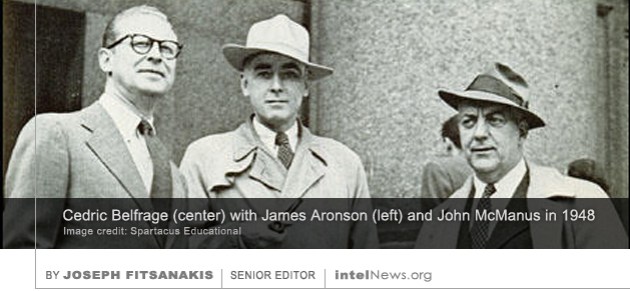
Cedric BelfrageThe British government has released a nine-volume file on an influential film critic who some believe was “one of the most important spies the Soviet Union ever had”. Cedric Belfrage was born in 1904 in London and read English Literature at Cambridge University in the 1920s. While a student at Cambridge he made a name for himself as a reviewer of motion pictures, and by the early 1930s he was known as Britain’s highest-paid film critic. Soon afterwards he moved to the American city of Los Angeles, where he became a film and theater correspondent for British tabloid newspaper The Daily Express. But a multivolume file on him compiled by the British Security Service (MI5) and released last week by the National Archives in London, confirms that Belfrage spied for Soviet intelligence under the codename BENJAMIN.
According to the file, Belfrage turned to communism after witnessing the effects of the Great Depression in the United States. After a 1936 trip to the USSR, he reached out to the Communist Party of the US, which eventually put him in touch with a number of Soviet intelligence operatives in America. In 1940, the Secret Intelligence Service (MI6) set up the British Security Coordination (BSC) in New York. It was a clandestine propaganda project aimed at turning local public opinion in favor of America’s entry into World War II. Belfrage was one of many writers and intellectuals that were recruited by the BSC to help counter the prevalent isolationist sentiment in the country. The film critic worked for MI6 until 1943, and then returned to Britain to join another wartime propaganda outfit, the Political Warfare Executive.

At war’s end, Belfrage returned to the US, only to find that he had attracted the attention of the Federal Bureau of Investigation. The FBI had discovered that the British film critic had dealings with the Communist Party in the 1930s and suspected that he may have worked for Soviet intelligence. Further investigations revealed that Belfrage had indeed conducted espionage under the guidance of Jacob Golos, a Ukrainian-born American who managed a large network of pro-Soviet spies in America in the interwar period. But when he was questioned by the FBI, Belfrage said that he had given Golos a number of British —not American— government documents under direct orders by MI6. The latter allegedly hoped that the Soviets would reciprocate the move within the context of the anti-Nazi alliance between the UK and the USSR.

Eventually, Belfrage was brought up before the House Un-American Activities Committee (HUAC) of the US Congress in 1953. The Committee was conducting public hearings aimed at unmasking suspected communist sympathizers in the American entertainment industry. But the British-born film critic refused to answer questions put to him, prompting HUAC to recommend that he should be deported from the country. The government adopted the Committee’s recommendation and deported Belfrage in 1955 for having been a member of the Communist Party under a fake name. Belfrage traveled throughout the Caribbean and Latin America before settling in Mexico, where he died in 1990, aged 86.

Interestingly, the British files reveal that MI5 decided not to prosecute Belfrage, most likely in order to avoid the embarrassment of admitting that British intelligence had employed a Soviet spy. The decision was probably not unrelated to the public scandal that followed the escape of the so-called Cambridge spies to the Soviet Union. Interestingly, Belfrage studied at Cambridge at the same time that Kim Philby (Soviet cryptonym STANLEY), Donald Duart Maclean (HOMER) and Guy Burgess (HICKS) were students there. But there is no evidence he ever collaborated with them, as he was not interested in politics at that time.

Author: Joseph Fitsanakis | Date: 24 August 2015 | Permalink

German government charges CIA spy with treason

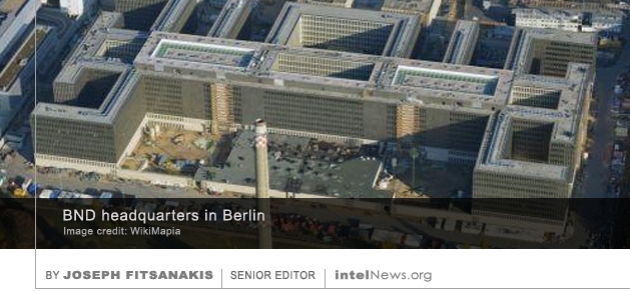
BND GermanyA German intelligence officer, who is accused of spying for the United States Central Intelligence Agency, has been officially charged with treason by authorities in Berlin. The 32-year-old man, identified in court papers only as “Markus R.”, worked as a clerk at the Bundesnachrichtendienst, or BND, Germany’s external intelligence agency. He was arrested in July 2014 on suspicion of having spied for the CIA for approximately two years. German prosecutors say they have evidence that shows Markus R. supplied the American spy agency with around 200 classified German government documents in exchange for around €25,000 —approximately $30,000.

Germany’s Office of the Federal Prosecutor said on Thursday that Markus R. made contact with the CIA in 2008 and offered his services to the American spy agency. He began working for the United States as a double agent soon afterwards. His arrest last year added to the already tense relations between Berlin and Washington. The latter had been damaged a year earlier, when it was revealed that the US National Security Agency, America’s signals intelligence organization, had bugged the personal cell phone of German Chancellor Angela Merkel. The revelation, which was made public by Edward Snowden, an American defector to Russia who had previously worked for the NSA, showed that Chancellor Merkel had been targeted as part of a wider US spy operation against Germany.

The revelations sparked the establishment in Germany of a nine-member parliamentary committee that was tasked with evaluating Snowden’s revelations and proposing Germany’s response. It appears that Markus R. tried to spy on the activities of the committee on behalf of his American handlers. Soon after Markus R.’s arrest was made public, the German government ordered the immediate removal from Germany of the CIA chief of station –who was essentially the top American intelligence official in the country. Berlin also instructed its intelligence agencies to limit their cooperation with their American counterparts “to the bare essentials” until further notice.

It is worth noting that, before his arrest last year, Markus R. is also said to have approached Russian intelligence with an offer to work for them. He is thus believed to have supplied Moscow with classified German government documents as well.

Author: Joseph Fitsanakis | Date: 21 August 2015 | Permalink

Pakistan spy chief who helped US covert activities in Soviet-Afghan war dies

Hamid GulGeneral Hamid Gul, a controversial Pakistani spymaster who helped facilitate America’s covert involvement during the closing stages of the Soviet-Afghan war, has died at the age of 72. General Gul entered military service in 1956, aged 20, and saw action in two of Pakistan’s wars with India. He rose to power within the military through his close association with General Muhammad Zia-ul-Haq, who became Pakistan’s sixth president in 1977. In 1987, shortly before President Zia died in a plane crash, General Gul was promoted to director of Pakistan’s Inter-Services Intelligence directorate, which is known as ISI. In that capacity, he oversaw the closing stages of the Soviet-Afghan war, which had begun nearly a decade later and gradually led to a resounding defeat for the Soviets.
As head of the ISI, General Gul helped the intelligence agencies of several countries, including those of Saudi Arabia and the United States, engage covertly in the war taking place across the Hindu Kush. In particular, he helped facilitate the transfer of foreign funds and weaponry to Sunni mujahedeen forces who were fighting the Soviets. It was from within the ranks of these forces that groups like al-Qaeda and the Taliban later emerged.

General Gul was never shy about his close operational links with the Afghan Taliban and al-Qaeda. He maintained close contact with al-Qaeda founder Osama bin Laden and with the late Mullah Muhammad Omar, leader of the Afghan Taliban. However, at the conclusion of the Soviet-Afghan War, Washington gradually disassociated itself from Sunni fundamentalist groups, including the Taliban. But General Gul maintained his public support for Muslim-inspired militant groups, among them Lashkar-e-Taiba, which operates in Indian-controlled Kashmir. As America began distancing itself from its former Afghan allies, and siding instead with India, General Gul’s relations with Washington worsened dramatically. In 2009, the General gave one of many controversial interviews to the media, in which he condemned the increasing military and political collaboration between the US and India. He noted that “the Americans and Israel [are] hell-bent” on positioning India to the role of overseer of “60 per cent of the world’s trade [which] passes through the Indian Ocean”, including transport routes of “Gulf oil, bound for China and Japan”.

In later years, General Gul became a vocal critic of US foreign policy in the Middle East and Central Asia, spoke out against the US invasions of Afghanistan and Iraq, and publicly supported the Taliban insurgency against the North Atlantic Treaty Organization forces in Afghanistan. He is survived by a widow and three children.

Author: Joseph Fitsanakis | Date: 20 August 2015 | Permalink

Soviet mole penetrated Australian intelligence, says former officer

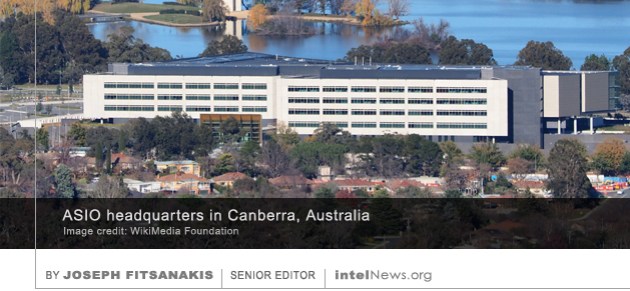
ASIO AustraliaA Soviet double spy was able to penetrate the senior echelons of Australia’s intelligence agency during the Cold War, according to a retired Australian intelligence officer who has spoken out for the first time. Molly Sasson, was born in Britain, but worked for the Australian Security Intelligence Organisation (ASIO) from 1969 until her retirement in 1983. A fluent German speaker, Sasson was first recruited during World War II by the Royal Air Force, where she worked as an intelligence officer before transferring to the Security Service (MI5), Britain’s domestic intelligence agency. At the onset of the Cold War, Sasson helped facilitate the defection to Britain of Colonel Grigori Tokaty, an influential rocket scientist who later became a professor of aeronautics in London. But in the late 1960s, Sasson moved with her husband to Australia, where she took up a job with ASIO, following a personal invitation by its Director, Sir Charles Spry. Upon her arrival in Canberra, Sasson took a post with ASIO’s Soviet counterintelligence desk, which monitored Soviet espionage activity on Australian soil.
Aged 92 today, Sasson spoke publicly for the first time on Australia’s ABC News television network about her life and times. She told the reporter that she had “no doubt at all” that ASIO had been infiltrated by at least one Soviet-handled double spy in the 1970s. “If we put on an operation, it failed”, she said, adding that the Soviets “always seemed to be a step ahead of us. There must have been a tip-off. It can’t have been otherwise”, said Sasson. The 92-year-old former intelligence officer recounted one specific operation involving a Russian diplomat named Vladimir Dobrogorsky, who was believed by ASIO to be an intelligence operative. According to Sasson, ASIO counterintelligence officers were monitoring Dobrogorsky and knew the precise time and place that he was scheduled to meet with an Australian informant in downtown Canberra. However, not only did the meeting not occur, but Dobrogorsky left the Soviet embassy in the Australian capital that morning, never to return.

“I am convinced that someone within ASIO tipped him off”, said Sasson. Not only that, but when she and other ASIO officers expressed their concerns about the possible existence of a mole inside ASIO, senior agency officials dismissed them. At one point she was told to “not open this can of worms”, she told ABC News. The former ASIO officer added that the chief of the United States Central Intelligence Agency station in Canberra shared similar concerns with the ASIO’s leadership, but that they too were dismissed. Soviet intelligence operatives were notably active in Australia and New Zealand during the Cold War, as it was believed that intelligence agencies in the two Pacific Rim countries offered an easier path toward accessing British and American government secrets, due to the so-called Five Eyes agreement.

Author: Joseph Fitsanakis | Date: 19 August 2015 | Permalink

Former KGB officer facing deportation voluntarily leaves Canada

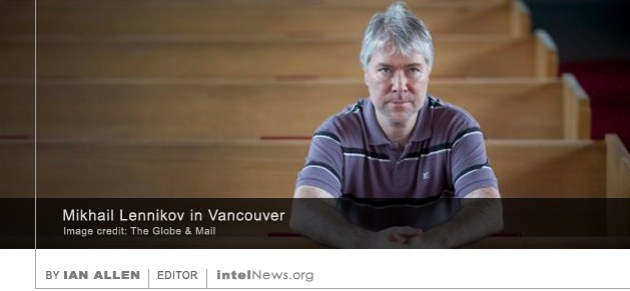
Mikhail LennikovA Russian former officer in the Soviet KGB, who defied deportation orders issued against him by the Canadian government by taking refuge in a Vancouver church for six consecutive years, has voluntarily left the country. Mikhail Lennikov, who spent five years working for the KGB in the 1980s, had been living in Canada with his wife and son since 1992. But in 2009, Canada’s Public Safety Ministry rejected Lennikov’s refugee claim and notified him that he could “be ordered deported from the country in as early as a few weeks”.
Canadian authorities have refused to reveal the precise reason for the decision to issue deportation orders against the former KGB agent. But it is believed that his Soviet intelligence background is perceived by Canadian authorities as a national security threat. Lennikov has consistently rejected accusations that he is a threat to Canada’s national security and has previously stated that he voluntarily revealed his KGB background to Canadian authorities. He has also said that if sent back to Russia he could face imprisonment for having revealed his KGB background to a foreign government. In 2009, the former KGB officer sought refuge at the First Lutheran Church in Vancouver, where he lived until recently. Meanwhile, his wife and children, who have no connections to Soviet or Russian intelligence, were awarded asylum and eventually Canadian citizenship.

Last week, however, it emerged that Lennikov had left the Vancouver church that had been his home for six years. His lawyer, Hadayt Nazami, told reporters that the former KGB officer had left Canada. His departure appears to have taken place after an agreement was struck between him and the Canada Border Services Agency. Nazami said on Sunday that Lennikov had “left at the end of this week and left on his own accord, voluntarily, according to his own wishes and decisions he reached himself”. Canadian media reported that it “no longer seemed to be the case” that Lennikov would face treason charges if he went back to Russia. When asked about Lennikov’s whereabouts, Nazami told journalists that it was “something that I cannot comment on”, but added that his client “feels safe and we are going by that assumption”. Lennikov’s wife and children, who are Canadian citizens, plan to remain in Canada, said Nazami.

Author: Ian Allen | Date: 19 August 2015 | Permalink

US warns China against use of non-official-cover operatives

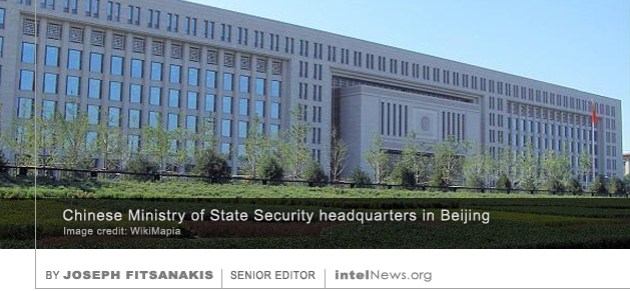
Chinese Ministry of State SecurityThe White House has warned the Chinese government to stop deploying on American soil intelligence operatives masquerading as tourists, business executives or other false covers. Nowadays the standard practice for intelligence personnel deployed abroad is to be posted as diplomatic staff in a foreign embassy or consulate. But there are some intelligence officers who do not follow that practice. These are known as non-official-cover operatives, or NOCs in American intelligence parlance. NOCs are typically high-level principal agents or officers of an intelligence agency, who operate without official connection to the diplomatic authorities of the country that is employing them. They typically pose as business executives, students, academics, journalists, or non-profit agency workers. Unlike official-cover officers, who are protected by diplomatic immunity, NOCs have no such protection. If arrested by authorities of their host country, they can be tried and convicted for operating as unregistered agents of a foreign government.
According to The New York Times, a significant number of Chinese NOCs have recently entered the United States as part of the Chinese government’s Operation FOX HUNT. Supervised by China’s Ministry of State Security (MSS), FOX HUNT is aimed at the thousands of former officials and other fugitives from China, who are alleged to have embezzled funds and are now living abroad, usually in considerable wealth. As part of the MSS operation, teams of intelligence agents are said to have been dispatched around the world in order to hunt down these fugitives, many of whom are believed to have embezzled hundreds of millions of dollars in government funds. Chinese media reports claim that nearly 1000 such fugitives have been “repatriated”, either voluntarily or involuntarily, since the launch of FOX HUNT. The tactics used by the Chinese NOCs are not clear, and some suspect that they include direct or indirect threats against the fugitives’ family members in China. Chinese reports have described FOX HUNT operatives as “mostly young, highly skilled”, and accustomed to “rapid-fire deployment” around the world.

The Times said that Washington views the parts of Operation FOX HUNT that take place on US soil as “a departure from the routine practice of secret government intelligence gathering” that both America and China practice against each other. The US, therefore, does not want Chinese officers without official diplomatic credentials, but posing instead as students, tourists or business representatives, engaging in intelligence operations on US soil, said the paper. It added that Washington’s warning had been delivered to Beijing “in recent weeks”. The Times article did not include specific descriptions of FOX RUN activities on American soil.

Author: Joseph Fitsanakis | Date: 17 August 2015 | Permalink

Rwandan spies target government critics abroad: Canadian report

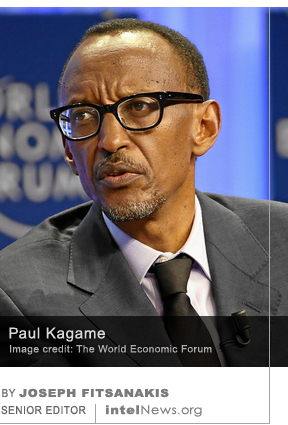
Paul KagameThe government of Rwanda uses intelligence operatives to systematically spy on, harass, and even kill opposition figures living abroad, according to a report issued by a Canadian security agency. The report was written by the National Security Screening Division of the Canada Border Services Agency, and was partly based on information from the Canadian Security Intelligence Service (CSIS). It was released as part of a court case involving a Rwandan man living in Canada, who was accused of working as a spy for the government of Rwanda.
The report claims that there is “a well- documented pattern of repression of Rwandan government critics, both inside and outside Rwanda”, and says there is ample evidence of involvement by Rwandan spies in threats, attacks and even killings of opposition activists living abroad. The document cites the case of Patrick Karegeya, a leading member of the Rwandan Patriotic Front (RPF), an armed Tutsi rebel group that fought to end the genocide inflicted upon the Tutsis by their rival Hutus in the 1990s. Karegeya, who used to be director general of External Intelligence in the RPA, fell out with Rwanda’s President, Paul Kagame, in 2004. In January 2014, Karegeya was found dead in a hotel in Johannesburg, South Africa, where he had been living in exile.

Also cited in the report is a case in the United Kingdom, where two Rwandan exiles were warned by the police in 2011 that there were “threats to their [personal] safety emanating from the Rwandan government”. There was also evidence of Rwandan intelligence activity targeting opposition figures in Canada, said the report. In one recent case, the Rwandan government had attempted to “organize indoctrination training” aimed at Canadian youths of Rwandan heritage, but had to drop its plan following an investigation by CSIS. IntelNews regulars might also remember the case of Evode Mudaheranwa, a Rwandan diplomat who was expelled by the government of Sweden in 2012 for allegedly operating under orders by the Kagame government to silence its critics abroad.

Author: Joseph Fitsanakis | Date: 14 August 2015 | Permalink

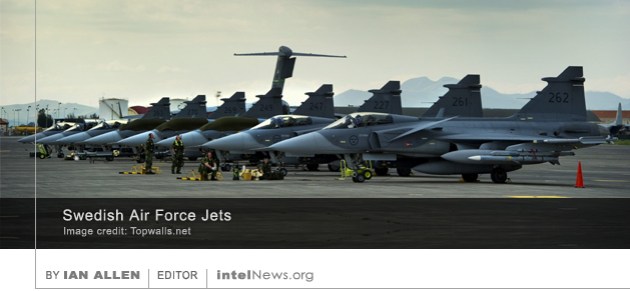
Sweden conducts spy flights over Russia amidst heightened tensions

Swedish Air ForceSwedish Air Force spy planes conducted reconnaissance flights over Russia on Wednesday —and there was nothing the Kremlin could do about it. The flights were part of the 1992 Treaty on Open Skies, an international agreement designed to build trust among former Cold War rivals. The treaty was first proposed by the United States in 1990, with the intention of covering all member-states of the Warsaw Pact and the North Atlantic Treaty Organization. When it was eventually signed, on March 24, 1992, it was ratified by 23 countries, including the US and Russia. An additional 11 states have joined the treaty at various times since, with Sweden joining in 2002. On Wednesday, Swedish reconnaissance airplanes conducted flights over a number of Russian military installations as part of the treaty, as they do every year during predetermined times.


This year, however, the stakes are different, since relations between Stockholm and Moscow have deteriorated dramatically. The Scandinavian country has issued numerous formal complaints against what it says were illegal infiltrations of its airspace by Russian military jets since 2014. Carl Bildt, Sweden’s Minister of Foreign Affairs, said earlier this year that some of these alleged airspace infiltrations represented “the most serious aerial incursions by the Russians in almost 10 years”. In October of last year, Swedish authorities shut down airspace over Stockholm while searching for a misery foreign vessel seen off the coast of the Swedish capital, said to be a Russian spy submarine. The mystery vessel was never detected, but some Swedish media sites claimed that its mission had been to either “pick up or drop off a Russian spy” without alerting Swedish authorities. In March of this year, the Swedish Security Service, known as SAPO, said that Russia was Sweden’s greatest short-term threat, adding that nearly a third of all Russian diplomats stationed in Sweden were in fact intelligence officers.

Swedish media quoted Swedish Armed Forces Colonel Carol Paraniak, who said that Russia was and would always remain an intelligence target for Sweden. This is especially true today, as the “security and political situation […] has changed a lot compared to last year. Tensions have increased dramatically”, said Paraniak.

Author: Ian Allen | Date: 13 August 2015 | Permalink