Turkey launches investigation after explosive found under Erdoğan guardsman’s car
December 6, 2021 1 Comment
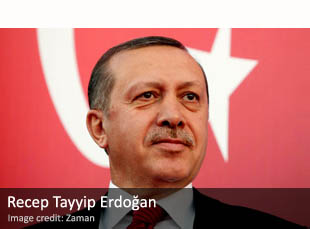
 TURKISH AUTHORITIES HAVE LAUNCHED an investigation after a makeshift explosive device was found under the car of a police officer guarding an open-air speech by President Recep Tayyip Erdoğan. The rally took place on Saturday in Siirt, a Kurdish-majority town located about 90 miles from the Turkish-Syrian border. The town has a symbolic significance for Erdoğan, as it is the hometown of his wife, Emine Erdoğan, and was his constituency for four years. In 2003 he won a by-election there and entered the Turkish Grand National Assembly as a member.
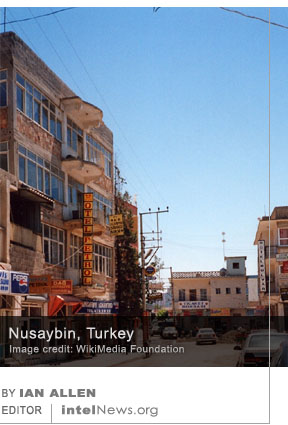
According to pro-government Turkish media, the makeshift bomb was affixed to the undercarriage of a private car. The car belongs to a police officer in the city of Nusaybin (pictured), in the province of Mardin, which is situated on the Turkish-Syrian border. The explosive device was detected by a bomb squad on Saturday morning, as the police officer was preparing to depart for Siirt, where he was going to help secure an outdoor rally by Erdoğan. The purpose of the rally was to gather support for the embattled Erdoğan, as the Turkish economy is undergoing its most serious recession in a generation.
Turkish media said that a specialist bomb squad was dispatched to Nusaybin upon the discovery of the device, and defused it “in a controlled manner”. Later that day, Erdoğan began his speech at the rally in Siirt by mentioning the discovery of the device, saying that the “defeats suffered by the terrorists” were bound to prompt “confessions of treachery and meanness”, which will be “revealed in time”. Southeastern Turkey, where Siirt is located, is a stronghold of the Kurdistan Workers Party (PKK), an armed secessionist group that Turkey has been battling for nearly 40 years.
► Author: Ian Allen | Date: 06 December 2021 | Permalink
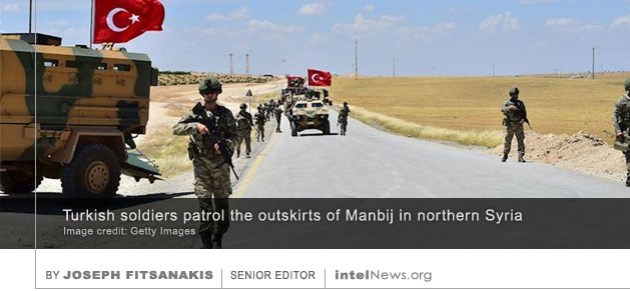 Senior White House officials close to United States President Donald Trump believed that Turkish President Recep Tayyip Erdoğan was bluffing when he threatened to invade northern Syria, according to sources. For over two years, most of northern Syria has been controlled by American-supported Kurdish militias, who were instrumental in helping Washington defeat the Islamic State. But the growing strength of the Kurdish forces alarmed Turkey, which views Kurdish nationalism as a bigger threat than the Islamic State.
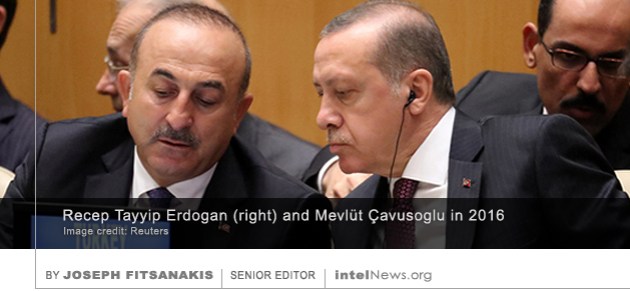 A number of European intelligence agencies have reportedly warned the Turkish government of a possible assassination attempt against the country’s president, Recep Tayyip Erdoğan, during an official state visit to Bosnia and Herzegovina. On Sunday the Turkish leader embarked on a week-long visit to the Balkans, beginning with Bosnia, which along with Albania is seen as Turkey’s strongest political ally in Europe. During his visit to Bosnia, Mr. Erdoğan is scheduled to meet with Bakir Izetbegovic, one of the country’s three presidents. He is also scheduled to address a rally of expatriate Turks in the Bosnian capital Sarajevo, held in support of his ruling Justice and Development Party.








 intelNews.org
Analysis: A murky assassination that could radically alter Turkish politics
January 30, 2023 by Joseph Fitsanakis 1 Comment
Turkey’s Far-Right Shock Troops
Known officially as the Idealist Clubs Educational and Cultural Foundation, the Grey Wolves organization is the paramilitary arm of the Nationalist Movement Party (MHP), a militant political force that occupies most of the far-right space of Turkish politics. The MHP espouses authoritarian and anti-Western views and is violently opposed to negotiations with Turkey’s ethnic minorities, including the Kurds. Its politics appeal to ultra-conservative voters, who are usually male and over the age of 35. The Grey Wolves operate as the MHP’s shock troops, often engaging in bloody street fights against Kurds, leftists, and other popular forces that stand in opposition to the Turkish far-right. Known for their machismo and violent bravado, the Grey Wolves appeal to working-class men in their teens and twenties. In essence, therefore, the MHP and the Grey Wolves are two sides of the same coin.
In 2015, the MHP formed an electoral pact with President Erdoğan’s Justice and Development Party (AKP). The formation of this pact, known as the People’s Alliance, marked the culmination of a long process of informal cooperation between the two sides, which had been going on since at least 2007. The People’s Alliance has been instrumental in preserving the AKP’s domination of Turkish political life in recent years, despite the loss of popularity that President Erdoğan has been experiencing. Currently the AKP relies directly on the MHP’s parliamentary support to rule Turkey with a minority government. The Grey Wolves, which tend to be more unruly than their parent organization, are nominally in support of Erdoğan, but tend to see him as too mellow and not sufficiently authoritarian.
The Fragmentation of the MHP
The MPH likes to project itself as a unified militant organization. In reality, it has always been the product of an uneasy alliance between disparate far-right groups. Its membership ranges from social conservatives to ultranationalists, Hanafi (Sunni) puritans and even neo-fascists. In 2017, when the MHP and the AKP formed the People’s Alliance, several of these groups voiced serious misgivings about aligning themselves with Erdoğan. Eventually, a vocal faction of pro-Western and secularist conservatives left the party over concerns that the MHP would be completely absorbed by the pro-Islamist and anti-Western AKP. Read more of this post
Filed under Expert news and commentary on intelligence, espionage, spies and spying Tagged with Analysis, assassinations, Grey Wolves (Turkey), Joseph Fitsanakis, Justice and Development Party (Turkey), Nationalist Movement Party (Turkey), Newstex, Recep Tayyip Erdoğan, Sinan Ateş, Turkey