US government publicly admits existence of rogue phone-tapping devices in DC
April 4, 2018 1 Comment
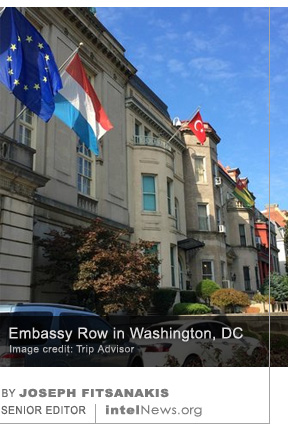 The United States government has for the first time admitted publicly that it has detected devices known to be used by foreign intelligence services to spy on cellular communications in the nation’s capital. Known commonly as Stingrays, after a leading hardware brand, these devices are primarily used by government agencies, including law enforcement. But they can be purchased by anyone with anywhere from $1,000 to $200,000 to spare. They work by simulating the activity of legitimate cell towers and tricking cell phones into communicating with them. That allows the users of these cellphone-site simulators to monitor the physical whereabouts of targeted cell phones. Some of the more expensive Stingray models can intercept the actual content of telephone conversations and can even plant Trojans on the compromised phones of unsuspecting users.
Many governments have expressed concerns about the use of these devices, which are known to be used by intelligence agencies to monitor cellular communications on foreign soil. Major cities around the world, including Washington, are major targets of cellphone-site simulators, which are frequently located inside foreign embassies. However, the US government has never publicly commented on this issue, despite intense rumors that government agencies headquartered in Washington are major targets of Stingray devices. This changed recently, however, after Senator Ron Wyden (D-OR) wrote a letter to the Department of Homeland Security seeking information about the use of such devices in Washington. Wyden received a written response from Christopher Krebs, who heads the DHS’ National Protection and Programs Directorate. In the letter, dated March 26, Krebs confirmed that the DHS detected a number of active Stingrays in the DC area in 2017, which he referred to as “anomalous activity consistent with Stingrays”. But he added that the DHS lacks both funding and equipment needed to detect the full number of the devices and the full spectrum of Stingrays that are active in the nation’s capital.
The Associated Press, which published Krebs’ letter, said it acquired it from Wyden’s office in the US Senate. The news agency noted that the letter from DHS did not provide the technical specifications of the cellphone-site simulators, and did not enter into speculation about who might be employing them. Additionally the letter did not provide the exact number of Stingrays detected in DC in 2017, nor did it provide the exact locations in DC where Stingray activity was traced. In response to Krebs’ letter, Senator Wyden’s office released a statement blaming the US Federal Communications Commission for having failed to hold the cellular telecommunications industry accountable for the lack of security against Stingrays. “Leaving security to the phone companies has proven to be disastrous”, Senator Wyden’s statement concluded.
► Author: Joseph Fitsanakis | Date: 4 April 2018 | Permalink








 intelNews.org
Saudi Arabia may be abusing global phone tracking system to spy on dissidents
March 30, 2020 by Ian Allen 1 Comment
The alleged documents may implicate Saudi Arabia’s three largest cellular telecommuni- cations service providers, said The Guardian, namely Mobily, Zain and Saudi Telecom. The anonymous whistle-blower told the paper that these companies were “weaponizing mobile technologies”, allegedly under the direction of Saudi Arabia’s ruling monarchy, which is notorious for suppressing political dissent within and outside the oil kingdom.
The alleged method of surveillance relies on SS7, a decades-old feature of the global cellular telecommunications system, which allows cellular providers to provide service to mobile phone users as they travel internationally. The SS7 system allows a mobile phone registered in a specific country to be used from a different country, and its user to be charged for the service. But to do so with accuracy, the SS7 system enables the service provider to track the owner of the device being charged for the phone call. This is done through what is known in cellular telecommunications parlance as a Provide Subscriber Location, or PSL, request.
According to The Guardian, Saudi cellular telecommunications providers have been making “excessive use” of PSLs in recent years. This indicates possible attempts to track the physical movements of Saudi cell mobile phone users who are traveling to the United States, and possibly other countries. The paper said that millions of PSLs were filed by Saudi Arabia in a one-month period in November of 2019. There is no telling how long this alleged surveillance operation has been going on, and in how many countries.
The paper also said that Ron Wyden, a Democratic senator from the US state of Oregon, who is a member of the Senate’s powerful Committee on Intelligence, has written to the Federal Communications Commission (FCC) about the privacy vulnerabilities of the SS7 system. However, the FCC has taken no action on the matter.
► Author: Ian Allen | Date: 30 March 2020 | Permalink
Filed under Expert news and commentary on intelligence, espionage, spies and spying Tagged with cellular telephony, Mobily, News, Provide Subscriber Location, Ron Wyden, Saudi Arabia, Saudi Telecom, SS7, United States, US Federal Communications Commission, Zain