Sophisticated spy malware found on Russian government computers
August 1, 2016 1 Comment
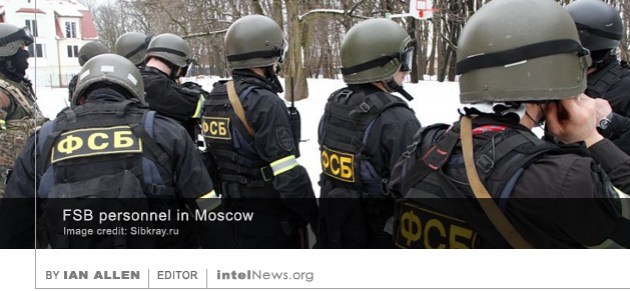 According to the predominant media narrative, the United States is constantly defending itself against cyber-attacks from countries like China and Russia. But, as intelNews has argued for years, this narrative is misleading. Recent intelligence disclosures clearly show that the US cyber-security posture is as offensive as that of its major adversaries. Additionally, China and Russia have to defend their computer networks as much as America does. Last weekend’s report from Moscow helps restore some of the balance that is missing from media reporting on cyber-security. According to the Russian Federal Security Service (FSB), a meticulously coded and sophisticated virus has been found on the computer networks of at least 20 major Russian agencies and organizations. The targets appear to have been carefully selected by the malware’s authors. They include government bodies, weapons laboratories and defense contractors located throughout Russia.
The FSB said that once installed, the virus gave its handler control of the infected computer system. It permitted an outside hacker to turn on a computer’s microphone or camera, and capture screenshots. It also stealthily installed keylogging software, thus allowing an outside party to monitor keyboard strokes on an infected system. Based on its functions, the malicious software seems to be designed to conduct deep surveillance on infected computers and their physical surroundings. The FSB would not attribute the malware to a specific hacking group or nation. But it said it believed that the malware attack was “coordinated”, “planned and planned professionally”. It also said that the coding of the virus “required considerable expertise”. In a brief statement released Saturday, the FSB said that aspects of the coding of the virus, as well as other identifying information, resembled those detected in preceding hacking attacks on computer servers in Russia and other countries. The statement did not elaborate, however.
The news about hacked Russian computers comes less than two weeks after it was claimed that Russian government-backed hackers stole electronic data belonging to the Democratic National Convention (DNC) in the United States. The Democratic Party’s presidential candidate, Hillary Clinton, publicly accused the Russian government of orchestrating the hacking of the DNC computer systems in an attempt to damage her campaign.
► Author: Ian Allen | Date: 01 August 2016 | Permalink
 Russian and Turkish authorities will not confirm or deny reports that the Kremlin warned Turkey’s intelligence services about an impending coup on July 15, several hours before tanks appeared on the streets of major Turkish cities. On Wednesday, several
 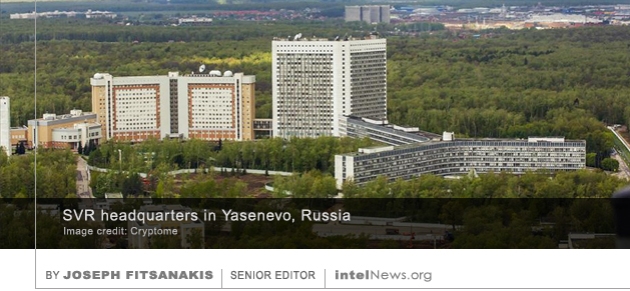 Recent satellite images reveal that the headquarters of the Russian Federation’s external intelligence agency has doubled, and possibly tripled, in size in the past nine years. The Russian Foreign Intelligence Service, known as SVR, is one of the successor agencies of the Soviet-era KGB. During the Soviet times, the present-day SVR was known as the First Chief Directorate or First Main Directorate of the KGB. Despite its name change, however, its mission remains the same, namely to collect secrets from targets outside the Russian Federation —often through the use of espionage— and to disseminate intelligence to the president. In the Soviet days, along with most of the KGB, the First Chief Directorate was headquartered in the imposing Lubyanka building, which is located in Moscow’s Meshchansky District. But in the early 1970s, the entire First Chief Directorate began a decade-long process of moving to a new, state-of-the-art complex in the southern suburbs of the Russian capital. The complex, which is located in Yasenevo, today houses the entire apparatus of the SVR, including its espionage wing, and is informally known as les (the forest) or kontora (the office).
 American Scientists’ Secrecy News blog, has
 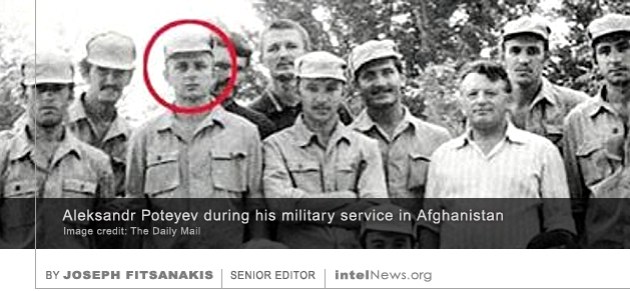 A Russian former senior intelligence officer, who reportedly defected to the United States after helping the Federal Bureau of Investigation arrest 10 Russian spies in 2010, is believed to have died. The arrests, which revealed the so-called “Russian illegals program” in the US, were part of a counterintelligence operation codenamed GHOST STORIES by the FBI. The operation culminated in June 2010 with the
 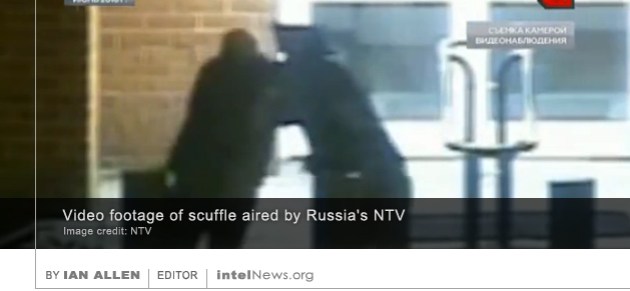 A Russian television station has aired footage allegedly showing a Russian guard stationed outside the United States embassy in Moscow trying to stop an American diplomat from entering the embassy. The Kremlin claims that the alleged US diplomat was in fact a Central Intelligence Agency officer who was returning to the embassy in disguise following a spy operation. As intelNews
  A notable increase in incidents of harassment of American diplomats stationed in Europe by Russian intelligence personnel appears to be part of what some officials describe as an escalating “gray war” between the US and Russia. For over a year now, American State Department personnel stationed in Europe have been complaining of a systematic campaign of “harassment and intimidation” against them and their families by Russian intelligence operatives. The campaign is allegedly being waged in Moscow and other European capitals, and has prompted one US diplomat to say that he and his colleagues were “feeling embattled out there in the embassy”. The Washington Post, which published the
  A German intelligence report alleges that the so-called ‘Cyber Caliphate’, the online hacker wing of the Islamic State, is in fact a Russian front, ingeniously conceived to permit Moscow to hack Western targets without retaliation. The group calling itself Cyber Caliphate first appeared in early 2014, purporting to operate as the online wing of the Islamic State of Iraq and Syria (ISIS), later renamed Islamic State. Today the Cyber Caliphate boasts a virtual army of hackers from dozens of countries, who are ostensibly operating as the online arm of the Islamic State. Their known activities include a strong and often concentrated social media presence, and computer hacking, primarily in the form of cyber espionage and cyber sabotage.
 A report by Canada’s primary intelligence agency warns in stark language that Russia is “retooling its military for a fight” and appears to be “mobilizing for war”. The classified report was
 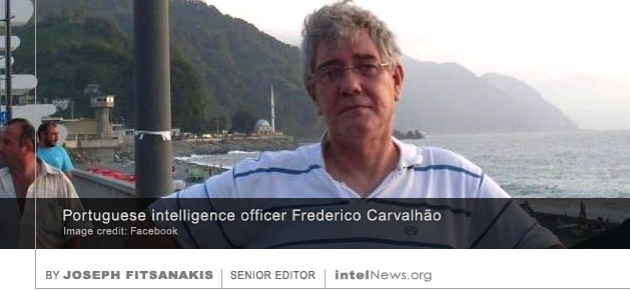 A Portuguese intelligence officer arrested a week ago in Rome, allegedly while passing classified documents to his Russian handler, may have accomplices with access to North Atlantic Treaty Organization (NATO) secrets. IntelNews
 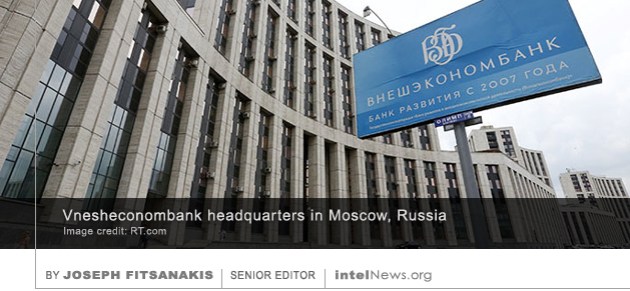 A Russian intelligence officer, who posed as a banker in the United States, has been handed a prison sentence by a court in New York. Evgeny Buryakov, 41, posed as an employee of the New York branch of Vnesheconombank, a Russian state-owned bank headquartered in Moscow. However, in January 2015, the Federal Bureau of Investigation
 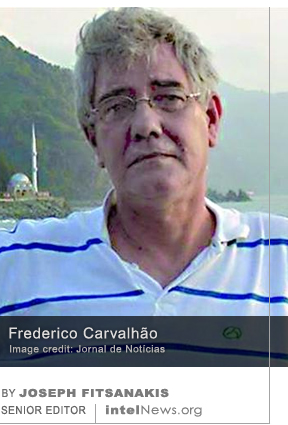 Two intelligence officers, one Russian and one Portuguese, have been arrested by Italian authorities on charges of espionage. The arrests took place in Rome on Monday by Italian police, who were reportedly accompanied by Portuguese counterintelligence officers. It is suggested in Portuguese media that the two men were arrested in the act of exchanging classified documents and money. The Portuguese intelligence officer has been identified in
 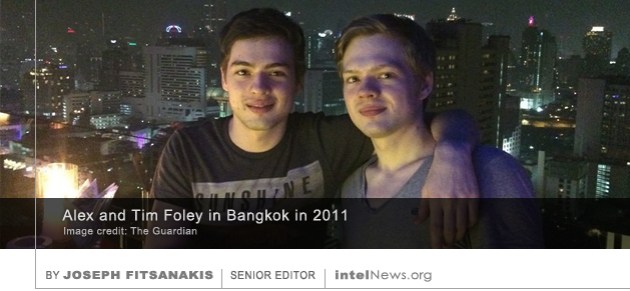 The two sons of a Russian couple, who were among 10 deep-cover spies arrested in the United States, have given an interview about their experience for the first time. Tim and Alex Foley (now Vavilov) are the sons of Donald Heathfield and Tracey Foley, a married couple arrested in 2010 under Operation GHOST STORIES, a counterintelligence program run by the US Federal Bureau of Investigation. Following their arrest, their sons, who had grown up thinking their parents were Canadian, were told that they were in fact Russian citizens and that their real names were Andrei Bezrukov and Elena Vavilova. Their English-sounding names and Canadian passports had been
  The Russian government says it has arrested a senior Ukrainian intelligence officer, who was allegedly trained by the United States Central Intelligence Agency and tasked with infiltrating the Russian secret services. In a







Notorious Russian arms dealer ‘refused US offer for lighter sentence’
August 10, 2016 by Joseph Fitsanakis 1 Comment
In a newspaper interview on Tuesday, Bout’s wife, Alla Bout, said her husband could have gotten away with a considerably lighter sentence had he agreed to testify against a senior Russian government official. Speaking to Moscow-based daily Izvestia, Alla Bout said her husband had been approached by American authorities after being extradited to the United States from Thailand. He was told that US authorities wanted him to testify against Igor Sechin, a powerful Russian government official, whom American prosecutors believed was Bout’s boss. In return for his testimony, US prosecutors allegedly promised a jail sentence that would not exceed two years, as well as political asylum for him and his family following his release from prison. Alla Bout added that her husband’s American lawyers were told by the prosecution that the ‘merchant of death’ “would be able to live in the US comfortably, along with his wife and daughter”, and that his family could stay in America during his trial “under conditions”. Alla Bout claimed she was told this by Bout himself and by members of his American legal team.
From 2008 to 2012, Sechin, who has military background, served as Russia’s Deputy Prime Minister. Today he heads the Board of Directors of Rosneft, a government-owned oil extraction and refinement company, which is considered one of the world’s most powerful business ventures. Many observers see Sechin as the most formidable man in Russia after Russian President Vladimir Putin. He is also believed to be a senior member of the Siloviki, a secretive group of government officials in the Putin government who have prior careers in national security or intelligence. Although Bout and Sechin have never acknowledged having met each other, some investigators of Bout’s weapons-trading activities believe that the two were close allies. It is believed that the two men first met in Angola and Mozambique in the 1980s, where they were stationed while serving in the Soviet military. But the two men deny they knowing each other. According to Alla Bout, Viktor told his American captors that he “never worked for Sechin and did not know him in person”. He therefore turned down the prosecution’s offer and was handed a 25-year sentence. When asked by the Izvestia reporters whether Bout was simply protecting the powerful Russian government official, Alla Bout insisted that the two “have never even met, not once”.
► Author: Joseph Fitsanakis | Date: 10 August 2016 | Permalink
Filed under Expert news and commentary on intelligence, espionage, spies and spying Tagged with Alla Bout, extraditions, Igor Sechin, News, Russia, United States, Viktor Bout, weapons smuggling, weapons trade