German security agencies had watched Berlin market attacker for a year
December 22, 2016 2 Comments
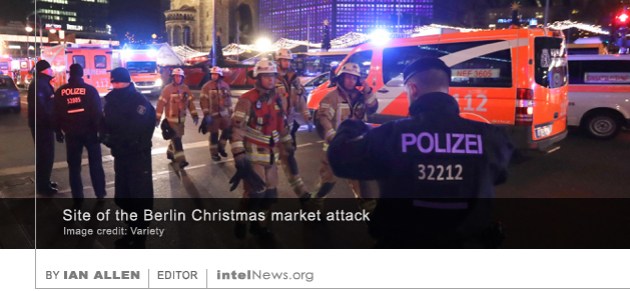 The central suspect in the Berlin Christmas market attack had been on the radar of German security agencies since January of this year, because he had links with radical Islamists and sought to buy guns for a terrorist attack. Anis Amiri, 23, left his native Tunisia in 2011, soon after the outbreak of the so-called Arab Spring there. He lived in Italy for three years before arriving in Germany in July 2015. In April of this year, he applied for an asylum in Germany. According to German authorities, Amiri was arrested multiple times in Tunisia for drug-related offenses. He is also believed to have used at least six different aliases since moving to Europe, and to have claimed to be a citizen of Lebanon and Egypt at different times.
On Wednesday, German newspaper Süddeutsche Zeitung revealed that Amiri’s cell phone and email accounts had been monitored by German security agencies at least since January of this year. The decision to monitor his telecommunications was reportedly taken by officials at Germany’s Center for Terrorism Defense (GTAZ). The agency functions as a fusion center for intelligence cooperation between German police and spy services. The newspaper said that Amiri was deemed suspicious because of his connections with several radical Islamists, who were arrested in Germany in recent months. They include Abu Walaa, a vocal supporter of the Islamic State who was captured in Northern Germany in November. According to anonymous German officials, Amiri had also told friends that he was seeking people to help him purchase weapons and use them to carry out attacks on civilians in Europe.
Last summer, Amiri was involved in a scuffle between rival drug gangs in Berlin, in which at least one knife was used. But he disappeared for several weeks when police tried to question him about it. He was eventually arrested and questioned by police in Berlin. It was discovered that, according to one German official, Amiri “was highly mobile”, moving between Berlin and northern Germany every few weeks. But, according to the Süddeutsche Zeitung, German authorities did not have enough evidence against him to keep him in detention. Shortly after Amiri’s arrest and subsequent release, German authorities decided to turn down his application for asylum due to security concerns. He was due to be deported from Germany before December 31. The German police is now offering up to €100,000 for Amiri’s capture.
► Author: Ian Allen | Date: 22 December 2016 | Permalink
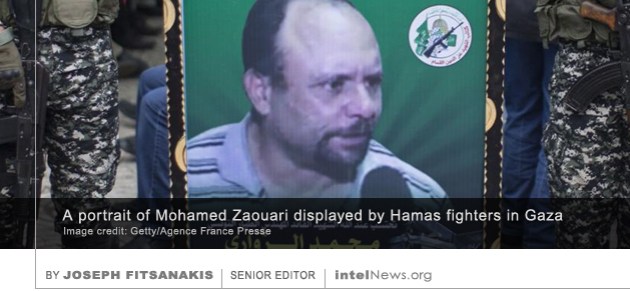 Despite persistent silence from Tel Aviv, commentators there seem increasingly convinced that Israeli spies were behind last week’s killing of an aviation engineer who worked for the Palestinian militant group Hamas. The man, Mohamed Zaouari, 49, was a Tunisian national who had spent over a decade creating an innovative aerial drone program for the Palestinian group that controls the Gaza Strip. He was
 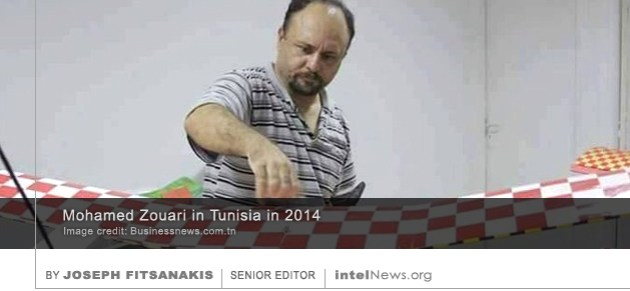 A senior aviation engineer who headed the unmanned aerial vehicle program of the Palestinian militant group Hamas, has been shot dead outside his home in Tunisia by a group of assailants using gun silencers. Mohamed Zaouari, 49, was a Tunisian national who had spent over a decade creating an innovative aerial drone program for Hamas, the Palestinian group that today controls the Gaza Strip. He had lived outside of Tunisia for much of his life, most recently in Syria, where he is believed to have worked as an engineer in a private firm, while also consulting with the Palestinian group. He had returned to Tunisia in 2011, following the upheaval in the country that sparked the so-called Arab Spring.









 intelNews.org
Tunisia suspects espionage after Belarusians are caught with several passports
July 4, 2019 by Ian Allen 1 Comment
Tunis Afrique Presse, a private news agency headquartered in Tunis, said on Monday that the two Belarusians arrived in Sfax in early June, and checked into a hotel using Belarusian passports. They reportedly attracted the attention of the hotel staff, because Sfax is not a noted tourist destination and attracts few of the foreigners who visit the North African country. Hotel staff alerted the authorities after the two Belarusians forbade anyone, including hotel cleaning staff, to enter their room. Tunisian security officers then monitored the two Belarusians for two weeks before entering their room and searching their belongings, after receiving permission from their superiors. The search reportedly produced several forged passports from Ukraine, the Maldives and Poland, as well as SIM cards and electronic surveillance equipment. At a press conference in Sfax on Monday, Mourad Turki, a court official, said that the Tunisian Prosecutor’s Office decided to issue an arrest warrant for the two Belarusians. An investigation has been launched, he said.
Tunisia and Belarus do not have active diplomatic relations. There have been several high-level meetings between Tunisian and Belarusian officials in recent years, but diplomatic relations between the two countries have remained stagnant. Belsat TV, a Belarusian news network based in Poland, contacted the Belarusian Ministry of Foreign Affairs but a spokesman refused to comment on the cases of the two men. The United States-based Radio Free Europe was told by a government official in Minsk that the Belarusian government is looking into the matter.
► Author: Ian Allen | Date: 04 July 2019 | Permalink
Filed under Expert news and commentary on intelligence, espionage, spies and spying Tagged with Belarus, espionage, News, Sfax (Tunisia), travel documentation, Tunisia