Maltese far-right party had links to CIA, British documents suggest
August 25, 2015 Leave a comment
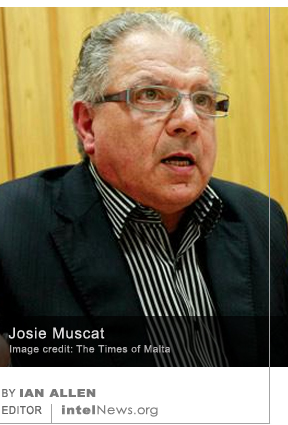 A Maltese ultra-nationalist group believed to be behind a string of bombings in the 1980s was believed by British intelligence to have links to the United States Central Intelligence Agency (CIA), according to recently declassified documents. The Front Freedom Fighters (FFF) was a staunchly anticommunist group whose members violently objected to what they saw as Malta’s overly close contacts with the Communist Bloc. During the 16-year rule of the Maltese Labour Party, which began in 1971, the Mediterranean island maintained close relations with countries during such as Libya and North Korea. The Maltese Nationalist Party, which formed the main opposition to Labour, was highly critical of these contacts, but failed to win three consecutive electoral contests and was thus unable to influence the country’s foreign policy in any significant way.
The FFF emerged in the early 1980s from within the ranks of the Nationalist Party. It consisted of younger activists who favored a violent response to the rule of the Labour Party. The group was led by Josie Muscat, a dynamic anticommunist campaigner and longtime Nationalist Party Member of Parliament, who gathered around him some of the more extreme rightwing elements in the Nationalist Party. A string of bombings and threats directed at Labour Party facilities on the island was attributed to the FFF by the popular press, though Muscat himself consistently denied such accusations. Many believed that the FFF was actively preparing to launch an armed coup d’etat.
Eventually, the leadership of the Nationalist Party, which saw itself as falling within the mainstream of the European conservative tradition, began distancing itself from the FFF’s rhetoric and actions. In July of 1983, the party expelled FFF leaders from its ranks and forbade its members from associating with FFF-linked groups. Few Nationalist Party members followed Muscat, and his movement eventually suffered what some observers described “a natural death”.
However, new documents released this month by the National Archives in Britain show that the British Foreign Office believed that the FFF was being funded by the CIA. A Foreign Office Report from the early 1980s states that the group was probably behind several bomb explosions targeting Labour Party activists, as well as moderate Nationalist Party members. The report describes the FFF as “neo-Fascist in character” that prioritized crude violence as its main tactic. It goes on to say that the group consisted of about 500 determined members, but that its violent core was much smaller. The Foreign Office report also suggests that Muscat may have traveled abroad to meet CIA officers, as well as to network with other anticommunist organizations throughout Europe.
Asked to give his reaction to the British government documents, Muscat told The Times of Malta that he “hadn’t had such a good laugh in years”. The now retired politician denied having any links to the CIA and said that the FFF’s activities had been “mostly limited to political debating and had never even come close to any form of violence”.
► Author: Ian Allen | Date: 25 August 2015 | Permalink















 intelNews.org
Russia accuses UK of deliberately delaying visas for its diplomats in London
October 24, 2016 by Ian Allen Leave a comment
“As our people return home or go on to other postings, visas for their replacements are not being issued”, said Yakovenko. Consequently, the Russian embassy’s personnel numbers were shrinking, and would shrink even further unless the issue was resolved by Whitehall, he said. The Russian ambassador added that his embassy did not understand “the strategy of this country on visa issues”, implying that London was following a deliberate plan to prevent Russian diplomats from staffing the embassy. But the British Foreign Office responded on Saturday that it was not following a deliberate policy of delaying the issuance of visas for Russian diplomats. The BBC quoted a Foreign Office spokesman who said that the British government had “made it clear to the Russians that the queues [for visa issuances] need to be cleared on both sides”. The comment implies that London’s stance may be a response to efforts by Moscow to reduce the size of the British diplomatic core stationed in the Russian capital.
Bilateral relations between Britain and Russia have suffered since 2006, when the murder of former Russian intelligence officer Alexander Litvinenko in London prompted Whitehall to expel four Russian diplomats stationed there. The Russian involvement in Ukraine and Syria has further strained relations between Moscow and London in recent years. In August of 2015, the Russian Embassy accused the British government of “effectively expelling” four of its diplomats from London by refusing to grant them visas for more than three months.
► Author: Ian Allen | Date: 24 October 2016 | Permalink
Filed under Expert news and commentary on intelligence, espionage, spies and spying Tagged with Alexander Yakovenko, diplomacy, News, Russia, Russian embassy in the UK, UK, UK Foreign and Commonwealth Office