Ukraine, Belarus expel diplomats following espionage claims
November 24, 2017 Leave a comment
 Ukraine fired its deputy-head of foreign intelligence and expelled a Belarussian diplomat a day after the government of Belarus claimed that it busted a Ukrainian spy ring that recruited local agents. The chain of events began on October 25, when the Belarussian Committee for State Security (KGB) arrested a Ukrainian journalist. The journalist, Pavlo Sharoyko, is based in the Belarussian capital Minsk and works as the Belarus correspondent for the National Radio Company of Ukraine —the country’s public broadcaster. Even though Sharoyko was arrested in October, his imprisonment was not publicly announced by Belarus until last Saturday. On Tuesday, November 21, at a press conference held at the KGB headquarters in Minsk, KGB spokesman Dmitry Pobyarzhin told reporters that Sharoyko was arrested for engaging in espionage on behalf of the Ukrainian government.
According to Pobyarzhin, Sharoyko is an undercover intelligence officer masquerading as a journalist. His real employer, said Pobyarzhin, is the Chief Directorate of Intelligence of the Ministry of Defense of Ukraine. While based in Minsk, the Ukrainian radio correspondent allegedly built an extensive network of spies, consisting of Belarussian citizens who carried out espionage tasks in exchange for financial compensation, said Pobyarzhin. The KGB spokesman also claimed that Sharoyko was not officially associated with the Ukrainian embassy in Minsk, but he had a spy handler there. The alleged handler, a Ukrainian diplomat by the name of Ihor Skvortsov, had been confronted by the KGB and expelled from the country for engaging in espionage, said Pobyarzhin.
Late on Tuesday, The Ukrainian Ministry of Defense said that Sharoyko had worked there as a spokesman before 2009, but rejected the charges against him. However, on Monday, a day after Sharoyko’s arrest was announced, Ukraine’s President, Petro Poroshenko, dismissed the deputy director of the country’s Foreign Intelligence Service, V. Sinkevich, from his post. It is not known whether the surprise dismissal is connected to the announcement by the Belarussian KGB. On Tuesday, Kiev announced that it had expelled a Belarussian diplomat from the embassy of Belarus in the Ukrainian capital, in response to the expulsion of Skvortsov the day before. The Ukrainian government did not name the expelled Belarussian diplomat.
► Author: Joseph Fitsanakis | Date: 24 November 2017 | Permalink
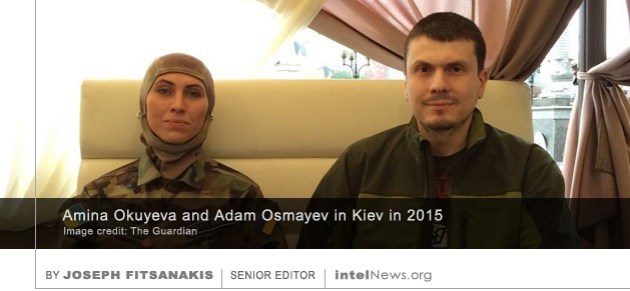 An armed attack in the outskirts of Kiev has killed the wife of a Chechen commander of a Ukrainian paramilitary unit, who is wanted in Russia for an alleged plan to kill President Vladimir Putin. Adam Osmayev is believed to have survived the attack, but his wife, Amina Okuyeva, was reportedly shot in the head and died on the spot. Osmayev, a Russian Chechen, became widely known in Ukraine in February of 2012, when he was arrested by police in Odessa, a major port city located on the northwestern shore of the Black Sea in the country’s south. He was found to be carrying forged identity documents. When police searched his apartment, they found large quantities of illegal explosives. Authorities in Moscow told the Ukrainian government that Osmayev was involved in a conspiracy to kill Russian President Vladimir Putin. A Chechen associate of Osmayev, Ilya Pyanzin, was handed over to Russia by the Ukrainians and was given a 10-year prison sentence by a Moscow court.
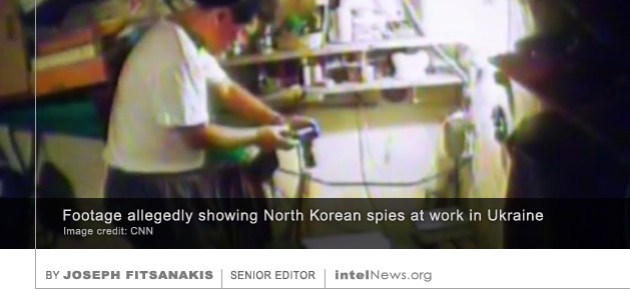 Ukrainian authorities have released rare surveillance footage filmed during a sting operation that ended with the capture of three North Korean spies. The North Koreans, two of whom are now serving prison sentences in Ukraine, had traveled there in 2011 believing they would be given missile technology secrets. Last July, North Korea surprised missile technology experts by successfully testing two intercontinental ballistic missiles (ICBMs). Government-controlled media in Pyongyang claimed that North Korean ICBMs were capable of reaching the United States’ mainland.
 A senior military intelligence officer, who commanded a Ukrainian special-forces unit that fought against the Russians in eastern Ukraine, was killed on Monday when his car exploded in broad daylight in Kiev. Initially, the Ukrainian government sources simply said that the dead driver of the car was a member of the Ministry of Defense’s Main Directorate of Intelligence. Later, the casualty was
  Ukrainian security service personnel raided the offices of a Russia-based internet search engine firm in two cities on Tuesday, as part of a treason investigation. The probe is reportedly related to the ongoing dispute between Kiev and Moscow, which intensified after 2014, when Russia unilaterally annexed the Russian district of Crimea. The Ukrainian government also accuses the Kremlin of clandestinely supporting pro-Russian insurgents in southeastern Ukraine, something that Moscow denies.
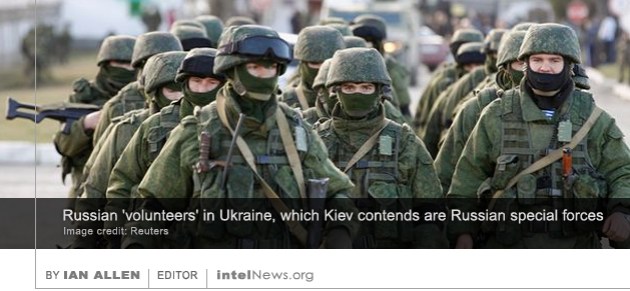 Ukrainian intelligence and defense officials are sharing intelligence with Britain about cutting-edge Russian military tactics in the Crimea and parts of eastern Ukraine. Since the 2014 Russian military intervention in Ukraine, observers have noted the sophisticated tactics used by Moscow. The Russian forces seem to be combining their advanced conventional arsenal with electronic warfare and information operations. The latter include the use of deception, spreading propaganda through social media, and computer hacking. Some experts have described Russia’s tactics in the Crimean Peninsula and the Donbass region of Ukraine as a form of “
 The Russian government says it has arrested a senior Ukrainian intelligence officer, who was allegedly trained by the United States Central Intelligence Agency and tasked with infiltrating the Russian secret services. In a
 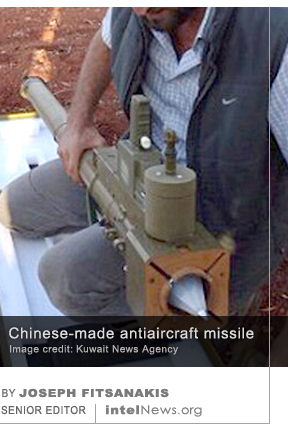 Significant amounts of Ukrainian-manufactured weapons are ending up in the hands of the Islamic State, prompting accusations that Kiev may be arming the militant group in an effort to impair its regional foe Russia. Persisting rumors that Ukraine may be secretly arming the Islamic State —also known as the Islamic State of Iraq and Syria, or ISIS— resurfaced last week, when authorities in Kuwait
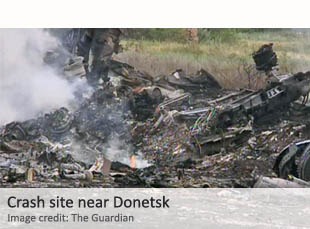
 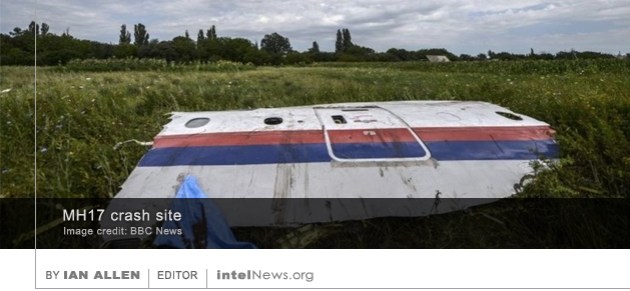 A German investigator, who is probing the downing of a civilian airliner over Ukraine nearly a year ago, says that an informant has claimed a multimillion reward for information pointing to those responsible for the attack. The investigator, Josef Resch, of Lübeck, Germany, says that a binding non-disclosure agreement does not allow him to reveal his client, who offered the $47 million reward. But he told German business magazine Capital that he is hopeful his client will soon reveal the details, since “people who pay that kind of money in exchange for information do not keep it for themselves”. However, he also hinted that his client may be an intelligence agency, who may decide to “deal with the matter without fanfare”.









Ukraine arrests prime minister’s interpreter, accuses him of spying for Russia
December 22, 2017 by Joseph Fitsanakis 2 Comments
On Wednesday, the Security Service of Ukraine (SBU), the country’s main counterintelligence agency, released a statement announcing that “an official” in the Ukrainian state had been arrested in the capital Kiev on Saturday, December 16. The SBU statement said that the official had “access to sensitive government information” and that he had operated in the service “of an adversary state for a long period”. The statement then identified the “adversary state” as Russia. Yezhov’s name and profession were not included in the SBU statement. But Ukrainian government officials later revealed it. According to subsequent local media reports, Yezhov was recruited by Russian intelligence in 2014, when he was posted at the Ukrainian embassy in Washington, DC. Prior to that post, Yezhov is believed to have served at the Ukrainian embassy in Slovenia.
The Russians allegedly trained him and provided him with specially designed collection technology, which he then used to gather intelligence and communicate it to his Russian handlers. Speaking on Ukrainian television, Anton Gerashchenko, advisor to Arsen Avakov, the country’s Minister of Internal Affairs, said that Yezhov had worked for Russian intelligence “for at least two years, possibly longer”. Yezhov is now reportedly facing charges of treason. The government of Russia has not issued any statements about Yezhov’s arrest.
► Author: Joseph Fitsanakis | Date: 22 December 2017 | Permalink
Filed under Expert news and commentary on intelligence, espionage, spies and spying Tagged with espionage, News, Russia, Security Service of Ukraine, Stanislav Yezhov, Ukraine, Volodymyr Groysman