Russians use front-company to access US federal employees’ contact info, says report

EFIS EstoniaRussian spy agencies use front companies to purchase directorates that contain the contact details of United States government employees, according to a new intelligence report. The contact details are contained in multi-page directories of Congressional staff members and employees of US federal agencies. They are published every January by a specialist vendor called Leadership Connect with the cooperation of a Washington, DC-based provider of publishing services. The directories contain the names, job titles, professional addresses and telephone numbers of US government employees.

But according to the Estonian Foreign Intelligence Service (EFIS), copies of the directorate are purchased every year by the Russian intelligence services, such as the Federal Security Service (FSB) and the Foreign Intelligence Service (SVR). The two Russian spy agencies allegedly use a front company in order to purchase copies of the directory. In reality, however, the purchases are made on behalf of Russian intelligence units, such as Military Unit 71330 of the FSB. This allegation is contained in the 2019 security environment assessment, which was published this week by the EFIS. Titled International Security and Estonia, the report is an overview of the main threats to Estonia’s internal security and a description of how these threats relate to international developments.

The directories, says EFIS, are not classified. On the contrary, they contain information that is publicly available in the US. However, the job descriptions and contact information of US federal employees are difficult to access in a collected format. The directories are therefore useful to Russian intelligence, which routinely tries to access large quantities of open-source information from foreign countries. Russian spy agencies are known to incorporate this open-source information into recruitment or surveillance plans that target specific individuals or foreign government agencies. They also use them to fill gaps in intelligence collection about specific agencies or parts of agencies, according to Robert Dannenberg, a former CIA officer who spoke to Yahoo News about the EFIS report.

Author: Ian Allen | Date: 14 March 2019 | Permalink
US warns Germany it will end intelligence sharing if Huawei is given 5G contract

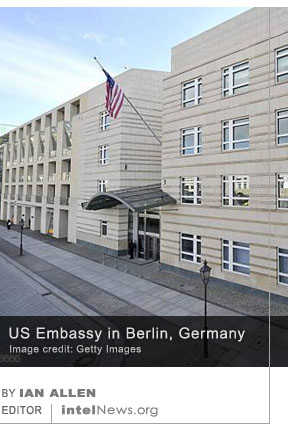
US embassy Berlin GermanyThe United States has warned Germany that intelligence sharing between the two countries will be threatened if the Chinese telecommunications giant Huawei is awarded a contract to build Germany’s 5G network. The company, Huawei Technologies, is a private Chinese venture and one of the world’s leading telecommunications hardware manufacturers. In recent years, however, it has come under scrutiny by some Western intelligence agencies, who view it as being too close to the Communist Party of China. More recently, Washington has intensified an international campaign to limit Huawei’s ability to build the infrastructure for 5G, the world’s next-generation wireless network. Along with Britain, Australia and Canada, the US is concerned that the Chinese telecommunications giant may facilitate global wiretapping on behalf of Beijing’s spy agencies.

But some American allies, including Spain, France and Germany, are not satisfied with Washington’s arguments and claim that the United States is eyeing the financial benefits that would arguably come from its domination of the global digital superhighway. German officials, in particular, have told their American counterparts that Berlin has not seen any evidence that Huawei’s telecommunications hardware come with hidden interception features. Moreover, Germany says that it plans to subject Huawei’s systems to rigorous security tests before using them. On Friday, Washington increased its pressure on Berlin by informing German officials that intelligence cooperation between the two allies would be severely impacted if Chinese telecommunications manufacturers are given the green light to build Germany’s 5G infrastructure.

According to The Wall Street Journal, the warning was included in a letter signed by Ambassador Richard Grenell, America’s top diplomat in Germany. It was allegedly sent to Peter Altmaier, Germany’s Minister of Economic Affairs and Energy. The paper says that Grenell suggests in his letter that Berlin should consider rival bids by companies belonging to American allies, such as the Swedish telecommunications equipment manufacturer Ericsson, Finland’s Nokia Corporation, or the South Korean Samsung Corporation, which is the world’s leading telecommunications hardware manufacturer. The Wall Street Journal did not reveal how it acquired Grenell’s letter, nor did it say whether the German government responded to it.

Author: Ian Allen | Date: 12 March 2019 | Permalink

US weapons given to UAE and Saudi Arabia are diverted to al-Qaeda-linked groups

Shabwani EliteWeapons supplied to the Saudi and Emirati governments by the United States and other Western nations are ending up in the hands of al-Qaeda-linked Sunni militias in Yemen, according to two separate investigations. The weapons are being supplied to the militaries of Saudi Arabia and the United Arab Emirates by the West on the understanding that they will be used in the war in Yemen. The war has been going on since 2015, when a alliance of rebel groups from Yemen’s Shiite communities formed the Houthi movement, which quickly seized control of much of the country. The Houthis effectively toppled the government, prompting a reaction by a coalition of Sunni Arab states, which see the Shiite movement as an Iranian front. In an effort to restore Yemen’s Sunni-dominated government, Western countries have supplied Saudi Arabia and the United Arab Emirates with more than $5 billion-worth of weaponry.

However, a report published this week by Amnesty International alleges that some of that weaponry, including machine guns, mortars and even armored vehicles, are being deliberately diverted to Sunni militia groups in Yemen. Among them are three militias that are known to be supported by the government of the Emirates, namely the Giants, the Security Belt and the Shabwani Elite. These groups, says Amnesty, have been seen using Western-supplied weaponry in the field of battle and in their compounds throughout Yemen. In its report, the human-rights group says that these groups are not accountable to any government and have been linked to serious war crimes against civilians. Meanwhile, a separate investigation aired this week by CNN claims that American-manufactured weaponry and materiel given by Washington to the Saudi and Emirati militaries is ending up in the hand of Salafist militias in Yemen. The report names the Sunni Abu al-Abbas Brigade, which is closely linked to al-Qaeda in the Arabian Peninsula (AQAP). The CNN report also claims that some of the American weaponry has fallen in the hands of Houthi fighters.

On Wednesday the BBC quoted a senior American general who said that the Pentagon plans to investigate whether American and other Western-supplied weapons are being illegally diverted into the hands of non-state Sunni militias in Yemen. The government of the United Arab Emirates has not commented on the reports. As intelNews reported last August, an investigative report published by the Associated Press claimed that senior AQAP commanders were on the payroll of US-backed Sunni militias in Yemen and that its fighters were being recruited to fight against the Houthis. The report also argued that Washington was privy to the secret agreements between Yemen’s Sunni militias and AQAP.

Author: Joseph Fitsanakis | Date: 08 February 2019 | Permalink

Morton Sobell, convicted of conspiracy in the Rosenberg espionage case, dies at 101

Morton SobellMorton Sobell, an American radar engineer who in 1951 was convicted of conspiracy alongside Julius and Ethel Rosenberg in one of the Cold War’s most prominent espionage cases, has died at 101 years old. His death was announced yesterday by his son, Mark, who also said that his father died on December 26 last year at a nursing home, but that the family had not alerted the media.
Sobell was born in New York’s Manhattan Island in 1917 and worked on radar tracking systems for defense contractors. During college, he and several of his friends, including fellow-engineer Julius Rosenberg, joined the United States Communist Party, partly in reaction to the Great Depression. When the Federal Bureau of Investigation began to arrest members of what the United States government claimed was a Soviet atomic spy ring led by Rosenberg, Sobell escaped with his family to Mexico, where he used a fake identity to evade the authorities. But he was dramatically abducted by a paramilitary force and surrendered to the FBI.

He was then tried alongside Rosenberg and his wife Ethel for conspiracy to commit acts of espionage. The Rosenbergs refused to cooperate with the FBI and were sentenced to death. Both were executed in 1953 and remain to this day the only American citizens to have been executed for espionage after the Civil War. Sobel was found guilty of the lesser charge of conspiracy and no evidence was presented in court that connected him to atomic espionage. He was therefore sentenced to 30 years in prison and served 18 of those, following a successful public-relations campaign organized by his wife, Hellen. He was released from prison in 1969 and continued to insist that he had never been a spy and had been wrongly convicted of conspiracy.

But in 2008, at the age of 91, Sobell spoke to The New York Times and publicly admitted for the first time that he had been a spy for the Soviet Union. He said that he had worked systematically to provide Moscow with information on weapons systems and other classified technologies. However, he had “never thought of it” as spying, he said. He also told The Times that he had developed a favorable impression of Soviet communism during the Great Depression, when he and many others saw the Soviet economic system as an antidote to crisis-ridden capitalism. “Now I know it was an illusion”, he told the paper.

Author: Joseph Fitsanakis | Date: 31 January 2019 | Permalink

CIA has maintained secret communication with North Korea for 10 years

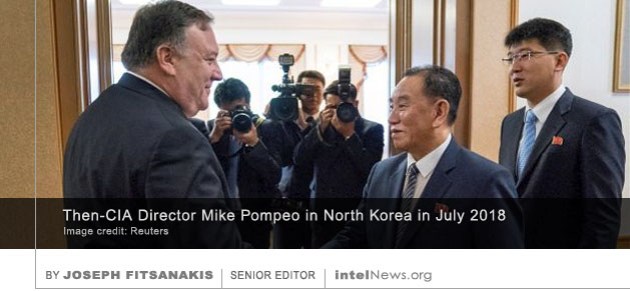
Mike Pompeo North KoreaWith presidential approval, the United States Central Intelligence Agency has maintained a secret channel of communication with North Korea since at least 2009, according to The Wall Street Journal. Many were surprised in 2018, when the then CIA director Mike Pompeo made a sudden visit to Pyongyang to speak with senior North Korean officials. But according to The Wall Street Journal, the CIA channel with the North Koreans had been there since at least 2009 and Pompeo simply “re-energized it” after being instructed to do so by the White House.
The United States and North Korea have never had official diplomatic relations, nor have they ever maintained embassies at each other’s capitals. In rare instances, the North Korean Permanent Mission to the United Nations in New York has been utilized to pass messages from the White House to the communist country’s Ministry of Foreign Affairs. No other systematic diplomatic activity between the two sides has ever been reported.

But an article published in The Wall Street Journal on Monday claims that an intelligence channel between the CIA and unspecified North Korean intelligence officials has been active —with some periods of dormancy— for at least a decade. The previously unreported channel has led to a number of public meetings, such as the 2014 visit to Pyongyang by James Clapper, the then US Director of National Intelligence, as well as an earlier visit to the North Korean capital by former US President Bill Clinton in 2009. But, says the paper citing “current and former US officials”, most of the contacts have been secret. They include several visits to North Korea by CIA official Joseph DeTrani before and after Clinton’s visit, as well as two trips to Pyongyang by CIA Deputy Director Michael Morell, in 2012 and 2013. His successor, Avril Haines, also visited North Korea, says The Journal, but notes that the channel went “dormant late in the Obama administration”.

Upon becoming CIA director following the election of Donald Trump to the presidency, Mike Pompeo was briefed about the secret channel’s existence and decided to resume it, with Trump’s agreement. That led to his eventual visit to North Korea along with Andrew Kim, who at the time headed the CIA’s Korea Mission Center. Eventually, this channel of communication facilitated the high-level summit between President Trump and Supreme leader Kim Jong-un in June 2018 in Singapore. The Wall Street Journal said it reached out to the CIA, the Department of State and the White House about this story, but received no responses. The North Korean mission in the United Nations in New York also declined to comment.

Author: Joseph Fitsanakis | Date: 22 January 2019 | Permalink

‘Illusion of safety’ blamed for deaths of four US service members in Syria

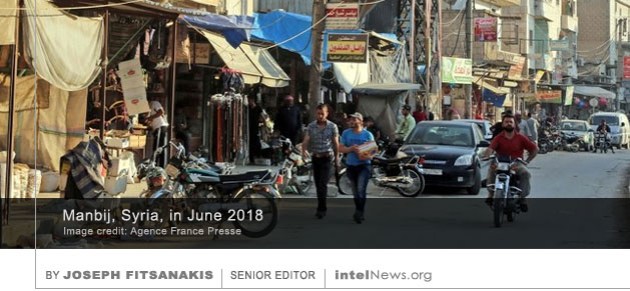
Manbij SyriaThe “illusion of safety” has been blamed for the death of four American service members in northern Syria last week, after a suicide bomber attacked a restaurant, killing at least 19 people and wounding countless others. The deadly attack happened in Manbij, a small Kurdish-majority town near the Syrian-Turkish border, which American forces previously viewed as an oasis of security in the war-torn country. American troops fought alongside a coalition of Kurdish and Arab fighters who in 2016 took control of Manbij from the Islamic State of Iraq and Syria (ISIS). Since then, American forces have remained in the area —mostly to prevent a military invasion by Washington’s ally Turkey, which views the Kurds as terrorists and has threatened to destroy their armed forces.
The relative stability of Manbij was violently disrupted last Wednesday, when a man detonated a suicide vest inside the Palace of the Princes restaurant in downtown Manbij. Until that moment, United States forces had lost just two members during the Syrian Civil War. Four more Americans died in Wednesday’s blast, including two service members, a military contractor and a civilian intelligence officer working for the Pentagon. Three other Americans were wounded and were airlifted out of the country. In an insightful article published last week, The New York Times quoted a US Special Forces member who wondered whether the US troops in northern Syria have “developed a false sense of security” in what remains a dangerous conflict zone. “The illusion of safety”, said the anonymous commentator, had caused the behavior of American service members in Manbij to fall into predictable routines. That became a vulnerability that the Islamic State was able to exploit, he said.

The Sunni militant group targeted the Palace of the Princes, one of the most popular eateries for Americans in Manbij. The Times quoted locals who said that American troops appeared to eat there nearly every time they patrolled the city, “often many times a week”. They would even park their military vehicles outside the restaurant while dining there, they said. The paper commented that many US troops had “grown complacent and should have varied their […] routes or increased their operational security” while on patrol. Unfortunately, however, their presence —and lack of adequate security— was noticed by the Islamic State, which targeted them on Wednesday.

Author: Joseph Fitsanakis | Date: 21 January 2019 | Permalink

Trial witness claims ‘El Chapo’ gave Mexico’s ex-president $100 million bribe

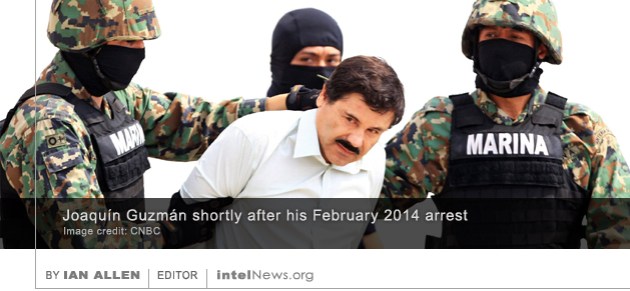
Joaquín ‘El Chapo’ GuzmánA high-profile witness has told the trial of Joaquín ‘El Chapo’ Guzmán in New York that the accused bribed the then President of Mexico, Enrique Peña Nieto, with $100 million in order to stay out of prison. Guzmán, the leader of the powerful Sinaloa drug cartel, was arrested in February 2014 in Mexico. In January 2017, he was extradited to the United States, where he faces a litany charges ranging from conspiracy to import and distribute drugs to money-laundering and homicide. His trial began at the Federal District Court in Brooklyn, New York, last November.
All of last Tuesday was taken up by the testimony of Alex Cifuentes Villa, a Colombian former drug lord from Medellin who, until his arrest in 2012, was one of Guzmán’s closest collaborators. Villa told the court that Peña Nieto employed mediators to reach out to the Sinaloa cartel soon after he was elected president in 2012. He alleged that the mediators offered to strike a bargain with Guzmán, according to which he would stay out of prison in return for a $250 million bribe. The bribe would be shared between Peña Nieto and his closest government aides and advisors, said Villa. In return, the Mexican president would call off a national manhunt to capture the Sinaloa cartel leader. Following prolonged negotiations, Guzmán agreed to pay Peña Nieto $100 million, said Villa, in order to secure his freedom.

This is not the first time that a witness in the trial of Guzmán has alleged that the Sinaloa cartel leader bribed senior Mexican government officials, including police and military leaders. However, it is the most sensational allegation to have emerged the trial so far, and —if true— points out that even the highest echelons of the Mexican state have succumbed to the moneyed power of the drug cartels. Last November, when Guzmán’s trial began, his lawyers hinted that claims of corruption would be aired against the highest levels of the Mexican government, including two of its recent presidents, which they called “completely corrupt”. At the time, Peña Nieto’s office issued a statement condemning the allegations and saying that the former president had never received bribes from anyone.

Author: Joseph Fitsanakis | Date: 17 January 2019 | Permalink

FBI releases new information on alleged Iranian deep-cover spies

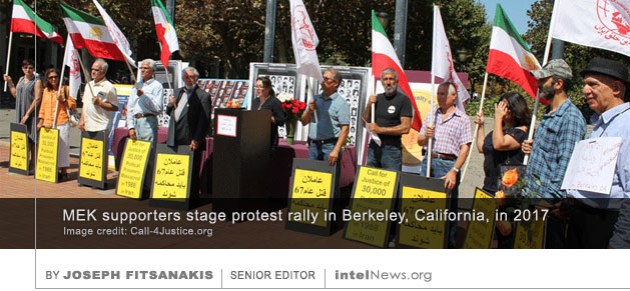
MEK supporters CaliforniaThe United States Federal Bureau of Investigation has charged two men of Iranian descent, who were arrested in California, of operating as deep-cover spies for Iran. Documents filed in a federal court in Washington, DC, name the men as Majid Ghorbani, 59, and Ahmadreza Mohammadi Doostdar, 38. Both have American citizenship and were arrested by the FBI in August, following a year-long counterintelligence investigation. The Los Angeles Times reports that Ghorbani is believed to have immigrated to the US from Iran in 1995. For the past two decades he has worked as a waiter at an upscale Persian restaurant in Santa Ana. Doostdar was born in the southern Californian city of Long Beach, but eventually moved with his family to Canada, and later to Iran, where he grew up. But he kept his US citizenship and made regular trips to America. It is believed that he planned to eventually move with his family to California.
According to the FBI, the two men were tasked by Iranian intelligence with carrying out surveillance on Jewish religious, cultural and political facilities in the US. They were also tasked with conducting surveillance and compiling reports of diplomatic and other facilities connected to the state of Israel. Another part of their mission, said the FBI, was collecting information on the activities and individual members of Mujahideen-e Khalq (MEK), a militant group that has roots in radical Islam and Marxism. The MEK initially supported the Islamic Revolution of 1979, but later withdrew its support, accusing the government of Ayatollah Khomeini of “fascism”. It continued its operations in exile, mainly from Iraq, where its armed members were trained by the Palestine Liberation Organization and other Arab leftist groups. Until 2009, the European Union and the US officially considered the MEK a terrorist organization. But the group’s sworn hatred against the government in Iran brought it close to Washington after the 2003 US invasion of Iraq. By 2006, the US military was openly collaborating with MEK forces in Iraq, and in 2012 the group was dropped from the US Department of State’s list of foreign terrorist organizations. Today the group enjoys open protection from the EU and the US.

Documents filed in court by the FBI state that the two men were secretly recorded during a year-long counterintelligence operation, as they traveled throughout the US to observe MEK rallies and gather intelligence or Israeli diplomatic facilities. Locations visited by the two men allegedly include Chicago, New York and Washington, as well as several cities in the American West Coast. During those visits, they would compile reports that, according to the FBI, were meant to “enable an intelligence or military unit find [and] neutralize a threat”. The men also traveled back to Iran through third countries, bringing back written operational instructions from their Iranian intelligence handlers, according to the FBI documents. IntelNews wrote about the arrest of the two men in August. However, this is the first concrete information released by the FBI about their identities and activities. They are both accused of acting as unregistered agents of a foreign government —a technical term for deep-cover espionage.

Author: Joseph Fitsanakis | Date: 15 January 2019 | Permalink

US sent troops to OPEC member Gabon just days before military coup

Libreville, GabonThe United States deployed troops to the Central African nation of Gabon just days before a group of military officers staged tried to take over power in the oil-rich nation on Monday. Situated on the Atlantic coastline of Central Africa, Gabon is a member of the Organization of Petroleum Exporting Countries (OPEC). However, despite producing of 176,000 barrels of oil per day, making it one of Africa’s most significant oil producers, over a third of its 2 million inhabitants live below the official poverty line. The country has been ruled by the Bongo family for over a century with its current President, Ali Bongo Ondimba, having led the country since his father’s death a decade ago. In October of last year, however, Bongo went to Saudi Arabia for medical treatment after suffering a stroke, and has yet to return. In a televised message aired on New Year’s Day, Bongo told the citizens of Gabon that he was recovering and would soon be returning to his duties.
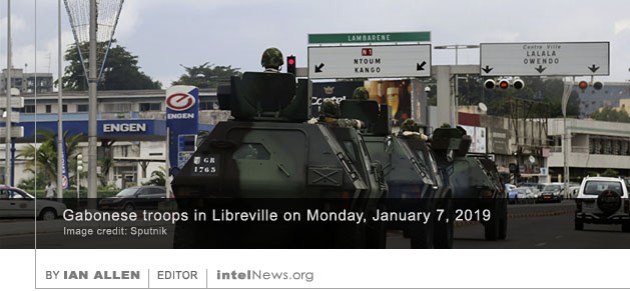
But in the early hours of Monday gun shots were reported in the vicinity of the studios of Radio Télévision Gabonaise (RTG), the country’s state-owned national broadcaster in the capital city, Libreville. A few hours later, regular broadcasting was suspended. A message was transmitted on the national radio station frequency by troops claiming to be members of a group calling itself the Patriotic Movement of the Defense and Security Forces of Gabon. Its leader, a man identifying himself as Lieutenant Kelly Ondo Obiang, said that the armed forces had “doubts” about President Bongo’s “ability to perform the responsibilities of his office”. He also announced the formation of a “Council of National Restoration” that would “ensure the smooth operation of the state and guarantee a transition to democracy”. However, a few hours later a government spokesman told international media that the coup had been defeated and that Lieutenant Obiang was under arrest. Two of his co-conspirators had been killed, said the spokesman.

Interestingly, the US deployed 80 American soldiers to Gabon on January 2, less than a week before the coup unfolded. In a letter sent to Congress on January 4, US President Donald Trump said that the troops would be stationed in Libreville and would carry with them “appropriate combat equipment”. Their purpose, said President Trump, would be to provide security protection for US “citizens, personnel and diplomatic facilities” in Kinshasa, capital of the neighboring Democratic Republic of the Congo (DRC). Security analysts fear that the pending announcement of the delayed election results in the DRC may spark widespread riots in the country of 81 million people. On Monday, a spokesman for the United States Africa Command (AFRICOM) told reporters that there was “no change in the status of our forces in Gabon” and that they would not be involved in the domestic political situation. The US troops were “not currently tasked with securing [US] diplomatic assets [in Gabon]”, added the AFRICOM spokesman. However, AFRICOM said that additional US troops may deploy to Gabon, the DRC or the Republic of the Congo, should the need arise.

It is not known whether the coup plotters were aware of the presence of the 80 US troops in Libreville when they tried to take over power on Monday.

Author: Ian Allen | Date: 08 January 2019 | Permalink

American held on espionage charges in Russia has three other citizenships

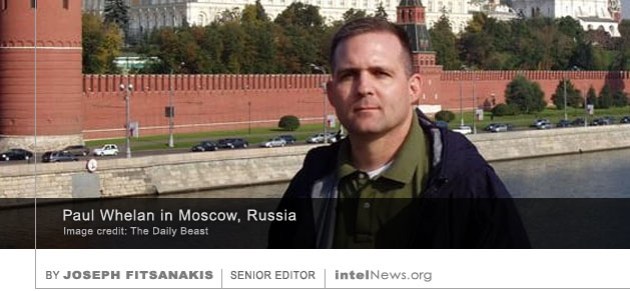
Paul WhelanAn American former Marine, who faces espionage charges in Russia, is a citizen of at least three other countries, namely Canada, Britain and the Republic of Ireland, according to reports. Paul Whelan, 48, was arrested by Russia’s Federal Security Service (FSB) on December 28 at the Metropol, a five-star hotel in downtown Moscow. News of Whelan’s arrest first emerged on January 3 in a report from Rosbalt, a Moscow-based news agency that known to be close to the Russian security services. He was reportedly indicted on Thursday and is now facing between 10 to 20 years in prison for espionage. His trial is not expected to take place until March.
According to Rosbalt, the FSB arrested Whelan in his hotel room while he was meeting with a Russian citizen who allegedly handed him a USB drive containing a list that included “the names of all employees of a [Russian] security agency”. However, Whelan’s family claim that the former Marine arrived in Moscow on December 22 to attend the wedding of an American friend who married a Russian woman. Whelan served two tours in Iraq with the United States Marines and was reportedly discharged for bad conduct. At the time of his arrest last month, he was the director of global security for BorgWarner, a Michigan-based manufacturer of spare parts for cars. He is believed to have visited Russia regularly since 2006, and is thought to have a basic command of the Russian language. He is currently being held in solitary confinement in Moscow’s Lefortovo detention center.

At the time of his arrest, Whelan was identified as an American citizen. On Friday, however, the Associated Press reported that he also has United Kingdom citizenship because he was born to British parents. Additionally, he is now believed to hold Canadian citizenship as well, because he was born in Canada. He then acquired American citizenship after arriving in the US with his parents as a child. It is not known how he acquired Irish citizenship, but the Irish government confirmed it on Friday. Also on Friday, the Washington-based National Public Radio said that embassies of at least four Western countries —the US, Britain, Ireland and Canada— were working to gain consular access to Whelan. On Thursday, the former Marine was visited in prison by Jon Huntsman, America’s ambassador to Russia. Meanwhile, Britain’s Foreign Secretary, Jeremy Hunt, said London was “extremely worried” about Whelan’s fate and warned Moscow “not to try to use [him] as a diplomatic pawn”, possibly by exchanging him with Russians arrested for espionage in the West.

Author: Joseph Fitsanakis | Date: 05 January 2019 | Permalink

Wave of bomb threats prompts hundreds of evacuations in four countries

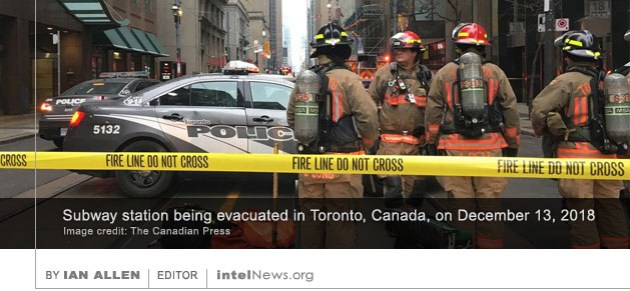
Toronto subway evacuationAn unprecedented “flood of bomb threats” prompted hundreds of evacuations and closures of private buildings, transport hubs and offices in four countries on Thursday, causing confusion and in some cases panic. The threats —which numbered in the hundreds— were issued throughout the day Thursday against businesses, schools, hospitals and media companies in the United States, Canada, New Zealand and the United Kingdom. It is the first time in history that such a large wave of bomb threats was issued against so many targets internationally.
Police agencies in the United States and Canada said that most of the threats were emailed, but some were phoned in by unknown individuals. They warned that devices containing explosive compounds such as tetryl or trinitrotoluene would be detonated unless funds were deposited into an international account using the virtual currency bitcoin. The messages also warned that the alleged devices would be detonated if “any police activity or unusual behavior” were detected. A deadline of one business day was given to deposit the funds. Throughout the day, police agencies across three continents issued notices cautioning people to remain aware of their surroundings and report suspicious messages or behavior. It was eventually determined that virtually all bomb threats were not credible.

However, it was the sheer number and geographical extent of the threats that shocked law enforcement agencies across four countries. In the United States, threats were reported in cities such as Boston, Philadelphia, San Francisco and Oklahoma City, where over dozens of specific addresses were targeted. Nearly 30 schools were placed on lockout in the state of Colorado, while numerous buildings were evacuated in Los Angeles, Chicago, Washington, Cincinnati and Seattle. Smaller cities were also affected, including South Bend, Indiana, Grand Rapids, Iowa, Charlotte, North Carolina, Norfolk, Virginia, and Park City, Utah. In Canada dozens of bomb threats were issued in Montreal, Ottawa, Winnipeg, Calgary, and Toronto, where five of the city’s subway stations were shut down for several hours. Media reports late on Thursday said it was unclear how many —if any— of those targeted paid the bitcoin ransoms demanded by the hoaxers.

Author: Ian Allen | Date: 14 December 2018 | Permalink

CIA names first woman to lead Directorate of Operations

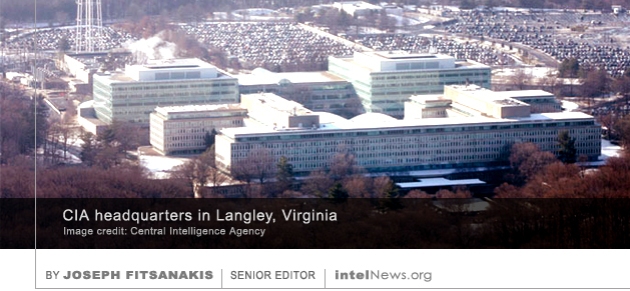
CIAIn a surprising departure from established practice, the United States Central Intelligence Agency has publicized the name of its incoming head of operations. Beth Kimber, a 34-year veteran of the Agency, will become the first woman in the CIA’s 70-year history to lead the Directorate of Operations. Officers in the Directorate of Operations, formerly known as the National Clandestine Service, spend their careers recruiting foreign agents to spy for the United States, while also carrying out covert operations around the world. This is also the first time that the CIA has chosen to publicly identify its Deputy Director for Operations —Kimber’s official title, abbreviated as DDO. Previous DDO have been undercover officers whose namse have remained undisclosed. Kimber’s promotion was announced on December 7 by Brittany Bramell, the CIA’s Director of Public Affairs.

Little is known about Kimber, who spent much of her career as a case officer before joining the CIA’s senior intelligence staff. She is a graduate of Hamilton College, a private, liberal arts college situated in upstate New York, and spent much of her early career with the CIA as a case officer in Western Europe. She is also believed to have led the “Russia Group”, a network of intelligence planners in the CIA’s Directorate of Operations that manage a broad spectrum of espionage operations targeting the Russian spy services. She has also served as deputy director of the National Clandestine Service, before it was renamed to Directorate of Operations. Newsweek intelligence correspondent Jeff Stein wrote about Kimber in 2014, but did not name her, as she was still serving in an undercover capacity.

For a few months this year, Kimber served as the CIA’s acting deputy director while Congress considered President Donald Trump’s nomination of Gina Haspel’s for the Agency’s director position. Kimber’s most recent prior post in the CIA was head of the Agency’s Europe and Eurasia Mission Center. Kimber is the third woman to assume a central role in the CIA in the past six months. In May of this year, Gina Haspel, a 33-year veteran of the CIA, became the Agency’s first female director. In August, Haspel picked Sonya Holt, a 34-year CIA veteran, to serve as the Agency’s chief diversity and inclusion officer. On Friday, the American news network CBS cited “people familiar with the shift”, who said that the outgoing DDO “will take another role within the agency” and is expected to remain undercover.

Author: Joseph Fitsanakis | Date: 11 December 2018 | Permalink

Jailed Russian who spied for CIA writes letter to Trump, asking to be freed

Russian Ministry of Internal AffairsA Russian former police officer, who is serving a prison sentence in Russia for having spied for the United States Central Intelligence Agency, has written an open letter to President Donald Trump, asking to be freed. Yevgeny A. Chistov was arrested by the Russian Federal Security Service (FSB) in 2014 on charges of spying for Washington. During his trial, he admitted having been recruited by the CIA when he worked as an officer in the police, Russia’s federal law-enforcement agency, which operates under the Ministry of Internal Affairs. Russian state prosecutors accused him of having established contact with the CIA in 2011. In 2015, he was sentenced to 13 years in prison, which he is currently serving at a labor camp in the Nizhny Novgorod town of Bor, located in central European Russia.
On Saturday, British newspaper The Guardian published a letter that was allegedly written by Chistov. In the letter, the jailed spy admits that he passed Russian state secrets to the CIA for three years, after deciding “to help the US as a friend”. He claims that he did it out of love for his country, and in order to help “overthrow […] the regime” of Russian President Vladimir Putin. Chistov goes on to accuse “Putin and his cronies” of having plundered Russia and of oppressing its people through “corruption and extortion”. He blames the Kremlin for Russia’s current economic state: “we have a resource-rich country yet our people are poor”, he says. The jailed spy adds that he told the CIA about the “secret plans” of the Ministry of Internal Affairs, that he provided “names of some people from the FSB”, and that he “revealed some objectives of Russia’s Ministry of Defense”. He does not provide details. He then claims that, even though he was paid by the CIA for his services, he did not act out of self-interest.

Chistov says that the conditions of his imprisonment are inhumane and that he and his family “are in great danger in Russia”. He also claims that his wife visited the US embassy in Ukraine in an attempt to secure a travel visa, but that her application was rejected and she was forced to return to Russia. The jailed spy adds that he “wrote two letters to the CIA asking them to help and received no response”. He then pleads with President Trump to help him, in two ways. First, by granting asylum in the US to his wife and mother. Second, by swapping him with someone “who worked for Russia” and is serving time in a US prison. “I want to appeal to the president to conduct the exchange”, he concludes.

The United States has participated in very few spy swaps in the post-Cold War era. In 2010, Washington and Moscow conducted one of history’s largest spy exchanges, as ten deep-cover Russian agents captured in the US earlier that year were swapped for four Russian citizens imprisoned by Moscow for spying for the US and Britain. Four years later, a Cuban intelligence officer who spied for the CIA was released as part of a wider exchange between Washington and Havana of persons held in each other’s prisons on espionage charges. The White House has not commented on Chistov’s letter.

Author: Joseph Fitsanakis | Date: 10 December 2018 | Permalink

ISIS evolving into ‘effective clandestine organization’ US Pentagon warns

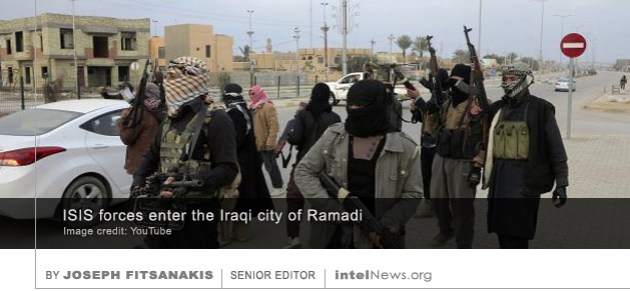
ISIS forces in RamadiA report from the United States Department of Defense warns that the Islamic State is swiftly returning to its insurgent roots, as observers in Iraq and Syria caution that the group is witnessing a revival. It has been four years since the Islamic State —known then as the Islamic State of Iraq and Syria, or ISIS— conquered much of eastern Syria and more than a third of Iraq’s territory. But by the end of 2017, virtually the entirety of ISIS’ self-styled ‘caliphate’ had been obliterated by an ‘unholy alliance’ of US-backed Iraqi government forces, Iranian-supported Shiite militias, Kurdish guerillas and Western airpower.


However, experts warn that, despite its loss of territorial control, the Islamic State maintains an active force of as many as 30,000 armed fighters in Iraq and Syria. Additionally, a recent US government report argues that, having been driven out of nearly all of the territory that it once held, the Islamic State is promptly “returning to its insurgent roots”. The report, authored by analysts at the US Department of Defense, claims that the militant Sunni group is “re-emerging as a guerrilla force”. In the place of what used to be a de-facto state, an “effective clandestine ISIS organization appears to be taking hold”, it states. The Pentagon document, summarized in a Financial Times article on Thursday, appears to be backed by information from the ground in Iraq and Syria. Iraqi military sources told The Times that ISIS appears to have more fighters in its ranks than initially thought, and that the group’s organizational structure that helped it grow in the first place “has not been eliminated”.

Moreover, the group is “still well-funded” and its operations remain lethal, said the paper, especially in Iraq, where it continues to undermine the government’s efforts to improve the country’s security. Islamic State fighters are systematically targeting regional leaders, said The Times, in an effort to prevent the government from delivering economic development in Iraq’s Sunni-majority western regions. A similar pattern of activities is being observed in Syria, where a resurgence of ISIS activity has prolonged the deployment of around 2,000 US military personnel there. What is more, ISIS fighters frequently cross the Iraq-Syria border and spend much of their time in safe houses and other hideouts. The paper quotes Yahya Rasool, spokesperson for the Iraqi Army’s Joint Operations Command, who says that “our war on ISIS today is an intelligence war, not a military war. We are searching and raiding their hide-outs”.

Author: Joseph Fitsanakis | Date: 07 December 2018 | Permalink

Canada arrests daughter of Chinese telecom giant’s founder at US request

Meng WanzhouThe daughter of the founder of Huawei Technologies, one of the world’s leading telecommunications hardware manufacturers, has been arrested in Canada, reportedly at the request of the United States. Meng Wanzhou (pictured, also known as Sabrina Meng) serves as Huawei’s deputy chair and chief financial officer. She is the daughter of Ren Zhengfei a former officer in the Chinese People’s Liberation Army, who established the company in 1988 and has since amassed a personal fortune estimated at $3.5 billion. By virtue of her family background and position in Huawei, Meng is often referred to as “a member of China’s corporate royalty”.

Few details of Meng’s arrest have been publicized. On Wednesday, Canada’s Department of Justice confirmed that the Huawei CFO was detained on December 1 in Vancouver as she was transferring between flights. The Justice Department also confirmed that the arrest occurred at the request of American law enforcement officials. In a carefully worded statement, the Canadian government said Meng is “sought for extradition by the United States” and that her bail hearing will be taking place this coming Friday. On Wednesday, the Canadian newspaper The Globe and Mail cited an unnamed “Canadian law enforcement source with knowledge of the arrest”, who said that US authorities had evidence that Meng “tried to evade the American embargo against Iran”. This statement appears to refer to reports in Western media in April of this year, according to which the US Departments of Commerce and Treasury were probing suspected violations of Washington’s sanctions against Iran and North Korea by Huawei.

The embassy of China in Canada immediately protested news of Meng’s arrest, saying that the Huawei CFO had been detained despite “not violating any American or Canadian law”. In a statement issued on Wednesday, the embassy added that it had “lodged stern representations” to the Canadian government and “urged them to immediately […] restore the personal freedom of Ms. Meng Wanzhou”. Meanwhile, a representative at Huawei’s corporate headquarters in the southern Chinese city of Shenzhen told the BBC that the company is certain “the Canadian and US legal systems will ultimately reach a just conclusion” in the case.

Several officials in the United States, United Kingdom, Australia and other Western countries, have repeatedly flagged Huawei as a company that is uncomfortably close to the Chinese government and its intelligence agencies. In 2011, the US Open Source Center, which acts as the open-source intelligence arm of the Office of the Director of National Intelligence, became the first US government agency to openly link Huawei with the Chinese intelligence establishment. In 2013, the British government launched an official review of Huawei’s involvement in the UK Cyber Security Evaluations Centre in Oxfordshire, England, following a British Parliament report that raised strong concerns about the Chinese company’s links with the government in Beijing. And in 2017 the Australian government expressed concern about Huawei’s plan to provide high-speed Internet to the Solomon Islands, a small Pacific island nation with which Australia shares Internet resources.

Author: Joseph Fitsanakis | Date: 06 December 2018 | Permalink