Iran says it dismantled a ‘complicated’ CIA cyber operation in several countries

Ali ShamkhaniA senior Iranian security official said on Monday that Tehran had dismantled “one of the most complicated” espionage operations by the United States Central Intelligence Agency, leading to “arrests and confessions” of suspects in several countries. The announcement was made by Ali Shamkhani (pictured), secretary of the Supreme National Security Council of Iran, the Islamic Republic’s highest security decision-making body, which is chaired by the country’s president.
Speaking in Tehran to reporters from pro-government news agencies, including IRIB and Fars News, Shamkhani said that Iran had “exposed” what he described as a CIA-run cyber espionage network, which carried out “operations in different countries”. He said the alleged espionage network had been detected by Iranian counterintelligence agencies “some time ago and was dismantled”. Iran’s counterintelligence actions had led to the “identification and arrest of CIA intelligence agents”, said Shamkhani, many of whom had been arrested “in different countries”. The arrests occurred after Iran “shared the information about the exposed network with our allies”, said Shamkhani, which led to the “disclosure and dismantling of a network of CIA officers” as well as the “detention and punishment of several spies”. Shamkhani did not specify the number of people arrested, or in which countries, but appeared to refer to both CIA personnel and local assets. He concluded his remarks by saying that Iran was building a regional alliance “to counter American espionage”. He also urged Iran’s Ministry of Intelligence to release “videos and confessions” relating to the arrests.

Meanwhile, Iranian anti-government groups based abroad alleged on Monday that a senior official in the Islamic Revolutionary Guard Corps was arrested in Tehran for allegedly working for Israel. The unidentified individual is believed to have helped Israel’s Mossad intelligence agency gain access to the archive of the Iranian nuclear program in 2018, and steal an unspecified number of classified documents. It is not known whether this alleged arrest is connected with Shamkhani’s announcement on Monday.

Author: Joseph Fitsanakis | Date: 18 June 2019 | Permalink

Trump says US will not use spies on North Korea, then appears to retract statement

Trump CIA - JFUnited States President Donald Trump said on Tuesday that he would not allow American intelligence agencies to use spies against North Korea, raising eyebrows in Washington, before appearing to backtrack a day later. The American president was speaking to reporters at the White House on Tuesday, when he was asked about a report that appeared in The Wall Street Journal that day. According to the report, Kim Jong-nam, the half-brother of North Korean leader Kim Jong-un, held regular meetings with officers of the US Central Intelligence Agency before he was assassinated with VX nerve gas at a busy airport terminal in Malaysia in February 2017. The Wall Street Journal’s claim was echoed by a book written by Washington Post correspondent Anna Fifield, which also came out on Tuesday. In the book, entitled The Great Successor, Fifield claims that Kim had traveled to Malaysia to meet his CIA handler when he was killed.

On Tuesday, President Trump said he had seen “the information about the CIA, with respect to [North Korean Supreme Leader Kim Jong-un’s] half-brother. And I would tell [Kim] that would not happen under my auspices, that’s for sure”, said the US president, before repeating, “I wouldn’t let that happen under my auspices”. Reporters interpreted Trump’s comments to mean that he would not use human assets or any other kinds of informants to collect intelligence on the regime of the North Korean leader. As can be expected, the US president’s remarks raised eyebrows among lawmakers and national security experts in Washington. It was suggested that Trump appeared to voluntarily eliminate a potentially invaluable tool of intelligence collection from America’s arsenal. The president’s comments were even more peculiar given the hermetically sealed nature of the North Korean regime, which Western spy agencies would argue necessitates the use of human assets for intelligence collection. Moreover, President Trump’s comments appeared to once again place him at odds with his own Intelligence Community, as previously in the cases of Iran’s nuclear program, the current status of the Islamic State, or Russia’s meddling in American political life.

On Wednesday, however, the US president appeared to backtrack on his comments. When asked at a joint press conference with Polish President Andrzej Duda about his earlier remarks, Trump denied that he had implied the US would not use spies to collect information on North Korea. “No, it’s not what I meant”, the president responded to the reporter who asked him the question. “It’s what I said and I think it’s different, maybe, than your interpretation”, said President Trump, but refused to elaborate on what he actually meant with his statement on Tuesday. The Reuters news agency contacted the CIA seeking an official statement on the US president’s remarks, but the agency said it had no immediate comment on the issue.

Author: Joseph Fitsanakis | Date: 13 June 2019 | Permalink

North Korean leader’s half-brother worked with CIA before his death, paper claims

Kim Jong-nam murderKim Jong-nam, the half-brother of North Korean leader Kim Jong-un, held regular meetings with American intelligence officers before he was assassinated with VX nerve gas at a busy airport terminal in Malaysia. Two women approached Kim Jong-nam as he was waiting to board a plane at the Kuala Lumpur International Airport on February 13, 2017. The estranged half-brother of the North Korean leader was about to travel to the semi-autonomous Chinese territory of Macau, where he had been living in self-exile since 2007. Soon after his encounter with the two women, Kim collapsed and eventually died from symptoms associated with VX nerve agent inhalation.

But a new book published on Tuesday by a Washington Post reporter, and an article that came out in The Wall Street Journal on the same day, allege that Kim Jong-nam was working with the United States Central Intelligence Agency and was in fact in Malaysia to meet with his American spy hander when he was killed. The Wall Street Journal article said that many details of Kim Jong-nam’s precise relationship with the CIA remain “unclear”. It is doubtful that the late half-brother of the North Korean leader had much of a powerbase in the land of his birth, where few people even knew who he was. So his usefulness in providing the CIA with crucial details about the inner workings of the North Korean regime would have been limited. However, the paper quoted “a person knowledgeable about the matter” as saying that “there was a nexus” between the CIA and Kim. The article also alleges that Kim met with CIA case officers “on multiple occasions”, including during his fateful trip to Malaysia in February of 2017.

In her just-published book The Great Successor, Anna Fifield, a correspondent with The Washington Post, claims that Kim spent a number of days on the island of Langkawi, a well-known resort destination in Malaysia. Security footage at his hotel showed him meeting with “an Asian-looking man [Korean-American, according to The Wall Street Journal] who was reported to be an American intelligence [officer]”. It was one of regular trips Kim took to places like Singapore and Malaysia to meet his spy handlers, according to Fifield, who cites “someone with knowledge of the intelligence”. She adds that, although meeting with this CIA handler may not have necessarily been the sole purpose of Kim’s fateful trip to Malaysia, it was certainly a major reason. Fifield alleges that the backpack Kim was carrying when he was killed at the Kuala Lumpur International Airport was found to contain $120,000 in cash. The Wall Street Journal claims that, in addition to meeting with the CIA, Kim held regular meetings with spy agencies of other countries, including China.

Meanwhile, two South Korean government agencies, the National Intelligence Service and the Ministry of Reunification, said on Tuesday that they were unable to confirm that Kim was indeed an asset of the CIA or any other intelligence agency. They also said that they could not confirm whether Kim had traveled to Malaysia to meet with a CIA case officer at the time of his assassination.

Author: Joseph Fitsanakis | Date: 12 June 2019 | Permalink

In a surprise move, Iran releases Washington resident accused of espionage

Nizar ZakkaIran has announced that it will release a Lebanese national and United States permanent resident, who has served nearly half of his 10-year prison sentence for allegedly spying for Washington. Nizar Zakka, 52, was born in Lebanon but was schooled in the US, where he lived permanently until 2015. In September of that year, Zakka traveled to the Iranian capital Tehran at the invitation of the government of Iran, where he spoke at a conference on Internet-based entrepreneurship. He attended the event as an information technology expert who worked for companies like Cisco and Microsoft before setting up his own company called IJMA3. Based in Washington, DC, IJMA3 lobbies investors to help build online networks in the Middle East in order to develop the region economically, socially and politically.

But on September 18, 2015, as Zakka was traveling to the Imam Khomeini International Airport in Tehran for his return flight, he was detained by Iranian security officers and never made it out of the country. A year later, he was convicted of spying for the US and sentenced to 10 years in prison. The court also handed him a $4.2 million fine, allegedly for “collaborating with a government that was hostile to Iran”. Iran’s state-run media said Zakka was a “treasure trove” of intelligence on the American military. But the Lebanese IT expert denied all charges leveled against him. He said he was tortured during his interrogation and he went on frequent hunger strikes to protest his innocence and the conditions of his detention. Throughout his imprisonment, the Lebanese government pressured Iran for his release. The US also raised the issue through Congress and the Department of State. But Washington’s ability to influence Iran was limited, as it does not have diplomatic relations with Tehran.

On Tuesday, however, Lebanon’s Ministry of Foreign Affairs said it had received word from Iran’s ambassador to Lebanon that Zakka would be released soon. The Iranians reportedly said they decided to release Zakka following personal interventions by Lebanon’s Prime Minister Saad Hariri and the country’s President Michel Aoun. Additionally, said the Iranian ambassador, Zakka would be released as “a goodwill gesture” during Eid al-Fitr, a Muslim holiday that marks the end of Ramadan, the Islamic holy month of fasting. The statement added that Iran’s President Hassan Rouhani was “ready to receive a Lebanese delegation at any time for the extradition of the Lebanese prisoner Nizar Zakka”.

Author: Ian Allen | Date: 05 June 2019 | Permalink

Leaked documents show Cuban spies targeted Miami International Airport

Miami International AirportDocuments that were allegedly leaked by a Cuban intelligence insider show that Cuban spies targeted the Miami International Airport (MIA) and may have acquired MIA internal files, passwords and other sensitive information. The documents were published on Monday by CiberCuba, an online news portal that was founded in 2014 by Cuban exiles in Spain. The website said that it was given access to several batches of classified Cuban intelligence files by an “anonymous source”. The files allegedly contain copies of internal emails and email attachments, personnel contracts, financial information, as well as intelligence collected on “persons of interest” to the Cuban government.

The Spain-based website said on Monday that the leaked documents, which it dubbed “CiberCubaleaks”, constitute one of history’s largest and most significant disclosures of internal files of the Cuban Ministry of Interior. In a lading article on Monday, CiberCuba published six documents from the Ministry’s Directorate of Counterintelligence, which are dated between mid-2015 and late 2017. The documents contain information provided by two spies in the United States, codenamed CHARLES and EL GORDO. They contain internal passcodes that can be used to access secure areas at MIA, sensitive records relating to the commercial airlines that use the airport, and descriptions of restricted areas at MIA.

But in a statement made to The Miami Herald, the Director of Aviation for Miami-Dade County, Lester Sola, dismissed the information in the leaked documents as “not credible”. Sola said that the description of MIA documents in the leaded files did not seem accurate and missed some basic clues, such as a correct description of the colors of MIAs security protocols. Consequently, said Sola, “nothing in the [CiberCuba] report poses a credible security threat”. However, his office did not ignore the information and shared it with government agencies; consequently, the Federal Bureau of Investigation was “looking into” the CiberCuba report as of Monday morning, he said.

Author: Joseph Fitsanakis | Date: 04 June 2019 | Permalink

North Korea said to have executed senior nuclear negotiators as ‘spies’

Kim Song-hye Kim Hyok-cholNorth Korea has executed at least five of its senior nuclear negotiators and imprisoned several others, according to a report in a leading South Korean newspaper. Rumors of executions of North Korean nuclear negotiators have circulated in international diplomatic circles since February, but specific allegations have not surfaced in the news media. That changed on Friday, when Chosun Ilbo, South Korea’s highest-circulation newspaper, said that at least five executions of nuclear negotiators took place in Pyongyang in March.

According to the paper, the most senior North Korean official to be executed was Kim Hyok-chol (pictured), who led the nuclear negotiations with Washington until February, when the North Korean Supreme Leader Kim Jong-un met US President Donald Trump in Vietnam. Citing an “anonymous source” Chosun Ilbo said on Friday that Kim was executed by a firing squad at the Pyongyang East Airfield in Mirim, a suburb of the North Korean capital. Four other Ministry of Foreign Affairs officials were executed at the same time, allegedly for having been “swayed by American imperialists to betray the Supreme Leader”, said the newspaper. Two more senior North Korean nuclear negotiators, Kim Yong-chol and Kim Song-hye (also pictured), have been stripped of their government posts and sent to labor camps, according to the report. Until recently, Kim Song-hye headed the Bureau of the Committee for the Peaceful Reunification of the Fatherland, Pyongyahg’s main agency for negotiations with South Korea. Kim Yong-chol was one of several vice-chairs of the ruling Workers’ Party of Korea. He visited Washington with Kim Song-hye for negotiations prior to last February’s high-level summit in Vietnam.

There have been no reports in North Korean media about purges of senior officials or executions of alleged spies. However, the three officials named in the Chosun Ilbo report have not been seen in public in nearly a month. Additionally, last week the official Workers’ Party of Korea newspaper, Rodong Sinmun, published an editorial that condemned “counter-party and counter-revolutionary actions” of government officials who “claim to labor for the Supreme Leader […] but clandestinely harbor other machinations behind the back of the Supreme Leader”. The New York Times reached out to the South Korean and American governments about the Chosun Ilbo report, but no-one would comment on record. If the Chosun Ilbo report is accurate, it would support the view that there is exasperation in Pyongyang about the breakdown of its nuclear negotiations with Washington. It would also signify that Kim has radically reshuffled his team of negotiators, but this does not necessarily denote a change in his negotiating stance.

Author: Joseph Fitsanakis | Date: 03 June 2019 | Permalink

Jonathan Pollard, US spy for Israel, complains of neglect by Israeli state

Jonathan PollardJonathan Pollard, an American who spied on his country for Israel in the 1980s, and is now free after spending 30 years in prison, has spoken of his frustration with the Israeli government, which it claims has forgotten about him. Pollard, a former intelligence analyst for the United States Navy, was released from an American prison in 2015, after serving a lengthy sentence for selling US government secrets to Israel. Throughout Pollard’s time in prison, the government of Israel lobbied for his release, claiming that the convicted spy did not harm American interests, but was simply trying to help Israel. But the US Intelligence Community and successive American presidents consistently rejected Israel’s claims, arguing that Pollard’s activities were severely detrimental to US interests. Pollard was eventually released after serving the entirety of his sentence. Ever since his release, Pollard has been required to wear an ankle monitor at all times. His Internet browsing is strictly regulated by the US government and he is not permitted to leave his New York home after sunset. He is also not permitted to leave the US, and Washington has refused to allow him to move to Israel.

Last week, Israel’s Channel 12 television station aired a rare interview with Pollard, in which the former spy claimed he had been “forgotten” by the Israeli government. Speaking from a restaurant in New York with his wife Esther by his side, Pollard told Channel 12 that no officials from the Israeli government had made contact with him since his release. He added that he felt “there is always something more urgent than me” for the government of Israel, whether it is “the [nuclear] deal with Iran or the [US] embassy’s move to Jerusalem, or the sovereignty of the Golan Heights”. When the Channel 12 reporter asked him whether he was disappointed by Israel’s perceived lack of efforts to bring him to Israel, Pollard replied that he would be “very depressed” if his “faith in God and [his] love for Israel and its people [was not] so strong”. At another point in the interview, Pollard appeared to criticize the Israeli government of Prime Minister Benjamin Netanyahu. “I am very concerned about what this entails for the [government’s] commitment and for [Israel’s] security”, he said. “If you do not care about someone like me, who spent 30 years in prison for the land of Israel and its citizens, how much concern is there for others in the country, [whether they are] soldiers or civilians?”.

In November of 2017, Israel’s Channel 2 television reported that Israeli Prime Minister Netanyahu had asked the United States President Donald Trump to allow Jonathan Pollard to move to Israel. However, despite the popular perception of the Trump administration as strongly pro-Israel, there are no indications that such a move may be taking place any time soon.

Author: Joseph Fitsanakis | Date: 27 May 2019 | Permalink

Star on CIA’s memorial wall honors employee who took her own life

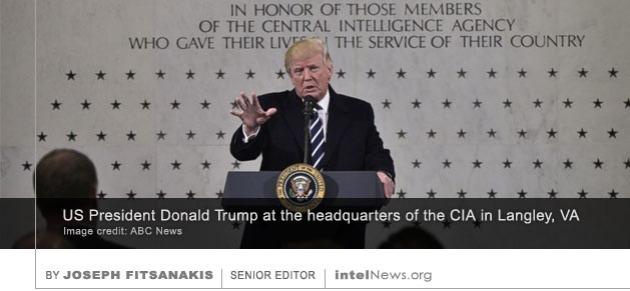
CIA memorial wallA new star that was recently added to the United States Central Intelligence Agency’s memorial wall is seen by some as a way to draw attention to the mental pressures that come with the job, while others view it as disrespectful to the Agency’s mission. The specially designated wall is located at the main entrance lobby of the CIA’s headquarters in Langley, Virginia. It was created in 1974 and displays a star for each of the CIA’s personnel who have perished in the line of duty while working for the Agency. Today it displays nearly 130 stars, which span the CIA’s 72-year history.
The CIA holds an annual ceremony in recognition of its fallen members, at which time new stars are usually added to the memorial wall. Among them there is a star for Ranya Abdelsayed, who died on August 28, 2013, while employed by the CIA in Kandahar, Afghanistan. However, unlike the other 19 known deaths of CIA personnel in Afghanistan since 2001, Abdelsayed reportedly died by suicide. Her lifeless body was found by a colleague after she shot herself to death at Firebase Gecko, an International Security Assistance Force base in Afghanistan, which is commanded by the North Atlantic Treaty Organization. It is believed that Abdelsayed’s star is the only star on the CIA’s memorial wall that recognizes a CIA employee who took her own life.

In an article published on Sunday, The Washington Post’s Ian Shapira reports that not everyone at CIA agrees that Abdelsayed deserves to have a star on the Agency’s memorial wall. Shapira spoke to Nicholas Dujmovic, a recently retired CIA historian, who claims that Abdelsayed’s star “must absolutely come off the wall” because it violates the CIA’s own criteria for this highest of honors. Dujmovic opines that the memorial wall is reserved for deaths of CIA personnel that are “of an inspirational or heroic character”, typically deaths that are caused by hazardous conditions or violent actions by adversaries. The CIA historian tells The Washington Post that he has researched past deaths of CIA personnel and fears that “there has been an erosion of understanding in CIA leadership for at least two decades about what the wall is for and who is it that we’re commemorating”.

The paper reports that Dujmovic made his views known to CIA officials when the Agency’s Merit Awards Board decided to include a star in honor of Abdelsayed. But the Board upheld its decision, and so did the CIA’s director at the time, John Brennan. He told The Post that he stands by that decision today, arguing that Abdelsayed’s death was “something the Agency needed to recognize as being one of those unfortunate consequences of the global challenges the CIA addresses”.

Author: Joseph Fitsanakis | Date: 21 May 2019 | Permalink

US-Iran tensions may have been sparked by ‘misread intelligence’, claims report

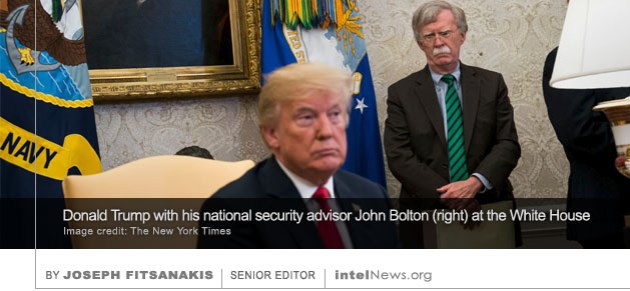
Trump BoltonThe escalating tension between the United States and Iran, and the ensuing military buildup in the Persian Gulf, may have resulted from a misreading of intelligence by both sides, according to a new report in The Wall Street Journal. Reports from the Middle East continue to describe the situation there as tense, while the political rhetoric by both Washington and Tehran remains heightened. Last week, the White House ordered the USS Abraham Lincoln carrier strike group to sail to Middle Eastern waters, following intelligence showing that “Iran or its proxies were planning attacks against US forces in Iraq, Syria and at sea”. Washington also evacuated all non-essential personnel from its embassy in Iraq. Meanwhile Iranian officials stated on Thursday that they were “prepared for war”, while the head of Iran’s Revolutionary Guard Corps, Major Genreal Hossein Salami, described the escalating crisis as “the most decisive moment in the [40-year history] of the Islamic Revolution”.
But a new report in The Wall Street Journal claimed on Thursday that the crisis between the two countries may have been caused by a misinterpretation of intelligence on each other’s moves. The paper said that new intelligence collected by American spy agencies appears to show that Tehran was under the impression that the US was about to launch attacks against it. There is no information about what precisely led the Iranians to draw that conclusion. But it is believed that Iran responded to the perceived threat from Washington by abruptly bolstering its military posture and placing its allies in the region —including Hezbollah in Lebanon and numerous Shiite militias in Iraq and Syria, on high alert. Those actions were interpreted by Washington as evidence that Iran was planning to launch an attack against American interests in the region, thus prompting the White House to send the USS Abraham Lincoln strike group to sail to the area, and to partially evacuate its embassy in Iraq. Citing “people familiar with the matter”, the Journal said that new intelligence that has been collected “in recent days” points to the initial actions taken by Tehran as “defensive in nature”.

However, said that paper, there continue to be “sharply differing views” about the situation among officials in the administration of US President Donald Trump. Specifically, some administration officials continue to argue that the available intelligence indicates that Iran “was planning to strike first”, and some even believe that Tehran is still “planning imminent attacks” on the US and its interests in the region. The paper also noted that President Trump is believed to have told senior officials in his administration —including the Secretary of Defense Patrick Shanahan— that he does not want to see a military confrontation with Iran.

Author: Joseph Fitsanakis | Date: 17 May 2019 | Permalink

British commander in Iraq contradicts US assessment of increased Iranian threat

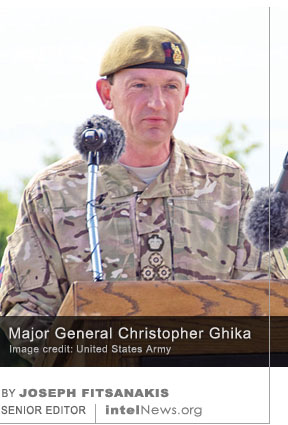
Christopher GhikaThe most senior British military officer in the war against the Islamic State contradicted American assessments of a heightened threat from Iran, prompting an unusually strong rebuke from Washington. Last week, the White House ordered the USS Abraham Lincoln carrier strike group to sail to Middle Eastern waters, following intelligence showing that “Iran or its proxies were planning attacks against US forces in Iraq, Syria and at sea”.

On Tuesday, however, this view appeared to be challenged by Major General Christopher Ghika, Britain’s most senior military official in the Middle East, who is deputy commander of Operation Inherent Resolve (OIR). The OIR umbrella brings together all pro-Western forces that are fighting the Islamic State in Iraq and Syria. General Ghika spoke to American reporters at the US Department of Defense via a live video-link from Baghdad, where he is currently stationed as OIR deputy commander. In responding to questions by reporters about alleged threats to Western forces from Iran or its proxies, General Ghika said that the OIR forces were “aware of that presence [or Iranian-led Shia militia groups in Iraq and Syria], clearly. And we monitor them along with a whole range of others because that’s the environment we are in”. However, added the general, “no, there has been no increased threat from Iranian-backed forces in Iraq and Syria”.

British newspaper The Guardian, which published General Ghika’s comments on Tuesday, noted that his statements appeared to directly contradict Washington’s claims of a heightened Iranian threat in the region. But in a statement released on Tuesday night local time, the US Central Command CENTCOM, whose responsibilities include the Middle East and Central Asia theaters, rejected General Ghika’s comments. “Recent comments from OIR’s Deputy Commander run counter to the identified credible threats available to intelligence from U.S. and allies regarding Iranian backed forces in the region”, said the statement. The Guardian described CENTCOM’s statement as “particularly striking” and “an extraordinary rebuke of an allied senior [military] officer”. The British Ministry of Defense had not responded to CENTCOM’s statement by Wednesday morning.

Author: Joseph Fitsanakis | Date: 15 May 2019 | Permalink

‘Unusual’ high-level meeting held at CIA headquarters to discuss Iran, say sources

CIA headquartersAn untypical high-level meeting was convened at the headquarters of the United States Central Intelligence Agency last week to discuss Iran, according to NBC News. The meeting, which NBC described as “highly unusual” was convened by President Donald Trump’s National Security Adviser John Bolton. Participants allegedly included Secretary of State Mike Pompeo, Acting Secretary of Defense Patrick Shanahan, Director of National Intelligence Dan Coats, CIA Director Gina Haspel, and Chairman of the Joint Chiefs of Staff General Joe Dunford. Citing “six current US officials”, NBC said the meeting was held at 7 a.m. on Monday, April 29, in Langley, Virginia.

The list of participants refers to a high-level national security meeting. These are almost always held at the White House —typically in the Situation Room— says NBC. In general, it is extremely rare for senior White House officials, like Bolton, or members of the Cabinet, like Pompeo, to participate in meetings at CIA headquarters. It is also worth noting that, according to NBC’s sources, the meeting was not related to Washington’s recent decision send the USS Abraham Lincoln carrier strike group to the Middle East. This leaves two options, according to the NBC report: first, that the meeting concerned a “highly sensitive covert action” involving Iran or an Iranian proxy, such as the Lebanese Hezbollah. It could have been an update on an existing CIA operation, or a description of options for an impending operation. Alternatively the meeting could have been called due to a disagreement between the CIA and the White House about the results of an intelligence assessment or estimate about Iran.

NBC said it contacted the National Security Council to inquire about the April 29 meeting, but a spokesperson refused to comment. Meanwhile, Pompeo abruptly canceled the final leg of a four-nation tour of Europe on Thursday and returned to Washington, reportedly in light of heightening tensions between Washington and Tehran. Also on Thursday, the Iranian government described the Trump administration’s decision to deploy the USS Abraham Lincoln carrier strike group to the Middle East as “an action of psychological warfare” against the Iranian people. Late on Thursday, President Trump urged Iran to reach out to him: “What I would like to see with Iran, I’d like to see them call me”, said the US leader during a press conference at the White House. Iranian officials did not immediately respond to his comments.

Author: Ian Allen | Date: 10 May 2019 | Permalink

Intel that prompted US to deploy aircraft carrier to Middle East ‘came from Israel’

USS Abraham LincolnThe sudden decision by the United States to deploy significant firepower to the Middle East was partly in response to intelligence that was given to Washington by Israeli officials, according to a report. On Wednesday, the US announced that the USS Abraham Lincoln carrier strike group had received instructions to sail to the Middle East. The aircraft carrier is reportedly sailing alongside a cruiser and four destroyers, while an unspecified number of B-52 heavy long-range bombers have been ordered to fly to a US military base in Qatar.

Commenting on this last-minute development, US National Security Adviser John Bolton warned Iran that it would face “unrelenting force” if it threatened American interests in the Middle East and beyond. The Chairman of the Joint Chiefs of Staff, General Joseph Dunford, said that the move aimed to “deter Iran […] so that there would be no ambiguity about our preparedness to respond to any threat against our people or partners in the region”. Speaking in Congress, the US Acting Secretary of Defense Patrick Shanahan said that the decision to move a significant amount of firepower to the Middle East came in response to intelligence showing that Iran had “made plans to target US forces in Iraq and elsewhere in the Middle East”. According to ABC News, the intelligence suggested that “Iran or its proxies were planning attacks against US forces in Iraq, Syria and at sea”. But there was no further information reported about the precise nature of the alleged warnings.

Meanwhile, the American news and information website Axios said on Monday that the intelligence that caused Washington’s response was given to the US by Israeli officials. Citing “senior Israeli officials”, the website said that the intelligence given to the US had been gathered “primarily by the Mossad”, Israel’s main external intelligence agency. It added that the information about possible Iranian attacks against the US or its allies in the Middle East was “raised two weeks ago” during closed-door talks at the White House between a US team led by Bolton and an Israeli delegation headed by his Israeli counterpart, Meir Ben Shabbat. The intelligence, said Axios, showed that the US or its allies, including the United Arab Emirates or Saudi Arabia, would be targeted by Iran. The information is “understood to be part of the reason for Bolton’s announcement” this week, said Axios.

Author: Joseph Fitsanakis | Date: 09 May 2019 | Permalink

US lifts sanctions on Venezuelan ex-spy chief, calls on others to defect

SEBIN VenezuelaIn an effort to persuade senior members of the Venezuelan government to defect, the United States has lifted punitive financial sanctions on the country’s intelligence director, who left his post on April 30. General Christopher Figuera became director of the Bolivarian National Intelligence Service (SEBIN) in October 2018. SEBIN is Venezuela’s primary intelligence agency and has a dual domestic and international role. Much of its domestic mission is to protect and defend the Bolivarian Revolution, which forms the ideological framework of the government headed by President Nicolás Maduro. It follows that SEBIN’s employees are all trusted supporters of Venezuela’s embattled President.

On February 15 of this year, the United States government included General Figuera on a financial sanctions list of Venezuelan government officials who held senior posts in the Maduro government. But on April 30, General Figuera appeared to be one of relatively few senior Venezuelan officials to respond favorably to an open call by Juan Guaidó, the United States-supported President of the Venezuelan National Assembly, to remove Maduro from power. Figuera was reportedly denounced by Venezuelan government officials and summarily replaced by Gustavo Gonzalez Lopez, who was director of SEBIN until he was replaced by Figuera in 2018.

On Tuesday, the United States government said that it had removed General Figuera from its financial sanctions list. Speaking before reporters in Washington, US Vice President Mike Pence said that Figuera was “an example to follow” for other senior Venezuelan government officials and urged more of them to follow Figuera’s example. Pence added that the US government wanted to reward Figuera for abandoning his post and denouncing Maduro. In a subsequent statement given to the media, the US Department of the Treasury said that removal of sanctions “may be available” for all senior Venezuelan officials “who take concrete and meaningful actions to restore democratic order” in the Latin American country. The statement did not elaborate on the meaning of taking “concrete and meaningful actions”.

In a potentially related development, the Venezuelan government said on Tuesday that it had taken control of three private airfields in the vicinity of the capital city of Caracas, in order “to prevent illicit acts which would compromise the safety of civil aviation”. It is believed that General Figuera left the country with his family using a private airfield, and that the Maduro government is trying to stop others from following his example.

Author: Joseph Fitsanakis | Date: 08 May 2019 | Permalink

Malaysia is helping Iran evade US economic sanctions, intelligence sources claim

Petronas MalaysiaCiting “Western intelligence officials”, Israeli newspaper Haaretz said on Thursday that a deepening alliance between Malaysia and Iran is expected to enable Tehran evade some of the economic sanctions imposed on it by the United States. In the past, every time Washington has imposed economic sanctions on Iran, it has issued renewable waivers for a number of countries whose economies have historically depended on substantial Iranian energy imports. This is done in order to prevent these economies from entering a recession due to lack of access to sufficient energy supplies. This week, however, US President Donald Trump said that Washington would not renew waivers for these countries, which include Italy, India, Turkey, South Korea and China. These waivers are now expected to run out on May 2, 2019, after which date the US has threatened to impose economic sanction on all countries that have substantial financial dealings with Tehran.

Many observers believe that these new sanctions will have a deep and immediate impact on the Iranian economy. But, according to Haaretz, the American sanctions are bringing Iran closer to Malaysia. Throughout the past month, says the Israeli newspaper, “atypical numbers” of oil tankers have been sailing between the two countries —a sign of trying to move as much oil as possible out of Iran before the US sanctions hit. Citing “Western intelligence officials”, Haaretz claims that Iran plans to continue to funnel funds from oil and natural gas sales through Malaysian banks. Much of that assistance, which sources claim will grow in the next month, is facilitated through Petronas, Malaysia’s state-owned oil company. As one of the world’s largest companies and the most powerful corporate entity in Malaysia, Petronas has immense political power. Much of the country’s political elite connected with Petronas —including the country’s current Prime Minister, Mahathir Mohamad, who was a senior advisor to the company in the early 2000s. In 2017, Petronas signed a cooperation agreement with an Iranian refinery facility and announced its intention to develop an emerging oilfield in the Middle Eastern country. Then in late 2018, Petronas officials traveled to Iran to sign a memorandum of understanding on mutual cooperation between the Malaysian company and Iran’s state-owned energy producer and distributor, the National Iranian Oil Company.

Haaretz notes that cultural and political ties between Malaysia and Iran run deep. The Southeast Asian country is one of a handful of nations that allow Iranians to visit without first having to obtain a visa. If fails to note, however, that in recent times there have been tensions between the two countries, due to concerns in Kuala Lumpur that Iran is trying to spread a militant version of Shia Islam in Malaysia.

Author: Joseph Fitsanakis | Date: 26 April 2019 | Permalink

British spy agency calls Trump’s espionage claim ‘utterly ridiculous’

GCHQThe Government Communications Headquarters (GCHQ), Britain’s primary signals-intelligence agency, has called claims by United States President Donald Trump that it spied on his election campaign “utterly ridiculous”. President Trump’s allegations are not new. They apparently rest on claims made in March 2017 by a Fox News commentator, that the GCHQ spied on Trump on orders of then-US President Barack Obama. The claim was repeated on March 17 at the White House by Sean Spicer, Trump’s then-press secretary, who said that Obama had used the GCHQ to spy on Trump so as to evade American privacy laws. At the time, Spicer’s claim prompted an angry response from the British government in London and from the British spy agency itself. In a rare public comment, GCHQ called the allegations “utterly ridiculous”.

This past Wednesday, the US president appeared to repeat his claim that GCHQ had spied on his election campaign, via a post on the popular social networking platform Twitter. Responding to a reiteration of the claim on the conservative cable television channel One America News Network, Trump tweeted “WOW! It is now just a question of time before the truth comes out, and when it does, it will be a beauty!”. The president’s tweet appeared just hours after the British government confirmed that Trump had been invited for a four-day state visit to the United Kingdom in June. The visit is believed to include a meeting with British Prime Minster Theresa May and dinner with Queen Elizabeth II at Buckingham Palace.

Following Trump’s tweet, the US newsmagazine Newsweek contacted GCHQ with a request for a response to the US president’s allegation. A GCHQ spokesperson referred the newsmagazine to the agency’s 2017 statement, and repeated: “The allegations that GCHQ was asked to conduct ‘wire tapping’ against the then president-elect are nonsense. They are utterly ridiculous and should be ignored”. It is extremely rare for GCHQ —one of Britain’s most secretive and publicity-shy agencies— to respond publicly to stories in the media. Late on Wednesday, British Foreign Affairs Secretary Jeremy Hunt said that the invitation to President Trump to visit London would not be rescinded, and insisted that Britain’s “special relationship” with the US remained “intact”.

Author: Joseph Fitsanakis | Date: 25 April 2019 | Permalink