German spies dismiss US warnings about Huawei threat to 5G network

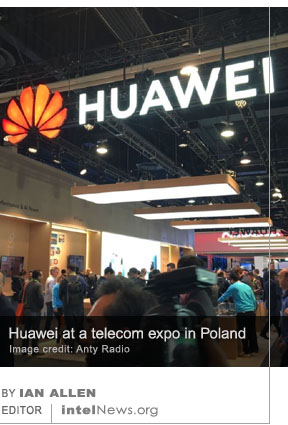
Huawei 2German intelligence officials appear to be dismissing Washington’s warning that it will limit security cooperation with Berlin if China’s Huawei Telecommunications is allowed to build Germany’s 5G network. The company, Huawei Technologies, is a private Chinese venture and one of the world’s leading telecommunications hardware manufacturers. In recent years, however, it has come under scrutiny by some Western intelligence agencies, who view it as being too close to the Communist Party of China. More recently, Washington has intensified an international campaign to limit Huawei’s ability to build the infrastructure for 5G, the world’s next-generation wireless network. Along with Britain, Australia and Canada, the US is concerned that the Chinese telecommunications giant may facilitate global wiretapping on behalf of Beijing’s spy agencies.
In the past several months the United States has repeatedly warned Germany that intelligence sharing between the two countries will be threatened if the Chinese telecommunications giant is awarded a 5G contract by the German government. In March, Washington informed German officials that intelligence cooperation between the two allies would be severely impacted if Chinese telecommunications manufacturers were given the green light to build Germany’s 5G infrastructure. The warning was allegedly included in a letter to Peter Altmaier, Germany’s Minister of Economic Affairs and Energy, written by Ambassador Richard Grenell, America’s top diplomat in Germany. The letter urged the German government to consider rival bids by companies belonging to American allies, such as the Swedish telecommunications equipment manufacturer Ericsson, Finland’s Nokia Corporation, or the South Korean Samsung Corporation.

But a report by Bloomberg on Wednesday said that German authorities were not convinced by Grenell’s argument. Citing “four people with knowledge on the matter”, the news agency said that Germany’s intelligence community see Washington’s warnings as “political grandstanding”. The US and Germany “need each other’s resources to tackle global conflicts” and “rely on each other too much to risk jeopardizing crucial data sharing”, said the report. The anonymous officials told Bloomberg that Germany does benefit from America’s “vast array” of intelligence. However, German spy agencies also provide their American counterparts with crucial intelligence from several regions of the world, they said. The US Department of State did not comment on the Bloomberg report. The Chinese government has repeatedly dismissed allegations that Huawei poses an espionage threat to Western nations.

Author: Ian Allen | Date: 18 April 2019 | Permalink

Venezuelan ex-spy chief with ‘treasure trove of intel’ on Maduro arrested in Spain

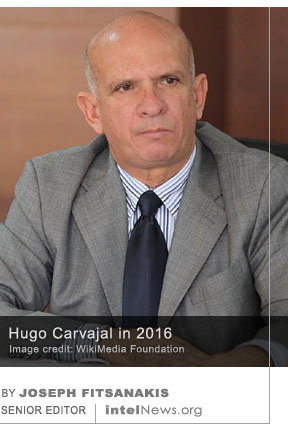
Hugo CarvajalThe former director of Venezuela’s military spy agency, who is wanted in the United States for facilitating international drug trafficking, has been arrested in Spain and may be extradited to Washington. Hugo Carvajal is a retired general and former diplomat, who was a member of the late Venezuelan President Hugo Chávez’s inner circle. From 2004 to 2011, under Chávez’s tutelage, Carvajal headed the Directorate General of Military Counterintelligence (DGCIM). But in 2008, the US named Carvajal as a major facilitator of international drugs trafficking and imposed financial sanctions on his assets around the world. Washington accused Carvajal of assisting the paramilitary group known as the Revolutionary Armed Forces of Colombia (FARC) transport drugs from Latin America to Mexico and from there to the US.
In 2014, the US government officially charged Carvajal with orchestrating a shipment of 1,200lbs of cocaine from Venezuela to Mexico. Washington also charged Carvajal with supplying FARC drug traffickers with Venezuelan passports bearing fake names, which they used to travel internationally to avoid detection. In 2014, Carvajal was arrested by authorities in Aruba, a Dutch overseas territory in Latin America, where he was serving as Venezuela’s consul general. But, to Washington’s dismay, he was released after the Dutch government ruled that his diplomatic immunity gave him immunity from prosecution. Following his release, Carvajal returned to Venezuela, where he was given a hero’s welcome by Chávez’s successor, President Nicolás Maduro. It came as a shock, therefore, when in February of this year Carvajal posted a video on social media in which he denounced Maduro and sided with his arch-nemesis, Juan Guaido, the President of the National Assembly of Venezuela. Carvajal’s issued his video a few weeks after Guaido declared himself president of Venezuela, citing powers afforded to him by the country’s constitution. He has since been openly supported by the United States and dozens of other Western countries. In his video, Carvajal urged the Venezuelan armed forces to stop siding with Maduro and support Guaido as Venezuela’s acting president.

The BBC reported that, shortly after Carvajal’s arrest in Spain, the US Department of Justice filed a formal request for the former spy chief’s extradition to the US. But the Reuters news agency cited an unnamed US government official who said that Carvajal was in possession of a “treasure trove” of intelligence about Maduro’s administration. The US official hinted that Carvajal may have willingly given himself up to Spanish police to express his desire to cooperate with the US. He is scheduled to appear before Spain’s High Court on Saturday. The court has 24 hours following Carvajal’s arrest to rule whether he will be extradited or freed from detention.

Author: Joseph Fitsanakis | Date: 15 April 2019 | Permalink

US prosecutors to use secret surveillance evidence in Huawei lawsuit

Huawei 2Prosecutors in the United States have informed lawyers representing the Chinese telecom- munications firm Huawei that they intend to use evidence obtained through secret surveillance in a lawsuit against the company. The case involves the arrest of Meng Wanzhou by Canadian authorities in December of last year. Meng, 47, is Huawei’s deputy chair and chief financial officer, and is the daughter of Ren Zhengfei, a former officer in the Chinese People’s Liberation Army, who founded the telecommunications giant in 1988. She was detained on December 1 in Vancouver at the request of the US, which claims it has evidence that she “tried to evade the American embargo against Iran”. On March 1, the Canadian Department of Justice formally commenced Meng’s extradition process to the US, which Huawei’s lawyers are currently seeking to prevent.

In a lawsuit brought by US government prosecu- tors against Huawei, the Chinese telecom- munications firm is accused of having conspired to defraud several multinational banks by misrepresenting its relationship with a company called Skykom Tech. Washington says that the company is in fact a front used to conceal illicit activities conducted by the Islamic Republic of Iran. American government prosecutors claim that Huawei worked with Skykom Tech to evade US-imposed economic sanctions on Iran. At a Thursday morning hearing in a federal court in Brooklyn, New York, Assistant US Attorney Alex Solomon said that US authorities had used “secret surveillance” to collect evidence against Huawei. He also said that the evidence had been obtained under a US Foreign Intelligence Surveillance Act (FISA) warrant, which is issued by a secret court and usually pertains to counterintelligence investigations —i.e. when a target is suspected of spying against the US.

Solomon said that the evidence against Huawei was “obtained […] from electronic surveillance and physical search”. He did not elaborate, but added that US government’s legal team had notified Huawei that it planned to use the FISA evidence in court. Last month Huawei rejected all charges filed against it. The company has not yet commented on the FISA evidence. The next date in the court case has been scheduled for June 19, 2019.

Author: Ian Allen | Date: 05 April 2019 | Permalink

US Homeland Security Department accused of disbanding homegrown terrorism unit

Department of Homeland Security DHSSome employees of the United States Department of Homeland Security claim that a unit specializing on homegrown and domestic terrorism was inexplicably disbanded, leaving America vulnerable to attack. The allegations were published on Tuesday on the website of The Daily Beast, an investigative news and opinion website. In a leading article published on the site, reporter Betsy Woodruff cites “current and former DHS officials” with knowledge about the Office of Intelligence and Analysis (I&A), which is the intelligence wing of the DHS.
Woodruff claims that, until recently, I&A employoed a team of analysts that worked on potential threats from domestic terrorism activity and homegrown violent extremist individuals or groups. They then shared their reports with law enforcement on the state and local level, which is DHS’s mission. But in August of 2017, when David Glawe assumed the post of Under Secretary of Homeland Security for Intelligence and Analysis, I&A experienced a major reorganization. The article alleges that Glawe —who was appointed by President Donald Trump— did away with the I&A unit that monitors domestic militancy, including far-right radicalization. Ever since that move, I&A have “significantly reduced their production [of analysis] on homegrown violent extremism and domestic terrorism”, according to a DHS official quoted in The Daily Beast piece. The I&A’s reduction in output has “generated significant concern at headquarters given the growth in right-wing extremism and domestic terrorism we are seeing in the US and abroad”, said another DHS official.

But in a written response to the website’s allegations, Glawe dismissed the claims as “patently false and the exact opposite of what we have done”. He went on to state that I&A has “significantly increased tactical intelligence reporting on domestic terrorists and homegrown violent extremists since 2016”. Referring to The Daily Beast’s claims, Glawe said that “those pushing such a narrative either do not understand intelligence collection efforts or don’t care about the truth”.

Author: Ian Allen | Date: 04 April 2019 | Permalink

Moscow confirms arrival of Russian troops in Venezuela

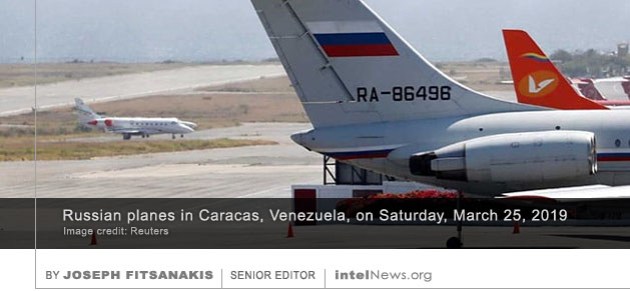
Russian planes CaracasRussian media reports have confirmed that an airplane carrying 100 Russian troops arrived in Caracas on Saturday, causing tensions to rise between Washington and Moscow over the deepening crisis in Venezuela. The arrival of the Russian troops in the Venezuelan capital was first reported on Saturday morning by Venezuelan reporter Javier Mayorca, who said on Twitter that two Russian military airplanes had landed in Caracas. The reporter said that an Antonov An-124 Ruslan cargo plane belonging to the Russian Air Force could be seen on the tarmac of the Simón Bolívar International Airport in the Venezuelan capital. Another, smaller aircraft, also bearing the Russian flag on its fuselage, landed shortly afterwards, said Mayorca.
Within hours, several Venezuelan media reports appeared to confirm Mayorca’s claims, some even posting photographs of the two Russian planes surrounded by what appeared to be uniformed Russian soldiers. The BBC reported that the Russian cargo plane had delivered 100 Russian troops and 35 tons of military equipment. The force was led by General Vasily Tonkoshkurov, commander of the General Staff of Russia’s Armed Forces, according to the BBC. Later on Saturday, the Russian government-owned news agency Sputnik confirmed that Russian troops had arrived in Caracas. Citing anonymous “diplomatic sources”, Sputnik said the Russian troops had been sent to Caracas in order “to fulfil technical military contracts” and “to take part in consultations […] on defense industry cooperation” with Venezuelan officials. It added that there was “nothing mysterious” about the visit and that it was “related to [military] contracts that had been signed by the two countries years ago”.

Russia has supported Venezuela militarily, economically and diplomatically ever since 1999, when Hugo Chávez became president. The recent political crisis in the Latin American country, which has prompted a direct diplomatic intervention by Washington, has brought Caracas and Moscow closer together, as Russia has strongly opposed efforts by the United States to bring down the government of Nicolás Maduro. Earlier this year, Russia sent two Tu-160 long-range bomber aircraft to take part in a military exercise organized by the Venezuelan government.

On Monday, Washington said that the United States Secretary of State Mike Pompeo had a telephone conversation with Russian Foreign Affairs Minister Sergei Lavrov. Pompeo told his Russian counterpart that Moscow should “cease its unconstructive behavior” and warned him that the United States would “not stand idly by as Russia exacerbated tensions” in Venezuela. Late on Monday, Sputnik quoted a “diplomatic source” as saying that that the “visit of Russian military personnel to Venezuela [was] in no way connected to the statements of the United States on potential intervention in Venezuela”.

Author: Joseph Fitsanakis | Date: 26 March 2019 | Permalink

Putin’s ex-adviser found dead in Washington had broken neck, say medical examiners

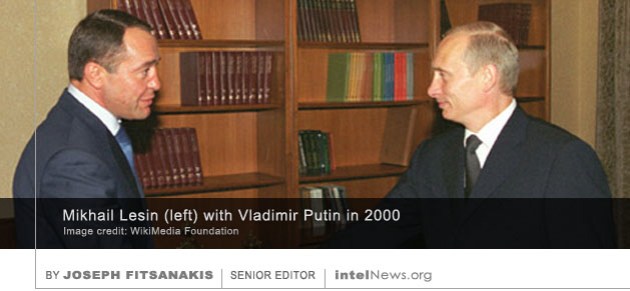
Mikhail LesinA former senior adviser to Russian President Vladimir Putin, who died allegedly by falling while intoxicated in a luxury hotel room in Washington, may in fact have been strangled to death, according to a newly released medical examination. The body of Mikhail Yuriyevich Lesin, a well-known Russian media mogul, was found in the luxury Dupont Circle Hotel on November 5, 2015. He became famous in Russia soon after the collapse of the communist system, when he founded Video International, an advertising and public-relations agency that was hired by Russian President Boris Yeltsin to run his reelection campaign in 1995.
Yeltsin’s electoral success was partly attributed to the well-tailored media message projected by Lesin’s company. The media magnate was rewarded by Yeltsin, who offered him influential government posts, including that of director of Russia’s state-owned news agency Novosti. Meanwhile, Lesin became a media personality and frequently gave interviews espousing a free-enterprise model for the Russian media industry. But soon after Vladimir Putin’s ascendance to the presidency, Lesin saw the writing on the wall and began advocating for increased government regulation of media and telecommunications conglomerates. In 1999, Putin made him Minister of Press, Broadcasting and Mass Communications, a post he held for nearly six years, until 2004. In 2006, Lesin was awarded the Order for Merit to the Fatherland, one of the most prestigious civilian decorations in Russia.

But in late 2009, Putin abruptly fired Lesin from his post in the Kremlin’s Media Advisory Commission, allegedly because the media mogul had developed close contacts with Russian organized crime. Lesin’s ties with Putin’s inner circle were further strained in 2014, when he resigned from his position as head of Gazprom Media, after he clashed with pro-Putin executives on the board. When Lesin’s body was found in his hotel room by a member of the hotel staff, some suggested that he may have been killed by the Kremlin. Read more of this post

Russians use front-company to access US federal employees’ contact info, says report

EFIS EstoniaRussian spy agencies use front companies to purchase directorates that contain the contact details of United States government employees, according to a new intelligence report. The contact details are contained in multi-page directories of Congressional staff members and employees of US federal agencies. They are published every January by a specialist vendor called Leadership Connect with the cooperation of a Washington, DC-based provider of publishing services. The directories contain the names, job titles, professional addresses and telephone numbers of US government employees.
But according to the Estonian Foreign Intelligence Service (EFIS), copies of the directorate are purchased every year by the Russian intelligence services, such as the Federal Security Service (FSB) and the Foreign Intelligence Service (SVR). The two Russian spy agencies allegedly use a front company in order to purchase copies of the directory. In reality, however, the purchases are made on behalf of Russian intelligence units, such as Military Unit 71330 of the FSB. This allegation is contained in the 2019 security environment assessment, which was published this week by the EFIS. Titled International Security and Estonia, the report is an overview of the main threats to Estonia’s internal security and a description of how these threats relate to international developments.

The directories, says EFIS, are not classified. On the contrary, they contain information that is publicly available in the US. However, the job descriptions and contact information of US federal employees are difficult to access in a collected format. The directories are therefore useful to Russian intelligence, which routinely tries to access large quantities of open-source information from foreign countries. Russian spy agencies are known to incorporate this open-source information into recruitment or surveillance plans that target specific individuals or foreign government agencies. They also use them to fill gaps in intelligence collection about specific agencies or parts of agencies, according to Robert Dannenberg, a former CIA officer who spoke to Yahoo News about the EFIS report.

Author: Ian Allen | Date: 14 March 2019 | Permalink

US warns Germany it will end intelligence sharing if Huawei is given 5G contract

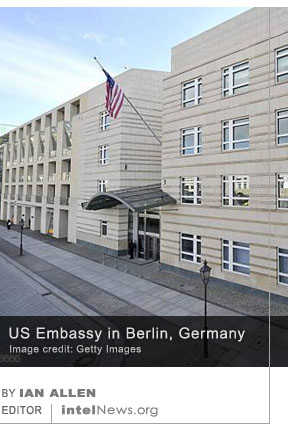
US embassy Berlin GermanyThe United States has warned Germany that intelligence sharing between the two countries will be threatened if the Chinese telecommunications giant Huawei is awarded a contract to build Germany’s 5G network. The company, Huawei Technologies, is a private Chinese venture and one of the world’s leading telecommunications hardware manufacturers. In recent years, however, it has come under scrutiny by some Western intelligence agencies, who view it as being too close to the Communist Party of China. More recently, Washington has intensified an international campaign to limit Huawei’s ability to build the infrastructure for 5G, the world’s next-generation wireless network. Along with Britain, Australia and Canada, the US is concerned that the Chinese telecommunications giant may facilitate global wiretapping on behalf of Beijing’s spy agencies.
But some American allies, including Spain, France and Germany, are not satisfied with Washington’s arguments and claim that the United States is eyeing the financial benefits that would arguably come from its domination of the global digital superhighway. German officials, in particular, have told their American counterparts that Berlin has not seen any evidence that Huawei’s telecommunications hardware come with hidden interception features. Moreover, Germany says that it plans to subject Huawei’s systems to rigorous security tests before using them. On Friday, Washington increased its pressure on Berlin by informing German officials that intelligence cooperation between the two allies would be severely impacted if Chinese telecommunications manufacturers are given the green light to build Germany’s 5G infrastructure.

According to The Wall Street Journal, the warning was included in a letter signed by Ambassador Richard Grenell, America’s top diplomat in Germany. It was allegedly sent to Peter Altmaier, Germany’s Minister of Economic Affairs and Energy. The paper says that Grenell suggests in his letter that Berlin should consider rival bids by companies belonging to American allies, such as the Swedish telecommunications equipment manufacturer Ericsson, Finland’s Nokia Corporation, or the South Korean Samsung Corporation, which is the world’s leading telecommunications hardware manufacturer. The Wall Street Journal did not reveal how it acquired Grenell’s letter, nor did it say whether the German government responded to it.

Author: Ian Allen | Date: 12 March 2019 | Permalink

US weapons given to UAE and Saudi Arabia are diverted to al-Qaeda-linked groups

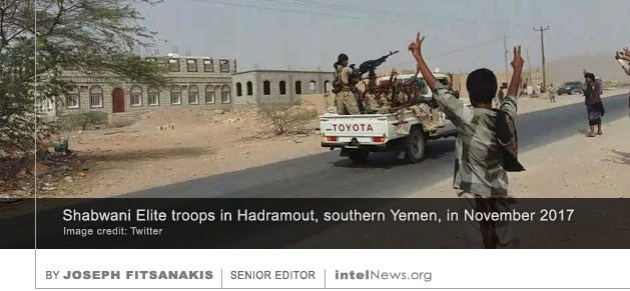
Shabwani EliteWeapons supplied to the Saudi and Emirati governments by the United States and other Western nations are ending up in the hands of al-Qaeda-linked Sunni militias in Yemen, according to two separate investigations. The weapons are being supplied to the militaries of Saudi Arabia and the United Arab Emirates by the West on the understanding that they will be used in the war in Yemen. The war has been going on since 2015, when a alliance of rebel groups from Yemen’s Shiite communities formed the Houthi movement, which quickly seized control of much of the country. The Houthis effectively toppled the government, prompting a reaction by a coalition of Sunni Arab states, which see the Shiite movement as an Iranian front. In an effort to restore Yemen’s Sunni-dominated government, Western countries have supplied Saudi Arabia and the United Arab Emirates with more than $5 billion-worth of weaponry.

However, a report published this week by Amnesty International alleges that some of that weaponry, including machine guns, mortars and even armored vehicles, are being deliberately diverted to Sunni militia groups in Yemen. Among them are three militias that are known to be supported by the government of the Emirates, namely the Giants, the Security Belt and the Shabwani Elite. These groups, says Amnesty, have been seen using Western-supplied weaponry in the field of battle and in their compounds throughout Yemen. In its report, the human-rights group says that these groups are not accountable to any government and have been linked to serious war crimes against civilians. Meanwhile, a separate investigation aired this week by CNN claims that American-manufactured weaponry and materiel given by Washington to the Saudi and Emirati militaries is ending up in the hand of Salafist militias in Yemen. The report names the Sunni Abu al-Abbas Brigade, which is closely linked to al-Qaeda in the Arabian Peninsula (AQAP). The CNN report also claims that some of the American weaponry has fallen in the hands of Houthi fighters.

On Wednesday the BBC quoted a senior American general who said that the Pentagon plans to investigate whether American and other Western-supplied weapons are being illegally diverted into the hands of non-state Sunni militias in Yemen. The government of the United Arab Emirates has not commented on the reports. As intelNews reported last August, an investigative report published by the Associated Press claimed that senior AQAP commanders were on the payroll of US-backed Sunni militias in Yemen and that its fighters were being recruited to fight against the Houthis. The report also argued that Washington was privy to the secret agreements between Yemen’s Sunni militias and AQAP.

Author: Joseph Fitsanakis | Date: 08 February 2019 | Permalink

Morton Sobell, convicted of conspiracy in the Rosenberg espionage case, dies at 101

Morton SobellMorton Sobell, an American radar engineer who in 1951 was convicted of conspiracy alongside Julius and Ethel Rosenberg in one of the Cold War’s most prominent espionage cases, has died at 101 years old. His death was announced yesterday by his son, Mark, who also said that his father died on December 26 last year at a nursing home, but that the family had not alerted the media.

Sobell was born in New York’s Manhattan Island in 1917 and worked on radar tracking systems for defense contractors. During college, he and several of his friends, including fellow-engineer Julius Rosenberg, joined the United States Communist Party, partly in reaction to the Great Depression. When the Federal Bureau of Investigation began to arrest members of what the United States government claimed was a Soviet atomic spy ring led by Rosenberg, Sobell escaped with his family to Mexico, where he used a fake identity to evade the authorities. But he was dramatically abducted by a paramilitary force and surrendered to the FBI.

He was then tried alongside Rosenberg and his wife Ethel for conspiracy to commit acts of espionage. The Rosenbergs refused to cooperate with the FBI and were sentenced to death. Both were executed in 1953 and remain to this day the only American citizens to have been executed for espionage after the Civil War. Sobel was found guilty of the lesser charge of conspiracy and no evidence was presented in court that connected him to atomic espionage. He was therefore sentenced to 30 years in prison and served 18 of those, following a successful public-relations campaign organized by his wife, Hellen. He was released from prison in 1969 and continued to insist that he had never been a spy and had been wrongly convicted of conspiracy.

But in 2008, at the age of 91, Sobell spoke to The New York Times and publicly admitted for the first time that he had been a spy for the Soviet Union. He said that he had worked systematically to provide Moscow with information on weapons systems and other classified technologies. However, he had “never thought of it” as spying, he said. He also told The Times that he had developed a favorable impression of Soviet communism during the Great Depression, when he and many others saw the Soviet economic system as an antidote to crisis-ridden capitalism. “Now I know it was an illusion”, he told the paper.

Author: Joseph Fitsanakis | Date: 31 January 2019 | Permalink

CIA has maintained secret communication with North Korea for 10 years

Mike Pompeo North KoreaWith presidential approval, the United States Central Intelligence Agency has maintained a secret channel of communication with North Korea since at least 2009, according to The Wall Street Journal. Many were surprised in 2018, when the then CIA director Mike Pompeo made a sudden visit to Pyongyang to speak with senior North Korean officials. But according to The Wall Street Journal, the CIA channel with the North Koreans had been there since at least 2009 and Pompeo simply “re-energized it” after being instructed to do so by the White House.

The United States and North Korea have never had official diplomatic relations, nor have they ever maintained embassies at each other’s capitals. In rare instances, the North Korean Permanent Mission to the United Nations in New York has been utilized to pass messages from the White House to the communist country’s Ministry of Foreign Affairs. No other systematic diplomatic activity between the two sides has ever been reported.

But an article published in The Wall Street Journal on Monday claims that an intelligence channel between the CIA and unspecified North Korean intelligence officials has been active —with some periods of dormancy— for at least a decade. The previously unreported channel has led to a number of public meetings, such as the 2014 visit to Pyongyang by James Clapper, the then US Director of National Intelligence, as well as an earlier visit to the North Korean capital by former US President Bill Clinton in 2009. But, says the paper citing “current and former US officials”, most of the contacts have been secret. They include several visits to North Korea by CIA official Joseph DeTrani before and after Clinton’s visit, as well as two trips to Pyongyang by CIA Deputy Director Michael Morell, in 2012 and 2013. His successor, Avril Haines, also visited North Korea, says The Journal, but notes that the channel went “dormant late in the Obama administration”.

Upon becoming CIA director following the election of Donald Trump to the presidency, Mike Pompeo was briefed about the secret channel’s existence and decided to resume it, with Trump’s agreement. That led to his eventual visit to North Korea along with Andrew Kim, who at the time headed the CIA’s Korea Mission Center. Eventually, this channel of communication facilitated the high-level summit between President Trump and Supreme leader Kim Jong-un in June 2018 in Singapore. The Wall Street Journal said it reached out to the CIA, the Department of State and the White House about this story, but received no responses. The North Korean mission in the United Nations in New York also declined to comment.

Author: Joseph Fitsanakis | Date: 22 January 2019 | Permalink

‘Illusion of safety’ blamed for deaths of four US service members in Syria

Manbij SyriaThe “illusion of safety” has been blamed for the death of four American service members in northern Syria last week, after a suicide bomber attacked a restaurant, killing at least 19 people and wounding countless others. The deadly attack happened in Manbij, a small Kurdish-majority town near the Syrian-Turkish border, which American forces previously viewed as an oasis of security in the war-torn country. American troops fought alongside a coalition of Kurdish and Arab fighters who in 2016 took control of Manbij from the Islamic State of Iraq and Syria (ISIS). Since then, American forces have remained in the area —mostly to prevent a military invasion by Washington’s ally Turkey, which views the Kurds as terrorists and has threatened to destroy their armed forces.

The relative stability of Manbij was violently disrupted last Wednesday, when a man detonated a suicide vest inside the Palace of the Princes restaurant in downtown Manbij. Until that moment, United States forces had lost just two members during the Syrian Civil War. Four more Americans died in Wednesday’s blast, including two service members, a military contractor and a civilian intelligence officer working for the Pentagon. Three other Americans were wounded and were airlifted out of the country. In an insightful article published last week, The New York Times quoted a US Special Forces member who wondered whether the US troops in northern Syria have “developed a false sense of security” in what remains a dangerous conflict zone. “The illusion of safety”, said the anonymous commentator, had caused the behavior of American service members in Manbij to fall into predictable routines. That became a vulnerability that the Islamic State was able to exploit, he said.

The Sunni militant group targeted the Palace of the Princes, one of the most popular eateries for Americans in Manbij. The Times quoted locals who said that American troops appeared to eat there nearly every time they patrolled the city, “often many times a week”. They would even park their military vehicles outside the restaurant while dining there, they said. The paper commented that many US troops had “grown complacent and should have varied their […] routes or increased their operational security” while on patrol. Unfortunately, however, their presence —and lack of adequate security— was noticed by the Islamic State, which targeted them on Wednesday.

Author: Joseph Fitsanakis | Date: 21 January 2019 | Permalink

Trial witness claims ‘El Chapo’ gave Mexico’s ex-president $100 million bribe

Joaquín ‘El Chapo’ GuzmánA high-profile witness has told the trial of Joaquín ‘El Chapo’ Guzmán in New York that the accused bribed the then President of Mexico, Enrique Peña Nieto, with $100 million in order to stay out of prison. Guzmán, the leader of the powerful Sinaloa drug cartel, was arrested in February 2014 in Mexico. In January 2017, he was extradited to the United States, where he faces a litany charges ranging from conspiracy to import and distribute drugs to money-laundering and homicide. His trial began at the Federal District Court in Brooklyn, New York, last November.

All of last Tuesday was taken up by the testimony of Alex Cifuentes Villa, a Colombian former drug lord from Medellin who, until his arrest in 2012, was one of Guzmán’s closest collaborators. Villa told the court that Peña Nieto employed mediators to reach out to the Sinaloa cartel soon after he was elected president in 2012. He alleged that the mediators offered to strike a bargain with Guzmán, according to which he would stay out of prison in return for a $250 million bribe. The bribe would be shared between Peña Nieto and his closest government aides and advisors, said Villa. In return, the Mexican president would call off a national manhunt to capture the Sinaloa cartel leader. Following prolonged negotiations, Guzmán agreed to pay Peña Nieto $100 million, said Villa, in order to secure his freedom.

This is not the first time that a witness in the trial of Guzmán has alleged that the Sinaloa cartel leader bribed senior Mexican government officials, including police and military leaders. However, it is the most sensational allegation to have emerged the trial so far, and —if true— points out that even the highest echelons of the Mexican state have succumbed to the moneyed power of the drug cartels. Last November, when Guzmán’s trial began, his lawyers hinted that claims of corruption would be aired against the highest levels of the Mexican government, including two of its recent presidents, which they called “completely corrupt”. At the time, Peña Nieto’s office issued a statement condemning the allegations and saying that the former president had never received bribes from anyone.

Author: Joseph Fitsanakis | Date: 17 January 2019 | Permalink

FBI releases new information on alleged Iranian deep-cover spies

MEK supporters CaliforniaThe United States Federal Bureau of Investigation has charged two men of Iranian descent, who were arrested in California, of operating as deep-cover spies for Iran. Documents filed in a federal court in Washington, DC, name the men as Majid Ghorbani, 59, and Ahmadreza Mohammadi Doostdar, 38. Both have American citizenship and were arrested by the FBI in August, following a year-long counterintelligence investigation. The Los Angeles Times reports that Ghorbani is believed to have immigrated to the US from Iran in 1995. For the past two decades he has worked as a waiter at an upscale Persian restaurant in Santa Ana. Doostdar was born in the southern Californian city of Long Beach, but eventually moved with his family to Canada, and later to Iran, where he grew up. But he kept his US citizenship and made regular trips to America. It is believed that he planned to eventually move with his family to California.

According to the FBI, the two men were tasked by Iranian intelligence with carrying out surveillance on Jewish religious, cultural and political facilities in the US. They were also tasked with conducting surveillance and compiling reports of diplomatic and other facilities connected to the state of Israel. Another part of their mission, said the FBI, was collecting information on the activities and individual members of Mujahideen-e Khalq (MEK), a militant group that has roots in radical Islam and Marxism. The MEK initially supported the Islamic Revolution of 1979, but later withdrew its support, accusing the government of Ayatollah Khomeini of “fascism”. It continued its operations in exile, mainly from Iraq, where its armed members were trained by the Palestine Liberation Organization and other Arab leftist groups. Until 2009, the European Union and the US officially considered the MEK a terrorist organization. But the group’s sworn hatred against the government in Iran brought it close to Washington after the 2003 US invasion of Iraq. By 2006, the US military was openly collaborating with MEK forces in Iraq, and in 2012 the group was dropped from the US Department of State’s list of foreign terrorist organizations. Today the group enjoys open protection from the EU and the US.

Documents filed in court by the FBI state that the two men were secretly recorded during a year-long counterintelligence operation, as they traveled throughout the US to observe MEK rallies and gather intelligence or Israeli diplomatic facilities. Locations visited by the two men allegedly include Chicago, New York and Washington, as well as several cities in the American West Coast. During those visits, they would compile reports that, according to the FBI, were meant to “enable an intelligence or military unit find [and] neutralize a threat”. The men also traveled back to Iran through third countries, bringing back written operational instructions from their Iranian intelligence handlers, according to the FBI documents. IntelNews wrote about the arrest of the two men in August. However, this is the first concrete information released by the FBI about their identities and activities. They are both accused of acting as unregistered agents of a foreign government —a technical term for deep-cover espionage.

Author: Joseph Fitsanakis | Date: 15 January 2019 | Permalink

US sent troops to OPEC member Gabon just days before military coup

Libreville, GabonThe United States deployed troops to the Central African nation of Gabon just days before a group of military officers staged tried to take over power in the oil-rich nation on Monday. Situated on the Atlantic coastline of Central Africa, Gabon is a member of the Organization of Petroleum Exporting Countries (OPEC). However, despite producing of 176,000 barrels of oil per day, making it one of Africa’s most significant oil producers, over a third of its 2 million inhabitants live below the official poverty line. The country has been ruled by the Bongo family for over a century with its current President, Ali Bongo Ondimba, having led the country since his father’s death a decade ago. In October of last year, however, Bongo went to Saudi Arabia for medical treatment after suffering a stroke, and has yet to return. In a televised message aired on New Year’s Day, Bongo told the citizens of Gabon that he was recovering and would soon be returning to his duties.

But in the early hours of Monday gun shots were reported in the vicinity of the studios of Radio Télévision Gabonaise (RTG), the country’s state-owned national broadcaster in the capital city, Libreville. A few hours later, regular broadcasting was suspended. A message was transmitted on the national radio station frequency by troops claiming to be members of a group calling itself the Patriotic Movement of the Defense and Security Forces of Gabon. Its leader, a man identifying himself as Lieutenant Kelly Ondo Obiang, said that the armed forces had “doubts” about President Bongo’s “ability to perform the responsibilities of his office”. He also announced the formation of a “Council of National Restoration” that would “ensure the smooth operation of the state and guarantee a transition to democracy”. However, a few hours later a government spokesman told international media that the coup had been defeated and that Lieutenant Obiang was under arrest. Two of his co-conspirators had been killed, said the spokesman.

Interestingly, the US deployed 80 American soldiers to Gabon on January 2, less than a week before the coup unfolded. In a letter sent to Congress on January 4, US President Donald Trump said that the troops would be stationed in Libreville and would carry with them “appropriate combat equipment”. Their purpose, said President Trump, would be to provide security protection for US “citizens, personnel and diplomatic facilities” in Kinshasa, capital of the neighboring Democratic Republic of the Congo (DRC). Security analysts fear that the pending announcement of the delayed election results in the DRC may spark widespread riots in the country of 81 million people. On Monday, a spokesman for the United States Africa Command (AFRICOM) told reporters that there was “no change in the status of our forces in Gabon” and that they would not be involved in the domestic political situation. The US troops were “not currently tasked with securing [US] diplomatic assets [in Gabon]”, added the AFRICOM spokesman. However, AFRICOM said that additional US troops may deploy to Gabon, the DRC or the Republic of the Congo, should the need arise.

It is not known whether the coup plotters were aware of the presence of the 80 US troops in Libreville when they tried to take over power on Monday.

Author: Ian Allen | Date: 08 January 2019 | Permalink