Jailed Russian who spied for CIA writes letter to Trump, asking to be freed

Russian Ministry of Internal AffairsA Russian former police officer, who is serving a prison sentence in Russia for having spied for the United States Central Intelligence Agency, has written an open letter to President Donald Trump, asking to be freed. Yevgeny A. Chistov was arrested by the Russian Federal Security Service (FSB) in 2014 on charges of spying for Washington. During his trial, he admitted having been recruited by the CIA when he worked as an officer in the police, Russia’s federal law-enforcement agency, which operates under the Ministry of Internal Affairs. Russian state prosecutors accused him of having established contact with the CIA in 2011. In 2015, he was sentenced to 13 years in prison, which he is currently serving at a labor camp in the Nizhny Novgorod town of Bor, located in central European Russia.
On Saturday, British newspaper The Guardian published a letter that was allegedly written by Chistov. In the letter, the jailed spy admits that he passed Russian state secrets to the CIA for three years, after deciding “to help the US as a friend”. He claims that he did it out of love for his country, and in order to help “overthrow […] the regime” of Russian President Vladimir Putin. Chistov goes on to accuse “Putin and his cronies” of having plundered Russia and of oppressing its people through “corruption and extortion”. He blames the Kremlin for Russia’s current economic state: “we have a resource-rich country yet our people are poor”, he says. The jailed spy adds that he told the CIA about the “secret plans” of the Ministry of Internal Affairs, that he provided “names of some people from the FSB”, and that he “revealed some objectives of Russia’s Ministry of Defense”. He does not provide details. He then claims that, even though he was paid by the CIA for his services, he did not act out of self-interest.

Chistov says that the conditions of his imprisonment are inhumane and that he and his family “are in great danger in Russia”. He also claims that his wife visited the US embassy in Ukraine in an attempt to secure a travel visa, but that her application was rejected and she was forced to return to Russia. The jailed spy adds that he “wrote two letters to the CIA asking them to help and received no response”. He then pleads with President Trump to help him, in two ways. First, by granting asylum in the US to his wife and mother. Second, by swapping him with someone “who worked for Russia” and is serving time in a US prison. “I want to appeal to the president to conduct the exchange”, he concludes.

The United States has participated in very few spy swaps in the post-Cold War era. In 2010, Washington and Moscow conducted one of history’s largest spy exchanges, as ten deep-cover Russian agents captured in the US earlier that year were swapped for four Russian citizens imprisoned by Moscow for spying for the US and Britain. Four years later, a Cuban intelligence officer who spied for the CIA was released as part of a wider exchange between Washington and Havana of persons held in each other’s prisons on espionage charges. The White House has not commented on Chistov’s letter.

Author: Joseph Fitsanakis | Date: 10 December 2018 | Permalink

ISIS evolving into ‘effective clandestine organization’ US Pentagon warns

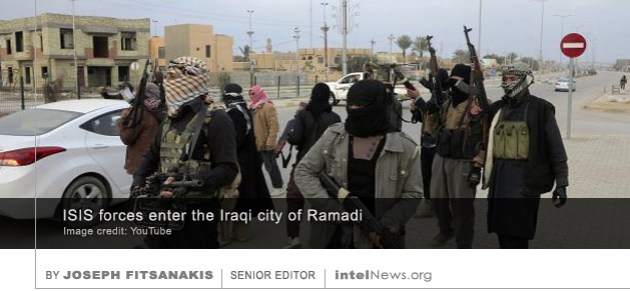
ISIS forces in RamadiA report from the United States Department of Defense warns that the Islamic State is swiftly returning to its insurgent roots, as observers in Iraq and Syria caution that the group is witnessing a revival. It has been four years since the Islamic State —known then as the Islamic State of Iraq and Syria, or ISIS— conquered much of eastern Syria and more than a third of Iraq’s territory. But by the end of 2017, virtually the entirety of ISIS’ self-styled ‘caliphate’ had been obliterated by an ‘unholy alliance’ of US-backed Iraqi government forces, Iranian-supported Shiite militias, Kurdish guerillas and Western airpower.
However, experts warn that, despite its loss of territorial control, the Islamic State maintains an active force of as many as 30,000 armed fighters in Iraq and Syria. Additionally, a recent US government report argues that, having been driven out of nearly all of the territory that it once held, the Islamic State is promptly “returning to its insurgent roots”. The report, authored by analysts at the US Department of Defense, claims that the militant Sunni group is “re-emerging as a guerrilla force”. In the place of what used to be a de-facto state, an “effective clandestine ISIS organization appears to be taking hold”, it states. The Pentagon document, summarized in a Financial Times article on Thursday, appears to be backed by information from the ground in Iraq and Syria. Iraqi military sources told The Times that ISIS appears to have more fighters in its ranks than initially thought, and that the group’s organizational structure that helped it grow in the first place “has not been eliminated”.

Moreover, the group is “still well-funded” and its operations remain lethal, said the paper, especially in Iraq, where it continues to undermine the government’s efforts to improve the country’s security. Islamic State fighters are systematically targeting regional leaders, said The Times, in an effort to prevent the government from delivering economic development in Iraq’s Sunni-majority western regions. A similar pattern of activities is being observed in Syria, where a resurgence of ISIS activity has prolonged the deployment of around 2,000 US military personnel there. What is more, ISIS fighters frequently cross the Iraq-Syria border and spend much of their time in safe houses and other hideouts. The paper quotes Yahya Rasool, spokesperson for the Iraqi Army’s Joint Operations Command, who says that “our war on ISIS today is an intelligence war, not a military war. We are searching and raiding their hide-outs”.

Author: Joseph Fitsanakis | Date: 07 December 2018 | Permalink

Canada arrests daughter of Chinese telecom giant’s founder at US request

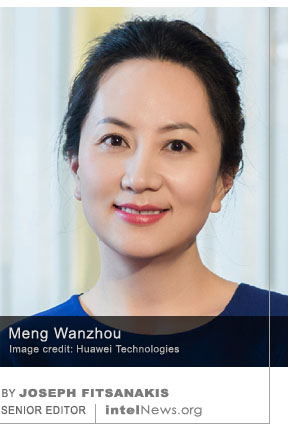
Meng WanzhouThe daughter of the founder of Huawei Technologies, one of the world’s leading telecommunications hardware manufacturers, has been arrested in Canada, reportedly at the request of the United States. Meng Wanzhou (pictured, also known as Sabrina Meng) serves as Huawei’s deputy chair and chief financial officer. She is the daughter of Ren Zhengfei a former officer in the Chinese People’s Liberation Army, who established the company in 1988 and has since amassed a personal fortune estimated at $3.5 billion. By virtue of her family background and position in Huawei, Meng is often referred to as “a member of China’s corporate royalty”.
Few details of Meng’s arrest have been publicized. On Wednesday, Canada’s Department of Justice confirmed that the Huawei CFO was detained on December 1 in Vancouver as she was transferring between flights. The Justice Department also confirmed that the arrest occurred at the request of American law enforcement officials. In a carefully worded statement, the Canadian government said Meng is “sought for extradition by the United States” and that her bail hearing will be taking place this coming Friday. On Wednesday, the Canadian newspaper The Globe and Mail cited an unnamed “Canadian law enforcement source with knowledge of the arrest”, who said that US authorities had evidence that Meng “tried to evade the American embargo against Iran”. This statement appears to refer to reports in Western media in April of this year, according to which the US Departments of Commerce and Treasury were probing suspected violations of Washington’s sanctions against Iran and North Korea by Huawei.

The embassy of China in Canada immediately protested news of Meng’s arrest, saying that the Huawei CFO had been detained despite “not violating any American or Canadian law”. In a statement issued on Wednesday, the embassy added that it had “lodged stern representations” to the Canadian government and “urged them to immediately […] restore the personal freedom of Ms. Meng Wanzhou”. Meanwhile, a representative at Huawei’s corporate headquarters in the southern Chinese city of Shenzhen told the BBC that the company is certain “the Canadian and US legal systems will ultimately reach a just conclusion” in the case.

Several officials in the United States, United Kingdom, Australia and other Western countries, have repeatedly flagged Huawei as a company that is uncomfortably close to the Chinese government and its intelligence agencies. In 2011, the US Open Source Center, which acts as the open-source intelligence arm of the Office of the Director of National Intelligence, became the first US government agency to openly link Huawei with the Chinese intelligence establishment. In 2013, the British government launched an official review of Huawei’s involvement in the UK Cyber Security Evaluations Centre in Oxfordshire, England, following a British Parliament report that raised strong concerns about the Chinese company’s links with the government in Beijing. And in 2017 the Australian government expressed concern about Huawei’s plan to provide high-speed Internet to the Solomon Islands, a small Pacific island nation with which Australia shares Internet resources.

Author: Joseph Fitsanakis | Date: 06 December 2018 | Permalink

US government plans background checks on Chinese students over espionage fears

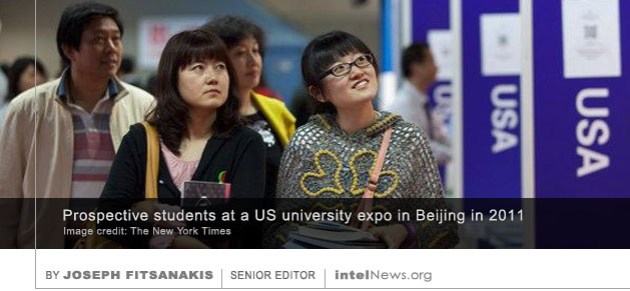
Chinese students in USAThe United States government plan to impose tighter visa restrictions and wider background checks on Chinese nationals studying at American universities, over espionage concerns. The news follows reports earlier this year that the administration of US President Donald Trump considered banning all Chinese nationals from studying at American universities. In October of this year, The Financial Times reported that the White House came close to imposing the ban, after it was allegedly proposed by Stephen Miller, speechwriter and senior advisor to Trump. Miller became known as the main architect of Executive Order 13769 —the travel ban imposed on citizens of several countries, most of them predominantly Muslim. According to The Financial Times, Trump was eventually dissuaded from imposing the Chinese student ban by Terry Branstad, US ambassador to China.
Now, however, the Trump administration is reportedly considering the possibility of imposing deeper background checks and additional vetting on all Chinese nationals wishing to study in the US. Citing “a US official and three congressional and university sources”, Reuters said on Thursday that the measures would apply to all Chinese students wishing to register in undergraduate and graduate academic programs in the US. The news agency quoted a “senior US official” as saying that “no Chinese student who’s coming [to the US] is untethered from the state […. They all have] to go through a party and government approval process”. Reuters reported that the proposed plan includes a comprehensive examination of the applicants’ phone records and their presence on social media platforms. The goal would be to verify that the applicants are not connected with Chinese government agencies. As part of the proposed plan, US law enforcement and intelligence agencies would provide counterintelligence training to university officials.

However, the plan has many American universities —including elite Ivy League schools— worried that they may be losing up to $14 billion in tuition and other fees spent annually by more than 350,000 Chinese nationals studying in the US. The fear is that the latter may be looking to study elsewhere, in countries such as Canada, Australia and the United Kingdom. Reuters said that many of America’s top universities are “regularly sharing strategies to thwart” plans by the Trump administration to make it more difficult for Chinese nationals to study in the US. The news agency said it contacted the Chinese ambassador to Washington, who called the White House’s fears of espionage by Chinese students “groundless” and “very indecent”.

Author: Joseph Fitsanakis | Date: 30 November 2018 | Permalink

Head of CIA’s Korean mission center to resign, say sources

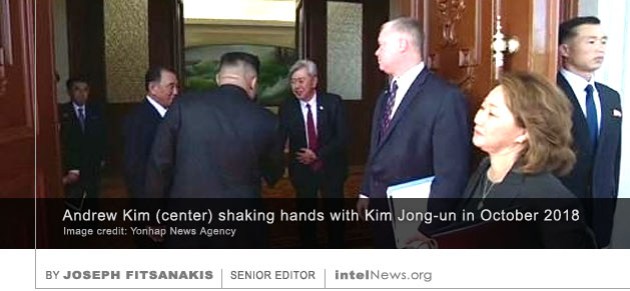
Andrew KimA senior North Korea expert in the United States Central Intelligence Agency, who has been instrumental in the ongoing negotiations between Washington and Pyongyang, has tendered his resignation, according to sources. The official was identified last may by US media as Andrew Kim, a former South Korean citizen who moved to the US with his parents when he was 13 years old. According to sources, Kim joined the CIA after graduating from college and rose through the Agency’s ranks to serve its stations in Moscow, Beijing and Bangkok. His most recent overseas post was reportedly in Seoul, where he served as the CIA’s station chief —the most senior American intelligence official in the country.

Following his return to the US from Seoul, Kim reportedly retired, but returned last year to head the CIA’s new Korea Mission Center (KMC). The purpose of the specialized unit is to analyze Pyongyang’s ballistic missile and nuclear weapons programs, which the administration of US President Donald Trump considers as matters of priority for the White House. It was as head of the KMC that Kim reportedly met Mike Pompeo once he became Director of the CIA in January 2017. The two men worked closely together and it is believed that Kim’s role was instrumental in organizing the negotiations between Washington and Pyongyang that led to last summer’s historic high-level meeting between President Trump and Supreme Leader Kim Jong-un. According to American and South Korean media, Kim accompanied the then-CIA director on his secret trip to North Korea. He also accompanied Pompeo on his trips to North Korea once the Kansas Republican became Secretary of State.

The Yonhap News Agency said on Tuesday that Kim initially intended to leave his CIA post in the summer, but was persuaded by Secretary Pompeo to continue. However, he has now tendered his resignation, which will take effect on December 20. Citing “multiple sources”, including “a senior official at South Korea’s National Intelligence Service”, the Seoul-based news agency said that Kim plans to take up an academic post at Stanford University, adding that he intends to continue serving as an adviser to the secretary of state. Prior media reports have stated that “Kim is widely viewed as a hawk on North Korea”, so there are suspicions that his departure from the CIA stems from his disagreement with the policy of negotiation signaled by President Trump. However, the CIA has not commented on the Yonhap report. The South Korean agency said that the CIA is already reviewing candidates to succeed Kim.

Author: Joseph Fitsanakis | Date: 28 November 2018 | Permalink

New book names ex-KGB defector who outed FBI agent Robert Hanssen as Russian spy

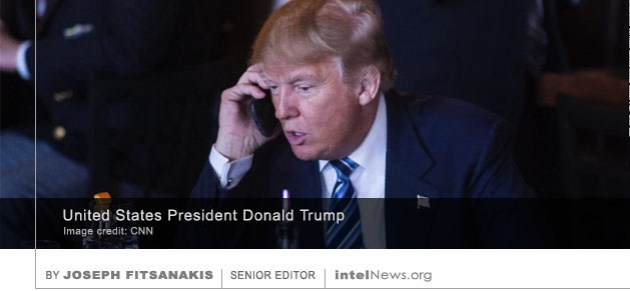
Robert HanssenA new book reveals for the first time the name of a former intelligence officer of the Soviet KGB who helped American authorities arrest Robert Hanssen, an American spy for the Soviet Union and Russia. The son of a Chicago police officer, Hanssen joined the Federal Bureau of Investigation in 1976 and was eventually transferred to the Bureau’s Soviet analytical unit, where he held senior counterintelligence posts. It wasn’t until 2000, however, that the FBI realized Hanssen had spied for Moscow since 1979. Following Hanssen’s arrest in 2001, it emerged that he had betrayed the names of 50 FBI and CIA assets or informants, many of whom perished in the hands of the Russian intelligence services.
In 2002, the US Department of Justice opined that Hanssen had caused “possibly the worst intelligence disaster in US history”. He is currently serving 15 consecutive life terms without the possibility of parole. But despite numerous articles, reports and books on the Hanssen spy case, the story of the FBI investigation that led to his arrest remains at best fragmentary. A major question concerns the identity of the mysterious person that helped FBI counterintelligence investigators zero in on Hanssen after years of fruitless efforts to confirm suspicions of the existence of a Russian mole. It is known that the FBI paid the sum of $7 million to a former KGB officer, who delivered the contents of Hanssen’s Russian intelligence file. But the identity of that informant has not been revealed.

That may have changed as of last month, however, thanks to The Seven Million Dollar Spy, a book written by the late David Wise, a journalist and best-selling intelligence author who died on October 8, aged 88. Wise’s book, published posthumously on October 23 in audio book format, received little media attention. But Newsweek intelligence correspondent Jeff Stein said last week that the book might bring us a step closer to uncovering the identity of the individual who led to Hanssen’s capture. Stein explains that the mysterious informant had previously developed a business relationship with Jack Platt, a retired CIA case officer who after the end of the Cold War co-founded an international security consultancy with ex-KGB operative Gennady Vasilenko. The two men staffed their company with several American and Russian former spies. Among them was Anatoly Stepanov, a former case officer in the KGB. Stein reports that, according to Wise’s posthumous book, Stepanov is in fact the pseudonym of former KGB officer Aleksandr Shcherbakov. It was he who delivered Hanssen’s file to the FBI, thus facilitating his eventual capture. It is believed that Shcherbakov defected to the United States in 2010 where he continues to live today under an assumed identity.

Author: Joseph Fitsanakis | Date: 06 November 2018 | Permalink

CIA suffered ‘catastrophic’ compromise of its spy communication system

CIAThe United States Central Intelligence Agency suffered a “catastrophic” compromise of the system it uses to communicate with spies, which caused the death of “dozens of people around the world” according to sources. This is alleged in a major report published on Friday by Yahoo News, which cites “conversations with eleven former US intelligence and government officials directly familiar with the matter”. The report by the online news service describes the compromise of an Internet-based covert platform used by the CIA to facilitate the clandestine communication between CIA officers and their sources —known as agents or spies— around the world.

According to Yahoo News, the online communication system had been developed in the years after 9/11 by the US Intelligence Community for use in warzones in the Middle East and Central Asia. It was eventually adopted for extensive use by the CIA, which saw it as a practical method for exchanging sensitive information between CIA case officers and their assets in so-called ‘denied areas’. The term refers to regions of the world where face-to-face communication between CIA case officers and their assets is difficult and dangerous due to the presence of ultra-hostile intelligence services or non-state adversaries like the Taliban or al-Qaeda. However, it appears that the system was flawed: it was too elementary to withstand sustained scrutiny by Internet-savvy counterintelligence experts working for state actors like Iran, China or Russia.

In September of 2009, Washington made a series of impressively detailed revelations about the advanced status of Iran’s nuclear program. These angered Tehran, which redoubled its efforts to stop the US and others from acquiring intelligence information about the status of its nuclear program. Some sources told Yahoo News that one of the CIA assets inside Iran’s nuclear program was convinced by the Iranians to become a double spy. He proceeded to give Tehran crucial information about the CIA’s online communication system. Based on these initial clues, the Iranians allegedly used Google-based techniques “that one official described as rudimentary” to identify an entire network of CIA-maintained websites that were used to communicate with assets in Iran and elsewhere. The Iranians then kept tabs on these websites and located their users in order to gradually unravel an entire network of CIA agents inside their country. Around that time, Iranian media announced that the Islamic Republic’s counterintelligence agencies had broken up an extensive CIA spy ring consisting of more than 30 informants.

The Yahoo News report says that the CIA was able to successfully exfiltrate some of its assets from Iran before the authorities were able to apprehend them. The agency also had to recall a number of undercover officers, after they were identified by the Iranians. The effects of the compromise, however, persisted on a global scale, according to former US intelligence officials. In 2011 and 2012, another network of CIA spies was busted in China, leading to the arrest and execution of as many as three dozen assets working for the US. Many, says Yahoo News, believe that the Iranians coached the Chinese on how to use the CIA’s online communication system to identify clandestine methods and sources used by the agency.

Along with other specialist websites, IntelNews monitored these developments as they took place separately in Iran and China. However, the Yahoo News report is the first to piece together these seemingly disparate developments and suggest that they were likely triggered by the same root cause. What is more, the report suggests that the CIA had been warned about the potential shortcomings of its online communication system before 2009, when the first penetrations began to occur. In response to the compromise, the CIA has reportedly modified, and at times completely abandoned, its online communication system. However, the implications of the system’s compromise continue to “unwind worldwide” and the CIA is “still dealing with the fallout”, according to sources. The effects on the agency’s operational work are likely to persist for years, said Yahoo News.

Author: Joseph Fitsanakis | Date: 05 November 2018 | Permalink

Trump’s use of unsecured iPhone worries White House officials

Donald TrumpOfficials in the White House are concerned about President Donald Trump’s insistence on using an unsecured iPhone to communicate with friends and associates, despite warnings that foreign spies may be listening in. Prior to being elected president, Trump used an Android phone, made by Google, which the NSA advised him to abandon due to security concerns. That is when he switched to using iPhones. Since his election to the presidency, Trump has routinely used three iPhone cell phones. He uses one of them to access a limited list of authorized applications, including Twitter. He uses the second iPhone for phone calls, but cannot use it to send texts, take pictures, or download and install applications. Both of these iPhones have been vetted and secured by the National Security Agency (NSA).
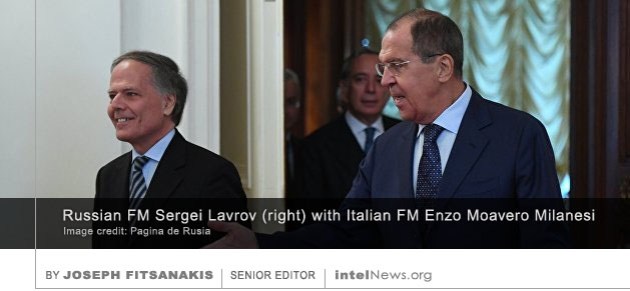
But The New York Times said on Wednesday that, despite the advice of the NSA, the US president continues to use a third iPhone, which is his personal device. The newspaper cited “current and former American officials” who said that the president’s third iPhone has not been secured by the NSA, and is thus “no different from hundreds of millions of iPhones in use around the world”. Trump uses that third iPhone to call many of his old friends and associates. The president has been repeatedly warned, sources said, to abandon the use of his unsecured third iPhone. Moreover, US intelligence agencies have confirmed that Chinese, Russian, and possibly other spy agencies have been “routinely eavesdropping” on the US president’s calls made on his personal iPhone.

To some extent, Trump has heeded the advice of his intelligence agencies in recent months and has begun to rely on his secure White House landline to make important calls, thus avoiding cell phones altogether. But he refuses to give up use of his iPhones, despite repeated warnings by the NSA, sources told The Times. They added that “they can only hope [Trump] refrains from discussing classified information when he is on them”. The president’s use of unsecured phone devices adds to what sources described as “frustration” with his “casual approach” to communications security. In July of this year, Nada Bakos, a 20-year veteran of the Central Intelligence Agency, said in an editorial that President Trump’s “Twitter feed is a gold mine for every foreign intelligence agency”. The CIA veteran described Trump’s use of social media is too impulsive and potentially dangerous from a national-security perspective.

Author: Joseph Fitsanakis | Date: 25 October 2018 | Permalink

Russia claims ‘misunderstanding’ led to arrests of four spies in Holland

Sergei LavrovRussia’s minister of foreign affairs has downplayed the arrest and expulsion of four Russian military intelligence officers in Holland last April, saying that the incident was caused by a “misunderstanding”. Last Thursday, the US government named and indicted seven officers of the Main Directorate of the General Staff of Russia’s Armed Forces, known as GRU. The seven are alleged to have participated in cyber-attacks on international agencies, private companies and government computer networks in at least half a dozen countries around the world since 2015. Four of the men named last week were reportedly detained in April of this year while trying to hack into the computer network of the Organization for the Prohibition of Chemical Weapons (OPCW). Headquartered in The Hague, the OPCW oversees efforts by its 193 member states to detect and eliminate chemical weapons stockpiles around the world. In the past year, the OPCW has been probing the failed attempt to poison the Russian former double spy Sergei Skripal in England, which the British government has blamed on Moscow.

On Monday, Russia’s Minister of Foreign Affairs Sergei Lavrov dismissed Washington’s accusations against the GRU and said that the Dutch authorities had overreacted in detaining the four Russian officers in April. Following a meeting in Moscow with his Italian counterpart Enzo Moavero Milanesi, Lavrov said that the visit of the four GRU officers in Holland had been “customary”, adding that “there was nothing clandestine in it”. The GRU specialists were in Holland in order to secure computer servers used at the Russian embassy there. “They were not trying to hide from anyone once they arrived at the airport”, said Lavrov. They then “checked into a hotel and paid a visit to our embassy”, he added. Had they been engaged in espionage, the men would have taken strict precautions, said the Russian foreign affairs minister. They were eventually “detained by Dutch police without any reason or explanations, and were not allowed to contact our embassy”, said Lavrov. Eventually they were “asked to leave the country”, but it was “all because of a misunderstanding”, he concluded.

The Russian official did not address the information provided a series of photographs released by Holland’s Ministry of Defense, which show a car used by the four Russians at the time of their arrest in April. The photographs show that the car was equipped with WiFi antennas and transformers. A wireless server and batteries can also be seen in the photographs. Lavrov said that the allegations against the GRU were meant to draw attention to Russia and distract Western citizens from “widening divisions that exist between Western nations”.

Author: Joseph Fitsanakis | Date: 09 October 2018 | Research credit: S.F. | Permalink

Envelopes containing deadly ricin poison intercepted at US Pentagon

PentagonAn investigation was opened in the United States on Tuesday, after two envelopes containing the deadly poison ricin were intercepted at the Pentagon. The envelopes were reportedly intercepted at a mail screening facility located in the vicinity of the headquarters of the US Department of Defense in Washington, DC. One of the envelopes was addressed to US Secretary of Defense James Mattis, while the other was addressed to Admiral John Richardson, who serves as Chief of Naval Operations. According to US news media, the envelopes were found to contain a powder-like substance. Upon discovery, the envelopes were secured by members of the Pentagon Force Protection Agency, the US Department of Defense’s law enforcement body that is responsible for safeguarding the Pentagon complex.
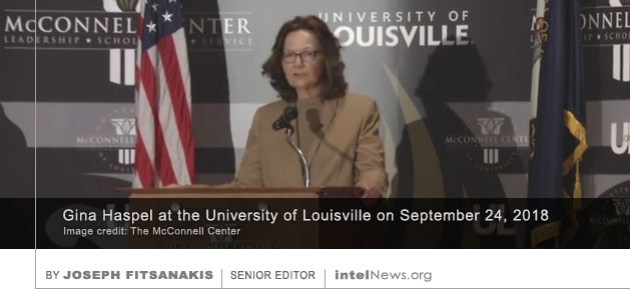
On Tuesday, the Federal Bureau of Investigation announced that the substance inside the envelopes had been examined by its technicians and had tested positive for the deadly poison ricin. Ricin is a naturally occurring toxin found inside the seeds of castor oil plants, known commonly as castor beans. Though mostly harmless in its natural state, the toxin can be processed and effectively weaponized in the form of pellets, liquid acid, mist or powder. If it finds its way into the human body, through ingestion, inhalation or injection, it can kill in fewer than 48 hours. Death usually occurs as a result of organ failure and internal bleeding, which lead to a collapse of the circulatory system. There is no known antidote for ricin poisoning.

On Tuesday afternoon, parts of the Republican Senator Ted Cruz’s campaign office in Houston, Texas, were shut down, after two staff members came in contact with what was described as a “white powdery substance” inside an envelope. The staff members were rushed to the hospital, but tests carried out later that day showed that the substance was non-toxic.

The FBI said on Tuesday that its technicians would carry out further tests on the substances found at the Pentagon and at Senator Cruz’s office, in order to confirm the initial findings. It also said that there would be no further announcements until the tests are completed. Meanwhile, the Pentagon’s mail screening facility remains under quarantine.

Author: Ian Allen | Date: 03 October 2018 | Permalink

CIA to return to traditional espionage against state actors, says new director

Gina HaspelThe United States Central Intelligence Agency will return to traditional espionage against foreign states and focus less on counterterrorism against non-state actors, said its new director in her first public appearance. Gina Haspel joined the CIA in 1985 as a reports officer and completed several undercover tours overseas before serving as chief of station. She rose through the ranks to become deputy director of the National Clandestine Service and was appointed deputy director of the CIA in 2017. In May of this year, she became the Agency’s first female director, despite some controversy that arose from her role as chief of a CIA undercover facility (so-called “black site”) in Thailand. Critics alleged that Agency personnel under her command practiced enhanced interrogation, including waterboarding, on terrorism detainees.

On Monday, Haspel gave a talk at the University of Louisville, from where she graduated in 1978 with a degree in languages and journalism, having transferred there from the University of Kentucky. It was her first public appearance after being sworn in as CIA director. She told the audience that she intends to steer the Agency back to traditional intelligence collection against “current and potential […] nation-state adversaries” and away from counterterrorism operations against non-state actors. The latter took center stage after the events of September 11, 2001. Filling current “intelligence gaps” on countries like Russia and China will be “a strategic priority” for the CIA, said Haspel, adding that the Agency will seek to “sharpen its focus on nation-state adversaries”. She spoke at length about China, stating that Beijing was “working to diminish US influence” and expand its own authority “beyond their own region, in places like Africa, Latin America, the Pacific islands [and] South Asia”.

The CIA’s hiring priorities will reflect the Agency’s strategic shift, said Haspel. The Agency will seek to expand its foreign footprint by “increasing the number of [its] officers stationed overseas”. Priority for these assignments will be given to foreign-language speakers with skills in Chinese, Arabic and Farsi, among other target languages. Interestingly, the CIA director added Turkish, French and Spanish to the list. She also said that the Agency will “invest more heavily on […] counternarcotics efforts abroad”. Last but not least, Haspel spoke about the need for increased transparency, diversity and inclusion at the CIA, which last year marked its 70th anniversary.

Author: Joseph Fitsanakis | Date: 26 September 2018 | Permalink

US intelligence reevaluates safety of Russian defectors in light of Skripal poisoning

CIAIntelligence officials in the United States are feverishly reassessing the physical safety of dozens of Russian defectors, in light of the case of Russian double spy Sergei Skripal, who was poisoned in England last March. Skripal, a former military intelligence officer who spied for Britain, was resettled in the English town of Salisbury in 2010 by the British Secret Intelligence Service (MI6). But he and his daughter Yulia made international headlines in March, after they were poisoned by a powerful nerve agent that nearly killed them. The attack has been widely blamed on the Russian government, though the Kremlin denies that it had a role in it.

Like MI6, the US Central Intelligence Agency also has a protection program for foreign nationals whose life may be at risk because they spied for the US. The CIA’s protection division, called the National Resettlement Operations Center, helps resettle and sometimes hide and protect dozens of foreign agents, or assets, as they are known in CIA lingo. But following the Skripal case, some CIA resettlement officials have expressed concern that protection levels for some foreign assets may need to be significantly raised. The New York Times, which published the story last week, said that it spoke to “current and former American intelligence officials”, which it did not name. In light of those concerns, US counterintelligence officials have been carrying out what The Times described as “a wide-reaching review” of every Russian asset who has been resettled in the US. The purpose of the review is to assess the ease with which these former assets can be traced through their digital footprint on social media and other publicly available information.

According to the paper, several Russians who defected to the US after working for the CIA and other US intelligence agencies were tracked down by the Kremlin in recent years. In the mid-1990s, says The Times, the CIA actually found an explosive device placed under the car of a Russian defector living in the US. More recently, US intelligence traced the movements of a suspected Russian assassin who visited the neighborhood of a resettled Russian defector in Florida. In the past, Russian CIA assets who have been resettled in the US have voluntarily revealed their whereabouts by reaching out to relatives back in Russia out of homesickness. In some cases, they have left the US in order to meet a lover who may have been planted by the Russian spy services —with sometimes fatal consequences.

In addition to the US, at least one more country has initiated a thorough review of the way it protects former Russian assets living in its territory in light of the Skripal case. As intelNews reported in March, the British secret services tightened the physical security of dozens of Russian defectors living in Britain only a week after the attempted murder of Skripal. Britain’s security services reportedly viewed the attack on Skripal as an intelligence failure and launched a comprehensive review of the risk to British-based Russian double spies and defectors from “unconventional threats”. The latter included attacks with chemical and radiological weapons.

Author: Joseph Fitsanakis | Date: 18 September 2018 | Permalink

US sees Russian weapon behind US diplomats’ mystery ailments, say officials

Kirtland Air Force BaseA Russian-made device caused the mystery ailments that affected more than two dozen American diplomats in Cuba and China, according to United States government officials who have been briefed on the matter. Since September of last year, Washington has recalled the majority of its personnel from its embassy in Havana and at least two more diplomats from its consulate in the Chinese city of Guangzhou. The evacuees reported experiencing “unusual acute auditory or sensory phenomena” and “unusual sounds or piercing noises”. Subsequent tests showed that they suffered from sudden and unexplained loss of hearing as well as from various forms of brain injuries. In April of this year the Canadian embassy evacuated all family members of its personnel stationed in the Cuban capital over similar health concerns. More recently, the US issued a travel warning advising its citizens to stay away from the island and accused Cuba of neglecting to ensure the safety of US diplomatic personnel stationed there.

In early September, Douglas H. Smith, who heads the team of scientists tasked by the US government to examine the matter, said that microwave radiation was almost certainly responsible for the diplomats’ ailments. He added that microwaves were considered “a main suspect” and that his team of scientists was now “increasingly sure” that the diplomats had suffered brain injuries caused by microwave radiation. Now the US news network NBC reports that Russia is viewed as the primary culprit behind the mystery ailments that plagued US diplomats. Reporting on Tuesday the news network cited three unnamed officials in the administration of US President Donald Trump, as well as “congressional aides and others briefed on the investigation”. Specifically, NBC reported that the Russian connection was supported by “evidence from communications intercepts” (signals intelligence or SIGINT), though it did not elaborate on their precise nature. It also said that the ongoing investigation into the purported weapon involves the Federal Bureau of Investigation, the Central Intelligence Agency among other US intelligence and security agencies. Another leading actor in the investigation is the US Air Force, said NBC, stating that experts in its directed energy research program at the Kirtland Air Force Base near Albuquerque, New Mexico, are trying to reverse-engineer the alleged weapons based on the symptoms that they cause.

But NBC noted that the evidence remains relatively inconclusive and is not yet sufficient to allow Washington to openly accuse Moscow of having masterminded the alleged microwave attacks on the US diplomats. The news network said it reached out to the Office of the Director of National Intelligence but received no response. A spokeswoman from the US Department of State said that the investigation into the diplomats’ ailments was ongoing and that the Department had made “no determination of who or what is responsible for the health attacks” on its personnel.

Author: Joseph Fitsanakis | Date: 13 September 2018 | Permalink

Trump officials ‘discussed secret coup plans’ with Venezuelan army officers

Nicolas MaduroUnited States President Donald Trump authorized American officials to attend secret meetings held by Venezuelan military officers who conspired to launch a military coup against President Nicolás Maduro. The claim was made on Saturday by The New York Times, which cited “interviews with 11 current and former American officials” and information from an unnamed Venezuelan former military commander. The former commander claims to have attended the secret talks, which allegedly were held over several meetings during the past year.

According to The Times, the meetings were sparked by a comment made by President Trump in August of 2017, that he did not rule out a “military option” to “restore calm” in Venezuela. That comment reportedly prompted at least three groups of Venezuelan military officers opposed to the rule of President Maduro to reach out to the White House. One of these groups, said The Times, had one of its representatives contact American diplomats in an unnamed European country. That outreach led to “a series of covert meetings abroad”, according to The Times, the first of which took place in the fall of 2017. The meetings continued until recently, and were held with a number of Venezuelan military officers who claimed to represent the views of several hundred members of the National Bolivarian Armed Forces. The rebellious officers allegedly told the US government’s representative that they planned to launch a military coup aimed at deposing President Maduro and installing a transitional government that would guarantee peaceful elections. They reportedly asked the White House representative to supply them with secure communications equipment, which they could use to coordinate their operations.

However, the White House eventually decided that backing a military coup in Venezuela would be too risky due to the potential for spiraling bloodshed. It thus distanced itself from the plan. Additionally, some US government officials were alarmed by the composition of the rebel officers: at least one of them was a serious violator of human rights who had previously been accused by the US of involvement of participating in drugs smuggling and having close links with the Revolutionary Armed Forces of Colombia, which is on Washington’s official list of foreign terrorist organizations. Eventually the plotters canceled their plans for a coup, having assessed it would be met by fierce resistance by pro-Maduro forces.

The Times reached out to the White House, which rejected the paper’s report, saying it was important to “dialogue with all Venezuelans who demonstrate a desire for democracy”. But it refused to respond to specific questions about the allegations of a possible coup in Venezueal with Washington’s backing. President Maduro has already blamed the US for two attempts to assassinate him in the past 18 months, with the most recent one involving the use of an exploding drone. In 2002, Maduro’s predecessor, the late Venezuelan President Hugo Chávez, was briefly deposed by a military putsch. Chávez was able to beat back the rebels with the help of his civilian and military supporters, and then accused Washington of having had direct involvement with the attempt to remove him from power. The US has strongly denied Chávez’s charges.

Author: Joseph Fitsanakis | Date: 10 September 2018 | Permalink

US delegation met secretly with Syrian intelligence chiefs, newspaper claims

Ali MamloukA delegation of senior American government officials met secretly with Syria’s spy chiefs in an effort to lay out the terms of a possible deal between Washington and Damascus, according to a Lebanese newspaper. Relations between the United States and Syria have been strained since the late 1950s, when Damascus blamed Washington for a failed coup and expelled America’s ambassador there. In 2012, the US shut down its embassy in the Syrian capital in response to the government’s violent suppression of protests. Since then, Washington has carried out missile strikes on Syrian soil at least twice, while openly supporting armed groups that are opposed to the government of President Bashar al-Assad.

But according to the Lebanese newspaper Al-Akhbar, a group of senior American officials held a secret meeting in Damascus with Syrian spy chiefs. If true, the move could signify a major shift in US-Syrian relations. The paper, which supports the pro-Assad Shiite paramilitary group Hezbollah, and is close to the Syrian government, published news of the alleged meeting on Tuesday. It said that the meeting took place in complete secrecy during the last week of June and that it was facilitated by intermediaries from Russia and the United Arab Emirates. The latter used a UAE government airplane to fly the US delegation —whose names Al-Akhbar did not reveal— to the Syrian capital. The visiting delegation, which according to the paper “included [senior] officers from many US intelligence and security agencies”, was transported to a secret Syrian government facility in the dead of night by “a huge procession of black SUVs”, said the paper. The Syrian delegation at the meeting was reportedly headed by Ali Mamlouk, special security adviser to President al-Assad and head of the National Security Bureau of the governing Ba’ath Party. Other participants from the Syrian side included Mohammed Dib Zeitoun, director of the General Security Directorate, and Muwaffaq Asaad, the deputy chief of staff of the Syrian Armed Forces, said Al-Akhbar.

During the meeting, the two sides allegedly attempted to lay out the foundations of a possible post-civil war deal between Washington and Damascus. According to the Lebanese paper, the US delegation offered to withdraw American Special Forces from Kurdish-controlled northern Syria. In return, they allegedly asked for the removal of Iranian troops from Syrian regions that are adjacent to the Israeli border. The two sides also discussed the resumption of intelligence sharing on matters relating to Sunni radicals operating in Syria. No decisions were taken during the meeting, said Al-Akhbar, but the two sides decided to continue to share proposals and ideas about a possible bilateral agreement.

The French news agency Agence France Presse said on Tuesday that it could not independently confirm Al-Akhbar’s claims, as its attempts to contact the US departments of State and Defense were not fruitful. It noted, however, that both Mamlk and Zeitoun feature on the US government’s list of sanctions against Syrian government officials that are believed to have directly participated in human-rights abuses against political opponents since the outbreak of the civil war in 2011.

Author: Joseph Fitsanakis | Date: 29 August 2018 | Permalink