US imposes sanctions on companies for helping Russian spy agencies
June 13, 2018 1 Comment
 The United States has for the first time imposed economic sanctions on a number of Russian companies, which it says helped the Kremlin spy on targets in North America and Western Europe. On Monday, the US Department of the Treasury said it would apply severe economic restrictions on a number of Russian firms that work closely with the Kremlin. One of the companies was identified as Digital Security, which Washington says has been helping Russian intelligence agencies develop their offensive cyber capabilities. Two of Digital Security’s subsidiaries, Embedi and ERPScan, were also placed on the US Treasury Department’s sanctions list. Monday’s statement by the Treasury Department named another Russian firm, the Kvant Scientific Research Institute, which it described as a front company operated by the Russian Federal Security Service (FSB).
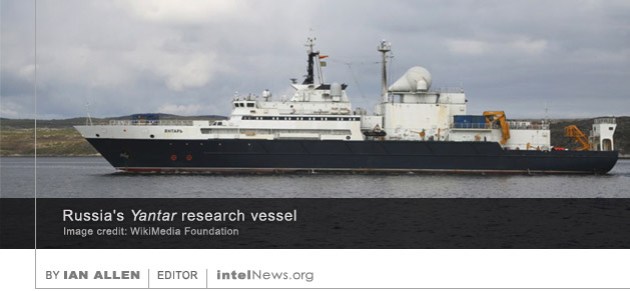
But the Russian firm that features most prominently in Monday’s announcement is Divetechnoservices, an underwater equipment manufacturer. The US alleges that the FSB paid the company $15 million in 2011 to design equipment for use in tapping underwater communications cables. According to Washington, equipment designed by Divetechnoservices is today used by a fleet of Russian ships that sail on the world’s oceans searching for underwater communications cables to tap. One such ship, according to reports, is the Yantar (pictured), ostensibly an oceanic research vessel, which Washington says is used to detect and tap into underwater communications cables.
In addition to Divetechnoservices, the US Treasury has named three individuals who will face economic sanctions due to what Washington says is their personal involvement with the underwater hardware manufacturer. They are: Vladimir Yakovlevich Kaganskiy, the company’s owner and former director; Aleksandr Lvovich Tribun, who serves as Divetechnoservices’ general director; and Oleg Sergeyevich Chirikov, identified as the manager of Divetechnoservices’ underwater surveillance program. These men —all Russian citizens— will not be able to enter into business relationships with American companies or citizens. On Tuesday, Russia’s Ministry of Foreign Affairs dismissed the latest round of US sanctions as an act of desperation. The White House would fail in its effort to “force the Russian Federation to change its independent course of action in the international arena”, said the Russian Ministry of Foreign Affairs.
► Author: Ian Allen | Date: 13 June 2018 | Permalink










 intelNews.org
DOGE breach of US Treasury data may harm CIA intelligence assets, officials warn
February 8, 2025 by Joseph Fitsanakis 13 Comments
According to The Washington Post, a senior Treasury employee filed a memorandum to Secretary Bessent, warning that any form of access to the department’s payment system by DoGE employees would “pose an unprecedented insider threat risk” to government secrets. The memo reportedly focused specifically on payments made by Treasury to human intelligence sources, which are typically recruited and handled abroad by the Central Intelligence Agency (CIA), the Defense Intelligence Agency (DIA), and other agencies of the United States Intelligence Community. Such payments are made to foreign assets who collect intelligence on behalf of American agencies, or Americans who work in an intelligence capacity without the use of diplomatic cover.
According to Newsweek, which followed up on the story, the memo noted that the Treasury Department employs several methods to disguise payments made to human intelligence sources. However, these methods remain vulnerable to detection by “people with the requisite know-how”, which would allow these assets to be identified and could place their lives in danger. As a result, DoGE’s access to the classified database posed an “unprecedented insider threat risk”, according to the memo. It advised Secretary Bessent to “suspend [DoGE’s] access immediately and conducting a comprehensive review of all actions [DoGE employees] may have taken on these systems”.
On Saturday a federal judge in the district of Manhattan issued a preliminary injunction that bars DoGE from accessing any Treasury Department databases that contain personally identifiable information. The injunction also instructs DoGE personnel to surrender back to Treasury all information they have obtained so far. A hearing to decide the next steps in the case is due to occur on February 14.
► Author: Joseph Fitsanakis | Date: 08 February 2025 | Permalink
Filed under Expert news and commentary on intelligence, espionage, spies and spying Tagged with Department of Government Efficiency, DoGE, High Court of Justice of the United Kingdom, News, United States, US Department of the Treasury