Declassified files shed light on 1956 disappearance of MI6 agent
October 28, 2015 Leave a comment
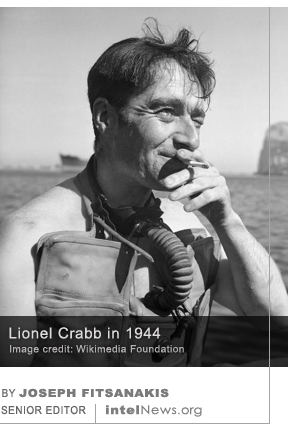 A set of newly released files from the archives of the British Cabinet Office shed light on the mysterious case of a highly decorated combat swimmer, who vanished while carrying out a secret operation against a Soviet ship. The disappearance happened during a historic Soviet high-level visit to Britain in 1956. In April of that year, First Secretary of the Communist Party of the USSR, Nikita Khrushchev, and Nikolai Bulganin, Chairman of the Council of People’s Commissars, arrived in Britain aboard Russian warship Ordzhonikidze, which docked at Portsmouth harbor. Their eight-day tour of Britain marked the first-ever official visit by Soviet leadership to a Western country. But the tour was marred by a botched undersea operation led by Britain’s Secret Intelligence Service, known commonly as MI6. The operation, which aimed to explore the then state-of-the-art Ordzhonikidze, ended in the disappearance of MI6 diver Lionel “Buster” Crabb. The body of Crabb, one of several MI6 operatives involved in the operation, was never recovered.
Now a set of documents released by the Cabinet Office, a British government department tasked with providing support services to the country’s prime minister and senior Cabinet officials, show that the operation had been mismanaged by MI6 from the start. According to The Daily Telegraph, the documents show that miscommunication between the British Foreign Office and MI6 caused the latter to believe that the operation to target the Ordzhonikidze had been authorized by the government, when in fact no such thing had ever occurred.
Moreover, MI6 had housed Crabb and other operatives in a Portsmouth hotel, where the agency’s handler had provided the front-desk clerk with the real names and addresses of the underwater team members. The documents also reveal that several of Crabb’s relatives and friends had been told by him that he would be diving in Portsmouth on the week leading up to his death. Those who knew included one of Crabb’s business partners, with whom he operated a furniture outlet. The partner apparently told the authorities that he was contemplating “consulting a clairvoyant, Madame Theodosia”, in an effort to discover the fate of his missing business partner.
After Crabb disappeared, British government officials were convinced that he had been abducted or killed by the Soviets and that the KGB was in possession of his body. Should the Soviets decide to disclose the existence of the MI6 operation to the world, there would be “no action that [MI6] could take [that] could stave off disaster”, said one British government memo. As intelNews has reported before, n 2007, Eduard Koltsov, a retired Russian military diver, said he killed a man he thinks was Crabb, as he was “trying to place a mine” on the Soviet ship.
► Author: Joseph Fitsanakis | Date: 28 October 2015 | Permalink
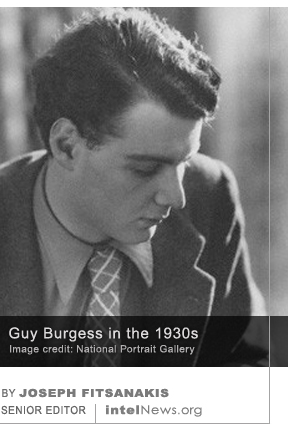 The life of Guy Burgess, one of the so-called ‘Cambridge Five’ double agents, who spied on Britain for the Soviet Union before defecting to Moscow in 1951, is
 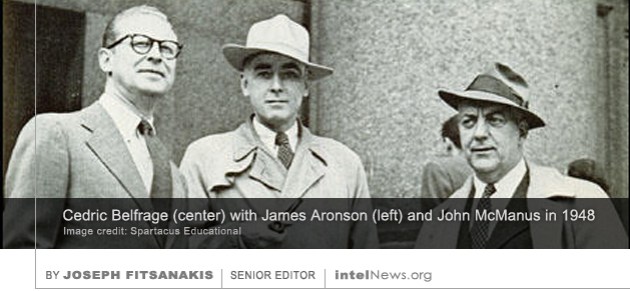 The British government has released a nine-volume file on an influential film critic who
  A Soviet double spy was able to penetrate the senior echelons of Australia’s intelligence agency during the Cold War, according to a retired Australian intelligence officer who has spoken out for the first time. Molly Sasson, was born in Britain, but worked for the Australian Security Intelligence Organisation (ASIO) from 1969 until her retirement in 1983. A fluent German speaker, Sasson was first recruited during World War II by the Royal Air Force, where she worked as an intelligence officer before transferring to the Security Service (MI5), Britain’s domestic intelligence agency. At the onset of the Cold War, Sasson helped facilitate the defection to Britain of Colonel Grigori Tokaty, an influential rocket scientist who later became a professor of aeronautics in London. But in the late 1960s, Sasson moved with her husband to Australia, where she took up a job with ASIO, following a personal invitation by its Director, Sir Charles Spry. Upon her arrival in Canberra, Sasson took a post with ASIO’s Soviet counterintelligence desk, which monitored Soviet espionage activity on Australian soil.
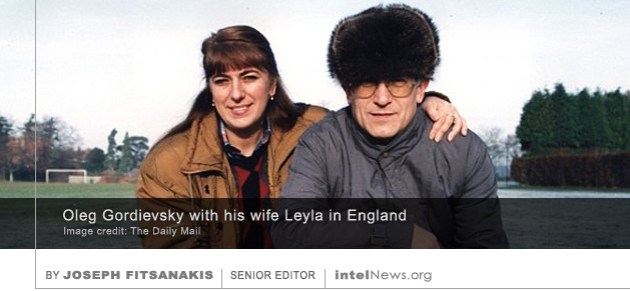 A Soviet double spy, who secretly defected to Britain 30 years ago this month, has revealed for the first time the details of his exfiltration by British intelligence in 1985. Oleg Gordievsky was one of the highest Soviet intelligence defectors to the West in the closing stages of the Cold War. He joined the Soviet KGB in 1963, eventually reaching the rank of colonel. But in the 1960s, while serving in the Soviet embassy in Copenhagen, Denmark, Gordievsky began feeling disillusioned about the Soviet system. His doubts were reinforced by the Soviet invasion of Czechoslovakia in 1968. It was soon afterwards that he made the decision to contact British intelligence.
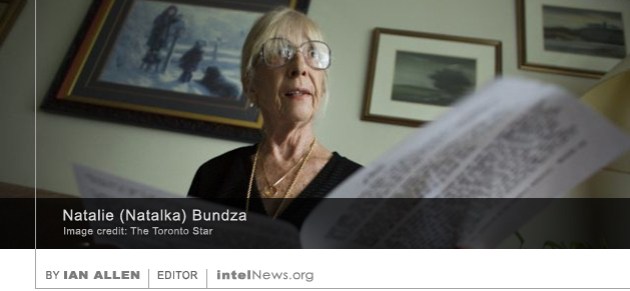 A set of declassified intelligence documents from the 1950s and 1960s offer a glimpse into the secret war fought in Canada between American and Soviet spy agencies at the height of the Cold War. The documents were authored by the United States Central Intelligence Agency and declassified following a Freedom of Information Act request filed on behalf of the Canadian newspaper The Toronto Star.
  A congratulatory letter sent by a senior Nazi official to







 intelNews.org
Marcus Klingberg, highest-ranking Soviet spy ever caught in Israel, dies
December 3, 2015 by Joseph Fitsanakis 5 Comments
Soon after arriving to Israel, Klingberg joined the Israel Defense Force, where he advanced to the rank of Lieutenant Colonel. In 1957, he joined the Israel Institute for Biological Research (IIBR), a government outfit that conducted classified research for Israel’s biological and chemical weapons program. Klingberg worked at Ness Ziona, a top-secret government facility that conducted research on some of the most advanced chemical and biological weapons in the world. Eventually, he rose to the position deputy scientific director at IIBR, a post that he held until 1972. Additionally, Klingberg enhanced his international profile as a leading epidemiologist and conducted research in universities in Europe and the United States. Throughout that time, he was regularly passing classified information to the KGB at meetings with his handlers in Europe.
The Soviets had painstakingly trained Klingberg in espionage tradecraft, a set of skills that came in handy in the early 1960s, when the Shin Bet, Israel’s counterintelligence agency, began suspecting him of spying for a foreign intelligence service. The Shin Bet began systematically monitoring Klingberg. After failing to get results, the agency gave Klingberg a lie detector test, which he passed on the first try. Meanwhile, the Soviet government secretly awarded Klingberg the Order of the Red Banner of Labor, in recognition of the quality of the information he had passed on to the KGB. In 1982, a Soviet defector to Israel confirmed that Klingberg was indeed a KGB spy. Shortly afterwards, the Shin Bet approached Klingberg and asked him to accompany a top-secret team of Israeli technical experts to Malaysia, where a chemical plant had exploded. But instead of taking the scientist to the airport en route to Malaysia, the government car that picked him up from his house drove him to a Shin Bet safe house. After being interrogated there for nearly two weeks, Klingberg confessed to being a Soviet spy, saying he had decided to join the KGB for ideological reasons. However, in a 2014 interview with British newspaper The Observer, Klingberg claimed that he felt morally indebted to the USSR “for saving the world from the Nazis”.
Klingberg was tried in secret and sentenced to 20 years in prison. He then disappeared inside Israel’s prison system, having been given a false name and occupation by the Israeli authorities. He spent the first 10 years of his prison sentence in solitary confinement. In 1998, following pressure from human-rights groups, the Israeli government agreed to place Klingberg under house arrest, providing he was able to cover the financial cost of his detention. In 2003, having served his 20-year sentence, Klingberg was allowed to leave Israel and settle in France, where his daughter and son-in-law were living. He spent the last years of his life in Paris, where he died on November 30. He was 97.
► Author: Joseph Fitsanakis | Date: 3 October 2015 | Permalink
Filed under Expert news and commentary on intelligence, espionage, spies and spying Tagged with biological weapons, chemical weapons, Cold War, counterintelligence, espionage, history, Israel, Israel Institute for Biological Research, KGB, Marcus Klingberg, News, obituaries, USSR