Seizure of Egypt-bound ship reveals North Korea’s illicit trade in arms
October 3, 2017 2 Comments
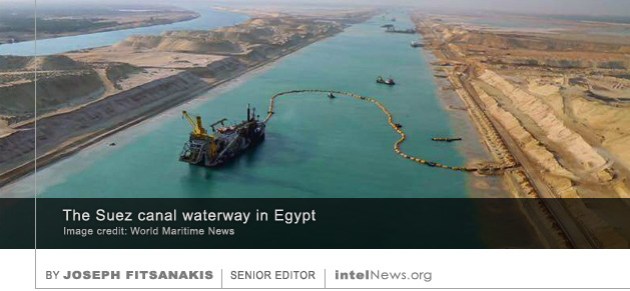 The seizure earlier this year of a North Korean ship secretly carrying thousands of weapons for use by the Egyptian military has revealed the scale of one of Pyongyang’s most profitable money-making ventures: global arms sales. Experts say that the North Korean state continues to supply thousands of tons of Cold-War-era conventional weapons to countries such as Eritrea, Cuba, Burma and Iran, as well as to some American allies, including as Egypt. There is also evidence that at least two non-state militant organizations, including the Lebanon-based group Hezbollah, are among Pyongyang’s customers. The latter take advantage of North Korea’s vast arsenal of weapons produced in the 1960s and 1970s, which are being sold on the international arms market at very low prices.
The Washington Post’s Joby Warrick reports that, in August of this year, American intelligence officials notified authorities in Egypt of a potentially suspicious transport ship named Jie Shun. The ship had been registered in Cambodia and was flying the Cambodian flag. However, its entire crew was North Korean and it had last sailed from North Korea, bound for Egypt. Its manifest said it carried hundreds of tons of iron ore. Acting on the tip from the United States, armed Egyptian customs officers boarded the ship as soon as it entered the Suez Canal. Upon inspecting the Jie Shun, the Egyptians found hidden 30,000 rocket-propelled grenades. The discovery was later described by the United Nations as “the largest seizure of ammunition in the history of sanctions against the Democratic People’s Republic of Korea”.
Remarkably, says Warrick, the ammunition had been purchased in secret by a consortium of Egyptian businessmen, who had hoped to resell it to the Egyptian military. It is believed that the businessmen had paid in excess of $23 million for the illicit cargo, with the money ending up in the coffers of the North Korean government. The ship’s North Korean origin had been completely hidden through its “flag of convenience” registration in Cambodia, which allowed the ship’s owners to claim that the its home port was in the Southeast Asian country. According to Warrick, who cites unnamed US officials, the discovery of the Jie Shun’s illicit cargo contributed to the recent decision of US President Donald Trump to hold back on approximately $300 million in military aid to Egypt that Washington had planned to give to Cairo in July.
► Author: Joseph Fitsanakis | Date: 03 October 2017 | Permalink
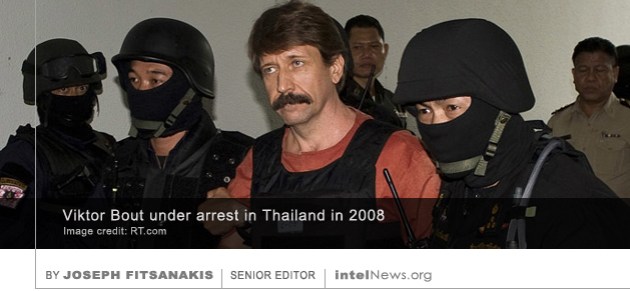 The wife of Viktor Bout, the imprisoned Russian arms dealer dubbed ‘the merchant of death’, said he rejected an offer by his American captors who asked him to testify against a senior Russian government official. Born in Soviet Tajikistan, Bout was a former translator for the Soviet military. After the end of the Cold War, he set up several low-profile international air transport companies and used them to transfer large shipments of weapons that fueled wars in Africa, Asia, Latin America and Europe. He made millions in the process and acquired international notoriety, which inspired the Hollywood blockbuster Lord of War. But his business ventures ceased in 2008, when he was
 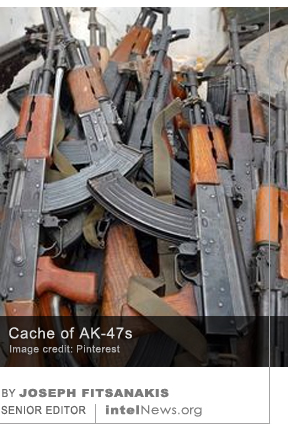 Unprecedented quantities of weapons and ammunition worth in nearly $1.5 billion have been procured from Eastern Europe and sent to Syria to arm nearly every side in the ongoing civil war, a study has found. The weapons are transported through the Balkans and sold legally to countries bordering Syria, including Jordan, Saudi Arabia and Turkey. Once there, they are secretly transported to Syria for use in the bloody five-year civil war, which has so far killed or displaced millions. The
  Former directors of the Central Intelligence Agency, the National Security Agency, as well as several 3- and 4-star generals and admirals have launched a new effort to control the sales of guns in the United States. The effort is certain to attract attention after last weekend’s deadly mass shooting in Orlando, Florida. The group, which calls itself Veterans Coalition for Common Sense, is led by former CIA Director David Petraeus, former CIA and NSA Director Michael Hayden, and US Army General (ret.) Stanely McChrystal. The group’s advisory committee includes recognizable figures such as that of Admiral Eric Olson, who led US Special Operations Command from 2007 to 2011 and was the first US Navy SEAL to be appointed to four-star rank. Other advisory committee members include high-ranking veterans from every branch of the US Armed Forces, such as R. Adm. Jamie Barnett, Brig. Gen. Stephen Cheney and Air Force commander Lt. Gen. Norman Seip.
 Out of the myriad of questions emerging from Sunday morning’s massacre in Orlando, two are perhaps most pressing. One concerns internal security in the United States; the other relates to the broad strategy of the Islamic State, the militant Sunni Muslim group that claimed responsibility for the bloody attack. The two topics are closely related.
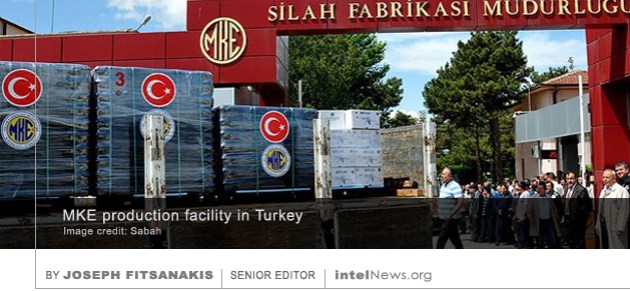 A senior official of Turkey’s state-run weapons manufacturer has been arrested on espionage charges, after he was caught selling weapons blueprints to the employee of an arms firm based in the United States. The official was named by Turkish authorities as Mustafa Tanriverdi, the general manager of one of Turkey’s largest weapons production facilities, located in the town of Kirikkale, 50 miles east of Turkish capital Ankara. Tanriverdi is reportedly employed by the Mechanical and Chemical Industry Corporation (MKE), a government-run manufacturing firm that provides much of the Turkish Armed Forces’ weaponry. The company also has a growing list of international buyers, which includes nearly 30 foreign governments.










 intelNews.org
France admits ownership of missiles found in Libyan rebels’ hands
July 11, 2019 by Joseph Fitsanakis 1 Comment
The GNA released photographs of the laser-guided missiles and their shipping containers, which showed that the weapons were property of the “Armed Forces of the United Arab Emirates”. This appeared to constitute a clear breach of the UN-imposed weapons embargo on Libya, which has been in place since 2011. Last week, officials in Abu Dhabi said that the weapons did not belong to the Emirates, and claimed that the government of the oil kingdom was upholding the UN embargo on the North African country. On Tuesday, The New York Times cited anonymous French government sources, who said that Paris had purchased the four Javelin missiles from the US in 2010 for nearly $700,000. Finally, yesterday the French Armed Forces Ministry issued a statement admitting that it had indeed purchased the missiles from the US in 2010, and that they had been transferred to Libya for “the self-protection of a French military unit deployed to carry out counter-terrorism operations” there (incidentally, France does not officially have troops in Libya, so this statement is Paris’ second admission of the presence of French Special Forces in the country). The Ministry’s statement went on to claim that the missiles were “defective” and had been marked for destruction. The statement insisted that the missiles were not meant to be “transferred to local forces”. Instead, like all “damaged and unusable armaments, they were being temporarily stocked at a depot ahead of their destruction”, it said.
In 2017, two leading American experts, including a former special counsel for the US Department of Defense and a Harvard University law professor, accused Haftar of having committed large-scale war crimes. Unfazed by such criticisms, Haftar launched a large-scale offensive in April of this year, with the aim of conquering Tripoli and ousting the GNA. Several UN reports have since indicated that Haftar’s forces are secretly supported by several Western countries, Israel, Egypt and the Emirates, but this is denied by officials from those countries. In April of this year, a number European Union member states led by Italy criticized France for blocking a joint resolution calling on all warring factions in Libya to cease all hostilities and return to the negotiating table.
► Author: Joseph Fitsanakis | Date: 11 July 2019 | Permalink
Filed under Expert news and commentary on intelligence, espionage, spies and spying Tagged with 2011 Libyan civil war, FGM-148 Javelin, France, Khalifa Haftar, Libya, Libyan Government of National Accord, News, United Arab Emirates, weapons smuggling, weapons trade