Analysis : Attack on Israel Points to Systemic Failure at All Levels
October 11, 2023 4 Comments
 THE COMPARISON BETWEEN THE October 2023 attack on Israel and the Yom Kippur War is reasonable. We still have an obscured perspective on what happened on October 7. But even this partial picture makes it possible to draw a preliminary comparison. Undoubtedly, there is no precedent for such a monumental failure in the history of Israeli intelligence.
The most striking difference between the two case studies is that in 1973 the system as a whole did not fail. The failure was personal, on the part of several key people, who did not perform according to expectations. The events of 2023 point to a systemic failure at all levels, not personal mistakes. The failure is at the level of intelligence warning, the military response to the attack, and even the actions of Israel’s political leadership.
An Intelligence and Military Failure
In 1973, the intelligence-gathering system was working well, and Egypt’s war intentions were known. Thousands of reports from observations along the Suez Canal spoke of the Egyptian preparations. The wireless transmissions that were issued testified to preparation for war in the Egyptian army. All this did not translate into a warning of war, due to the failed performance of some senior officers in the Israeli Military Intelligence (IMI), who stuck to their preconceived notions until the last moment.
In 2023, the failure is systemic. It involves both the level of collection and at the level of assessment. It relates both to the IMI and the Israel Security Agency (ISA). It has already become clear that the intelligence collection mechanisms failed to detect large-scale preparations for an all-out attack from the Gaza Strip. A massive intelligence system failed to detect the preparatory actions of the assailing forces.
When the perceived enemy is Palestinian civilians and when Israel Defense Forces (IDF) soldiers spend their time guarding settlements and worshipers, instead of engaging in hard training, the result is catastrophic. On October 7, we witnessed the operations of an army whose main mission is occupation. Given what we saw on that day, namely more than 1,000 civilian and military casualties and approximately 150 kidnapped Israelis, it is not clear how this army will be able to face the upcoming challenges in this war. The need  for the professionalism and resilience of the IDF, which was there in 1973, continues to exist.
A Political Failure
The comparison between the political leadership of 1973 and 2023 is also discouraging. Back then, the root of the failure was that the intelligence information the leadership received from Eli Zeira, the director of IMI, who was the nation’s most senior intelligence officer, was distorted and false. It is now understood that the IMI’s assessments were based on the concept of reassuring the political leadership. Yet, Prime Minister Golda Meir and Minister of Defense Moshe Dayan were challenged after the war, and were eventually removed from their positions. However, they acted responsibly.
In contrast, there is not much to say about Israel’s current political leadership. It suffices to look at the composition of the Security Cabinet and the first leaks that have already begun to emanate from it, or at the surge of slander that members of the governing coalition have begun to heap on the finest of the IDF’s officers. It is nothing short of a disgrace and a disaster.
This war has just begun. It is still too early to draw conclusions. But we can examine the conclusions from the Yom Kippur War and assess their relevance to today. When Israeli Prime Minister Benjamin Netanyahu talks about revenge, it is advisable to remember those lessons. The conflict with the Palestinians is long and bitter. They will not give up their ambition for their state. It is now time to comprehend the full cost of the continuation of the conflict.
► Author: Avner Barnea | Date: 11 October 2023 | Permalink
Dr. Avner Barnea is research fellow at the National Security Studies Center of the University of Haifa in Israel. He served as a senior officer in the Israel Security Agency (ISA). He is the author of We Never Expected That: A Comparative Study of Failures in National and Business Intelligence (Lexington Books, 2021).
 LAST WEEK, LEBANON’S GENERAL Security Directorate
  The United States Department of Justice has
  LAST WEEK, THE CHAIRMAN of the Israeli Religious Zionist Party, Bezalel Smotrich, who will soon be appointed as a cabinet minister, alleged that the Israel Security Agency (ISA) encouraged the killer of the late Israeli Prime Minister, Yitzhak Rabin. Smotrich’s allegation shocked many Israelis, because of the unfortunate timing —it was uttered close to the annual Remembrance Day for Prime Minister Rabin, who was assassinated by radical rightwing activist Yigal Amir 27 years ago. But also because of the unacceptable content, which echoes conspiracy theories that have accompanied Rabin’s assassination for many years. To counter these conspiracy theories, it is fitting to discuss the failure to defend Rabin that did occur under the responsibility of the ISA.
 ISA to infiltrate extreme rightwing groups. The Committee did not ask: could the ISA’s intelligence have prevented the murder?
 REPORTS FROM KUALA LUMPUR SUGGEST that Malaysian agents operating in the service of Israeli intelligence carried out the kidnapping of a Palestinian engineer, Omar al-Balbaisi, on September 28.
  ON JUNE 16, THE Dutch General Intelligence and Security Service (AIVD)
  A WEEK AFTER POLAND
  ON MARCH 3, 2022, Dutch newspaper Volkskrant
  LAST WEEK, THE DUTCH General Intelligence and Security Service (AIVD) launched an awareness campaign dubbed ‘Check before connecting’. The purpose of the campaign is to inform the Dutch public about risks of foreign actors using fake accounts on social media, in efforts to acquire sensitive business information. According to the AIVD, such online campaigns frequently target and recruit employees of Dutch private sector companies. The
  Since 2008, when intelNews was launched, it has been our
  Since 2008, when intelNews was launched, it has been our
  Since 2008, when intelNews was launched, it has been our
 IN HIS NEW BOOK, We Never Expected That: A Comparative Study of Failures in National and Business Intelligence (Lexington Books), Dr. Avner Barnea has coined two new terms in the field of strategic surprise. One is diffused surprise and the other is concentrated surprise, two terms that help us to better understand why intelligence failures occur. In a diffused surprise there is difficulty in identifying the intelligence target and therefore the chance of a surprise increases; while in a concentrated surprise the intelligence target is usually a recognized organization. At the same time, the mistake lies in the assessment of the target’s abilities and intentions.








Analysis: How Israeli Intelligence Failed to Anticipate the Hamas Attack
October 16, 2023 1 Comment
The IMI and ISA Assessment
It is important to note that the intelligence division of the Israel Defense Forces (IDF), known as Israeli Military Intelligence (IMI), and the Israel Security Agency (ISA), have been monitoring Hamas for years. These two agencies are believed to have conducted a situation assessment approximately two weeks before the October 7 attack. The assessment concluded that Hamas was deterred and had no interest in changing the status quo by attacking Israel in the short run. This assessment was communicated to Prime Minister Benjamin Netanyahu and Minister of Defense Yoav Gallant.
It appears that this assessment was not supported by concrete intelligence. The agencies that produced it relied primarily on monitoring the recent behavior of Hamas, including the fact that it was allowing Palestinians living in Gaza to work inside Israel. Additionally, the assessment noted the fact that Hamas was receiving funds from Qatar to help the poverty-stricken residents of Gaza. In retrospect, this assessment appears to have been based on wishful thinking.
The Egyptian Warning
It is now known that Abbas Kamel, Director of the Egyptian General Intelligence Directorate, sent a warning to Israel a few days before Hamas’ attack. Kamel allegedly warned of “something unusual, a terrible operation”, which was about to take place from the direction of Gaza. The warning was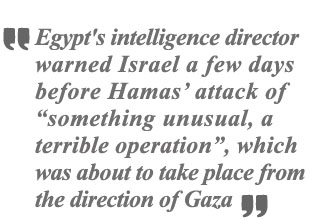 forwarded to Prime Minister Netanyahu’s office. The Israeli newspaper that published this report, Yedioth Ahronot, is known for its serious reputation and quality sources inside the Egyptian establishment. According to the report, Kamel was told by the Israelis that they were focused on preventing terrorist attacks in the West Bank.
Yet, in a speech that Netanyahu delivered immediately after the October 7 attack broke out, he denied claims about the Egyptian warning and claimed that they were fake news. However, American Congressman Michael McCaul, Chairman of the House Foreign Affairs Committee, said on October 11: “We know that Egypt […] warned the Israelis three days prior that an event like this could happen”. Speaking to reporters following a closed-door intelligence briefing on the crisis for American lawmakers, McCaul added: “I don’t want to get too much into classified [details], but a warning was given”. An Egyptian government source also asserted that Egyptian intelligence officials warned their Israeli counterparts that Hamas was planning “something big” ahead of the October 7 surprise onslaught. But this intelligence appears to have been ignored. Read more of this post
Filed under Expert news and commentary on intelligence, espionage, spies and spying Tagged with 2023 Israel-Hamas War, Analysis, Avner Barnea, Gaza Strip, Hamas, Israel, Palestine