Israel says it foiled attempt to smuggle spy drones into Gaza

spy droneAuthorities in Israel said on Sunday that they foiled a plan to smuggle dozens of spy drones from Israel into the Gaza Strip. The Israeli Ministry of Defense said in a statement late on Sunday that the drones had been detected by members of the Shin Bet, Israel’s security police. The incident reportedly took place at Kerem Shalom, a major border crossing in to Gaza, a Palestinian enclave that is controlled by Hamas. The Defense Ministry statement also said that Sunday’s incident was only the latest in a string of recent attempts to smuggle spy drones into Gaza, all of which had been stopped by the Shin Bet since January.

According to the Israeli government report, the spy drones were found hidden inside boxes of toys that had been marked for export to Gaza. The drones were of different sizes, types and capabilities, but all were equipped with sophisticated cameras and related software, said the report. Israeli media reported on Sunday that, according to Israeli government sources in Tel Aviv, the drones were almost certainly going to be used by Hamas to spy on possible targets inside Israel. A source in the Israeli Department of Defense said Hamas was known to employ drones in order to explore and map the terrain that is adjacent to the Gaza Strip.

In March of last year, Egyptian authorities reported seeing several spy drones flying out of the Gaza Strip and conducting reconnaissance over Egyptian airspace in the Sinai Peninsula, which borders Gaza. According to some reports, a number of the spy drones that flew out of Gaza were seen as far as 50 kilometers (35 miles) inside Egyptian territory. The latest information from Israel is that the government in Tel Aviv believes that the pattern and frequency of attempts to smuggle spy drones into the Gaza Strip justify an investigation, which is now underway.

Author: Ian Allen | Date: 22 February 2016 | Permalink

Concerns about Israeli spying prompt debate on EU security measures

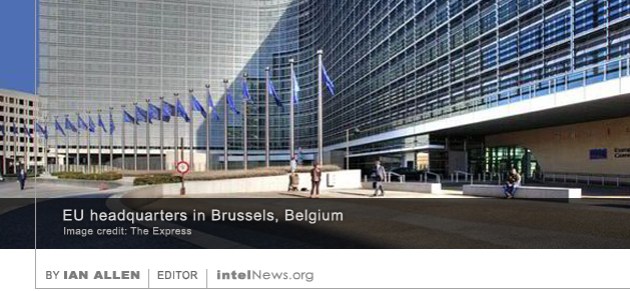
EU headquartersA debate on information security measures in the European Union was prompted last week after some officials voiced concerns that the proceedings of a closed-door meeting were secretly monitored by Israel. The meeting took place on January 15 as part of regular proceedings by the EU’s Political and Security Committee (PSC). The main item on the agenda was the EU’s Middle Eastern policy. According to some meeting participants, Israeli diplomats appeared to be aware of a statement discussed during the PSC meeting “in real time”, which prompted a wider debate on EU information security policies.

According to the Brussels-based EU Observer, which reported on the story, EU member state ambassadors present at the meeting worded a statement that contained a sentence deemed critical to Israel’s policy on Palestine. The sentence allegedly stated: “The EU will continue to unequivocally and explicitly make the distinction between Israel and all territories occupied by Israel in 1967”. According to some ambassadors who were present at the PSC meeting, “Israeli contacts sent text messages to them with requests to alter wording shortly after each new draft [of the PSC statement] went around”. Further suspicions were raised when, at the conclusion of the meeting, the Greek delegate vetoed the contentious line, standing alone against the remaining 27 delegates who had earlier supported it.

Last week, sources told the EU Observer that Israel may have placed bugs in the room where the PSC meeting took place. They added that the committee was debating whether to begin holding meetings in a secure room located in the EU headquarters building in Brussels, where the use of cell phones by meeting participants is not possible. They also said that a stricter classification policy should apply to PSC documents. Others, however, said that the source of the leak may have been the Greek delegate —the sole participant at the meeting who assumed a seemingly pro-Israeli stance. The Greek ambassador may have shared the details of the proceedings with Israeli officials, thus effectively spying on the conference on behalf of Israel, speculated the EU Observer. Another PSC meeting delegate told the paper that “the spy theory” was effectively concocted “in order to avoid confrontation” with the Greek delegation.

The EU Observer contacted the Greek mission to the EU, but was told that the Greek ambassador would never spy on the EU “as a matter of principle”. The Israeli mission to the EU declined to comment.

Author: Ian Allen | Date: 15 February 2016 | Permalink
Spy charges for journalists who claimed Turkey arms Syrian Islamists

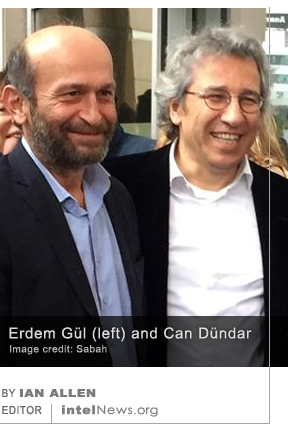
Can Dündar Erdem GülTwo leading Turkish journalists, who claimed in a series of articles that Ankara has been arming militant Islamists in Syria, are facing espionage charges for “airing Turkish state secrets”. The two, Can Dündar and Erdem Gül, work for Cumhuriyet, (The Republic), Turkey’s oldest newspaper, which typically voices staunchly secularist views representing the center-left of the political spectrum. Last year Dündar, who is the paper’s editor, and Gül, who serves as the paper’s bureau chief in Ankara, published a series of articles claiming that the Turkish government was secretly supporting Salafi Jihadist groups in Syria.
In the articles, Dündar and Gül alleged that a convoy of trucks had been intercepted on its way from Turkey to Syria. According to the two reporters, the trucks were transporting large quantities of weapons and ammunition to Syrian rebels as part of a secret operation conducted by the National Intelligence Organization (MİT), Turkey’s main spy agency. But the MİT had not shared details of the operation with Turkish police, which promptly stopped the vehicles, searched them and found them to be “loaded with weapons” and ammunition, according to Cumhuriyet. The paper also published video footage showing the alleged MİT trucks.

When the story was published, it caused major ripples in Turkish political life and prompted the government of President Recep Tayyip Erdoğan to issue official denials directed against the paper’s accusations. Government spokespeople claimed that the captured trucks contained humanitarian assistance, and not weapons. Later, however, Turkish officials admitted that the trucks were indeed carrying weapons, but that they were destined for Turkmen guerrillas operating in Syrian territory. President Erdoğan, however, was furious with Cumhuriyet and warned the paper’s investigative reporters that they would “pay a heavy price” for revealing state secrets.

The two reporters were arrested in November of last year and have since been held in detention. On Wednesday, state prosecutors charged Dündar and Gül with espionage, attempting to topple the Turkish government by force, and supporting terrorism. Interestingly, the main plaintiffs in the case are President Erdogan and Hakan Fidan, the director of MİT. If found guilty, the two Cumhuriyet journalists will face up to life in prison.

Author: Ian Allen | Date: 28 January 2016 | Permalink

German spy agency tapped Finnish phone lines in early 2000s

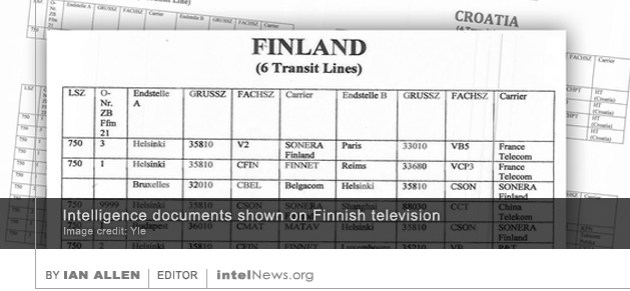
FinlandGerman intelligence, possibly with the collaboration of the United States, monitored communications lines connecting Finland with at least five countries in the early 2000s, according to leaked documents. The documents, aired this week by Yle Uutiset, the main news program of the Finnish Broadcasting Company (Yle), is based on information contained in “leaked German intelligence documents” that were first made public in May 2015. As intelNews reported at the time, the intelligence collection was described as a secret collaboration between Germany’s BND (Bundesnachrichtendienst) and America’s National Security Agency (NSA). According to Austrian politician Peter Pilz, who made the initial allegations, the BND-NSA collaboration was codenamed EIKONAL and was active from 2005 to 2008. Pilz said at the time that many European phone carriers and Internet service providers were targeted by the two agencies. Belgium and Switzerland have already launched investigations into EIKONAL.
Now new information provided by Yle seems to show that the secret BND-NSA collaboration targeted Finnish communications as well, focusing on at least six separate communications transit lines. The lines are believed to carry telephone call and possibly Internet traffic from Finnish capital Helsinki to a number of cities in France, Belgium, Hungary, Luxemburg, and China, said Yle Uutiset. Although the targeted lines are known to carry telephone and Internet traffic, it is unknown at this time whether EIKONAL targeted both kinds. But Yle said the interception lasted for most of the first part of the 2000s and involved large amounts of communications data.

The station contacted Tuomas Portaankorva, Inspector General of SUPO, the Finnish Security Intelligence Service. He told Yle that, speaking broadly, he was not surprised to be told that Finnish telecommunications lines had been monitored by foreign intelligence agencies, Western or otherwise. He went on to caution that, even though Finnish lines had been targeted, it was not possible to conclude that Finland was indeed the target of the surveillance operation. Yle also spoke to Vesa Häkkinen, spokesman for the from Finland’s Ministry of Foreign Affairs, who told the station that SUPO, and not the ministry, was the proper official body to be consulted about EIKONAL. “If there is reason to suspect that these actions were directed at the Finnish state”, said Häkkinen, “we would undertake appropriate action”.

Author: Ian Allen| Date: 20 January 2016 | Permalink | News tip: Matthew Aid

America’s most senior intelligence official has his phone, email hacked

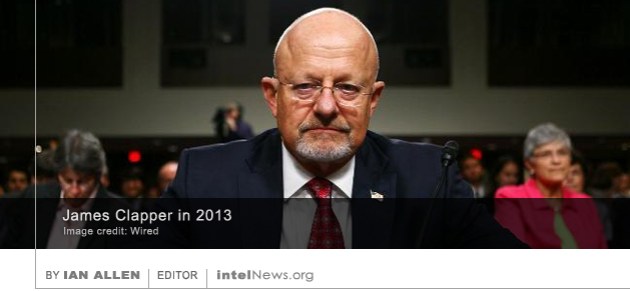
James ClapperA member of a hacker group that took responsibility for breaking into the personal email account of the director of the Central Intelligence Agency last year has now hacked the email of the most senior intelligence official in the United States. In October 2015, the hacker group referred to by its members as “Crackas With Attitude” —CWA for short— claimed it was behind the hacking of an AOL personal email account belonging to John Brennan, who heads the CIA. Less than a month later, the CWA assumed responsibility for breaking into an online portal used by US law enforcement to read arrest records and share sensitive information about crimes involving shootings. Shortly after the second CWA hack, the Federal Bureau of Investigation issued an alert to all government employees advising them to change their passwords and be cautious about suspicious emails and other phishing attempts.
On Monday, an alleged member of CWA contacted Motherboard, an online media outlet belonging to Vice Media, and alleged that the group had managed to hack into the personal email account of James Clapper, Director of National Intelligence (DNI). Clapper’s job is to help synchronize the operations of US intelligence agencies and to mediate between the US Intelligence Community and the Executive. According to CWA, clapper’s personal telephone and Internet service had also been compromised, as had his spouse’s personal email, which is hosted by Yahoo! services. The alleged CWA member told Motherboard that the forwarding settings of Clapper’s home telephone had been changed. As a result, calls made to the DNI were being forwarded to the headquarters of the Free Palestine Movement in California. Shortly afterwards, Free Palestine Movement executives confirmed that they had received a number of phone calls for Clapper. Last year, when they hacked the email of the director of the CIA, the CWA dedicated their action to the Free Palestine Movement.

Motherboard said that a spokesman at the Office of the DNI, Brian Hale, confirmed that Clapper’s personal email and telephone service had indeed been hacked. He told Motherboard’s Lorenzo Franceschi-Bicchierai that Office of the DNI was “aware of the matter” and had “reported it to the appropriate authorities”. The FBI was contacted as well but did not respond.

Author: Ian Allen | Date: 14 January 2016 | Permalink

Intelligence agencies doubt North Korea bomb test was hydrogen

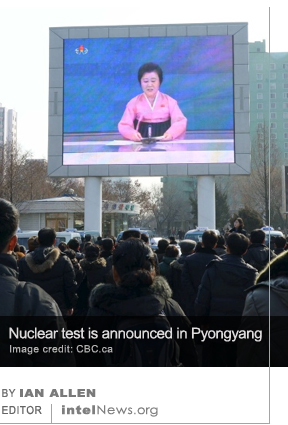
PyongyangIntelligence agencies outside North Korea, including those of South Korea and the United States, are skeptical of Pyongyang’s claims that it conducted a successful test of a hydrogen bomb. On the surface, North Korea’s announcement on Wednesday that it tested a hydrogen bomb is consistent with the policies of the Kim Jong-un administration. The North Korean leader, who succeeded his father as the nation’s supreme leader in 2012, has repeatedly said that he intends to strengthen and modernize the country’s nuclear arsenal. In December, North Korea issued several warnings that it would soon test a hydrogen bomb, nearly a decade after the regime announced its first successful test of an atomic weapon. Unlike atom bombs, which rely on nuclear fission to release energy, hydrogen bombs are based on nuclear fusion; they are far more powerful than atom bombs, which they use as a trigger to reach even more massive levels of energy release.
There was initial shock on Wednesday when Pyongyang announced it had successfully detonated a “miniaturized hydrogen bomb”. A 5.1 magnitude earthquake was registered at a site that had been used in the past by North Korea to test nuclear weapons. A few hours later, however, White House Press Secretary Josh Earnest told reporters in Washington that “initial analysis” conducted by US intelligence agencies was “not consistent” with North Korea’s claims. The explosion had been measured “in the single digit kilotons”, he said, whereas a thermonuclear device, which uses the energy from an initial nuclear device to ignite a secondary, much larger nuclear reaction, is typically measured in megatons. South Korean intelligence observers agreed that some kind of test occurred on Wednesday, but it did not display signs of a hydrogen bomb. Some South Korean officials cautioned that it could have been a failed test of a hydrogen device, or that the North Koreans could have tested only the initial trigger of a hydrogen bomb, which would be a much smaller explosion caused by fission. But Earnest insisted on Wednesday that “nothing [had] caused the US government to change our assessment of North Korea’s technical and military capabilities”.

Some media reports indicated that US intelligence agencies had expected a nuclear test by Pyongyang in 2015 or 2016, but had no specific information on a precise timeframe. It is also worth noting that assessments by US and South Korean intelligence agencies indicate that China was not informed by North Korea about an impending nuclear test and that Beijing was caught by surprise by Wednesday’s developments. China issued a statement condemning the alleged nuclear test soon after it was announced by North Korea.

Author: Ian Allen | Date: 07 January 2016 | Permalink

Head of Russian military intelligence dies unexpectedly at 58

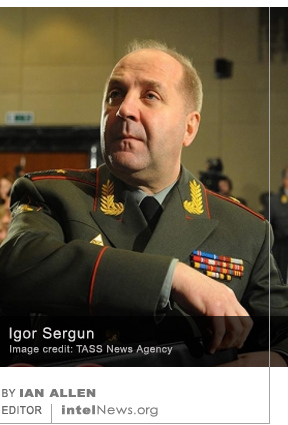
Igor SergunThe director of Russia’s powerful military intelligence agency has died unexpectedly at 58, according to the Kremlin, which has yet to release precise information about the circumstances of his death. General Igor Sergun had led the Main Intelligence Directorate, known as GRU, since 2011, when he replaced his predecessor, Colonel General Aleksandr Shlyakhturov, in a Kremlin-instigated reshuffle. The Russian government said at the time that Shlyakhturov, who had spearheaded a major shake-up of the GRU since his appointment in 2009, had “reached retirement age” and gave no other reason for his sudden replacement. General Sergun’s death was announced in a statement posted on the official website of the Kremlin on January 4. It said that the GRU director had “suffered a sudden death” on January 3. It gave no further details as to the exact cause or circumstances surrounding the general’s death.

General Sergun was a career GRU officer, having joined the service as soon as he graduated from the Military Academy of the Soviet Army in 1984. Under his leadership, the GRU —Russia’s largest intelligence agency, which operates under the supervision of the General Staff of the Russian Armed Forces— became increasingly important in Moscow’s foreign policy maneuvers. The agency was central during the Russian military campaign in Georgia in 2008, and observers considered its role during the onset of the eastern Ukraine crisis in 2013 as indispensable for Russia. This view was reflected early in 2014, when the European Union and the United States imposed economic sanctions on General Sergun, accusing him of coordinating “the activities of GRU officers in eastern Ukraine”.

The January 4 online statement by the Kremlin quoted Russian President Vladimir Putin, who reportedly contacted the late general’s family to offer his condolences. The Russian leader was quoted as saying that General Sergun had given his “life in its entirety to the service of the homeland and the Armed Forces” of the Russian Federation. The late general was “respected for their professionalism, strength of character, honesty and integrity”, said the statement. Moscow has not yet announced Sergun’s replacement at the helm of the GRU.

Author: Ian Allen | Date: 05 January 2016 | Permalink

We had no asset in Saddam’s inner circle, says ex-CIA deputy director

Morell - IA senior Central Intelligence Agency official, who led the agency as its acting director before retiring in 2013, has said that not having sources in the Iraqi government’s upper echelons led to the intelligence failure of 2003. Michael Morell retired as deputy director of the CIA, after having served twice as its acting director, in 2011 and from 2012 to 2013. A Georgetown University graduate, Morell joined the agency in 1980 and rose through the ranks to lead the Asia, Pacific and Latin America divisions. In May 2015, Morell published his book, The Great War of Our Time: The CIA’s Fight against Terrorism from al Qa’ida to ISIS, which he has been promoting while working as a consultant in the private sector.
Morell spoke at the Aspen Institute earlier this month, and once again offered a public apology to former United States Secretary of State Colin Powell for the CIA’s erroneous estimates on Iraq. He was referring to the Agency’s claims prior to the 2003 US invasion that Iraq maintained an active weapons-of-mass-destruction (WMD) program. The claims formed the basis of Powell’s February 2003 speech during a meeting of the United Nations Security Council, in which he claimed that the regime of Iraqi President Saddam Hussein had “biological weapons and the capability to rapidly produce […] many more.” There was no question, said Morell, that Powell’s reputation “was tarnished” as a result of the speech, and that a public apology was in order. The same apology, said Morell, applied “to every single American.”

The retired intelligence official went on to say that the main cause of the CIA’s erroneous assessment of Iraq’s WMD program was that the Agency had failed to penetrate the highest echelons of the Hussein regime. “We were not able to come up with the right answer [because] we didn’t do our fundamental job of penetrating [Hussein’s] inner circles with a human asset,” said Morell. As a result, there was “no information to give to the [CIA] analyst to say ‘here’s what this guy is up to’,” he added. The author of The Great War of Our Time, went on to suggest that the CIA’s failure to penetrate the inner circle of the Iraqi government prior to 2003 was “quite frankly a national security failure.”

Author: Ian Allen | Date: 29 December 2015 | Permalink

Many arrested in Bosnia for having links with Islamic State

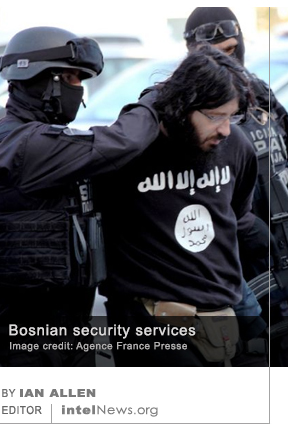
BosniaAuthorities in Bosnia and Herzegovina have announced the arrest of several people on suspicion of having direct links with the Islamic State and other militant groups fighting in Iraq and Syria. At least 11 people were arrested by police in simultaneous raids at a number of locations on Tuesday, including businesses and private homes, across the Bosnian capital Sarajevo. A police spokeswoman said the eleven men had been charged with having links to terrorist groups, financing terrorist groups, or inciting and helping organize criminal acts. A number of them were also charged with recruiting young men and women to join militant groups in Syria and Iraq, she said.
A statement issued by the office of the Bosnian prosecutor on Wednesday morning said the arrests were part of a “major operation […] to track down some 15 people” suspected of having close operational ties with Islamist organizations in the Middle East. The arrests were carried out less than a day after another five people were arrested in Sarajevo for illegally transporting weapons and ammunition from Bosnia to Germany. Large caches of weapons and ammunition were seized during the raids.

Depending on the source, there are estimates that the largely Muslim Balkan country of 3.8 million has supplied between 150 and 330 fighters to the Islamic State, the militant Sunni group that today controls much of Syria and Iraq. Hundreds more have joined from cities and towns in Kosovo, Serbia, Macedonia and Albania. Of those, several dozen have already been killed while fighting for the Islamic State. Security services in Bosnia are reportedly monitoring a number of unregistered mosques in the country, which are believed to be preaching a version of Salafi Jihadism that promotes the worldview of the Islamic State. Many of these mosques are led or supported by individuals from Africa and the Middle East. These men first went to Bosnia in the first half of the 1990s to fight in the war against Serbia and Croatia, two predominantly Christian regions of the former Yugoslavia. They ended up settling in Bosnia after marrying local women.

Author: Ian Allen | Date: 24 December 2015 | Permalink

US considers launching all-out cyber war against Islamic State

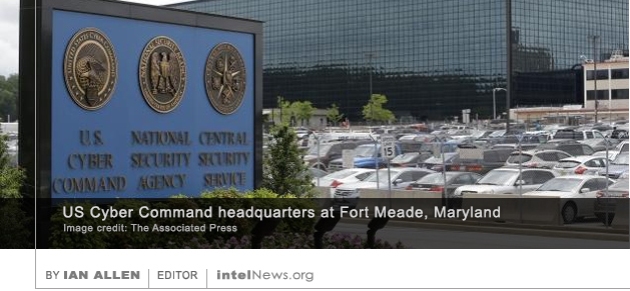
US Cyber CommandFollowing a request from the White House, the United States Department of Defense is putting together options to launch offensive cyber operations of an unprecedented scale against the Islamic State. The White House reportedly issued the request soon after the December 2 shooting in San Bernardino, California, in response to reports that the two shooters were radicalized through exposure to online propaganda by the Islamic State. According to American government officials, US President Barack Obama directed the Pentagon to put together a report outlining options for “a stepped up cyber offensive” against online activities by the Islamic State in Iraq and Syria.
The report is allegedly being prepared by the US Cyber Command (USCYBERCOM), the Pentagon office responsible for conducting what the US military calls “full spectrum military cyberspace operations”. Offensive cyber security planners at USCYBERCOM, which is located at Fort George G. Meade in Maryland, are said to have prepared plans that include proposals to launch numerous computer viruses, denial-of-service attacks and other cyber weapons against computers, internet servers and cell phone networks belonging to the Islamic State. The idea behind the plan is that an all-out online war against the Sunni militant group would hurt its image and prevent it from launching armed attacks against civilian targets abroad.

However, Canadian newspaper The Toronto Star reports that a number of other US agencies, including the Federal Bureau of Investigation, have voiced objections to the USCYBERCOM plan, arguing that an all-out cyber war against the Islamic State could backfire. Specifically, some US intelligence officials argue that sabotaging online communications nodes, as well as cell phone networks, would make it harder to spy on the Islamic State. Additionally, such a move would hinder the work of aid groups, opposition forces, and even Western-backed rebel forces in the Levant, who rely on the same Internet and cellular networks to communicate with each other. These officials argue instead that the US should opt for surgical attacks on specific computers or cell phones used by senior Islamic State planners.

According to media reports, US Defense Secretary Ashton Carter is scheduled to meet with USCYBERCOM commanders this week in order to evaluate the possibilities for offensive cyber attacks against the Islamic State. He will then brief President Barack Obama on the available options.

Author: Ian Allen | Date: 22 December 2015 | Permalink

Weapon used in Paris attacks was purchased in the United States

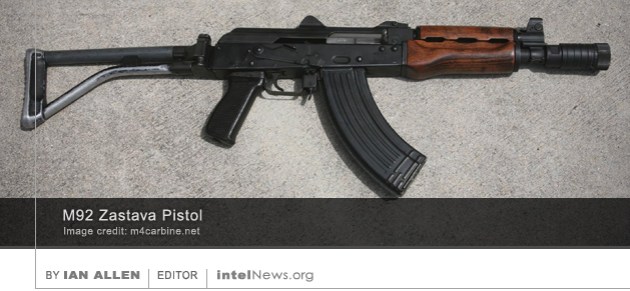
M92 Zastava PistolOne of the guns used by Islamist militants to attack locations in downtown Paris on November 13 was purchased legally through a dealer in the United States, according to a report by the Associated Press. Investigators have confirmed that several of the weapons used in the attack, which killed 130 and injured hundreds more, were manufactured in Serbia. Most are slightly modified versions of the Soviet-era AK-47, known in the West as “shortened Kalashnikov”. All were produced in a weapons factory called Zastava, which is located in the city of Kragujevac, in central Serbia. They were made in the 1980s and sold within the former Yugoslavia.
Last Thursday, however, the director of the Zastava factory, Milojko Brzakovic, told the Associated Press that he had contacted authorities in France to inform them that one of the weapons used in the Paris attacks was made in his factory and sold to a US dealer. It was an M92 semi-automatic pistol, which had been legally sold to an American online arms seller called Century Arms in May 2013. The seller, based in the state of Florida, is believed to import tens of thousands of weapons from the Zastava factory each year. Brzakovic said the M92 could only fire single shots, and was thus in accordance with American law. It sells for less than $500 a piece in the US, he said.

When asked how the weapon got into the hands of militants affiliated with the Islamic State of Iraq and Syria, Brzakovic said he had no idea. He told the Associated Press that all guns exports by Zastava to Century Arms and other American weapons dealers are in strict compliance with US government regulations. Someone, he said, must have illegally modified the weapon into an automatic at a later stage. Brzakovic also said he had no idea how the weapon left America and ended up in France. All weapons exports from the US must be approved by the US Department of State, he said, so the M92 pistol must have made its way to Europe illegally.

Author: Ian Allen | Date: 16 December 2015 | Permalink | News tip: R.W.

ISIS members attempting to target Russians in Thailand, FSB warns

ThailandRussian intelligence officials have warned authorities in Thailand that the Islamic State is planning to strike at Russian targets in the Southeast Asian country. Thai authorities received the warning in a memorandum dated November 27, 2015, which came from the Russian Federal Security Service (FSB). The document, marked ‘urgent’, warned of a series of coordinated attacks against Russian-related businesses and facilities in several cities across Thailand. Several Thai news sites, as well as CNN in the United States, said they had seen the memo. It was allegedly forwarded last week from the Royal Thai Police Special Branch division to police units across the country. It warned that the FSB had identified at least 10 Syrian citizens, all members of the Islamic State of Iraq and Syria (ISIS), who had entered Thailand between October 15 and October 31.

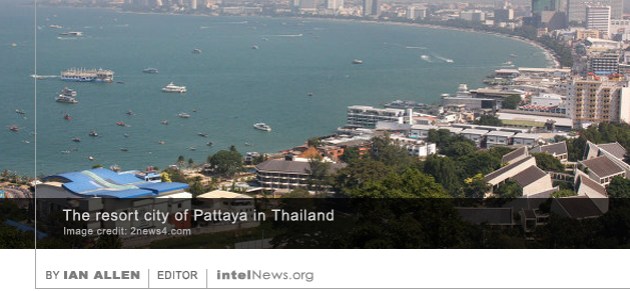
According to the FSB memorandum, the ISIS operatives had entered Thailand in three separate groups, arriving to the country from different international destinations. The largest of the groups, consisting of 4 members, is believed to have traveled to the coastal city of Pattaya (pictured), in eastern Thailand. Two more operatives went to Phuket Island in the Andaman Sea, while two other Syrians traveled to capital Bangkok. The two remaining members of the group went “to an unknown location”, said the FSB memorandum. After receiving the FSB memorandum, the Royal Thai Police issued a warning that ISIS may be trying to harm “Russians and Russia’s alliance with Thailand”. They also called for heightened security around tourist spots frequented by Russian tourists.

Phuket and Pattaya are busy resort destinations for Russian tourists, nearly 2 million of whom visit Thailand each year, many of them in December. The Russian Federation maintains consulates in both cities, in addition to the Russian embassy in Bangkok. When asked by reporters on Friday about the FSB memo, Royal Thai Police officials said they had not been able to locate the alleged ISIS members, but added that security had been increased across the country. General Thawip Netniyom, who heads the country’s National Security Council, said no “unusual movement” had been detected, and insisted that “everything is safe” in the country.

Author: Ian Allen | Date: 07 December 2015 | Permalink

Moldova arrests paramilitaries who ‘planned pro-Russian uprising’

MoldovaPolice in Moldova says it arrested members of a paramilitary group who allegedly planned to attack several cities and establish a separatist pro-Russian enclave. According to Moldovan authorities, the group, whose members include Ukrainian and Russian nationals, aimed to create a pro-Russian republic along the lines of the Donetsk People’s Republic in Ukraine. Representatives from Moldova’s General Police Inspectorate told journalists on Thursday that they began monitoring a group calling itself “Budjak Republic” in October, after pro-Russian supporters in Moldova’s Russian-dominated south began calling for independence.

Located in southwester Ukraine, the Budjak region is sandwiched between Moldova and the Black Sea. Its population is multiethnic, comprising of Ukrainian, Bulgarian, Russian, and Moldovan speakers. But following the war in Donbass, some nationalists in Budjak’s Russian-speaking community called for a united front of ethnic Russians in Moldova and Ukraine. The expressed goal of these nationalists is to establish a pro-Russian “Budjak Republic” that would incorporate regions in southwestern Ukraine and southern Moldova. According to Moldovan authorities, pro-separatist cells have been most vocal in cities such as Taraclia, Comrat and Balti, which have substantial ethnic-Russian populations.

The arrests of the alleged paramilitaries were announced last Thursday by Moldova’s acting chief of police, Gheorghe Cavaliuc. He told reporters that the separatist group intended to launch attacks against state buildings, which included government ministries in the capital Chisinau, as well as a prison in Balti. It then hoped to recruit more members, including prisoners, and attack the homes of government officials. Cavaliuc said that at least one member of the paramilitary group is a Russian-speaking Ukrainian national from the Donbass region, and that another member is a Russian customs officer. Both were charged with being members of a criminal gang, said Cavaliuc.

Moldova, which has deep historical links with neighboring Romania, has a history of pro-Russian separatism. In 1990, the Moldovan region of Transnistria, which is largely populated by Russian and Ukrainian speakers, broke off from Moldova and declared itself independent under the name “Pridnestrovian Moldavian Republic”. Another of Moldova’s heavily pro-Russian regions, Gagauzia, which borders Ukraine’s Budjak region, declared itself autonomous —but stopped short of announcing full independence— in 1994.

South Korean lawmakers accuse North of helping Islamic State

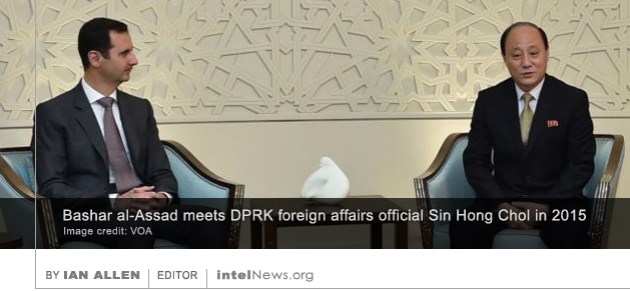
Syria North KoreaA powerful South Korean parliamentary committee has accused the North Korean government of ties to the Islamic State, an allegation that is vehemently denied by Pyongyang. On November 18, members of the Intelligence Committee of the National Assembly of Korea stated in a press conference that they believed North Korea had “possible ties to ISIS”. They were referring to the Islamic State of Iraq and Syria, which calls itself Islamic State. On Monday, North Korea’s state-run media blasted the South Korean allegations as “slander and fabrications”, and said they threatened to derail collaboration efforts between Seoul and Pyongyang.
The North Korean website Uriminzokkiri, which provides content from the Korean Central News Agency, accused Seoul of “carelessly tossing around claims of connections to terrorist groups”, in order to bring the two neighboring countries “closer to war”. Tensions remain high in the Korean Peninsula, despite an agreement that was struck in August between the two sides. In the preceding months, Pyongyang had threatened to carry out all-out invasion of South Korea, accusing Seoul of harboring aggressive intentions against it. A report in Uriminzokkiri warned that the August agreement “would be undone” if the South persisted in alleging that North Korea provided assistance to ISIS.

It should be noted that the Intelligence Committee of South Korea’s National Assembly has not given evidence of its claims that Pyongyang is supporting ISIS. Additionally, the North Korean regime is believed to be a strong international ally of Syrian President Bashar al-Assad, who is a primary adversary of ISIS. The two countries have longstanding military and commercial ties. It is believed that North Korean technicians aided in the construction of Syria’s al-Kibar nuclear facility, which was bombed by Israeli jets in Operation ORCHARD in 2007. Today, North Korea is among a small number of countries that maintain fully staffed embassies in Syrian capital Damascus. In September of this year, the government of Syria dedicated a park in the capital to Kim Il Sung, North Korea’s late leader.

Author: Ian Allen | Date: 10 November 2015 | Permalink

Russian-Iranian alliance over Syria is not as strong as some believe

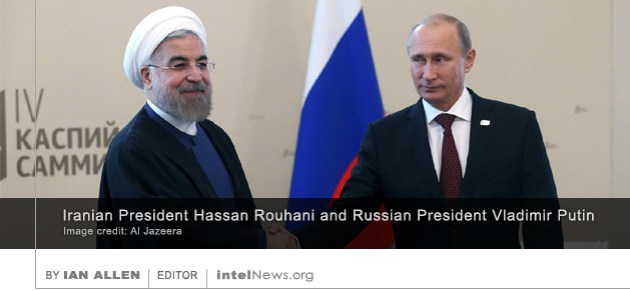
Rouhani PutinThe governments of Russia and the Islamic Republic of Iran are arguably the two most important allies of Syrian President Bashar al-Assad. But the Russian-Iranian alliance over Syria is not as solid —and may not be as durable— as some believe. On Monday, Iranian news agency ISNA reported that Iran’s minister for intelligence condemned Russia’s increased military involvement in Syria and said it would weaken Iran’s security. The minister, Mahmoud Alavi, opined at a press conference in Tehran that the intensification of Russia’s military operations in Syria would backfire against Iran, because it would prompt the Islamic State to “redouble its efforts to destabilize Iran’s security”.

Alavi’s comments came two weeks after Major General Mohammad Ali Jafari, the head of Iran’s Revolutionary Guards Corps said that Iran cared about the stability of al-Assad’s regime in Syria more than Russia did. Jafari was responding to earlier comments made by Maria Zakharova, spokeswoman for the Russian Ministry of Foreign Affairs, who said that Moscow would not insist in keeping al-Assad in power in Damascus as a matter of principle. When asked to comment on Zakharova’s comments, Jafari said Iran had to accept that Russia “may not care if al-Assad stays in power as we do”. The difference between Tehran and Moscow, said Jafari, was that “we don’t know any better person to replace him”.

So does that spell changes in the dynamics of the Russian-Iranian alliance over Syria? Such an eventuality should not be discounted, says Sergey Aleksashenko, nonresident senior fellow at the Brookings Institution. He explains that, although both the Russians and the Iranians have aided al-Assad, their reasons for doing so are very different. Russia’s interests in Syria center on maintaining access to its naval base in Tartus, and on retaining a geopolitical presence in the Middle East. Iran’s support for Assad aims to prevent Tehran’s traditional foes, namely Saudi Arabia and the Gulf States, from turning Syria into their protectorate. Additionally, says Aleksashenko, Iran appears much more willing to deploy ground troops in the fight against ISIS than Russia. The Islamic Republic is also much more willing to go against the wishes of other regional powers, like Saudi Arabia and Turkey, which Moscow tends to court.

Ultimately, says Aleksashenko, “although Russia has strategic interests in Syria, it has no intention to keep a military presence in the Middle East forever”. The Iranians, however, have no choice but to dwell in one of the world’s most unstable regions. Al-Assad’s removal would add significantly to that instability, and that is not something that Tehran is willing to permit.

Author: Ian Allen | Date: 18 November 2015 | Permalink