US Congressional review considers impact of federal database hack
July 30, 2015 Leave a comment
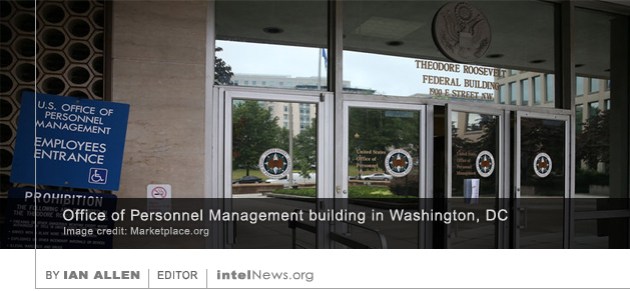 A United States Congressional review into last month’s cyber theft of millions of government personnel records has concluded that its impact will go far “beyond mere theft of classified information”. Up to 21 million individual files were stolen in June, when hackers broke into the computer system of the Office of Personnel Management (OPM). Part of OPM’s job is to handle applications for security clearances for all agencies of the US federal government. Consequently, the breach gave the unidentified hackers access to the names and sensitive personal records of millions of Americans —including intelligence officers— who have filed applications for security clearances.
So far, however, there is no concrete proof in the public domain that the hack was perpetrated by agents of a foreign government for the purpose of espionage. Although there are strong suspicions in favor of the espionage theory, there are still some who believe that the cyber theft could have been the financially motivated work of a sophisticated criminal ring. But a new report produced by the Congressional Research Service, which is the research wing of the US Congress, seems to be favoring the view that “the OPM data were taken for espionage rather than for criminal purposes”. The report was completed on July 17 and circulated on a restricted basis. But it was acquired by the Secrecy News blog of the Federation of American Scientists, which published it on Tuesday.
The 10-page document points out that strictly financial reasons, such as identity theft or credit card fraud, cannot be ruled out as possible motivations of the massive data breach. But it points out that the stolen data have yet to appear in so-called “darknet” websites that are used by the criminal underworld to buy and sell such information. This is highly unusual, particularly when one considers the massive size of the data theft, which involves millions of Americans’ credit card and Social Security numbers. Experts doubt, therefore, that the OPM data “will ever appear for sale in the online black market”. This inevitably leads to the conclusion that the breach falls “in the category of intelligence-gathering, rather than commercial espionage”, according to the report.
The above conclusion could have far-reaching consequences, says the report. One such possible consequence is that high-resolution fingerprints that were contained in the OPM database could be used to blow the covers of American case officers posing as diplomats, and even deep-cover intelligence operatives working secretly abroad. Furthermore, the hackers that are in possession of the stolen files could use them to create high-quality forged documents, or even publish them in efforts to cause embarrassment to American intelligence agencies.
► Author: Ian Allen | Date: 30 July 2015 | Permalink: https://intelnews.org/2015/07/30/01-1746/
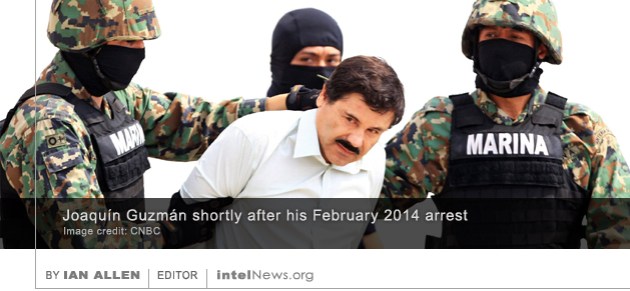 The notorious drug lord Joaquín ‘El Chapo’ Guzmán captured the attention of the world’s media a few weeks ago, when he
 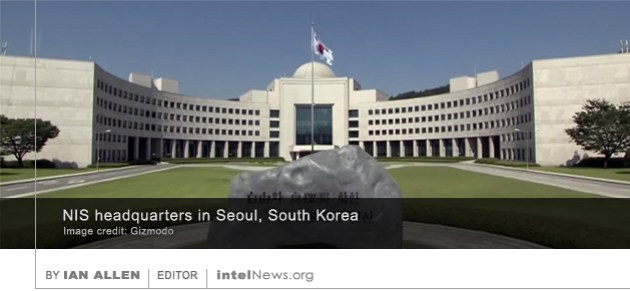 A suicide note found next to the body of a South Korean intelligence officer mentions a phone hacking scandal that has caused controversy in the country. The 45-year-old man, identified only as “Lim” by South Korean authorities, worked for the country’s primary intelligence organization, the National Intelligence Service (NIS). He was found dead late on Saturday morning inside his car, which had been parked on a deserted rural road on the outskirts of South Korean capital Seoul. According to local reports, authorities found a metal plate with burnt-out coal inside his car, which had been locked from the inside. Finding no apparent marks on his body, the police have ruled his death a suicide.
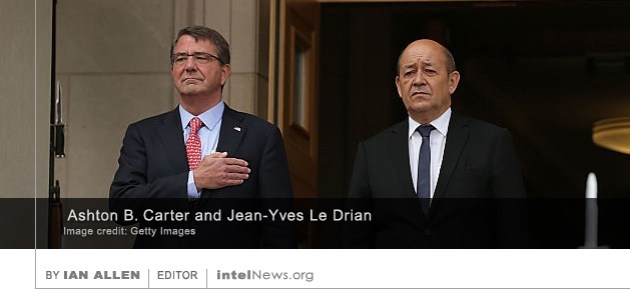 A fortnight ago, I gave an
  A set of declassified intelligence documents from the 1950s and 1960s offer a glimpse into the secret war fought in Canada between American and Soviet spy agencies at the height of the Cold War. The documents were authored by the United States Central Intelligence Agency and declassified following a Freedom of Information Act request filed on behalf of the Canadian newspaper The Toronto Star.
  n in Syria and Iraq, the continuing crises in Ukraine and in Libya, as well as the financial meltdown in Greece. So there is a recognition that their intelligence agencies must continue to work together on several pressing issues.
 routine practice. However, I do believe that this regimen can easily be changed to address particular needs, through what is called a “presidential finding”, basically a direct order issued by the president of the United States to target an individual foreign leader.
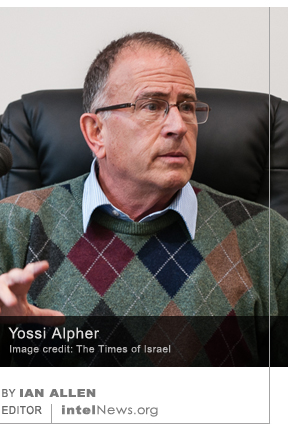 Yossi Alpher, a former Israeli intelligence officer, who was directly involved in numerous top-secret operations during his spy career, has published a new book that analyzes the overarching strategy behind Israel’s spy operations. Alpher served in Israeli Military Intelligence before joining the Mossad, where he served until 1980. Upon retiring from the Mossad, he joined Tel Aviv University’s Jaffee Center for Strategic Studies, which he eventually directed. Throughout his career in intelligence, Alpher worked or liaised with every Israeli spy agency, including the Shin Bet –the country’s internal security service.
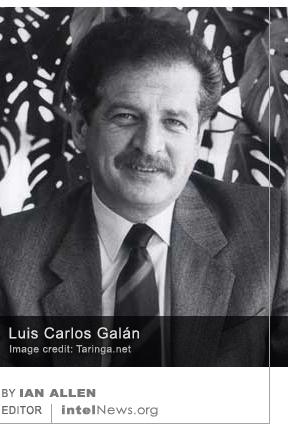 The former director of Colombia’s intelligence service returned to court this week to face charges of complicity in the assassination of a leading presidential hopeful, who was gunned down in 1989 by a powerful drug cartel. Luis Carlos Galán, a senator and former minister, was tipped to win the 1990 presidential election in which he stood on the Liberal Party ticket. His popularity with the electorate is largely attributed to his uncompromising stance against Colombia’s powerful drug cartels. He had vowed to arrest leading drug lords and send them to the United States to face criminal charges. He would do so, he said, after signing a mutual extradition treaty with Washington. However, Galán was assassinated on August 18, 1989, during a campaign rally in Soacha, a working-class suburb of Colombia’s capital, Bogotá. The assassination took place before thousands of spectators who were present at the rally, and is considered one of the highest-profile political killings in the history of Colombia.
 A team of officers from Israel’s Mossad intelligence agency were heading to Cyprus late yesterday to be briefed on the arrest of a dual Lebanese-Canadian citizen, who was found to be in possession of 67 thousand packages of ammonium nitrate. It is not yet clear whether the passports held by the 26-year-old man are genuine. Cypriot police said he used his Canadian passport to enter the Mediterranean island about a week ago. But he was
  The office of the Swiss Federal Prosecutor has launched an investigation into claims that the country’s largest telecommunications provider was spied on by a consortium of German and American intelligence agencies. The spy project was








 intelNews.org
Gaddafi’s spy chief could be executed before revealing Libya’s terror past
August 5, 2015 Leave a comment
Senussi rose rapidly through the ranks of Gaddafi’s regime in the 1970s after marrying the Libyan leader’s sister-in-law. Eventually, he became one of Gaddafi’s most trusted aides, escorting him on most international trips and seeing to the medical needs of the dictator. Throughout that time he is believed to have led at various times Libya’s internal security agency, its external spy organization, and the country’s military intelligence agency. It is unclear however, whether he actually held any official posts in the Libyan government, especially after 1977, when Gaddafi abolished official titles and declared that his country was a Jamahiriya —a “state of the masses” not ruled by officials, but by “revolutionary” popular councils and communes.
During Senussi’s reign, especially in the 1980s, Libya deepened its connections with militant groups in Africa, the Middle East and Europe, prompting some European and American officials to describe him as “the world’s most wanted man”. On Tuesday of last month, Senussi was among nine former Gaddafi aides and officials to be sentenced to death by a court in the Libyan capital. They include one of Gaddafi’s sons, Seif al-Islam al-Gaddafi, as well as the late Libyan dictator’s Prime Minister, Baghdadi al-Mahmoudi. Ironically, the sentence imposed on Gaddafi’s son cannot be implemented, as he is being kept prisoner by a militia in western Libya, which has refused to surrender him to the central government in Tripoli since 2011. Senussi however, is being held in Tripoli, having been captured at the Nouakchott International Airport in Mauritanian in March 2012 in what is believed to have been a successful French-led intelligence operation.
Critics of Libya’s past dealings with terrorist groups believe that the jailed former spy director is aware of crucial details relating to the bombing of Pan Am flight 103 over Lockerbie, Scotland, which killed 270 people in 1988. He is also thought to possess information relating to Libya’s support for the Provisional Irish Republican Army. The militant group is said to have received training, weapons and cash from the Libyan government in the 1980s and 1990s. Victims of IRA operations and their families have continued to pressure London to intervene to prevent Senussi’s execution since his extradition to Libya from Mauritania in 2013. The Libyan government has said that it intends to execute Senussi in September.
Filed under Expert news and commentary on intelligence, espionage, spies and spying Tagged with 2011 Libyan civil war, Abdullah Al-Senussi, lawsuits, Libya, Lockerbie air disaster, Mukhabarat (Libya), News, Provisional IRA