More documents emerge on CIA effort to salvage Soviet submarine
April 14, 2014 Leave a comment
 By IAN ALLEN | intelNews.org
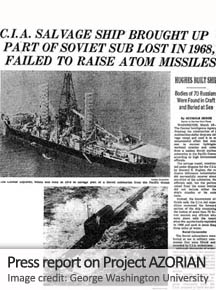
New documents have emerged about a massive effort by the United States Central Intelligence Agency to recover a sunken Soviet nuclear submarine in the 1970s. This blog has written before about Project AZORIAN, a 1974 attempt to recover a Soviet submarine in 5,200 meters of water. The initiative cost the CIA over $800 million, which translates to something like $3 billion in today’s prices. It centered on an effort to salvage K-129, a Soviet Golf II class submarine that had suffered an internal explosion while on a routine patrol mission in the Pacific Ocean, in 1968. The explosion caused the vessel to sink along with the three nuclear ballistic missiles it was carrying and nearly 100 crew members, all of whom died in the incident. The Soviets initiated an immediate frantic effort to recover the vessel but gave up after two months, unable to bring it to the surface. After the Soviets abandoned the site, a number of CIA scientists proposed to undertake an American effort to recover the sunken submarine. This, they suggested, would allow Washington to study the design features of Soviet nuclear warheads, as well as obtain cryptographic hardware that could prove useful in deciphering Soviet naval codes. This prompted the launch of Project AZORIAN, which commenced in 1974, once the Agency secured the necessary funds. As we have indicated before, the recovery team nearly caused a nuclear explosion when the submarine split while being raised, and its body hit the ocean floor. The CIA prepared to enter a new phase of the project in 1975, aimed at launching a second attempt to raise the sunken vessel. But the attempt was cancelled when vague snippets of information about the project were leaked to the press. Nothing more emerged until 2010, when the CIA aired a heavily redacted article about the project, which had originally appeared in the 1980s in Studies in Intelligence, the Agency’s in-house publication. Now, however, intelligence historians are able to rely on 200 pages of mostly fresh information on Project AZORIAN, released under the US Department of State’s Foreign Relations of the United States (FRUS) program. Read more of this post




 By IAN ALLEN | intelNews.org







 intelNews.org
News you may have missed #876 (analysis edition)
April 16, 2014 Leave a comment
►►Why did Obama not bomb Syria? In 2011 Barack Obama led an allied military intervention in Libya. Last August, after the sarin attack in Syrian capital Damascus, he was ready to launch an allied air strike to punish the Syrian government for allegedly crossing the ‘red line’ he had set in 2012 on the use of chemical weapons. But with less than two days to go before the planned strike, he announced that he would seek congressional approval for the intervention. The strike was later postponed. Why did Obama relent on Syria when he was not shy about rushing into Libya? Award-winning investigative reporter Seymour Hersh argues that the answer lies in “a clash between those in the Obama administration who were committed to enforcing the red line, and military leaders who thought that going to war was both unjustified and potentially disastrous”.
►►What is the role of the FSB in the Ukrainian crisis? On April 4, the Ukrainian Foreign Ministry sent a note to Moscow demanding to know why FSB Colonel General Sergei Beseda visited Kiev in February. The very next day Russian news agency InterFax cited a source in Russian intelligence confirming that visit. Beseda heads the FSB Fifth Service’s Operational Information Department, which is responsible for conducting intelligence activities focusing on the former Soviet republics. Agentura.ru intelligence analyst Andrei Soldatov says that the answer as to why Beseda was in Kiev could be key to understanding the role of Russia’s intelligence agencies in the current crisis and to the Kremlin’s entire strategy in Ukraine.
►►What would a US-Russia war look like? The chances that the US and Russia will clash militarily over Moscow’s invasion of Ukraine are very, very slim. But, says The Week’s Peter Weber, if we learned anything from World War I, it’s that huge, bloody conflicts can start with tiny skirmishes, especially in Eastern Europe. So what would a US-Russia war look like? The US is much wealthier than Russia and spends a lot more on its military. That doesn’t mean a war would be easy for the US to win, though, or even guarantee a victory. As Napoleon and Hitler learned the hard way, Russia will sacrifice a lot to win its wars, especially on its home turf.
Filed under Expert news and commentary on intelligence, espionage, spies and spying Tagged with 0 What is the role of the FSB in the Ukrainian crisis?, 0 What would a US-Russia war look like?, 0 Why did Obama not bomb Syria?, 2011 Syrian uprising, Analysis, forecasting, news you may have missed, Sergei Beseda, Ukraine