Austria issues international arrest warrant for alleged Russian spy

Igor Egorovich ZaytsevThe Austrian government has issued an international arrest warrant for a Russian man who allegedly recruited a retired colonel in the Austrian Federal Army to spy for Moscow. The arrest warrant was issued on Tuesday by the public prosecutor’s office in the city of Salzburg. It identifies the Russian man as Igor Egorovich Zaytsev. Austrian officials allege that the Moscow-born Zaytsev is in fact an intelligence officer for the Main Directorate of the General Staff of the Russian Armed Forces. Known as GRU, the organization is Russia’s primary military-intelligence agency.

In an accompanying press statement issued on Tuesday, the Austrian Ministry of the Interior said that Zaytsev had facilitated the “betrayal of state secrets” and that his actions had been “to the detriment of the Republic of Austria”. The arrest warrant accuses Zaytsev of having participated in the “intentional disclosure of a military secret”, but does not provide details. However, in a subsequent statement, Austrian police directly linked the search for Zaytsev with an espionage case that was reported in the Austrian media last year. The statement said that Zaytsev is believed to have recruited a man known as “Martin M.” to spy on Austria. This appears to refer to the arrest last November of a 70-year-old colonel in the Austrian Army, who was stationed in Salzburg. He is believed to have spied for Russia from at least 1992 until his arrest. Austrian media reported that the accused spy was believed to have given Russia information on a range of weapons systems used by the Austrian Army and Air Force, as well as the personal details of high-ranking officers in the Austrian Armed Forces.

Soon after the arrest of “Martin M.”, Austrian authorities arrested a second man, identified only as “O.”, who is also suspected on having spied for Russia. According to the Vienna Public Prosecutor’s Office, “O.” was an employee of the Austrian Office for Protection of the Constitution and Counterterrorism, known as BVT. He had been investigated on suspicion of espionage for more than a year prior to his arrest. The man’s arrest took place alongside simultaneous raids at two residential addresses associated with him, according to reports. No further details have been made available since the arrest. It is not known whether Zaytsev’s is also connected with the case of “O.”.

Author: Joseph Fitsanakis | Date: 26 July 2019 | Permalink

‘Sonic attacks’ may have shrunk brains of US diplomats in Cuba, study finds

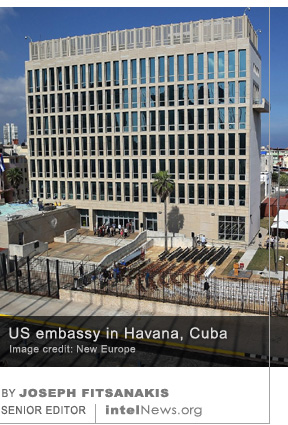
US embassy in CubaA series of alleged “sonic attacks” by a mysterious weapon may have caused the brains of American diplomats who served at the United States embassy in Cuba to shrink, according to a new scientific study. In 2017 Washington recalled the majority of its personnel from the US embassy in Havana and at least two more diplomats from the US consulate in the Chinese city of Guangzhou. The evacuees reported experiencing “unusual acute auditory or sensory phenomena” and “unusual sounds or piercing noises”. Subsequent tests showed that they suffered from sudden and unexplained loss of hearing, and possibly from various forms of brain injuries. In April of this year the Canadian embassy evacuated all family members of its personnel stationed in the Cuban capital over similar health concerns. Subsequently, the US issued a travel warning advising its citizens to stay away from the island and accused Cuba of neglecting to ensure the safety of US diplomatic personnel stationed there.

The theory that a sonic weapon caused the diplomats’ ailments is not universally held, with some scientists doubting the validity of such claims. But now a new study may have provided a tangible and measurable link that connects the physiological symptoms suffered by the diplomats. The study, published in the latest issue of the Journal of the American Medical Association,The study, published in the latest issue of the Journal of the American Medical Association, is based on a detailed examination of data from magnetic resonance imaging studies that assessed both structural and functional endpoints of the brains of the victims of the alleged sonic attacks. Scientists at the University of Pennsylvania took these images of the brains of 40 individuals who complained of acute auditory and other sensory disturbances while in Cuba, and compared them with those of healthy participants. The latter were matched with the patients for age, lifestyle and general background. According to the study, the comparison revealed statistically significant differences in various structures of the subjects’ brains. The differences were most pronounced in the white matter of their brains. The white matter is important because it is comprised of the myelin-protected nerve fibers that are responsible for transmitting the electrical signals from one brain cell (neuron) to another. Damage to these regions would result in a reduction of the brain’s ability to process information as rapidly as the brains of non-affected individuals. According to the study, the volume of white matter in the brains of the alleged sonic attack victims was approximately five percent smaller than that in the brains of healthy adults.

One of the scientists behind the study told the British newspaper The Daily Telegraph that his team of researchers have not seen “anything like it before”. But he added that he and his colleagues are “not sure […] what it is”, though “there does appear to be something there”. Another expert told the paper that the findings of the University of Pennsylvania study supported the validity of the symptoms reported by the American diplomats. However, they do not help answer the question of whether they suffered actual brain injuries. A spokesman from the United States Department of State told The Telegraph that the Department is “aware of the study and welcomes the medical community’s discussion of this incredibly complex issue”.

Author: Joseph Fitsanakis | Date: 25 July 2019 | Permalink
Hundreds of ISIS fighters returning to Iraq to wage low-level insurgency

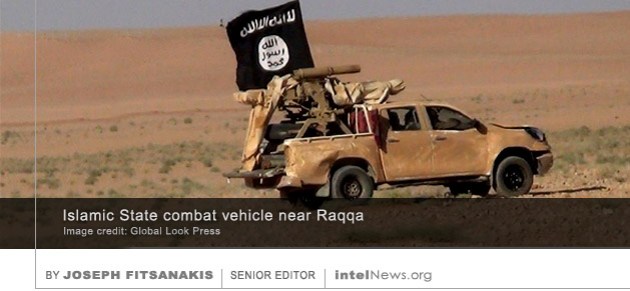
Islamic State ISISAbout 1,000 Islamic State fighters have returned to Iraq in recent months and are waging a low-level insurgency that threatens to destabilize rural areas and may be the forerunner of a new sectarian war, an expert has warned. Thousands of fighters belonging to the Islamic State —known also as the Islamic State of Iraq and Syria, or ISIS— crossed into Syria in late 2017. In December of that year, the Iraqi government of Prime Minister Haider al-Abadi declared victory in the war against the militant Sunni group. Since then, however, many of these fighters have been slipping back into Iraq from Syria and are now picking up arms again against the Iraqi state, which they see as being dominated by Iran-allied Shiites.
In an article published on Sunday, The Washington Post cites Hisham al-Hashimi, an Iraqi security advisor to the government in Baghdad, as well as several foreign aid groups, who warns that ISIS is regrouping in Iraq. Al-Hashimi told The Post that approximately 1,000 ISIS fighters are believed to have crossed into Iraq from Syria since December of 2018. Most of them are Iraqi nationals who are essentially returning to the Sunni-majority areas of the country that were considered ISIS strongholds before 2018. Upon their return, the fighters join small ISIS cells that operate mostly in rural areas in central and northern Iraq. They move at night and are intimately familiar with the local terrain, which allows them to utilize effectively a variety of hiding places. These cells can now be found in locations ranging from the city of Kirkuk in the north to the province of Diyala, east of Baghdad. They are responsible for scores of kidnappings, roadside bombings and sniper attacks that target local officials and security personnel. Local observers stress that the re-emerging ISIS cells are too weak to threaten the territorial control of the country by the Iraqi government. However, they are rapidly destabilizing rural areas in the country and appear to be preparing for a protracted insurgency that could potentially lead to another major sectarian war.

The Washington Post report comes a month after a group of researchers with the Institute for the Study of War warned that the Islamic State is capable of making a sudden comeback in the Middle East that could be “faster and even more devastating” than 2014, when the group quickly conquered territory the size of Britain. In a 76-page paper entitled ISIS’s Second Comeback: Assessing the Next ISIS Insurgency, the researchers said that the militant group had managed to subvert Iraqi and Syrian government efforts to reintroduce stability and safety in areas previously under ISIS domination. Not only were government forces finding it “increasingly difficult to establish durable and legitimate security and political structures” in those areas, but they should be worried about the possibility of ISIS actually reconquering territory in both Iraq and Syria, the report warned.

Author: Joseph Fitsanakis | Date: 24 July 2019 | Permalink

Analysis: Did the US Central Intelligence Agency lose 17 spies in Iran?

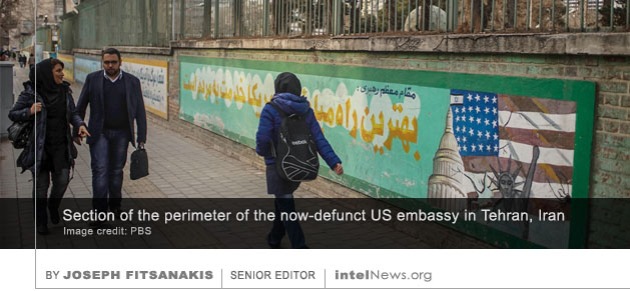
US embassy IranIf the announcements from Tehran are to be believed, the United States Central Intelligence Agency lost at least 17 spies in Iran in the months leading up to March 2019. According to Iran’s Ministry of Intelligence, the Islamic Republic busted an alleged “CIA network” operating in sensitive private sector companies and government agencies that relate to defense, aerospace and energy. At least some of the 17 alleged spies have reportedly been sentenced to death, though their exact number remains unknown.

Officials in Tehran said on Sunday that all of the purported spies are Iranian nationals and were lured by the CIA with promises of receiving visas to enter America. Others were already in possession of visas and were “blackmailed” to spy for the US in order to have them renewed by the US Department of State, according to Iranian media reports. Visa applicants were allegedly carefully selected based on their work in critical areas such as Iran’s nuclear program or defense procurement.

A government-sanctioned documentary, which aired on Iran’s state owned television on Monday, claimed that the 17 spies did not know each other, but all had been trained independently in clandestine tradecraft. This allegedly included setting up and using secret communications systems, as well as carrying out dead drops without being detected. Dead drops utilized containersQ Quote made to look like rocks, which were located “in parks and other mountainous areas” in Iran and elsewhere in the Middle East, according to Iranian officials. Some of the assets communicated with their handlers while attending science conferences through- out Europe, Africa and Asia.
The Iranian television documentary claimed that the 17 arrests had “dealt a lethal blow to US foreign intelligence”. But US President Donald Trump said in a tweet that Tehran’s allegations were “totally false” and contained “zero truth”, just “more lies and propaganda” from Tehran.

Who is right? To begin with, there is no question that the CIA recruits heavily in Iran, given that the Islamic Republic is one of America’s —indeed the world’s— primary intelligence targets. What is more, since 1979, when Washington lost its embassy in Iran, the CIA have found it more difficult to collect accurate information from inside the energy-rich country. Therefore, the need for dependable assets inside Iran has increased exponentially, and has become even more pressing now, given the importance placed on Iran by Donald Trump. Additionally, Read more of this post

South Korean spy agency says North Korean nuclear negotiators were not executed

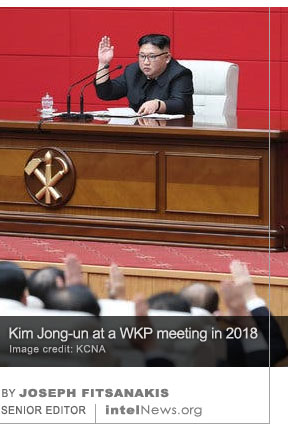
Kim Jong-unThe spy agency of South Korea has dismissed media reports that North Korea had several of its top nuclear negotiators executed or sent to labor camps, but has not rejected rumors of a major reshuffle in Pyongyang. In early June, media reports in Seoul claimed that North Korea had executed at least five of its senior nuclear negotiators and imprisoned several others. Prior to these reports, rumors of executions of North Korean nuclear negotiators had circulated in international diplomatic circles since February, but no specific allegations had surfaced in the news media. That changed when Chosun Ilbo, South Korea’s highest-circulation newspaper, alleged that at least five executions of nuclear negotiators had taken place in Pyongyang in March.
The paper claimed that the most senior North Korean official to be executed was Kim Hyok-chol, who led the nuclear negotiations with Washington prior to the Vietnam summit. The summit culminated with a —seemingly fruitless— face-to-face meeting between the North Korean Supreme Leader Kim Jong-un and US President Donald Trump. Citing an “anonymous source” Chosun Ilbo said that Kim had been executed by a firing squad at the Pyongyang East Airfield in Mirim, a suburb of the North Korean capital. Four other Ministry of Foreign Affairs officials were executed at the same time, allegedly for having been “swayed by American imperialists to betray the Supreme Leader”, said the newspaper. Two more senior North Korean nuclear negotiators, Kim Yong-chol and Kim Song-hye, were allegedly stripped of their government posts and sent to labor camps, according to the report.

On Tuesday, however, South Korea’s National Intelligence Service (NIS) directly contradicted Chosun Ilbo’s account. The spy agency told a closed-door meeting with members of parliament in Seoul that Kim Yong-chol had made recent appearances at senior-level events of the ruling Workers’ Party of Korea (WPK), and that Kim Hyok-chol was still alive. But the NIS did not rule out the possibility of a major reshuffle among the ranks of Pyongyang’s nuclear negotiators and the replacement of some of the top figures with new officials from the ranks of the WPK. Most international observers agree that Kim Jong-un is displeased with the impasse in the nuclear negotiations with Washington and has criticized —in some cases publicly— the performance of his team of negotiators.

Author: Joseph Fitsanakis | Date: 18 July 2019 | Permalink

Italian police find ‘combat-ready’ air-to-air missile in raids on far-right groups

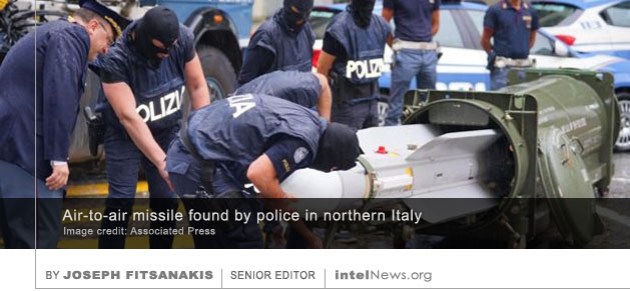
Air to air missile ItalyPolice in Italy have found an air-to-air missile in “perfect working order” alongside dozens of guns during raids on homes belonging to members of far-right groups. The raids took place in several northern Italian cities and were coordinated by the Digos, a special unit of the Turin Municipal Police that deals with organized crime and terrorism. Aside from Turin, synchronized raids took place in Varese, Novara, Forli and Milan. According to reports in the Italian media, the raids were part of a large-scale investigation into an extensive network of Italian far-right groups whose members provided logistical and material support to Russian-backed separatists in southeastern Ukraine.

At least three men were arrested in connection with the raids, two of them in Forli and one in Galarate, a small town near Varese on the Italian-Swiss border. They were named as Alessandro Monti, 42, a Swiss national, and Fabio Bernardi, 51, an Italian national. A third man, Fabio Del Bergiolo, 50, also an Italian national, is reportedly a retired customs officer who in 2001 run for office with Forza Nuova, a neo-fascist Italian grouping. Until 2014, Forza Nuova activists were known to have close links with Svoboda, the far-right Ukrainian paramilitary group. But in the past five years, the Italian neo-fascist group’s leaders have openly sided with Ukraine’s pro-Russian rebels. Italian police reported that they found several guns in Bergiolo’s home, including nine unspecified “assault weapons” and 29 hunting rifles, as well as pistols and ammunition. But the most worrying find was an air-to-air guided missile at an airport hangar, which was placed inside a box that belonged to one of the three men. The missile is designed to be fired from an aircraft to target another aircraft. It is reportedly a Matra Super 530F, which was manufactured by France in 1980. According to the police report, it is “in perfect working order”. The most recent legal owner of the missile was the Qatar Air Force. It is not known how it ended up in the hands of the three suspects, but it is believed that they have been seeking to sell it in the black market.

The police raids took place less than two weeks after a court in Genoa sentenced three men for traveling to Russia and taking up arms alongside pro-Russian separatists in Ukraine’s Donetsk and Luhansk regions. The three men were identified in court reports as Antonio Cataldo, an Italian citizen, Olsi Krutani, from Albania, and Vladimir Vrbitchii, who is from Moldova. The three men received jail sentences ranging from 16 months to 34 months. As a reminder, last September security agencies in Eastern Europe voiced concern about the rise of far-right paramilitary groups whose members allegedly have access to increasingly heavy weaponry, including in some cases armored vehicles and tanks.

Author: Joseph Fitsanakis | Date: 16 July 2019 | Permalink

Spy novel written by Kim Philby’s granddaughter to be published this week

Charlotte PhilbyA spy novel written by the granddaughter of Kim Philby, the British senior intelligence officer who secretly spied for the Soviet Union, will be published this week. Charlotte Philby, 36, is the London-based daughter of John Philby, who was one of the five children Kim Philby had with his English wife Aileen Furse. While working as a senior member of British intelligence, Harold Adrian Russell Philby, known as ‘Kim’ to his friends, spied for the Soviet NKVD and KGB. His espionage activities lasted from about 1933 until 1963, when he defected to the USSR from his home in Beirut, Lebanon. Philby’s defection sent ripples of shock across Western intelligence and is often seen as one of the most dramatic incidents of the Cold War. He was part of a larger ring of upper-class British spies, known collectively as ‘the Cambridge spies’ because they were recruited by Soviet intelligence during their student days at the University of Cambridge in England.
Following his sensational defection, Philby lived in the Soviet capital until his death in 1988 at the age of 76. His granddaughter gave an interview to British newspaper The Sunday Telegraph, in which she said that her father, John, “never said anything against Kim” and “enjoyed a very good relationship” with him. The family visited Kim Philby in Moscow every year until his death, when Charlotte was five. She told The Telegraph that she remembers these trips, and staying at Kim Philby’s apartment. She said the family would be met at the airport in Moscow “by men in grey suits” who would usher them into a government car and “whiz [them] to the gated apartment block where Kim lived” in downtown Moscow. During those trips, the family would give the double spy supplies of his favorite English foods and magazines. This may surprise some, given that Philby abandoned his second wife, an American, and his five children from his first wife. She had died six years prior to his defection, so the children, including Charlotte Philby’s father, were raised by relatives and family friends.

Charlotte Philby worked as a journalist for The Independent, a London-based British newspaper that ceased print circulation in 2016, and has since been writing as a freelancer. Her first novel, entitled The Most Difficult Thing, features a female protagonist who has to balance her espionage work with her relationship with those closest to her. The author says that Kim Philby’s ghost “hovers over the pages”. She notes that, if her grandfather had any regrets at the end of his life, “they wouldn’t be to do with betraying his country but with the individuals and the family members that he had to dupe and separate from”.

Author: Joseph Fitsanakis | Date: 15 July 2019 | Permalink

Germany extradites spy to Croatia to serve 30-year sentence for role in assassination

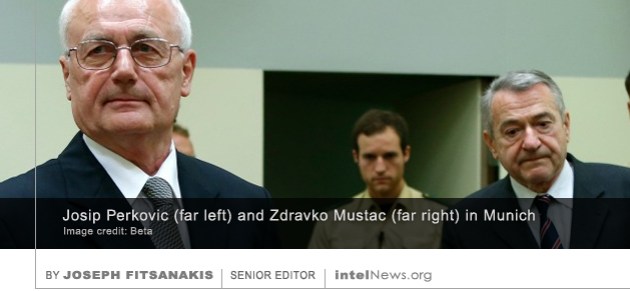
Josip Perkovic Zdravko MustacGermany has extradited a former senior official of the Yugoslav intelligence service to Croatia, where he is expected to serve a 30-year prison sentence for organizing the assassination of a dissident in Munich in 1983. Josip Perković is a former senior official in the Yugoslav State Security Service, known as UDBA. In 2014, he was extradited to Germany from Croatia alongside another former UDBA officer Zdravko Mustać. The two men were tried in a German court in the Bavarian capital Munich for organizing the assassination of Stjepan Đureković on July 28, 1983. Đureković’s killing was carried out by UDBA operatives in Wolfratshausen, Bavaria as part of a UDBA operation codenamed DUNAV. Đureković, who was of Croatian nationality, was director of Yugoslavia’s state-owned INA oil company until 1982, when he suddenly defected to West Germany. Upon his arrival in Germany, he was granted political asylum and began associating with Croatian nationalist émigré groups that were active in the country. It was the reason why he was killed by the government of Yugoslavia.
In 2016, both men were found guilty of organizing Đureković’s murder and were sentenced to life imprisonment, a sentence that was upheld by Germany’s Supreme Court in May. Last year, a court in the Croatian capital Zagreb commuted Perković’s prison sentence to 30 years so that he could be extradited there, since the Croatian justice system does not recognize life prison sentences. A statement from the German Interior Ministry said on Thursday that Perković had been transported to Zagreb on a regular flight from Munich “without incident”. Perković’s extradition to Croatia also concluded a long-standing bureaucratic battle between the former Yugoslav Republic and the European Union. In 2013, shortly before joining the EU, Croatia made it illegal to extradite individuals abroad for crimes committed before 2002. It is believed that Croatian officials changed the law in an attempt to protect armed Croatian nationalists who engaged in criminal activity during the Yugoslav Wars of the 1990s from being tried in European courts. Following systematic pressure from the EU, Croatia scrapped the extradition restriction and sent Perković and Mustać to Germany.

Legal proceedings to extradite Mustać to Croatia to serve his sentence there are continuing. Meanwhile, the two former spies have sued the German state at the European Court of Human Rights, arguing that they were not given a fair trial in Munich. Anto Nobilo, who represented Perković in court, said that the European Court of Human Rights is likely to rule in favor of his client and that he will be “released in a year or two”. If this happens, Croatia will have to re-extradite Perković to Germany to face a new trial.

Author: Joseph Fitsanakis | Date: 12 July 2019 | Permalink

France admits ownership of missiles found in Libyan rebels’ hands

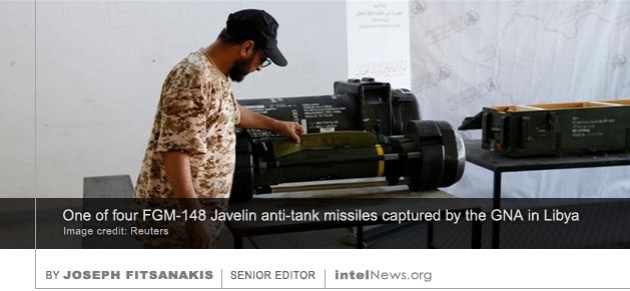
FGM-148 JavelinThe French government has admitted that four anti-tank missiles found in a Libyan rebel camp belonged to its Special Forces units, but denied accusations that it deliberately breached the United Nations-imposed weapons embargo on Libya. Libya’s UN-recognized government, the Government of National Accord (GNA), which is headed by Fayez al-Sarraj, announced in June that it discovered a cache of FGM-148 Javelin portable anti-tank missiles during a raid on a rebel camp. The camp belonged to forces loyal to Khalifa Haftar, a rogue Libyan warlord who is supported by a group of Western-led nations that includes the United States, France, Israel, Egypt and the United Arab Emirates.

The GNA released photographs of the laser-guided missiles and their shipping containers, which showed that the weapons were property of the “Armed Forces of the United Arab Emirates”. This appeared to constitute a clear breach of the UN-imposed weapons embargo on Libya, which has been in place since 2011. Last week, officials in Abu Dhabi said that the weapons did not belong to the Emirates, and claimed that the government of the oil kingdom was upholding the UN embargo on the North African country. On Tuesday, The New York Times cited anonymous French government sources, who said that Paris had purchased the four Javelin missiles from the US in 2010 for nearly $700,000. Finally, yesterday the French Armed Forces Ministry issued a statement admitting that it had indeed purchased the missiles from the US in 2010, and that they had been transferred to Libya for “the self-protection of a French military unit deployed to carry out counter-terrorism operations” there (incidentally, France does not officially have troops in Libya, so this statement is Paris’ second admission of the presence of French Special Forces in the country). The Ministry’s statement went on to claim that the missiles were “defective” and had been marked for destruction. The statement insisted that the missiles were not meant to be “transferred to local forces”. Instead, like all “damaged and unusable armaments, they were being temporarily stocked at a depot ahead of their destruction”, it said.

In 2017, two leading American experts, including a former special counsel for the US Department of Defense and a Harvard University law professor, accused Haftar of having committed large-scale war crimes. Unfazed by such criticisms, Haftar launched a large-scale offensive in April of this year, with the aim of conquering Tripoli and ousting the GNA. Several UN reports have since indicated that Haftar’s forces are secretly supported by several Western countries, Israel, Egypt and the Emirates, but this is denied by officials from those countries. In April of this year, a number European Union member states led by Italy criticized France for blocking a joint resolution calling on all warring factions in Libya to cease all hostilities and return to the negotiating table.

Author: Joseph Fitsanakis | Date: 11 July 2019 | Permalink

Poland frees on bail former intelligence officer arrested for spying for China

Orange PolskaThe Polish government has authorized the release on bail of a former counterintelligence officer who was charged in January of this year with spying for China. The man has been identified in media reports as Piotr Durbajlo and is believed to have served as deputy director of the Internal Security Agency, Poland’s domestic counterintelligence service. A cyber security expert, Durbajlo also served in Poland’s Office of Electronic Communications with a top security clearance and unrestricted access to classified systems of Poland and the North Atlantic Treaty Organization, of which Poland is a member.
However, at the time of his arrest on January 10, Durbajlo had left government service and was a mid-level executive at Orange Polska. The company operates as the Polish branch of a French multinational telecommunications carrier with sister companies in several European Union countries. Along with Durbajlo, Polish authorities arrested Wang Weijing, a Chinese national who worked for the Chinese telecommunications manufacturer Huawei. Orange Polska is Huawei’s main domestic partner in Poland. Wang reportedly learned Polish at the Beijing Foreign Studies University. In 2006 he was posted by the Chinese Ministry of Foreign Affairs at the Chinese consulate in Gdansk, Poland’s largest Baltic Sea port. In 2011 he left the Foreign Service and joined the Polish office of Huawei. Following his arrest on January 10, he was charged with espionage. Huawei denied it had any role in espionage against the Polish state, but fired Wang nonetheless. Both Wang and Durbajlo have been in pretrial detention since their arrest in January.

On Friday, July 5, Durbajlo’s legal team announced that he would be set free on July 7, on a $31,500 bail that must be paid within 30 days to secure his release. His lawyers explained that the charges against him had not been dropped, but did not explain why he was being released. It is worth noting that Durbajlo’s release on bail was announced during a visit to Poland by a high-level Chinese delegation, aimed at discussing economic and political ties between Warsaw and Beijing. Late on Tuesday it was announced that Wang would remain in pretrial detention for at least three more months.

Author: Joseph Fitsanakis | Date: 10 July 2019 | Permalink

Attack by Chinese hacker group targeted high-profile individuals around the world

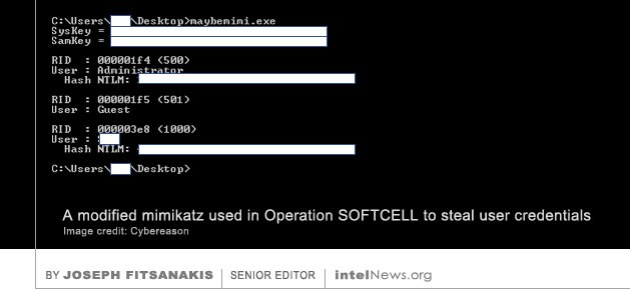
Operation SOFTCELLA hacker attack of impressive magnitude targeted specific individuals of interest to the Chinese government as they moved around the world, in what appears to be the first such operation in the history of cyberespionage. The attack was revealed late last month by Cybereason, an American cybersecurity firm based in Boston, Massachusetts. Company experts described the scope and length of the attack, dubbed Operation SOFTCELL, as a new phenomenon in state-sponsored cyberespionage. Cybereason said SOFTCELL has been in operation since at least 2017, and identified the culprit as APT10, a hacker group that is believed to operate on behalf of China’s Ministry of State Security.
The operation is thought to have compromised close to a dozen major global telecommunications carriers in four continents —the Middle East, Europe, Asia and Africa. According to Cybereason, the hackers launched persistent multi-wave attacks on their targets, which gave them “complete takeover” of the networks. However, they did not appear to be interested in financial gain, but instead focused their attention on the call detail records (CDRs) of just 20 network users. With the help of the CDRs, the hackers were able to track their targets’ movements around the world and map their contacts based on their telephone activity. According to The Wall Street Journal, which reported on Cybereason’s findings, the 20 targets consisted of senior business executives and government officials. Others were Chinese dissidents, military leaders, as well as law enforcement and intelligence officials.

An especially impressive feature of SOFTCELL was that the hackers attacked new telecommunications carriers as their targets moved around the world and made use of new service providers. The attacks thus followed the movements of specific targets around the world. Although this is not a new phenomenon in the world of cyberespionage, the geographical scope and persistence of the attacks are unprecedented, said The Wall Street Journal. Speaking last week at the 9th Annual International Cybersecurity Conference in Tel Aviv, Israel, Lior Div, Cybereason’s chief executive officer and co-founder, said SOFTCELL attacks occurred in waves over the course of several months. The hackers used a collection of techniques that are commonly associated with identified Chinese hacker groups. If detected and repelled, the hackers would retreat for a few weeks or months before returning and employing new methods. The Cybereason security experts said that they were unable to name the targeted telecommunications carriers and users “due to multiple and various limitations”.

Author: Joseph Fitsanakis | Date: 09 July 2019 | Permalink

Son of South Korean foreign minister defects to North Korea

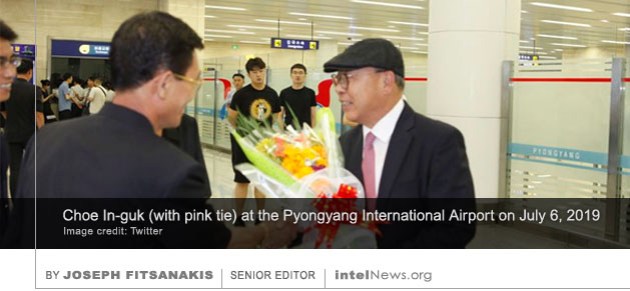
Choe In-gukThe son of a South Korean former cabinet minister has defected to North Korea, marking a rare instance of a citizen of South Korea switching his allegiance to the North. It is even rarer for such high-profile South Korean citizens to defect to North Korea. The defector is Choe In-guk, son of Choe Deok-sin, who served as South Korea’s minister of foreign affairs in the 1970s under the South Korean dictator Park Chung-hee. Choe was an American-trained army officer who served under United States command in the Korean War. He then served as a member of the cabinet and as South Korea’s ambassador to West Germany.
But by 1980, Choe had fallen out with the South Korean military government and was subsequently pushed out of the ruling Democratic Republican Party of Korea. He moved to the United States with his wife, Ryu Mi-yong, from where in 1986 the couple defected to North Korea. Soon after his defection, Choe was appointed director of North Korea’s Committee for the Peaceful Reunification of the Fatherland under the ruling Workers’ Party of Korea (WPK). Until her death in 2012, Ryu served as chairwoman of the Chondoist Chongu Party, a nationalist North Korean political party that supports the policies of the ruling WPK.

North Korean media reported that Choe and Ryu’s son, Choe In-guk, arrived at the Pyongyang Sunan International Airport on July 6. The North Korean state-run news website Uriminzokkiri published several photographs of the 73-year-old Choe being greeted by a welcoming committee of North Korean government officials holding flowers and gifts. Choe is reported to have given a brief speech upon his arrival in Pyongyang, praising North Korea’s leader and lamenting not having defected earlier in his life. The defector added that he intended to devote the remainder of his life to continue the work of his parents and to push for the reunification of the two Koreas.

On Sunday, South Korean Ministry of Unification confirmed that Choe had defected to North Korea from the United States. The Ministry also said that Choe had not obtained permission to travel to North Korea, which is required of all South Korean citizens who wish to cross the border between the two countries. It appears that Choe first traveled to the United States and for there to a third country —possibly China— before entering North Korea. South Korean officials announced that an investigation into his defection has been launched.

Author: Joseph Fitsanakis | Date: 08 July 2019 | Permalink

US Intelligence Community insiders express frustration with restructuring process

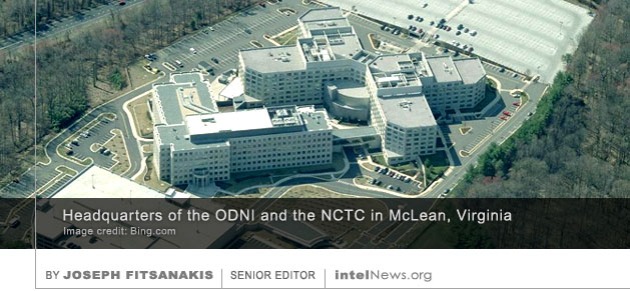
ODNI NCTCA private management consulting firm that was hired to streamline the United States Intelligence Community’s communication and decision-making process has made these practices worse, according to insiders. The news website Politico, which published the story on Tuesday, identified the management consulting firm in question as McKinsey and Co. Established in 1926, the company is one of the world’s industry leaders, with over 100 offices around the globe. It has a long history of working with the US government and is reported to have secured nearly $1 billion in US government sector contracts since 2010 alone. Among those contracts is a $10 million project to improve the communication and decision-making processes of the US Intelligence Community, which began in 2015.
But the effort has not been successful, according to Politico, which cited “nearly a dozen current and former officials” in several different agencies of the US Intelligence Community. These officials “either witnessed the restructuring firsthand or are familiar with the project”, said Politico. They described the results of the restructuring as “a coordination nightmare”, which complicated long-established linear chains of command and ended up “slowing down projects and turnaround time”. They accuse McKinsey of applying formulaic communication models to agency directorates and units with very unique cultures and methods of operation, effectively hindering decision-making processes at agencies such as the National Security Agency, the Central Intelligence Agency and the Office of the Director of National Intelligence. In one example, CIA analysts and operations officers, who have traditionally worked without regular face-to-face interaction, were placed side-by-side in so-called mission centers. This move “made missions more muddled” and generated “frustration” on both sides, said Politico. The resulting mayhem has left many intelligence employees “dismayed […], demoralized and less effective”, said the officials. They also warned that bureaucratic changes that delay response times may negatively affect intelligence collection and counterintelligence, and might even cost lives.

Spokespersons and some former officials from several intelligence agencies did not appear to share the criticisms of McKinsey’s work, said Politico. They argued that it was “too early to judge the results” of the restructuring and downplayed the role that the firm played in the process. In most cases, the latter was led by senior officials from within the intelligence agencies, they said. They added that the restructuring is “a work in progress” and that senior administration have in fact observed “a number of positive early returns” resulting from the restructuring process. Politico said it contacted McKinsey, but was told that the company has a policy of not discussing publicly its contractual obligations or performance.

Author: Joseph Fitsanakis | Date: 05 July 2019 | Permalink

ISIS militant was first-ever Filipino suicide bomber, say police officials

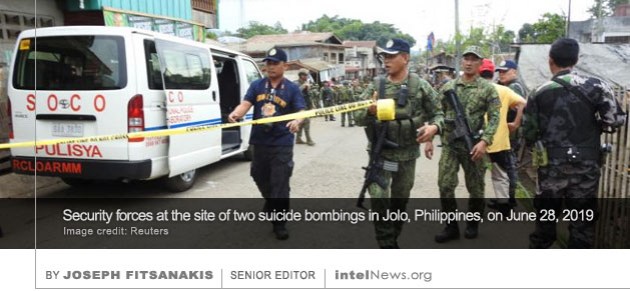
Jolo PhilippinesAn Islamic State militant who blew himself up in the Philippines last week was probably history’s first-ever Filipino suicide bomber, according to police officials. The man was one of two militants who detonated suicide vests in Indanan, a town in the southern Philippines island of Sulu, on Friday. The twin blasts killed six people, in addition to the two suicide bombers. The target of the attack was a military base that houses the 1st Brigade Combat team of the Philippine Army. The 1,500-strong brigade is leading the counterinsurgency campaign in the country’s heavily Muslim southern regions. Three of the victims were 1st Brigade Combat team soldiers, while three civilians who happened to be walking nearby were also killed.

The Islamic State —known also as the Islamic State of Iraq and Syria (ISIS)— claimed responsibility for the attack, leading many to speculate that the suicide bombers were not Filipinos, but other Arab nationals. That would fit the pattern of the two previous suicide bombings that have taken place in the history of the Philippines. In July of 2018, a Moroccan ISIS follower drove a van laden with explosives at an army checkpoint on the island of Basilan, killing ten people. And in January of this year, two Indonesian suicide bombers attacked a Roman Catholic congregation on Jolo Island, killing 23 and injuring over 100 churchgoers. All three suicide bombers were members of Abu Sayyaf, a Filipino Salafi jihadist group that pledged allegiance to ISIS in 2014. Moreover, none of the three suicide bombers were native Filipinos; rather they had traveled to the island country in order to carry out terrorist attacks.

This pattern may have changed as of last Friday, however. According to local military officials, a Filipino woman identified the remains of one of the two suicide bombers as belonging to her son. The woman reportedly told authorities that her son was named Norman Lasuca and was 23 years old. She also said that he, like his father, belonged to the Tausūg, a million-strong predominantly Muslim ethnic group that includes many recent converts to Islam.

On Tuesday, several Philippine Army commanders gave a press conference in Sulu, where they discussed the latest information regarding last week’s suicide attacks. One of the speakers, Brigadier-General Edgard Arevalo, said that the purported mother of the suicide bomber had provided DNA samples to the authorities, in order to help positively identify the body. If the DNA tests are positive “then […] we can say conclusively that the person is Filipino”, which will be a first, said Arevalo. A positive result would suggest that the ideology of ISIS may be more appealing to local Filipino youth than has generally been assumed by counterterrorism officials, Arevalo concluded.

Author: Joseph Fitsanakis | Date: 03 July 2019 | Permalink

Mossad chief sees historic shift of alliances as Arab states side with Israel against Iran

Yossi CohenIn a rare public appearance, the director of the Mossad spy agency said that the Middle East is witnessing a historic shift of alliances as many Arab states are forming tacit pacts with Israel against Iran and its proxies. Yosef “Yossi” Cohen spoke on Monday morning at the Herzliya Conference, a security-themed event organized by the Interdisciplinary Center, a university in Herzliya, just north of Tel Aviv.

In his 40-minute speech Cohen said that the Mossad had identified the present time as “a rare opportunity —perhaps the first in the history of the Middle East— to reach a regional understanding that would lead to an inclusive regional peace agreement” between Israel and most of the Arab states. He justified his reasoning by claiming that many Arab states are siding with Israel to pursue “common interests [such as] the fight against rivals like Iran and jihadist terrorism”. This historic shift in alliances is happening as Israel is enjoying “close relations with the White House” and keeping open “channels of communication with the Kremlin”, said the spy chief. These factors “combine to create what might be a one-time window of opportunity” for Israel to form a strategic alliance with the majority of its Arab neighbors, said Cohen.

The Mossad chief went on to allege that the Islamic Revolutionary Guard Corps (IRGC) were behind the recent bombings of commercial oil tankers in the Persian Gulf. He told the conference that he could “say with certainty that Iran was behind these attacks” and that they were “approved by the Iranian leadership and carried out by the [IRGC]”. Cohen cited “the best sources of Israeli and Western intelligence” but did not provide specific evidence to support his allegation, which Iran denies. Later in his speech, Cohen said that the IRGC and Iranian intelligence agencies had carried out assassinations throughout Europe and had discussed further plans to attack Jewish and Israeli targets in Denmark, Azerbaijan and the North America. “And that is only the tip of the iceberg”, said Cohen, and went on to claim that the IRGC had set up a network of 300 agents in the African continent and was heavily present in Syria, mainly through its Lebanese proxy Hezbollah.

At the conclusion of his speech, the Mossad chief repeated prior warnings by Israeli officials that the Jewish state would never allow the development of an Iranian nuclear arsenal. “Mossad and the State of Israel have not signed the nuclear deal and will do all to ensure Iran will never possess a nuclear arsenal”, said Cohen.

Author: Joseph Fitsanakis | Date: 02 July 2019 | Permalink