Sensitive UK defense documents found in bus stop by member of the public
June 28, 2021 1 Comment
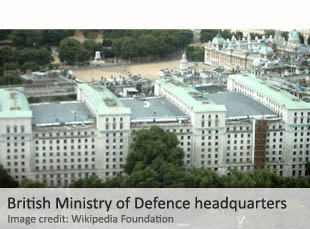 Sensitive documents belonging to the British Ministry of Defense were found by a member of the public behind a bus stop last week, in what the BBC described as “a major embarrassment” for the British government. The documents number 50 pages; most are marked “official sensitive”, which is a low level of classification, but it means they are still subject to security requirements.
The BBC said it was contacted by “a member of the public, who wishes to remain anonymous”, after he or she found the documents dumped behind a bus stop in the southeastern county of Kent, which borders greater London,. The papers were reportedly in a deteriorated state, as they had been exposed to the elements -including rain- for several days.
According to the BBC, the sensitive documents most likely originated in the office of a senior Ministry of Defense official. They include printouts of email exchanges, as well as a number of PowerPoint slides concerning several timely topics. Among them is a presentation about HMS Defender, a Type 45 Destroyer belonging to the Royal Navy. It is followed by a presentation on the tense maritime incident that took place between Britain and Russia off the coast of Crimea last week.
Another document concerns the defense priorities of the administration of United States President Joe Biden, especially as they relate to the Indo-Pacific region and China. Several emails concern the future of the British military presence in Afghanistan, following the pending withdrawal of US forces from there in September. Yet another set of documents addresses British defense contracts that may irk some of the former European Union member state’s European allies.
The British Defense Ministry said last week it was investigating the details of “an incident” in which sensitive papers were “recovered by a member of the public”. It added that one of its employees, who had been entrusted with the documents, had reported them missing in the days prior to their recovery.
► Author: Joseph Fitsanakis | Date: 28 June 2021 | Permalink








 intelNews.org
Kremlin spy participated in secret meeting to fund Italian separatist party
June 29, 2021 by Joseph Fitsanakis 1 Comment
AN ALLEGED EMPLOYEE OF Russian intelligence was present during a secret meeting in Moscow, in which politicians and investors discussed a plan to fund a northern Italian separatist political party. The party, Lega Nord (Northern League, or LN) was established in 1991 as an amalgamation of northern Italian separatist groups whose members seek greater autonomy and are opposed to Italy’s membership in the European Union. Under its current leader, Matteo Salvini, the LN has adopted an hard-line anti-immigration stance and has associated itself with United Russia, the political home of Russian President Vladimir Putin.
In July of 2019, the investigative news website BuzzFeed released audio recordings of a secret meeting that allegedly took place in Moscow’s Hotel Metropol, between members of the LN and Russian emissaries of the Kremlin. The discussion reportedly concerned a plan to sell Russian oil to an Italian firm connected to the LN at a markedly discounted price, which would allow it to compete with Italy’s state-owned energy supplier and at the same time enrich the LN’s election campaign coffers by nearly $70 million.
According to an investigation by Italian authorities, participants at that meeting were Salvini’s former spokesperson, Gianluca Savoini, as well as two other Italians, who managed investment banks and were also supporters of the LN. There were also three Russian participants, including a Kremlin lawyer who works for the Russian Ministry of Energy, and a Russian former banker and tycoon with clsoe ties to President Putin. But the third Russian had not been identified. Until now.
The Italian newspaper L’Espresso, which has led the investigative reporting into the alleged scandal, reports that the Milan Prosecutor’s Office has identified the third Russian participant as Andrey Yuryevich Kharchenko, an alleged employee of Russian intelligence. The paper said that Kharchenko’s identity was supplied to the Italian government by “another Western state” that has been targeted by Russian intelligence in recent years. The investigation into the alleged scandal continues.
► Author: Joseph Fitsanakis | Date: 29 June 2021 | Permalink
Filed under Expert news and commentary on intelligence, espionage, spies and spying Tagged with Andrey Yuryevich Kharchenko, corruption, Gianluca Savoini, Italy, La Lega Nord, News, Russia