Moscow is working with Taliban against ISIS, says Russian envoy

Zamir KabulovRussia’s official envoy to Afghanistan has said that Moscow is now working with the Afghan Taliban in order to stop the growth of the Islamic State in the region. Many Taliban fighters are direct descendants of the Afghan and Pakistani Pashtuns who fought the Soviet Red Army in the 1980s, when the USSR invaded Afghanistan and fought a bloody decade-long war there. But the militant group, which today continues to control much of Afghanistan, despite a prolonged American-led military effort to defeat it, is now being challenged by the Islamic State. Known also as the Islamic State in Iraq and Syria (ISIS), the group enjoys growing popularity in Afghanistan, and some tribal warlords have already declared their allegiance to it. In contrast, the leadership of the Taliban has rejected the legitimacy of ISIS and refused to recognize its leader, Abu Bakr al-Baghdadi, as the caliph of all Sunni Muslims. According to Sunni doctrine, a caliph is the recognized political and religious successor to Muhammad, Islam’s prophet, and thus commands the Muslim ummah, or community.
For the past two years, allegations have surfaced in the world’s media that Russia, fearing the continuing growth of ISIS in Central Asia, has reached out to the Taliban in hopes of halting ISIS’ popularity. Last week, however, Zamir Kabulov, Moscow’s special envoy to Afghanistan, openly admitted that Russia is collaborating with the Taliban against ISIS. “The interests of the Taliban completely coincide with ours”, said Kabulov, and added that Moscow maintains “communication channels with the Taliban to exchange intelligence”. It is important to note that Kabulov, who was born in Soviet Uzbekistan, is arguably the most knowledgeable Russian diplomat on matters relating to Afghanistan. Until 2009, he served as Russia’s ambassador to Afghanistan, having also served in Iran and Pakistan. Western observers believe that Kabulov is not simply a “career diplomat”, as he presents himself, but a former officer in the KGB, the USSR’s foremost intelligence agency. He is also believed to have served as the KGB’s chief of station in Kabul during the Soviet occupation of the 1980s, and to have worked closely with Khad, the intelligence agency of Soviet-dominated Afghanistan.

Kim Sengupta, a defense correspondent of British broadsheet The Independent, argues that Kabulov’s announcement reflects the growing ties between the Federal Security Service (FSB), one of the KGB’s successor agencies, and the National Directorate of Security (NDS), Afghanistan’s current intelligence agency. The latter maintains open lines of communication with the Taliban. There is also a question about the extent of Russia’s collaboration with the Taliban in pursuit of common goals. Kabulov implied last week that the collaboration centers on intelligence-sharing. But Sengupta suggests that Moscow may also be supplying weapons and ammunition to the Taliban, through Russian ally Tajikistan. He also notes that other regional powers, including China and Iran, are warming up to the Taliban, which they increasingly view as a more reasonable alternative to ISIS.

Author: Joseph Fitsanakis | Date: 08 January 2016 | Permalink

Intelligence agencies doubt North Korea bomb test was hydrogen

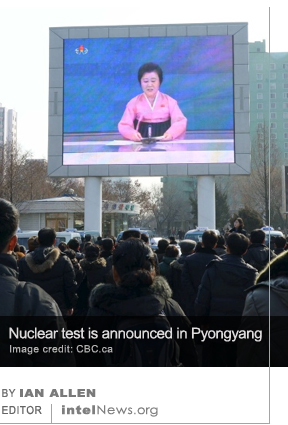
PyongyangIntelligence agencies outside North Korea, including those of South Korea and the United States, are skeptical of Pyongyang’s claims that it conducted a successful test of a hydrogen bomb. On the surface, North Korea’s announcement on Wednesday that it tested a hydrogen bomb is consistent with the policies of the Kim Jong-un administration. The North Korean leader, who succeeded his father as the nation’s supreme leader in 2012, has repeatedly said that he intends to strengthen and modernize the country’s nuclear arsenal. In December, North Korea issued several warnings that it would soon test a hydrogen bomb, nearly a decade after the regime announced its first successful test of an atomic weapon. Unlike atom bombs, which rely on nuclear fission to release energy, hydrogen bombs are based on nuclear fusion; they are far more powerful than atom bombs, which they use as a trigger to reach even more massive levels of energy release.

There was initial shock on Wednesday when Pyongyang announced it had successfully detonated a “miniaturized hydrogen bomb”. A 5.1 magnitude earthquake was registered at a site that had been used in the past by North Korea to test nuclear weapons. A few hours later, however, White House Press Secretary Josh Earnest told reporters in Washington that “initial analysis” conducted by US intelligence agencies was “not consistent” with North Korea’s claims. The explosion had been measured “in the single digit kilotons”, he said, whereas a thermonuclear device, which uses the energy from an initial nuclear device to ignite a secondary, much larger nuclear reaction, is typically measured in megatons. South Korean intelligence observers agreed that some kind of test occurred on Wednesday, but it did not display signs of a hydrogen bomb. Some South Korean officials cautioned that it could have been a failed test of a hydrogen device, or that the North Koreans could have tested only the initial trigger of a hydrogen bomb, which would be a much smaller explosion caused by fission. But Earnest insisted on Wednesday that “nothing [had] caused the US government to change our assessment of North Korea’s technical and military capabilities”.

Some media reports indicated that US intelligence agencies had expected a nuclear test by Pyongyang in 2015 or 2016, but had no specific information on a precise timeframe. It is also worth noting that assessments by US and South Korean intelligence agencies indicate that China was not informed by North Korea about an impending nuclear test and that Beijing was caught by surprise by Wednesday’s developments. China issued a statement condemning the alleged nuclear test soon after it was announced by North Korea.

Author: Ian Allen | Date: 07 January 2016 | Permalink

Dutch technical experts helped US bug foreign embassies in Cold War

Great Seal bugA tightly knit group of Dutch technical experts helped American spies bug foreign embassies at the height of the Cold War, new research has shown. The research, carried out by Dutch intelligence expert Cees Wiebes and journalist Maurits Martijn, has brought to light a previously unknown operation, codenamed EASY CHAIR. Initiated in secret in 1952, the operation was a collaboration between the United States Central Intelligence Agency and a small Dutch technology company called the Nederlands Radar Proefstation (Dutch Radar Research Station).

According to Dutch website De Correspondent, which published a summary of the research, the secret collaboration was initiated by the CIA. The American intelligence agency reached out to the Dutch technical experts after interception countermeasures specialists discovered a Soviet-made bug inside the US embassy in Moscow. The bug, known as ‘the Thing’, had been hidden inside a carved wooden ornament in the shape of the Great Seal of the United States. It had been presented as a gift to US Ambassador W. Averell Harriman by the Young Pioneer organization of the Soviet Union in 1945, in recognition of the US-Soviet alliance against Nazi Germany in World War II. But in 1952, the ornament, which had been hanging in the ambassador’s office in Moscow for seven years, was found to contain a cleverly designed listening device. The bug had gone undetected for years because it contained no battery and no electronic components. Instead it used what are known as ‘passive techniques’ to emit audio signals using electromagnetic energy fed from an outside source to activate its mechanism.

Wiebes and Martijn say the CIA reached out to the Dutch in 1952, soon after the discovery of ‘the Thing’, in fear that “the Soviets were streets ahead of the Americans when it came to eavesdropping technology”. According to the authors, the approach was facilitated by the BVD, the Cold War predecessor of the AIVD, Holland’s present-day intelligence agency. In the following years, technical specialists in the Netherlands produced the West’s answer to ‘the Thing’ —a device which, like its Soviet equivalent, used ‘passive techniques’ to emit audio signals. Moreover, the Americans are believed to have used the Dutch-made device to but at least two foreign embassies in The Hague, the Soviet Union’s and China’s, in the late 1950s and early 1960s.

The work by Wiebes and Martijn was initially published in Dutch by De Correspondent in September of last year. An English-language version of the article, which was published in December, can be read here.

Author: Joseph Fitsanakis | Date: 06 January 2016 | Permalink

Head of Russian military intelligence dies unexpectedly at 58

Igor SergunThe director of Russia’s powerful military intelligence agency has died unexpectedly at 58, according to the Kremlin, which has yet to release precise information about the circumstances of his death. General Igor Sergun had led the Main Intelligence Directorate, known as GRU, since 2011, when he replaced his predecessor, Colonel General Aleksandr Shlyakhturov, in a Kremlin-instigated reshuffle. The Russian government said at the time that Shlyakhturov, who had spearheaded a major shake-up of the GRU since his appointment in 2009, had “reached retirement age” and gave no other reason for his sudden replacement. General Sergun’s death was announced in a statement posted on the official website of the Kremlin on January 4. It said that the GRU director had “suffered a sudden death” on January 3. It gave no further details as to the exact cause or circumstances surrounding the general’s death.

General Sergun was a career GRU officer, having joined the service as soon as he graduated from the Military Academy of the Soviet Army in 1984. Under his leadership, the GRU —Russia’s largest intelligence agency, which operates under the supervision of the General Staff of the Russian Armed Forces— became increasingly important in Moscow’s foreign policy maneuvers. The agency was central during the Russian military campaign in Georgia in 2008, and observers considered its role during the onset of the eastern Ukraine crisis in 2013 as indispensable for Russia. This view was reflected early in 2014, when the European Union and the United States imposed economic sanctions on General Sergun, accusing him of coordinating “the activities of GRU officers in eastern Ukraine”.

The January 4 online statement by the Kremlin quoted Russian President Vladimir Putin, who reportedly contacted the late general’s family to offer his condolences. The Russian leader was quoted as saying that General Sergun had given his “life in its entirety to the service of the homeland and the Armed Forces” of the Russian Federation. The late general was “respected for their professionalism, strength of character, honesty and integrity”, said the statement. Moscow has not yet announced Sergun’s replacement at the helm of the GRU.

Author: Ian Allen | Date: 05 January 2016 | Permalink

US ‘spied on Israeli prime minister’ during Iran nuclear talks

Netanyahu and ObamaAmerican intelligence agencies spied on Israeli Prime Minister Benjamin Netanyahu during the negotiations between the United States and Iran over the Islamic Republic’s nuclear program, according to officials. Tehran entered a deal, referred to as ‘the Geneva pact’, following drawn-out negotiations with a group of nations that came to be known as P5+1, representing the five permanent members of the United Nations Security Council plus Germany. The government of Israel, however, strongly criticized the negotiations. Prime Minister Netanyahu called the pact a “historic mistake” that would enable “the most dangerous regime in the world” to get closer to “attaining the most dangerous weapon in the world”. Israel’s strong reaction, which included open criticism of US President Barack Obama, caused some in the US to accuse Tel Aviv of trying to “manipulate American institutions”, while the White House did not hide its frustration with the Israeli leader.

Last week, The Wall Street Journal said in a leading article that the Obama administration spied systematically on Prime Minister Netanyahu, whom it suspected of actively trying to kill the Geneva pact. Citing interviews with “over two dozen past and present US officials”, The Journal claimed that the National Security Agency, America’s leading signals-intelligence collector, intercepted the communications between the Israeli prime minister and his senior advisors. The main purpose of the spy program was to find out whether the government of Israel was considering launching military strikes on Iran without first notifying Washington. Such a possibility was eventually ruled out. But in the process the NSA was able to listen in to private conversations between a number of senior Israeli government officials and American lawmakers. The latter were critical of the White House’s efforts to strike a deal with Iran, and were specifically asked by Israeli officials whether Israel could count on them to vote against the Geneva pact in Congress.

The NSA was also able to intercept conversations between Israeli leaders and American members of pro-Israel groups operating in the US. The newspaper implies that the Israeli leaders coached the Americans on how to campaign against the Geneva pact. Ironically, the NSA intercepts showed that Israel was itself spying on America in an effort to access inside information on the negotiations with Iran. The paper said that the Israelis would then regularly leak the information they acquired through espionage, in an effort to sabotage a possible deal. The Journal said it contacted the US National Security Council for a comment, and was told by a media representative that the US does “not conduct any foreign intelligence surveillance activities unless there is a specific and validated national security purpose. This applies to ordinary citizens and world leaders alike”, said the spokesman, refusing to elaborate.

Author: Joseph Fitsanakis | Date: 04 January 2016 | Permalink

Year in Review: The 10 Biggest Spy-Related Stories of 2015, part II

End of Year ReviewEver since 2008, when we launched intelNews, we have monitored daily developments in the highly secretive world of intelligence while providing an expert viewpoint removed from sensationalism and conspiratorial undertones. As 2015 is about to conclude, we take a look back at what we think are the ten most important intelligence-related developments of the past 12 months. Regular readers of this blog will surely agree that we witnessed our fair share of significant intelligence-related stories this year. Some of them made mainstream headlines, while others failed inexplicably to attract the attention of the news media. In anticipation of what 2016 may bring, we present you with our selection of stories, which are listed below in reverse order of significance. This is part two in the series; part one was published yesterday.

5. CIA may have pulled officers from Beijing embassy following OPM hack. Up to 21 million individual files were stolen in June 2015, when hackers broke into the computer system of the US Office of Personnel Management. The office, known as OPM, handles applications for security clearances for agencies of the federal government.ch The breach gave the unidentified hackers access to the names and sensitive personal records of millions of Americans who have filed applications for security clearances. In late November it was reported that the Central Intelligence Agency (CIA) pulled a number of officers from the United States embassy in Chinese capital Beijing, following the massive cyber hacking. The irony is that, according to The Washington Post, the records of CIA employees were not included in the compromised OPM database. The latter contains the background checks of employees in the US State Department, including those stationed at US embassies or consulates around the world. It follows that US diplomatic personnel stationed abroad whose names do not appear on the compromised OPM list “could be CIA officers”, according to the paper.

4. Provisional IRA ‘still broadly in place’, says Northern Ireland police chief.. On July 28, 2005, the Provisional Irish Republican Army (PIRA), which fought British rule in Northern Ireland for decades, announced that was ceasing all paramilitary operations and disbanding as of that day. Three years later, the Independent Monitoring Commission declared that the PIRA’s Army Council, which steered the activities of the militant organization, was “no longer operational or functional”. In the ensuing years, which have seen the implementation of the Good Friday Agreement that restored peace in Northern Ireland, it has been generally assumed that the PIRA had ceased to exist. In August, however, George Hamilton, the head of the Police Service of Northern Ireland, told reporters that “some of the PIRA structure from the 1990s remains broadly in place” in the area. Hamilton was speaking in reference to the murder earlier that month of Kevin McGuigan in east Belfast. McGuigan, a 53-year-old father of nine, was a former member of the PIRA, who had fallen out with the organization. He was gunned down at his home, allegedly in retaliation for the murder last May of Gerard Jock Davison, a former commander of the PIRA, who was also shot dead in the Markets area of Belfast.

3. US Pentagon may have doctored intelligence reports on the Islamic State. Many Middle East observers, including this website, have made notably dire projections about the continuing reinforcement and territorial expansion of the Islamic State. In August, a leaked US intelligence report published by the Associated Press said the Islamic State’s strength had remained stable throughout 2014 and 2015, despite a US bombing campaign. However, earlier assessments by the Defense Intelligence Agency (DIA), which were communicated to senior US policymakers, including President Barack Obama, were far more optimistic about America’s ability to defeat the militant group. Why the discrepancy? According to The Washington Post, which published the story in late August, officials with the US Central Command (CENTCOM), the Pentagon body that directs and coordinates American military operations in Egypt, the Middle East and Central Asia, had systematically doctored the conclusions of intelligence reports about the Islamic State before passing them on to American leaders. It appears that the evidence pointing to deliberate manipulation of intelligence assessments was convincing enough to prompt the Pentagon’s Office of the Inspector General to launch an official probe into the matter.

2. China and Taiwan swap jailed spies in historic first. Few ongoing intelligence conflicts are as fierce as the one that has been taking place between China and Taiwan since 1949, when the two countries emerged following a bitter civil conflict between communist and nationalist forces. Observers were therefore surprised when, two weeks ahead of a historic November 7 meeting between Chinese President Xi Jinping and Taiwanese President Ma Ying-jeou, the two countries announced a spy swap. The exchange, which took place in secret in late October, was the first of its kind in the history of the two bitter rivals. Taipei released Li Zhihao, a mysterious Chinese intelligence officer known in spy circles as “the man in black”, who had been arrested in 1999 and was serving a life sentence. In return, Beijing freed Chu Kung-hsun and Hsu Chang-kuo, two colonels in Taiwan’s Military Information Bureau, who were arrested in mainland China’s nearly a decade ago. It is believed that they were the highest-ranked Taiwanese spies imprisoned in China. Their release, therefore, marks an unprecedented development in Chinese-Taiwanese relations.

1. Russia, Iraq, Iran, Syria, now officially sharing intelligence in war against ISIS. The increased involvement of major powers in Syria has been arguably the greatest intelligence-related development of 2015. The United States, Russia, Iran, Turkey, Israel, Germany, France, and the United Kingdom, are only some of the state and non-state actors that are now actively engaged on the ground in Syria, both with armies and with intelligence personnel. A significant related development is the growing relationship between the intelligence apparatus of US ally Iraq and a number of countries with which Washington has an adversarial relationship. Intelligence-sharing had been practiced for a while between Russia, Syria and Iran. But in September of this year, Iraq entered the intelligence alliance for the first time. According to the Baghdad-based Iraqi Joint Forces Command, the agreement entails the establishment of a new intelligence-sharing center in the Iraqi capital. It is staffed with intelligence analysts from all four participating countries, who pass on shared information to their respective countries’ militaries. In October, The Washington Times reported that Iraq had been fully integrated into the Russian-led intelligence-sharing alliance, and that the Iraqi government was already using Russian-supplied intelligence in its war against the Islamic State, according to officials in Baghdad.

Authors: Joseph Fitsanakis and Ian Allen | Date: 31 December 2015 | Permalink

Year in Review: The 10 Biggest Spy-Related Stories of 2015, part I

End of Year ReviewEver since 2008, when we launched intelNews, we have monitored daily developments in the highly secretive world of intelligence while providing an expert viewpoint removed from sensationalism and conspiratorial undertones. As 2015 is about to conclude, we take a look back at what we think are the ten most important intelligence-related developments of the past 12 months. Regular readers of this blog will surely agree that we witnessed our fair share of significant intelligence-related stories this year. Some of them made mainstream headlines, while others failed inexplicably to attract the attention of the news media. In anticipation of what 2016 may bring, we present you with our selection of stories, which are listed below in reverse order of significance. This is part one in the series; part two is available here.

10. Is the United States military sharing intelligence with Syria? Officially, the US government is opposed to the regime of Syrian President Bashar al-Assad. Washington has repeatedly stated that peace in Syria can only be achieved if the Assad family abandons power. But could it be that the common goal of combatting the Islamic State and al-Qaeda-linked groups is prompting a behind-the-scenes collaboration between the two countries? In a report published recently in The London Review of Books, veteran American investigative journalist Seymour Hersh claimed that America’s military leadership had secretly shared intelligence with Damascus in an effort to aid al-Assad’s efforts to defeat Islamist groups in Syria. What is more, Hersh alleged that the White House, including US President Barack Obama, had not authorized the intelligence sharing and was not aware of the secret arrangement. If Hersh’s sources are correct, this development would indicate a growing gap between the White House and the Pentagon over America’s position toward the Syrian Civil War.

9. After much speculation, the Mossad gets a new director. For years, intelligence observers have monitored the growing rift between Israel’s primary intelligence agency, the Mossad, and the government of Israeli Prime Minister Benjamin Netanyahu. In sharp contrast to the Likud party chairman, the Mossad has consistently argued that Iran voluntarily halted its nuclear program before 2012, and that establishing peace with the Palestinians is far more critical for Israel’s security than halting Iran’s nuclear ambitions. Moreover, senior former Mossad officials have joined calls urging Netanyahu to stop criticizing Washington’s Middle East policy and work together with the White House. In early December, the Israeli Prime Minister announced in a hastily announced press conference in Jerusalem that Yossi Cohen, a 30-year Mossad career officer, would lead the agency. Cohen left the Mossad in 2013 to chair Israel’s National Security Council and advise the prime minister, with whom he is believed to have a very close personal relationship. Does his new appointment mean that the Mossad will adopt a more pro-Likud stance on Israel’s foreign policy? Given the urgent regional pressures that Israel faces, it should not be long before we begin to find out.

8. The CIA was running a double spy inside German intelligence. In 2015, the relationship between the US and Germany continued to be negatively affected by the revelation two years ago that the National Security Agency had bugged the personal cell phone of German Chancellor Angela Merkel. However, American intelligence agencies appear to have also targeted German government secrets using human assets. In July of 2014, Germany //expelled// the Central Intelligence Agency station chief in Berlin, following the arrest of Marcus R., a 31-year-old, low-level clerk at the Bundesnachrichtendienst, or BND, Germany’s external intelligence agency. More details about the double spy emerged at his trial this year. The court was told that the spy may have given his American handlers information on the real identities, as well as operational aliases, of nearly 3,500 German intelligence operatives. German government prosecutors alleged that Marcus R. spied for the CIA for approximately two years, during which he supplied the American spy agency with around 200 classified German government documents in exchange for around €25,000 —approximately $30,000.

7. Who killed Alberto Nisman? In January of this year, Argentine state prosecutor Alberto Nisman accused the President of Argentina, Cristina Fernandez de Kirchner, and senior members of her cabinet, of having deliberately obstructed a terrorism investigation. It concerned the bombings of the Israeli embassy and a Jewish cultural center in Buenos Aires in the mid-1990s, which killed nearly 100 people. For years, Israeli authorities have accused Iran of perpetrating the attacks. But Nisman claimed that senior Argentine politicians colluded with the government of Iran to obstruct the investigation into the attacks, in exchange for lucrative commercial deals with Tehran, involving oil and arms exports. Then, on January 19, just hours before he was due to give Congressional testimony on the subject, Nisman was found dead in the bathroom of his apartment, which had been locked from the inside. In response, President Kirchner accused the Secretaría de Inteligencia del Estado (SIDE) of feeding Nisman fabricated information implicating her and her government minsters in a fictional collusion with the Islamic Republic, and then killing him in order to destabilize her rule. She has since dissolved SIDE and charged its leadership with involvement in Nisman’s killing.

6. NSA allegedly spied on every major French company. In June of this year, French President Francois Hollande convened an emergency meeting of the Conseil de la Défense, the country’s highest national security forum, to discuss revelations that the United States spied on three French heads of state, including himself. Documents leaked by American defector Edward Snowden appeared to implicate the US National Security Agency (NSA) in spying on President Hollande, as well as on Jacques Chirac and Nicolas Sarkozy, who ruled France from 1995 to 2012. Later that same month, however, further reports published by WikiLeaks suggested that the NSA collected information on export contracts by French companies and sought inside information on France’s position on international trade negotiations. According to the documents, the NSA target list included every major French company, including car makers Peugeot and Renault, banking conglomerate BNP Paribas, as well as Credit Agricole, one of Europe’s leading agricultural credit unions. It is one thing to collect political or military information on a foreign country; it is quite another to spy for financial reasons, as the US itself has argued before. But if the WikiLeaks documents are factual, it would mean that even Washington fails to refrain from economic espionage.

Authors: Joseph Fitsanakis and Ian Allen | Date: 30 December 2015 | Permalink

We had no asset in Saddam’s inner circle, says ex-CIA deputy director

Morell - IA senior Central Intelligence Agency official, who led the agency as its acting director before retiring in 2013, has said that not having sources in the Iraqi government’s upper echelons led to the intelligence failure of 2003. Michael Morell retired as deputy director of the CIA, after having served twice as its acting director, in 2011 and from 2012 to 2013. A Georgetown University graduate, Morell joined the agency in 1980 and rose through the ranks to lead the Asia, Pacific and Latin America divisions. In May 2015, Morell published his book, The Great War of Our Time: The CIA’s Fight against Terrorism from al Qa’ida to ISIS, which he has been promoting while working as a consultant in the private sector.

Morell spoke at the Aspen Institute earlier this month, and once again offered a public apology to former United States Secretary of State Colin Powell for the CIA’s erroneous estimates on Iraq. He was referring to the Agency’s claims prior to the 2003 US invasion that Iraq maintained an active weapons-of-mass-destruction (WMD) program. The claims formed the basis of Powell’s February 2003 speech during a meeting of the United Nations Security Council, in which he claimed that the regime of Iraqi President Saddam Hussein had “biological weapons and the capability to rapidly produce […] many more.” There was no question, said Morell, that Powell’s reputation “was tarnished” as a result of the speech, and that a public apology was in order. The same apology, said Morell, applied “to every single American.”

The retired intelligence official went on to say that the main cause of the CIA’s erroneous assessment of Iraq’s WMD program was that the Agency had failed to penetrate the highest echelons of the Hussein regime. “We were not able to come up with the right answer [because] we didn’t do our fundamental job of penetrating [Hussein’s] inner circles with a human asset,” said Morell. As a result, there was “no information to give to the [CIA] analyst to say ‘here’s what this guy is up to’,” he added. The author of The Great War of Our Time, went on to suggest that the CIA’s failure to penetrate the inner circle of the Iraqi government prior to 2003 was “quite frankly a national security failure.”

Author: Ian Allen | Date: 29 December 2015 | Permalink

Study: Who are the Americans fighting against ISIS in Iraq and Syria?

ISIS - JFMuch emphasis has been given to the Islamic State’s Western recruits, but there is almost nothing known about Westerners fighting against the Islamic State in Iraq and Syria. Last week, an investigative website published the first substantial study on the subject, focusing on volunteers who are citizens of the United States. Entitled “The Other Foreign Fighters”, the study focuses on those Americans who have voluntarily traveled to the Middle East to take up arms against the group, which is also known as the Islamic State in Iraq and Syria (ISIS). It was authored by Nathan Patin, an independent researcher who often publishes his work through Bellingcat, a website specializing in open-source investigations.

Patin reports that there are roughly 200 Americans who have either entered or attempted to enter Syria and Iraq in efforts to battle ISIS. Of those, at least 108 have spent time the region and enlisted in the various militias and armed groups that are fighting ISIS. Based on open sources, Patin claims that at least two thirds of the Americans fighting ISIS have previously served in the US Armed Forces, mostly in the Marine Corps and Army. Almost all of them are in their 20s and 30s and one of them is female. The majority have spent between one and four months on the battlefield in Iraq, Syria, or both. However, almost a third had little or no military experience prior to joining the war against ISIS. They included Keith Broomfield, 36, who died earlier this year while fighting ISIS in Kobani, Syria.

Almost half of the Americans tracked by Patin have fought for the People’s Protection Units (YPG), a Kurdish group that serves as the armed wing of the Kurdistan Workers’ Party (PKK) in northern Syria. Others have enlisted in the peshmerga forces of the Patriotic Union of Kurdistan (PUK) in Iraq, as well as in an assortment of Christian militias, including the Nineveh Plains Protection Units and the Dwekh Nawsha. There are major questions about the legality of the American volunteers’ actions, according to American law. The US Department of State does not include the YPG or the PUK in its official list of foreign terrorist organizations. But the PKK, which cooperates with both groups, is designated by Washington as a terrorist outfit. It is important to note, however that the Bellingcat study does not cover the legality of the American volunteers’ actions in Iraq and Syria. Finally, it is worth pointing out that almost nothing is known about several hundred Westerners from countries other than the US, who are also fighting against ISIS in the region. They include citizens of Finland, Greece, Italy, Spain, Sweden, Switzerland, and many other countries.

Author: Joseph Fitsanakis | Date: 28 December 2015 | Permalink

Many arrested in Bosnia for having links with Islamic State

BosniaAuthorities in Bosnia and Herzegovina have announced the arrest of several people on suspicion of having direct links with the Islamic State and other militant groups fighting in Iraq and Syria. At least 11 people were arrested by police in simultaneous raids at a number of locations on Tuesday, including businesses and private homes, across the Bosnian capital Sarajevo. A police spokeswoman said the eleven men had been charged with having links to terrorist groups, financing terrorist groups, or inciting and helping organize criminal acts. A number of them were also charged with recruiting young men and women to join militant groups in Syria and Iraq, she said.

A statement issued by the office of the Bosnian prosecutor on Wednesday morning said the arrests were part of a “major operation […] to track down some 15 people” suspected of having close operational ties with Islamist organizations in the Middle East. The arrests were carried out less than a day after another five people were arrested in Sarajevo for illegally transporting weapons and ammunition from Bosnia to Germany. Large caches of weapons and ammunition were seized during the raids.

Depending on the source, there are estimates that the largely Muslim Balkan country of 3.8 million has supplied between 150 and 330 fighters to the Islamic State, the militant Sunni group that today controls much of Syria and Iraq. Hundreds more have joined from cities and towns in Kosovo, Serbia, Macedonia and Albania. Of those, several dozen have already been killed while fighting for the Islamic State. Security services in Bosnia are reportedly monitoring a number of unregistered mosques in the country, which are believed to be preaching a version of Salafi Jihadism that promotes the worldview of the Islamic State. Many of these mosques are led or supported by individuals from Africa and the Middle East. These men first went to Bosnia in the first half of the 1990s to fight in the war against Serbia and Croatia, two predominantly Christian regions of the former Yugoslavia. They ended up settling in Bosnia after marrying local women.

Author: Ian Allen | Date: 24 December 2015 | Permalink

US Pentagon is secretly giving intelligence to Syria, claims journalist

PentagonThe United States Department of Defense has been secretly sharing intelligence with the Syrian government of President Bashar al-Assad without authorization by the White House, according to an American journalist. Officially, the US government is opposed to the Assad regime in Damascus and has repeatedly stated that peace in Syria can only be achieved if the Assad family leaves power. But in a report published yesterday in The London Review of Books, the veteran American investigative journalist Seymour Hersh claims that America’s military leadership has been secretly aiding the Assad family’s efforts to defeat Islamist groups in Syria.

Citing “a former senior adviser to the Joint Chiefs” of Staff (JCS), which comprises of the senior leadership of the Pentagon, Hersh says that the Pentagon is sharing intelligence with Damascus through “third nations”. These include Israel, Germany and even Russia, claims Hersh. The secret agreement is allegedly aimed at defeating the Islamic State and Jabhat al-Nusra, one of the al-Qaeda affiliates operating in Syria. It is important to note that Hersh claims that the White House, including US President Barack Obama, has not authorized the intelligence sharing and is not aware of the secret arrangement. However, the former JSC senior adviser said that was not surprising and that the Executive did not have to authorize every tactical decision made by the leadership of the Pentagon.

However, Hersh points out that if President Obama is indeed being kept in the dark about the Pentagon’s intelligence relationship with Damascus, the secret arrangement would amount to deliberate undermining of the Executive by the US military’s policies. It would also indicate a growing gap between the White House and the Pentagon in regards to America’s position toward the Syrian Civil War. Neither the Pentagon nor the White House responded to media inquiries about Hersh’s report.

Author: Joseph Fitsanakis | Date: 23 December 2015 | Permalink

US considers launching all-out cyber war against Islamic State

US Cyber CommandFollowing a request from the White House, the United States Department of Defense is putting together options to launch offensive cyber operations of an unprecedented scale against the Islamic State. The White House reportedly issued the request soon after the December 2 shooting in San Bernardino, California, in response to reports that the two shooters were radicalized through exposure to online propaganda by the Islamic State. According to American government officials, US President Barack Obama directed the Pentagon to put together a report outlining options for “a stepped up cyber offensive” against online activities by the Islamic State in Iraq and Syria.

The report is allegedly being prepared by the US Cyber Command (USCYBERCOM), the Pentagon office responsible for conducting what the US military calls “full spectrum military cyberspace operations”. Offensive cyber security planners at USCYBERCOM, which is located at Fort George G. Meade in Maryland, are said to have prepared plans that include proposals to launch numerous computer viruses, denial-of-service attacks and other cyber weapons against computers, internet servers and cell phone networks belonging to the Islamic State. The idea behind the plan is that an all-out online war against the Sunni militant group would hurt its image and prevent it from launching armed attacks against civilian targets abroad.

However, Canadian newspaper The Toronto Star reports that a number of other US agencies, including the Federal Bureau of Investigation, have voiced objections to the USCYBERCOM plan, arguing that an all-out cyber war against the Islamic State could backfire. Specifically, some US intelligence officials argue that sabotaging online communications nodes, as well as cell phone networks, would make it harder to spy on the Islamic State. Additionally, such a move would hinder the work of aid groups, opposition forces, and even Western-backed rebel forces in the Levant, who rely on the same Internet and cellular networks to communicate with each other. These officials argue instead that the US should opt for surgical attacks on specific computers or cell phones used by senior Islamic State planners.

According to media reports, US Defense Secretary Ashton Carter is scheduled to meet with USCYBERCOM commanders this week in order to evaluate the possibilities for offensive cyber attacks against the Islamic State. He will then brief President Barack Obama on the available options.

Author: Ian Allen | Date: 22 December 2015 | Permalink

Israel silent after assassination of key Hezbollah figure in Damascus

Samir Kuntar Israel has refused comment following the death of a senior official of Lebanese militant group Hezbollah, who was killed on Saturday in a missile strike in Syria. Samir Kuntar (also spelled Qantar) was a Druze who joined the Syrian-backed, Lebanese-based, Palestine Liberation Front (later Popular Front for the Liberation of Palestine – General Command) at a young age. In 1979, Kuntar was jailed for an attack on an apartment block in Israel’s northern coastal town of Nahariya, which resulted in the death of four Israeli civilians and two of the attackers. However, he was freed after nearly three decades in prison in exchange for the bodies of two Israel Defense Force soldiers, who had been captured and executed by Hezbollah in 2006.

Since his high-profile release, Kuntar was believed to have risen in the ranks of Hezbollah, and to have become a major operational figure in the Lebanese militant group. In September of this year, the United States Department of State officially designated Kuntar a Specially Designated Global Terrorist. This designation, under US Executive Order 13224, denoted that Kuntar posed a significant and immediate terrorist threat to American interests. A statement issued by the US State Department at the time described Kuntar as one of Hezbollah’s “most visible and popular spokesmen”, and said he also had an operational role in the organization.

Kuntar was reportedly killed alongside eight other people when a barrage of missiles hit a residential building in the Damascus suburb of Jaramana. A statement by Hezbollah-controlled television station Al-Manar said four long-range missiles were fired by two “Israeli warplanes” that appeared to target the residential building. Based on footage aired by Al-Manar, the multi-story building appears completely destroyed. Moreover, at least one other Hezbollah senior commander, Farhan al-Shaalan, is said to have died in the strike.

Although Hezbollah officially accused “the Zionist entity” for the missile strikes, Israel has refused comment on Kuntar’s killing. When asked for a response by reporters on Sunday morning, Israeli Minister for Construction and Housing Yoav Gallant said he was happy that Kuntar was dead, but stopped short of confirming that Israel was behind the killing.

Author: Joseph Fitsanakis | Date: 21 December 2015 | Permalink

Weapon used in Paris attacks was purchased in the United States

M92 Zastava PistolOne of the guns used by Islamist militants to attack locations in downtown Paris on November 13 was purchased legally through a dealer in the United States, according to a report by the Associated Press. Investigators have confirmed that several of the weapons used in the attack, which killed 130 and injured hundreds more, were manufactured in Serbia. Most are slightly modified versions of the Soviet-era AK-47, known in the West as “shortened Kalashnikov”. All were produced in a weapons factory called Zastava, which is located in the city of Kragujevac, in central Serbia. They were made in the 1980s and sold within the former Yugoslavia.

Last Thursday, however, the director of the Zastava factory, Milojko Brzakovic, told the Associated Press that he had contacted authorities in France to inform them that one of the weapons used in the Paris attacks was made in his factory and sold to a US dealer. It was an M92 semi-automatic pistol, which had been legally sold to an American online arms seller called Century Arms in May 2013. The seller, based in the state of Florida, is believed to import tens of thousands of weapons from the Zastava factory each year. Brzakovic said the M92 could only fire single shots, and was thus in accordance with American law. It sells for less than $500 a piece in the US, he said.

When asked how the weapon got into the hands of militants affiliated with the Islamic State of Iraq and Syria, Brzakovic said he had no idea. He told the Associated Press that all guns exports by Zastava to Century Arms and other American weapons dealers are in strict compliance with US government regulations. Someone, he said, must have illegally modified the weapon into an automatic at a later stage. Brzakovic also said he had no idea how the weapon left America and ended up in France. All weapons exports from the US must be approved by the US Department of State, he said, so the M92 pistol must have made its way to Europe illegally.

Author: Ian Allen | Date: 16 December 2015 | Permalink | News tip: R.W.

ISIS now has the ability to issue official-looking Syrian passports

Syrian passportThe Islamic State in Iraq and Syria (ISIS) is now able to produce authentic-looking Syrian passports using machines that are typically available only to governments, according to an American intelligence report. The report was accessed by the New York-based station ABC News, which said it was issued by Homeland Security Investigations (HSI), the investigative wing of the United States Department of Homeland Security. According to ABC News, the 17-page report was issued in early December to law enforcement departments across the US. It warns that ISIS is most likely able to print government-quality travel documents using Syrian passport templates.

According HSI, the militant group was first able to access passport-issuing technology when it conquered Raqqa, the Syrian city that today serves as the capital of the so-called Islamic State. The city has a passport office with at least one passport-issuing machine, said the report. A few months later, ISIS came in possession of a second passport-issuing machine when it captured the eastern Syrian city of Deir al-Zour. The HSI report states that the city’s passport office, which contained “boxes of blank passports” and at least one passport-printing machine, came into the hands of ISIS militants undamaged. Currently, the whereabouts of the Raqqa and Deir al-Zour passport machines “remain fluid”, says the report, pointing out that both machines are believed to be portable.

The intelligence report goes on to state “with moderate confidence” that ISIS has issued authentic-looking Syrian passports to individuals, and that some of them may have traveled to Europe and the US. Further on, the report says that Syria is virtually awash with fake documents; it cites an unnamed source who says that high-quality fake Syrian passports can be purchased in the black market in Syria for less than $400, and that some government employees will backdate passport stamps in exchange for a fee. IntelNews readers will recall that two of the suicide bombers who attacked Paris in November were carrying fake Syrian passports.

Author: Joseph Fitsanakis | Date: 14 December 2015 | Permalink