Mystery spy device found in Lebanon detonates remotely, kills one
September 10, 2014 4 Comments
 By JOSEPH FITSANAKIS | intelNews.org
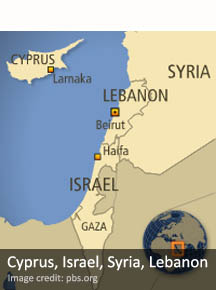
A mysterious spy device found in Lebanon was detonated remotely by what some say was an Israeli drone, killing one man and injuring several others. According to Lebanon’s Al-Manar TV, the alleged spy device was uncovered last week by a Lebanese military patrol near the village of Adloun in southern Lebanon. Most of the region is firmly controlled by Hezbollah, the Shiite militant group that governs large swathes of the Lebanese territory. The report was later confirmed by the Lebanese Army, which said that the device had been attached, probably by Israel, to the telecommunications network belonging to Hezbollah. The militant group operates its own telecommunications network and its own news media, including Al-Manar, the television station that broke the news of the discovery of the spy device. However, as soon as Hezbollah forces gathered around the “strange device”, an aircraft appeared overhead and remotely detonated the device “from a distance”. The TV station said Hezbollah member Hassan Ali Haidar was killed in the explosion. Last week’s incident was not the first report of an exploding spy device found attached to Lebanese telecommunications networks. In October of 2009, Lebanese authorities discovered three communications interception devices near Lebanon’s border with Israel. Two of the devices self-destructed by exploding as Lebanese security personnel were approaching. Members of the Lebanese Armed Forces decided to detonate a third device, fearing that it too might explode. A year later, at least two mysterious spy devices were discovered in mountain ranges around the Lebanese capital Beirut. The devices were found carefully concealed inside fake boulders in the mountain of Sannine, directly north of Beirut and in Barouk, which is adjacent to the city’s southern suburbs. The devices consisted of surveillance cameras, electronic transmitters, as well as satellite signal reception systems. Read more of this post




 By IAN ALLEN | intelNews.org
















War alone will not defeat Islamists, says US ex-military intel chief
September 11, 2014 by Ian Allen 2 Comments
The former chief of military intelligence in the United States has warned that military force cannot defeat Islamic-inspired militancy without a broader strategic plan. Lieutenant General Michael Flynn led the US Defense Intelligence Agency from July 2012 until August of this year, serving essentially as the most senior intelligence official in the US Armed Forces. He stepped down amidst rumors that he had been asked to resign because his plans to modernize military intelligence operations were “disruptive”. On Wednesday, while addressing the annual Maneuver Conference at the US Army’s Maneuver Center of Excellence in Fort Benning, Georgia, General Flynn addressed the issue of Sunni militancy and how to counter groups like the Islamic State. Responding to a question from the audience, the former DIA director said “what this audience wants [to hear] is ‘kill ’em all, let God sort ’em out, get the T-shirt [and] go down to Ranger Joe’s” (a military clothing retailer). And he added: “we can kill all day long, but until we understand why there are [such large] numbers of [fundamentalist] believers globally, [groups like the Islamic State] will not be defeated”. Flynn went on to say that America is losing initiative in the war of ideas with Islamic radicalism, as the latter is spreading rapidly across the world, especially in regions such as Africa and South Asia. Responding to another question from the audience, the former DIA director dismissed the view that there is an ideological split between al-Qaeda and the Islamic State, saying: “there is no tension; they hate us equally; it is an expansion”. Last month, Flynn gave an interview in which he said the international environment was “is the most uncertain, chaotic and confused” he had witnessed in his three-decade career. Read more of this post
Filed under Expert news and commentary on intelligence, espionage, spies and spying Tagged with DIA, Michael Flynn, military intelligence, News, United States, War on Terrorism